August 26, 2026
Why Mill Circuit Pumping Has Become a Mineral Processing Bottleneck
The economics of modern mineral processing are under structural pressure. Across copper, gold, and base metal operations worldwide, ore grades continue to decline while the physical complexity of feed materials increases. Mineral exploration economics underpin this reality, as harder rock, finer liberation sizes, and more abrasive mineralogy are now the norm rather than the exception in many of the world's major mining districts. This shift is not cyclical — it reflects a decades-long depletion of the highest-quality, most accessible ore bodies, forcing operations to process materials that would have been considered marginal just a generation ago.
Inside the processing plant, this trend places extraordinary demand on slurry handling infrastructure. SAG mill and ball mill circuits, which represent the highest-throughput, highest-energy stages of mineral processing, are particularly exposed. As feed hardness and abrasivity increase, the mechanical stress transmitted to every pump in the mill circuit escalates, compressing wear life, increasing the frequency of unplanned interventions, and making operating campaign duration progressively harder to predict.
The Hidden Cost of Pump Variability in Mill Circuit Operations
The three highest-consequence pump positions in any mineral processing flowsheet are mill discharge, cyclone feed, and wet crusher duty. These are not peripheral applications. They sit at the heart of the comminution circuit, and any unplanned interruption at these points cascades immediately into lost throughput at the plant level.
The financial exposure from unexpected pump failures in these positions is substantial. Unplanned downtime in a large-scale copper concentrator, for example, can translate into production losses measured in hundreds of tonnes of contained metal per day. Yet conventional pump designs were largely developed for conditions that no longer reflect the operating reality at many of the world's major operations.
The ability to sustain long, predictable pump operating campaigns has shifted from being a maintenance objective to a core production strategy across the global mining industry.
Variable wear rates create compounding problems beyond the immediate cost of replacement parts. They disrupt maintenance scheduling, interfere with shutdown planning, and introduce uncertainty into total cost of ownership (TCO) modelling. Furthermore, they make it difficult for operations teams to accurately forecast consumable spend or capital replacement timelines. This is the operational context into which the Weir WARMAN MCR2 mill circuit pump has been introduced.
When big ASX news breaks, our subscribers know first
How the Weir WARMAN MCR2 Mill Circuit Pump Works
Eight Patented Technologies Across Four Engineering Domains
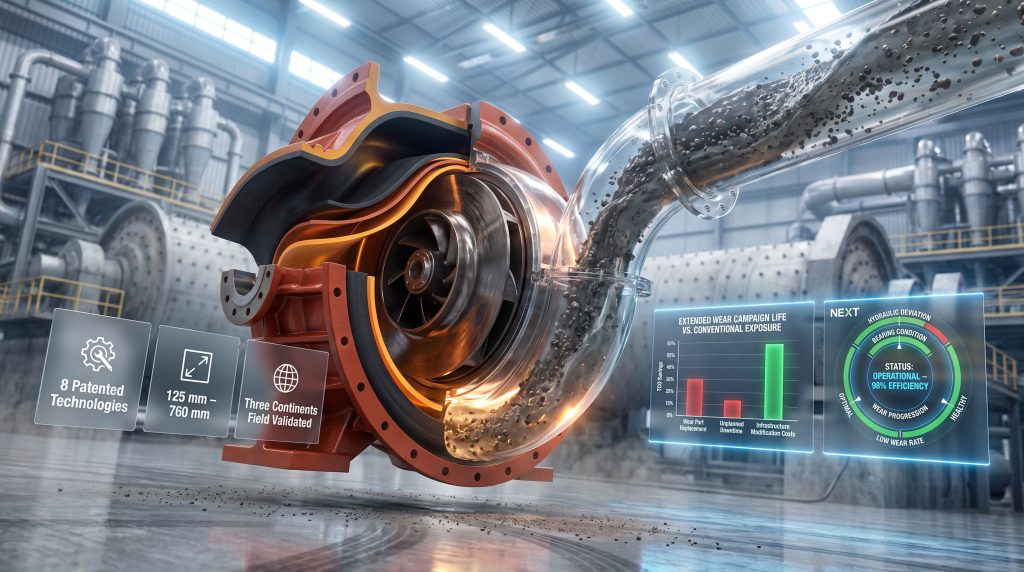
The WARMAN MCR2 is not a refinement of a previous design in the conventional sense. It integrates eight patented technologies spanning four distinct engineering disciplines within a single pump platform: hydraulics, wear management, serviceability, and condition monitoring. This multi-domain approach is architecturally significant because it eliminates the performance trade-offs that typically arise when operators attempt to optimise one characteristic independently of others.
Improving hydraulic efficiency, for instance, can sometimes accelerate wear in specific zones if liner geometry is not simultaneously optimised. Similarly, extending wear part life through material substitution can introduce serviceability challenges if component accessibility is not considered in the design. The MCR2 addresses these interdependencies at the engineering level rather than leaving them to be managed operationally.
Hydraulic Geometry and Its Role in Wear Distribution
One of the less-discussed aspects of mill circuit pump performance is the relationship between hydraulic geometry and internal wear distribution. Slurry velocity profiles inside a pump casing are highly non-uniform. Particle trajectories vary by size, density, and concentration, and the zones of highest wear are directly determined by where high-velocity, high-mass particles make repeated contact with internal surfaces.
Advanced hydraulic geometry in the MCR2 is designed to influence these trajectories, redistributing wear more evenly across internal surfaces and reducing peak wear rates in the zones historically most vulnerable to accelerated degradation. For large-particle slurries at high volumetric flow rates, this is particularly important because coarser particles carry significantly more kinetic energy at impact than fine-particle slurries at equivalent velocities.
Material Architecture: The MCR Configuration Explained
The MCR designation refers to the rubber-lined configuration within the broader Warman mill circuit pump family. Understanding the material architecture is essential for evaluating the pump's suitability across different ore types and slurry chemistries. In addition, considering ore mineralogy alongside material selection helps operations match liner configuration to the specific abrasivity profile of their feed material.
| Component | Material | Primary Function |
|---|---|---|
| Outer Casing | Ductile iron | Structural containment under operating pressure |
| Inner Lining | Rubber | Abrasion resistance in direct slurry contact zones |
| Impeller | Hardened metal alloy | Large particle slurry handling and hydraulic energy transfer |
| Throatbush | Metal or elastomer (interchangeable) | Wear zone protection, configurable by ore type |
| Frame Plate Liner Insert | Metal or elastomer (interchangeable) | Customisable abrasion protection based on site conditions |
The interchangeable nature of the throatbush and frame plate liner insert is operationally significant. It allows maintenance teams to configure the pump's internal wear surfaces specifically for the abrasivity characteristics of their ore body, without replacing the entire pump assembly. Operations processing transitional ore types, where mineralogy or hardness shifts through the mine plan, can adjust liner selection as feed conditions evolve.
Positioning Within the WARMAN Mill Circuit Pump Family
| Pump Variant | Lining Configuration | Primary Application |
|---|---|---|
| WARMAN MCR | Rubber-lined, metal impeller | Abrasive slurry, high-wear mill duties |
| WARMAN MCR2 | MCR architecture plus 8 patented technologies | Next-generation mill circuit with integrated condition monitoring |
| WARMAN MCU | Metal, unlined | High-temperature or solvent-sensitive duties |
| WARMAN MCM | Full metal-lined | Coarse particle, high-pressure applications |
What Integrated Condition Monitoring Changes About Mill Circuit Operations
The NEXT System: Embedded Intelligence, Not a Bolt-On Addition
The integration of the NEXT condition and performance monitoring system into the MCR2 represents one of the more consequential design decisions in the pump's development. The distinction between embedded sensor architecture and externally retrofitted monitoring solutions matters more than it might initially appear.
Externally mounted monitoring systems introduce measurement latency, require additional installation infrastructure, and are subject to data quality limitations arising from physical separation between the sensor and the monitored component. Embedded systems, by contrast, capture data at the point of interest, reducing noise and improving the signal quality available for anomaly detection.
The NEXT system provides continuous visibility into critical pump health parameters and real-time operating performance data. The types of process behaviour changes it is designed to detect early include wear progression patterns, hydraulic performance deviations, and bearing condition shifts — each of which, if identified sufficiently early, enables planned intervention rather than reactive repair.
From Fixed-Interval Servicing to Dynamic Campaign Management
The operational model shift enabled by continuous condition monitoring is more significant than it may appear on the surface. Traditional pump maintenance in mill circuit applications has historically operated on one of two models: time-based intervals (servicing at fixed hours regardless of actual component condition) or failure-triggered replacement (run to failure, then repair).
Both approaches are suboptimal. Time-based servicing frequently results in over-maintenance, replacing components that have significant remaining wear life and incurring unnecessary labour and parts costs. Failure-triggered replacement, by definition, accepts unplanned downtime as an operating cost.
Continuous condition visibility allows maintenance teams to transition from fixed-interval servicing schedules to dynamic, data-driven campaign management, reducing both over-maintenance and unexpected failure events simultaneously.
The NEXT system creates the data foundation for a third model: condition-informed campaign planning, where maintenance interventions are scheduled based on real-time asset health rather than elapsed time or component failure. Data-driven mining operations of this kind optimise wear part utilisation while protecting circuit availability, representing a fundamental shift in maintenance philosophy.
Integration Pathways With Site-Level Systems
For operations already running SCADA platforms, digital twin environments, or broader asset management systems, the integration pathway for NEXT condition data is a practical consideration. The ability to feed pump health data into plant-level control and optimisation systems expands the value of the monitoring capability beyond individual pump management into circuit-level performance optimisation.
Total Cost of Ownership: Reframing the Economics of Mill Circuit Pumping
Beyond Purchase Price to Campaign Economics
Pump procurement decisions in mineral processing are frequently evaluated against unit purchase price — a metric that captures only a fraction of the true economic exposure associated with pump selection. The more relevant analytical framework is total cost of ownership across the full operating campaign, which incorporates wear part consumption, maintenance labour, unplanned downtime losses, and infrastructure modification costs.
| Cost Category | Conventional Pump Exposure | MCR2 Design Response |
|---|---|---|
| Wear part replacement frequency | High in abrasive mill duties | Extended wear life through hydraulic and material design |
| Planned maintenance labour | Significant per-event complexity | Simplified serviceability reduces per-event cost |
| Unplanned downtime losses | Unpredictable without condition data | NEXT monitoring enables early intervention |
| Infrastructure modification costs | Required when upsizing or replacing | Retained footprint eliminates civil modification costs |
| Asset condition uncertainty | High without integrated monitoring | Continuous visibility supports confident campaign planning |
The Infrastructure Compatibility Advantage for Brownfield Operations
One of the least-discussed but most practically important features of the Weir WARMAN MCR2 mill circuit pump is its retention of the physical footprint of existing WARMAN mill circuit pump installations. For brownfield operations, the civil and structural engineering costs associated with pump replacement can be substantial. Foundation redesign, pipe rerouting, and structural support modifications can add significant cost and schedule risk to what might otherwise appear to be a straightforward equipment upgrade.
By engineering the MCR2 to occupy the same footprint as its predecessors, Weir has eliminated this cost category for operations upgrading from existing WARMAN installations. This is particularly relevant for operations seeking to increase throughput capacity within existing plant constraints, where available capital is better deployed toward production-generating assets than infrastructure modification.
Field Validation: Three Continents, High-Wear Applications
The WARMAN MCR2 was subjected to field trials across high-wear mill circuit duties spanning three continents prior to commercial launch. This multi-geography validation programme is significant for several reasons that go beyond conventional product testing.
Ore bodies on different continents exhibit substantially different mineralogical characteristics, particle size distributions, slurry chemistry profiles, and ambient operating conditions. A pump that performs consistently across this range of variables has demonstrated adaptability to real-world operating diversity rather than performance under controlled laboratory conditions optimised for the pump's design parameters.
For operations evaluating new pump technology, the distinction between laboratory-validated performance claims and field-proven campaign results is material to procurement and risk assessment decisions. Three-continent trial coverage provides a meaningful evidentiary basis for performance confidence across diverse mining environments, consequently reducing technology adoption uncertainty for operations processing complex or transitional ore bodies.
Pump Size Range and Application Selection
Available Configurations and Size Scope
The WARMAN mill circuit pump range spans discharge sizes from approximately 125 mm up to 760 mm, covering the full scope of volumetric flow requirements encountered in industrial-scale mill circuit applications. Furthermore, mining efficiency optimisation is directly influenced by selecting the correct size configuration for the application. Size selection within this range is determined by the interaction of several process variables:
- Volumetric flow rate requirements (m³/hr)
- Total dynamic head demands (m)
- Slurry specific gravity and solids concentration (% w/w)
- Particle size distribution, including d50 and d85 characterisation
- Circuit pressure profiles and system resistance curves
A Systematic Approach to Configuration Selection
Selecting the appropriate MCR2 configuration for a specific application involves a structured evaluation process:
- Define the duty point: Establish flow rate, total dynamic head, and slurry specific gravity as the primary sizing parameters.
- Characterise the slurry: Document particle size distribution, solids concentration, and abrasivity index to determine appropriate liner material selection.
- Identify wear priority: Select rubber-lined MCR configuration for fine, high-abrasivity slurries; evaluate metal-lined MCM configuration for coarse particle, high-pressure duties.
- Assess infrastructure constraints: Confirm footprint compatibility with existing pump bay dimensions and pipe connection geometry.
- Evaluate monitoring integration: Determine the data integration pathway for NEXT condition monitoring output with site-level control and asset management systems.
The next major ASX story will hit our subscribers first
The Broader Signal: What Next-Generation Pump Design Means for Mineral Processing
Pump Selection as a Process Engineering Decision
The convergence of materials science, hydraulic engineering, and embedded digital monitoring within a single pump platform reflects a meaningful shift in how slurry pump technology is being developed and evaluated. Pump selection is increasingly becoming a process engineering decision rather than a procurement function, with implications for circuit performance, throughput consistency, and long-term asset lifecycle economics.
Consequently, applying appropriate cut-off grade analysis alongside pump lifecycle economics allows operations to better understand the true cost threshold at which processing lower-grade ore remains viable. The eight-technology integration model embedded in the Weir WARMAN MCR2 mill circuit pump may influence how competitive product development evolves across the mill circuit pump sector more broadly.
As ore complexity increases globally, operations that treat pump performance as a throughput strategy rather than a maintenance variable will likely hold a structural advantage in production consistency and cost management over those that do not. For mineral processing operations navigating the twin pressures of declining ore quality and increasing throughput expectations, the design philosophy embodied in the MCR2 represents a technically grounded response to a problem that is only becoming more acute with time.
Readers seeking additional technical context on mill circuit pump selection, slurry handling engineering, and mineral processing equipment can explore related resources through Weir's official product documentation and Global Mining Review's equipment coverage at globalminingreview.com.
Want to Identify the Next Major Mineral Discovery Before the Broader Market Does?
As declining ore grades drive demand for advanced mineral processing infrastructure, the underlying exploration and investment landscape continues to evolve rapidly — and Discovery Alert's proprietary Discovery IQ model delivers real-time ASX mineral discovery alerts, turning complex geological data into actionable investment insights for both short-term traders and long-term investors. Explore Discovery Alert's dedicated discoveries page to understand how historic ASX mineral discoveries have generated exceptional returns, and begin your 14-day free trial today to position yourself ahead of the market.