August 5, 2026
The Hidden Economics Behind OEM Aftermarket Consolidation in Africa's Mining Sector
Across the global mining equipment industry, a structural shift has been quietly reshaping competitive dynamics for well over a decade. Original equipment manufacturers, long defined by the machinery they sell, have progressively repositioned themselves as lifecycle service providers. The logic is straightforward: a drill rig or haul truck purchased today will require continuous parts, rebuilds, and maintenance support for the next 15 to 20 years, irrespective of where commodity prices sit in any given cycle. For OEMs with the foresight to capture that downstream value, aftermarket services represent one of the most durable and defensible revenue streams in the entire capital goods sector.
This is the strategic context within which the Epiroc Eventspec acquisition must be understood. Completed in early Q3 2026 and formally announced on August 5, 2026, the deal brings a Johannesburg-based aftermarket specialist into Epiroc's Equipment & Service business area, reinforcing the Swedish OEM's ability to serve mine operators across Southern and Sub-Saharan Africa with locally produced parts, rebuild capabilities, and maintenance solutions.
When big ASX news breaks, our subscribers know first
Eventspec: More Than a Parts Supplier
To appreciate the strategic weight of this transaction, it helps to understand precisely what Eventspec Proprietary Limited does and where it sits within the broader mining services value chain.
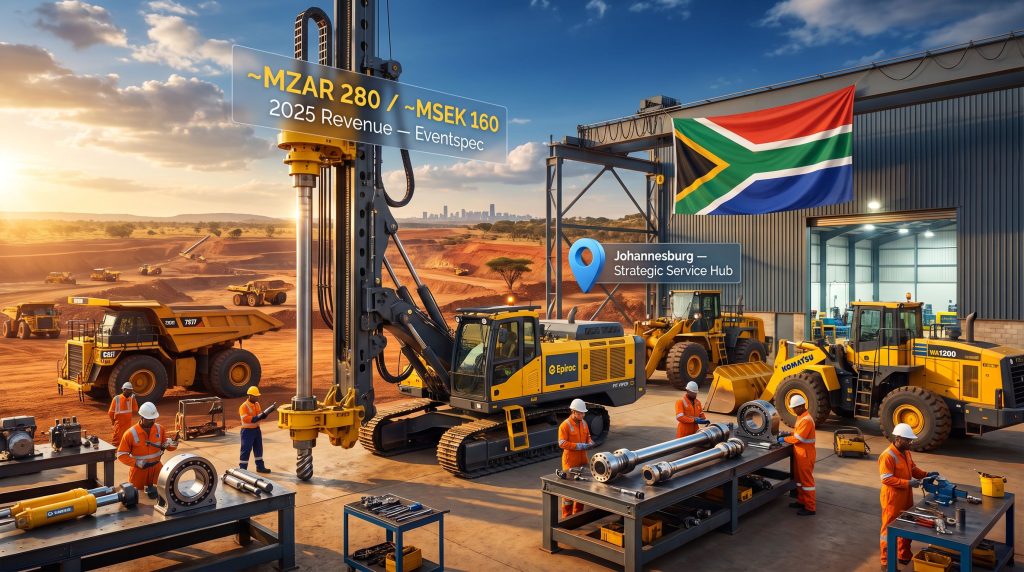
Eventspec is a privately held business headquartered in Johannesburg, employing approximately 120 to 125 people at the time of acquisition. In 2025, the company generated revenue of roughly MZAR 280, equivalent to approximately MSEK 160, positioning it as a meaningful-scale aftermarket business rather than a micro-cap tuck-in.
Its core offering spans four interconnected service areas:
- Specialised parts manufacturing for capital-intensive mining equipment, including drill rigs, mine trucks, and loaders
- Rebuild and overhaul services that extend asset operational lifespans and defer the capital expenditure burden of new equipment purchases
- Repair and maintenance solutions that reduce unplanned downtime, one of the most costly operational disruptions a mine site can face
- Spare parts supply chain management supporting mining operations across the African continent and into broader markets
What makes Eventspec particularly valuable within an OEM acquisition context is the direct overlap between its equipment coverage and Epiroc's own product portfolio. Drill rigs, loaders, and mine trucks are not peripheral to Epiroc's installed base in Africa; they are central to it. This is not a diversification play into unfamiliar territory. It is a precision fit designed to internalise aftermarket revenue that previously flowed to independent suppliers.
| Attribute | Detail |
|---|---|
| Headquarters | Johannesburg, South Africa |
| Ownership Structure | Privately held |
| Workforce | Approximately 120 to 125 employees |
| 2025 Revenue | ~MZAR 280 / ~MSEK 160 |
| Core Offering | Aftermarket parts, rebuilds, and repairs for mining equipment |
| Equipment Covered | Drill rigs, mine trucks, and loaders |
| Acquisition Announced | March 9, 2026 |
| Acquisition Completed | Early Q3 2026 (August 5, 2026) |
| Purchase Price | Not publicly disclosed |
Why the Aftermarket Segment Is the Battleground OEMs Cannot Afford to Lose
The independent aftermarket, commonly abbreviated in the industry as the IAM, represents one of the most persistent competitive threats facing OEMs in mining. IAM suppliers manufacture or source compatible components at lower price points, often undercutting OEM-branded parts by significant margins. For mine operators under cost pressure, the short-term economics of IAM procurement can appear attractive.
The OEM counterargument, increasingly backed by total cost of ownership data, centres on three areas:
- Component compatibility and fit tolerances – OEM-engineered parts are manufactured to specifications that align precisely with original design parameters, reducing the risk of premature failure or accelerated wear in connected systems.
- Warranty and liability continuity – Using non-OEM parts in certain equipment configurations can void manufacturer warranties, shifting failure risk back to the operator.
- Integrated service data – OEMs with full-lifecycle service relationships accumulate equipment performance data that informs predictive maintenance, a capability IAM suppliers cannot replicate at scale.
By acquiring Eventspec, Epiroc does not simply add a parts supplier to its roster. It absorbs manufacturing capability, technical expertise, and established customer relationships that would otherwise require years to build organically on the continent.
Acquisitions of regionally specialised, privately held aftermarket businesses typically offer a lower integration risk profile than large-scale mergers, while delivering strategically disproportionate value in markets where greenfield service infrastructure development would be prohibitively slow and capital-intensive.
Johannesburg as a Continent-Wide Service Hub
The geographic logic underpinning the Epiroc Eventspec acquisition is worth examining in detail. Johannesburg is not simply South Africa's commercial capital; it functions as the operational and logistics nerve centre for a vast arc of African mining activity.
Within a serviceable radius of Johannesburg, mine operators in the following jurisdictions rely on supply chains and service providers rooted in the city's infrastructure:
- South Africa – home to the world's largest platinum group metals reserves and significant gold and coal operations
- Zimbabwe – platinum, chrome, and gold production with growing demand for equipment services
- Zambia – one of Africa's principal copper-producing nations, where equipment uptime is directly tied to concentrate output. Furthermore, copper market trends across the continent are driving increased investment in service infrastructure to support expanded output
- Botswana – diamond mining operations with long-duration asset bases requiring ongoing maintenance
- Democratic Republic of Congo – a rapidly expanding copper and cobalt production region attracting significant capital investment, particularly given the growing importance of the cobalt mining industry to global battery supply chains
A Johannesburg-based manufacturing and service operation provides Epiroc with a geographically central platform capable of serving this entire mining corridor. Critically, on-continent parts production eliminates the logistical friction and lead time costs associated with shipping components from Europe or Asia, a meaningful operational advantage for mine sites where equipment downtime translates directly into lost production.
The Structural Economics of Mining Aftermarket: Why Demand Is Durable
One of the less widely understood dynamics of the mining equipment aftermarket is its relative insulation from commodity price cycles. While new equipment procurement is highly sensitive to capital expenditure budgets, which contract sharply during commodity downturns, aftermarket demand follows a different curve entirely.
Consider the following market dynamics that make Africa's aftermarket sector particularly compelling for OEM investment:
| Market Dynamic | Implication for OEM Strategy |
|---|---|
| Ageing equipment fleets across African operations | Elevated demand for rebuilds and component replacement |
| Limited local manufacturing of specialised parts | Premium pricing power for locally produced alternatives |
| High logistics costs for imported components | Competitive advantage for on-continent suppliers |
| Growing mine operator focus on asset lifecycle management | Long-term service contract opportunities |
| Expansion of junior and mid-tier mining activity in Africa | New customer acquisition opportunities beyond major producers |
An additional dynamic rarely discussed in mainstream OEM strategy coverage is the increasing prevalence of equipment rebuilds as a capital expenditure alternative. In markets where access to debt financing for new fleet purchases is constrained, mine operators increasingly choose to rebuild ageing assets to near-new operational condition rather than commit to full fleet replacement.
A complete drill rig rebuild can restore performance to within 85 to 95 percent of new equipment specifications at a fraction of the replacement cost, making rebuild-capable aftermarket providers structurally positioned for growth in exactly the operating environments that characterise much of Africa's junior and mid-tier mining sector. In addition, the broader shift towards data-driven mining operations is further increasing the value of OEM-integrated service relationships that can translate equipment data into actionable maintenance insights.
Transaction Timeline and Corporate Positioning
The progression from announcement to completion followed a structured path consistent with a cross-border acquisition of this nature:
- March 9, 2026 – Epiroc publicly announces its agreement to acquire Eventspec Proprietary Limited, flagging the deal's strategic rationale in the context of African market expansion.
- Q2 2026 – The customary regulatory filing and approval period, during which conditions precedent were addressed and transaction documentation finalised.
- Early Q3 2026, August 5, 2026 – The acquisition is formally completed and publicly confirmed as closed.
- Post-completion integration – Eventspec's operations are absorbed into Epiroc's Equipment & Service business area, with revenue contributions recorded under the Service revenue stream.
The classification of Eventspec within the Service revenue stream is a detail of structural significance. Epiroc's Equipment & Service business area distinguishes between equipment sales, which are transactional and cyclical, and service revenues, which are recurring and longer-duration. By anchoring Eventspec's contribution within the service stream, Epiroc signals that this acquisition is intended to compound recurring revenue capacity rather than generate one-time revenue events.
The purchase price was not publicly disclosed, which is consistent with Epiroc's historical approach to smaller bolt-on acquisitions where disclosure would not provide material information to the market.
The next major ASX story will hit our subscribers first
How the Epiroc Eventspec Deal Reflects Broader OEM Consolidation Strategy
A Pattern of Precision Acquisitions
Epiroc's acquisition history reveals a deliberate and consistent pattern. The company has pursued targeted bolt-on deals focused on service capability, automation technology, and geographic market access rather than large transformational mergers carrying integration complexity. Each acquisition tends to reinforce an existing business area rather than create new ones, reducing the execution risk that larger strategic pivots typically carry.
The Eventspec transaction fits this mould with precision. It does not represent a new direction; it deepens an existing African service infrastructure at a time when the continent's mining activity is expanding across copper, platinum group metals, gold, and battery materials supply chains. Moreover, mining industry consolidation of this kind is increasingly seen as a strategic imperative for OEMs seeking to defend and grow recurring revenue streams in competitive regional markets.
What This Means for Mine Operators
For mine operators across the region, the completed acquisition introduces several practical implications:
- Reduced parts lead times through locally manufactured and stocked components replacing import-dependent supply chains
- Expanded rebuild service access, removing the logistical and cost burden of shipping equipment off-continent for major overhauls
- Broader Epiroc network coverage across African jurisdictions, with a more integrated service offering for operators running mixed Epiroc fleets
- Potential for bundled lifecycle contracts that combine equipment provision with long-term aftermarket support under a single service agreement
The Epiroc Eventspec acquisition, in this context, is less a headline transaction and more a measured, strategically coherent step in the long game of OEM aftermarket consolidation. In a region where the gap between equipment deployed and quality local service infrastructure has historically been wide, closing that gap with a purpose-built acquisition represents exactly the kind of durable competitive positioning that generates returns measured in decades rather than quarters.
Disclaimer: This article contains forward-looking observations and market analysis based on publicly available information. It does not constitute financial advice. Readers should conduct independent research before making investment decisions.
Want to Stay Ahead of Major ASX Mineral Discoveries as Africa's Mining Sector Expands?
Discovery Alert's proprietary Discovery IQ model delivers real-time alerts on significant ASX mineral discoveries, transforming complex data across more than 30 commodities into clear, actionable insights for both traders and long-term investors — explore historic discoveries and their market returns to see what early positioning can mean, then begin a 14-day free trial to secure your market-leading edge.