August 24, 2026
India's Industrial Energy Geography: Why Concentration Matters
Across the world's fastest-growing economies, the geography of energy production is rarely accidental. Industrial clusters emerge where geology, infrastructure, and policy intersect in ways that create durable competitive advantages. In India, few places illustrate this principle more vividly than a single landlocked district in the southernmost corner of Uttar Pradesh, where coal-bearing geology, river systems capable of supporting massive reservoirs, and decades of capital-intensive investment have produced an extraordinary concentration of energy output. Understanding the Sonbhadra energy capital of Uttar Pradesh designation requires looking beyond the headline figures.
This is not simply a story about power plants and coal mines. It is a study in how a resource-endowed district can become a self-reinforcing industrial ecosystem, where each pillar of activity feeds and stabilises the others, and where the challenges of growth are as instructive as the achievements themselves. Furthermore, the broader mining industry evolution occurring across India adds important context to Sonbhadra's trajectory.
When big ASX news breaks, our subscribers know first
Why Sonbhadra Carries the Title of Energy Capital of Uttar Pradesh
The Geological Foundation That Makes It Possible
The designation of the Sonbhadra energy capital of Uttar Pradesh is not administrative branding. It reflects a physical reality embedded in the district's underlying geology. Sonbhadra district sits at the convergence of the Vindhya and Kaimur ranges, geological formations that have deposited commercially significant concentrations of coal, limestone, bauxite, and gold-bearing mineral bodies across the district's terrain.
This mineral endowment creates what geologists and industrial planners recognise as a feedstock loop: coal mined within the district fuels thermal power stations located within the same district, while limestone feeds cement plants, and bauxite supports aluminium operations nearby. The proximity of raw material supply to processing capacity dramatically reduces input costs and logistical complexity, making Sonbhadra's industrial economics structurally more efficient than districts that must import their primary feedstocks across long distances.
The Rihand River, which flows through the district, provided the hydraulic foundation for one of India's largest man-made reservoirs. The Rihand Dam and its associated hydroelectric facility add a non-thermal dimension to the district's generation portfolio, making the overall energy mix more resilient to coal supply disruptions and seasonal logistics variability.
Sonbhadra's Power Generation Infrastructure at a Glance
The scale of power generation infrastructure concentrated within Sonbhadra's administrative boundaries is remarkable by any standard. The following facilities collectively define the district's identity as a major electricity-producing zone:
| Power Facility | Location | Type | Role in District Energy System |
|---|---|---|---|
| Anpara Thermal Power Station | Anpara | Coal-based thermal | One of UP's highest-capacity coal plants |
| Obra Thermal Power Station | Obra | Coal-based thermal | Long-operating baseload contributor |
| Rihand Dam and Hydroelectric Plant | Rihand Nagar | Hydroelectric | Reservoir-based generation, water resource management |
| Renusagar Power Plant | Renusagar | Captive thermal | Dedicated supply for Hindalco aluminium complex |
| Singrauli/Shaktinagar Complex | Shaktinagar | Thermal | Cross-border industrial generation zone |
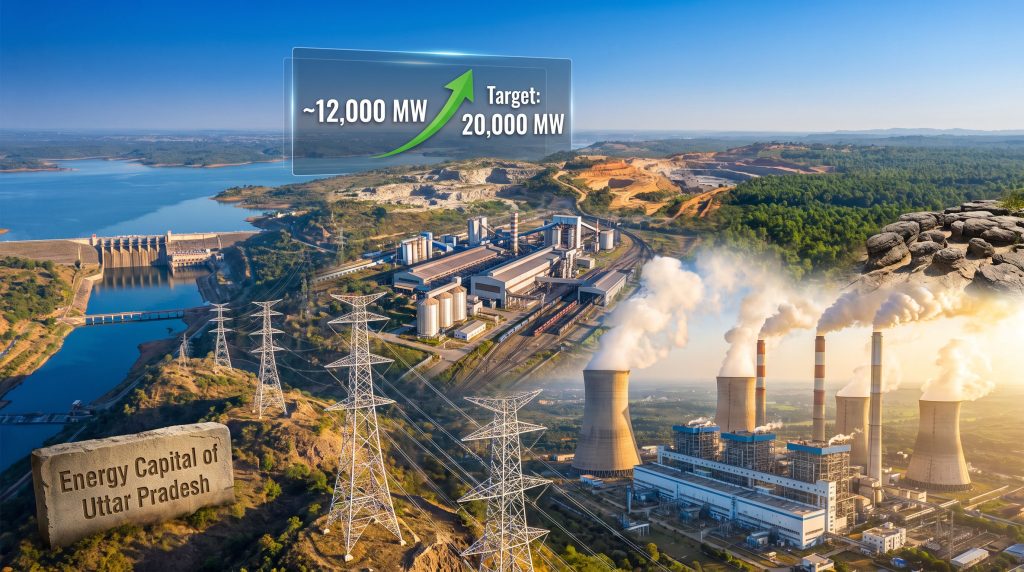
Together, these facilities contribute approximately 12,000 MW of electricity output. District-level planning envisions scaling this toward 20,000 MW through new project development and the integration of renewable energy sources alongside existing thermal capacity.
To contextualise that figure: 12,000 MW from a single district exceeds the total installed power generation capacity of many individual nations, underscoring just how extraordinary Sonbhadra's concentration of energy infrastructure truly is.
The Five Industrial Pillars That Define Sonbhadra's Economic Character
Pillar One: Thermal and Hydroelectric Power Generation
Power generation is the district's foundational economic activity and the primary justification for its energy capital designation. The thermal stations at Anpara, Obra, and the Singrauli complex, supported by Rihand's hydroelectric output, collectively supply a disproportionately large share of Uttar Pradesh's total electricity demand. This is not incidental output feeding a local grid. It is baseload generation that underpins state-level energy security.
The captive power model employed by Hindalco at Renusagar is particularly instructive from an industrial economics perspective. By generating its own electricity through a dedicated plant rather than purchasing from the grid, the aluminium complex insulates itself from tariff volatility and grid reliability risks. This is a structural competitive advantage that is rarely available to manufacturers in other locations.
Pillar Two: Coal Mining and Mineral Extraction
Coal mining forms the physical backbone of Sonbhadra's energy economy. The district's coal deposits not only fuel its own thermal stations but also contribute to broader regional supply chains. Beyond coal, limestone extraction feeds cement manufacturing operations, while bauxite production importance to the aluminium value chain is clearly demonstrated at Renukoot.
Mining operations sustain large numbers of direct employment positions and generate extensive indirect economic activity across transport, equipment supply, and maintenance services. The multiplier effect of mining in a district of this type is substantial: each direct mining job typically supports several additional positions in adjacent sectors, from truck drivers to equipment mechanics to catering and retail.
One less commonly appreciated aspect of Sonbhadra's mineral geography is the presence of gold-bearing formations within the district. While not currently a primary commercial focus, these formations represent a longer-term resource optionality that adds to the district's overall geological significance.
Pillar Three: Aluminium Manufacturing at Renukoot
Hindalco's integrated aluminium complex at Renukoot is among India's most strategically significant manufacturing facilities. The site operates on a vertically integrated model: bauxite sourced from proximate deposits feeds into alumina refining, which in turn feeds the aluminium smelting operation, all powered by the dedicated Renusagar captive plant. The aluminium industry leaders operating in India consistently highlight Renukoot as a benchmark for integrated production efficiency.
This vertical integration is not merely an operational convenience. It represents a structural cost advantage that makes the Renukoot complex more competitive in global aluminium markets than facilities that must purchase power at market rates or source bauxite from distant locations. India is a significant global aluminium producer, and Sonbhadra's contribution to that position runs through this complex.
Pillar Four: Cement Production and the ₹803 Crore Signal
Sonbhadra's limestone geology makes it a natural location for cement manufacturing. The district hosts multiple cement operations that benefit from on-site raw material availability and proximity to both power supply and transport networks.
The clearance of an ACC cement project valued at approximately ₹803 crore is a meaningful data point for understanding private sector sentiment toward Sonbhadra. Capital commitments of this scale do not occur without rigorous feasibility analysis. The fact that a project of this magnitude secured clearance and is advancing signals that established industrial investors view the district's infrastructure, resource base, and workforce as capable of supporting continued manufacturing expansion.
Pillar Five: Stone, Mineral Processing, and Chemical Industries
Completing the industrial ecosystem is a layer of ancillary mineral-based and chemical industries that leverage proximity to raw material sources and existing infrastructure. These operations may individually be smaller in scale than the power, aluminium, and cement sectors, but collectively they amplify the economic multiplier across transport, construction, and services. Understanding mining economics fundamentals helps explain why these ancillary operations remain viable even as the headline sectors dominate the district's identity.
New Investment and Infrastructure: What Is Changing Between 2017 and 2026
Capital Commitments and Industrial Estate Development
The most structurally significant new development for Sonbhadra's economic diversification is the planned 50-acre industrial estate at Markundi. This zone is specifically designed to accommodate micro, small, and medium enterprises, with an explicit focus on generating employment for young people from surrounding villages and fostering ancillary units that serve the larger industrial operators already established in the district.
The Markundi estate represents a deliberate policy logic: recognising that large capital-intensive facilities employ significant numbers of workers but are not always accessible to local entrepreneurs or recent school leavers without specialised industrial training. An MSME-focused zone creates a more permeable economic boundary, allowing smaller local enterprises to participate in the industrial economy as suppliers, service providers, and sub-contractors.
Infrastructure Upgrades Reducing Logistical Friction
Improved road connectivity across the Purvanchal region has materially altered the logistics economics of Sonbhadra's bulk commodity industries. Enhanced national highway linkages reduce the cost and time involved in moving coal, cement, aluminium ingots, and other high-volume materials to consuming markets and onward distribution points.
Lower transportation costs translate directly into improved competitiveness for manufacturers and energy producers. They also enable workforce mobility, allowing workers to commute from a wider catchment area rather than requiring industrial employers to manage large residential workforces on-site.
Beyond Heavy Industry: Tourism, Agriculture, and Rural Economic Diversification
Sonbhadra's Underappreciated Tourism Assets
Sonbhadra possesses a set of tourism assets that are genuinely distinctive but remain significantly underdeveloped relative to their potential. Sonbhadra's rich heritage encompasses three sites in particular that warrant attention:
- Rihand Dam Reservoir: One of India's larger artificial water bodies, offering scenic landscapes and eco-tourism opportunities including boating, birdwatching, and nature walks along the reservoir's extensive forested shoreline.
- Vijaygarh Fort: A historical structure providing archaeological and heritage tourism value, drawing visitors interested in the region's pre-modern history and military architecture.
- Salkhan Fossil Park: This is perhaps Sonbhadra's most scientifically extraordinary asset and one of its least widely known. The park contains stromatolite fossils estimated to be over 1,500 million years old, making it one of the oldest fossil sites in India and a location of genuine international scientific significance for palaeontologists and geologists studying early life on Earth.
Stromatolites are layered biochemical accretionary structures formed by microbial communities, most commonly cyanobacteria. Their significance lies in what they tell researchers about conditions on Earth during the Precambrian era, making Salkhan Fossil Park a resource of global scientific importance, not merely regional curiosity.
Rural Development and Agricultural Support Frameworks
Government programmes have expanded rural road networks, improved drinking water access, and strengthened irrigation and watershed management across Sonbhadra's rural belt. Farmer welfare measures including PM-KISAN income support have provided a degree of economic stabilisation in agricultural communities that might otherwise face acute vulnerability to commodity price cycles and monsoon variability.
In Sonbhadra's forested and tribal belts, targeted development initiatives aim to improve access to basic services and alternative livelihood pathways. These are central to the district's long-term social stability and to its ability to sustain the workforce supply that large industrial operations depend upon.
Employment Structure and Emerging Opportunities
The employment landscape in Sonbhadra spans multiple sectors and skill levels, creating a more complex labour market than is commonly assumed for a district primarily associated with heavy industry.
| Employment Category | Primary Driver | Current Stage |
|---|---|---|
| Coal and mineral mining | Established deposit base | Mature, sustaining |
| Thermal and hydro plant operations | Existing generation infrastructure | Stable, technical roles expanding |
| Aluminium manufacturing (Renukoot) | Hindalco integrated complex | Established, skilled workforce |
| Cement manufacturing | Limestone geology, new ACC project | Active growth |
| Construction and infrastructure | New project development | Cyclical, currently elevated |
| Transport and logistics | Highway connectivity upgrades | Active growth |
| MSME and ancillary manufacturing | Markundi industrial estate | Early-stage development |
| Eco-tourism and hospitality | Rihand, Vijaygarh, Salkhan assets | Nascent but growing |
| Green energy operations | Renewable integration targets | Very early stage |
The next major ASX story will hit our subscribers first
Sonbhadra and the Trillion-Dollar Uttar Pradesh Vision
The District's Non-Negotiable Role in State Economic Planning
Uttar Pradesh has articulated an ambition to become a $1 trillion economy. For context, India as a whole crossed the $3.5 trillion mark in recent years, meaning UP's goal represents roughly one-third of current national GDP from a single state. Achieving that target requires every major industrial district to perform at or above its current trajectory.
Sonbhadra's contribution is not discretionary. Its power generation capacity directly supports the energy security that UP's broader urban and industrial growth requires. Its mineral output feeds national supply chains for aluminium, cement, and construction materials that are central to India's ongoing infrastructure expansion. Green metals production ambitions at the national level, furthermore, may increasingly draw on districts like Sonbhadra as India reconfigures its heavy industry base.
What a 20,000 MW Future Looks Like
If Sonbhadra achieves its target of doubling generation capacity from approximately 12,000 MW to 20,000 MW, the implications extend well beyond the district's own boundaries:
- Sonbhadra would rank among the highest single-district energy output zones in South Asia.
- Increased generation capacity would attract additional energy-intensive industries including data centre operators, electrochemical manufacturers, and expanded aluminium smelting operations.
- Green energy integration alongside continued thermal operations could align the district's growth trajectory with India's national decarbonisation commitments while preserving its industrial employment base.
- Export of surplus power to neighbouring states would generate royalty and revenue flows that strengthen Uttar Pradesh's fiscal position.
Environmental and Social Sustainability: The Critical Variables
The risks attached to Sonbhadra's growth model are real and deserve honest acknowledgement. Mining and thermal power generation carry inherent environmental sensitivities including air quality degradation, water consumption pressures, land disturbance, and forest encroachment risks. Managing these dimensions is not simply an ethical responsibility. It is a practical requirement for maintaining the long-term investment attractiveness of the district.
Equitable distribution of economic benefits between established industrial workforces and the district's tribal and rural communities remains an ongoing governance challenge. Skill development programmes targeting local youth are essential to ensuring that Sonbhadra's industrial prosperity does not bypass the communities living closest to its major facilities.
Sonbhadra in Comparative Context: Eastern UP's Industrial Landscape
| Indicator | Sonbhadra | Mirzapur | Varanasi | Prayagraj |
|---|---|---|---|---|
| Primary Economic Identity | Energy and Mining | Stone quarrying, carpet weaving | Trade, tourism, education | Administrative and trade hub |
| Power Generation Presence | ~12,000 MW (dominant) | Negligible | Minimal | Minimal |
| Heavy Industry Concentration | Very High | Low to Moderate | Low | Low |
| MSME Development | Growing (Markundi estate) | Established | Established | Established |
| Tourism Potential | Moderate (eco and heritage) | Moderate | Very High | High |
| Mineral Resource Base | Coal, limestone, bauxite, gold formations | Sandstone | Limited | Limited |
The contrast with neighbouring districts is stark. While Varanasi and Prayagraj draw economic energy from trade, pilgrimage tourism, and administrative functions, the Sonbhadra energy capital of Uttar Pradesh economy is anchored in capital-intensive physical production. This makes it less glamorous in terms of visitor arrivals but significantly more important in terms of infrastructure-enabling output for the entire state.
Frequently Asked Questions: Sonbhadra as the Energy Capital of Uttar Pradesh
Why is Sonbhadra referred to as the Energy Capital of India?
Sonbhadra hosts one of the densest concentrations of power generation infrastructure found in any single district across India. Thermal stations at Anpara, Obra, Renusagar, and the Singrauli complex, combined with Rihand's hydroelectric output, produce approximately 12,000 MW of electricity. The district simultaneously functions as a fuel source through its coal deposits and as a major generation hub, a dual role that justifies the energy capital designation.
What minerals are found in Sonbhadra district?
The district contains commercially significant deposits of coal, limestone, bauxite, and gold-bearing mineral formations. These resources collectively underpin the power generation, aluminium manufacturing, and cement production sectors that define Sonbhadra's economic character.
What is the significance of the Salkhan Fossil Park?
Salkhan Fossil Park in Sonbhadra contains stromatolite fossils estimated to be over 1,500 million years old. Stromatolites are among the earliest known life forms on Earth, formed by microbial communities during the Precambrian era. The park is one of India's most scientifically significant palaeontological sites and holds international relevance for researchers studying early Earth biology and geology.
What is Sonbhadra's current power generation capacity and future target?
Current generation capacity stands at approximately 12,000 MW across thermal and hydroelectric facilities. District-level planning targets an expansion toward 20,000 MW through new project investment and potential renewable energy integration.
How does the Markundi industrial estate support local employment?
The proposed 50-acre estate at Markundi is designed to house micro, small, and medium enterprises, with a specific focus on creating employment opportunities for young people from surrounding villages. It is intended to encourage ancillary units that serve Sonbhadra's larger industrial operators, creating a more accessible entry point into the district's industrial economy for local entrepreneurs and workers.
Readers seeking broader context on Sonbhadra's energy and industrial developments can explore related reporting from Times of India's coverage of Sonbhadra, which covers the district's transformation in detail, as well as ET EnergyWorld at energy.economictimes.indiatimes.com, which covers developments across India's power and mining sectors.
Want to Stay Ahead of the Next Major Mineral Discovery?
Sonbhadra's coal, bauxite, and gold-bearing geology illustrates how resource-rich regions can generate extraordinary industrial value — and the same principle applies to ASX-listed exploration companies on the cusp of transformative discoveries. Discovery Alert's proprietary Discovery IQ model delivers real-time alerts the moment significant mineral discoveries are announced on the ASX, turning complex geological data into actionable investment insights for both short-term traders and long-term investors — explore historic discovery returns on Discovery Alert's discoveries page and begin your 14-day free trial to position yourself ahead of the broader market.