August 24, 2026
The Hidden Economics Behind Iran's Massive Gas Find
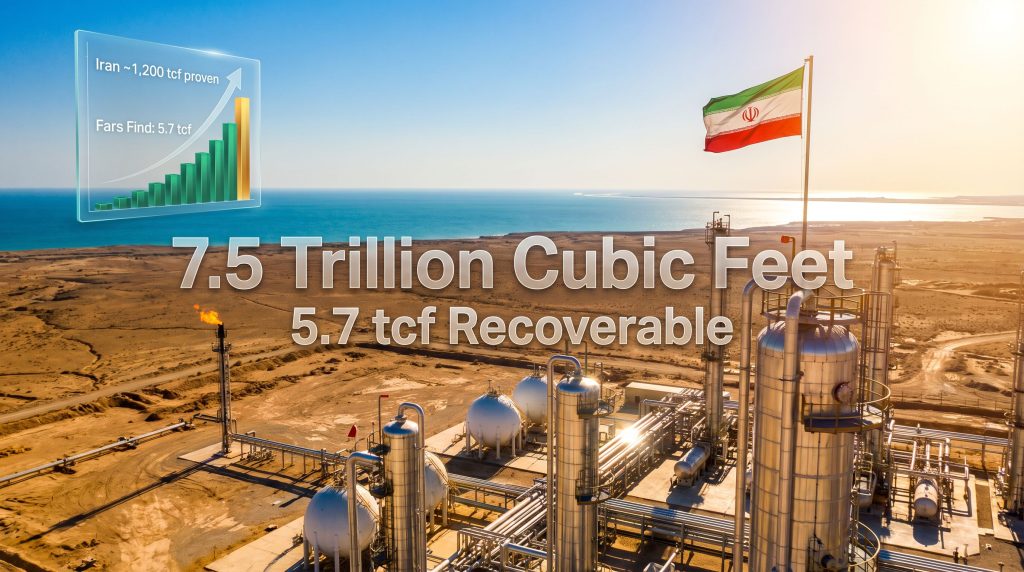
When a nation sitting atop the world's second-largest proven natural gas reserves announces a new discovery, the instinct is to ask how much rather than how soon. That distinction matters enormously in the case of Iran discovers 7.5 trillion cubic feet of gas reserves in Fars province, confirmed by Iranian Oil Minister Mohsen Paknejad, with roughly 5.7 tcf classified as technically recoverable. The announcement arrives at a moment of acute strategic tension, making it as much a political statement as an energy sector development.
Understanding what this find actually means requires separating the reserve arithmetic from the geopolitical theatre surrounding it, and then asking a harder question: under what realistic conditions does any of this gas reach consumers?
When big ASX news breaks, our subscribers know first
What 7.5 Trillion Cubic Feet Actually Represents
Raw volume figures in the energy sector are frequently misunderstood. The distinction between gas "in place" and technically recoverable volumes is not a footnote — it is the commercially decisive number. Of the 7.5 tcf identified in southern Fars province, approximately 5.7 tcf meets the technical recoverability threshold, implying a recovery factor of around 72 to 73 percent. That is a relatively high recovery factor for a conventional gas field and reflects the nature of the reservoir structure.
To frame the scale in practical terms:
- One trillion cubic feet of natural gas can supply roughly 15 million average homes for a full year
- The 5.7 tcf recoverable portion could theoretically power that same household base for nearly six years continuously
- Iranian oil ministry officials benchmarked the field against South Pars production phases, describing the recoverable volume as equivalent to approximately 15 years of output from a single South Pars phase
- The formation also contains gas condensates described as worth tens of billions of dollars, representing a separate and often underappreciated revenue stream
Gas condensates deserve particular attention here. Unlike dry natural gas, condensates are liquid hydrocarbons that separate from the gas stream during production and processing. They typically command pricing benchmarks closer to crude oil than to dry gas, meaning their value is partially insulated from gas-specific market dynamics. For a sanctions-constrained economy hungry for hard currency, condensate monetisation can be pursued through smaller-scale export arrangements that are harder to interdict than pipeline gas exports. Furthermore, considering the global oil market overview, condensate pricing dynamics remain closely tied to broader crude benchmarks.
| Metric | Figure |
|---|---|
| Total gas in place (Fars discovery) | 7.5 tcf |
| Technically recoverable gas | 5.7 tcf |
| Implied recovery factor | ~72-73% |
| South Pars phase equivalent | ~15 years of single-phase output |
| Gas condensate value estimate | Tens of billions of dollars |
| Iran's total proven gas reserves | ~1,200 tcf |
| Iran's global reserve ranking | 2nd (behind Russia) |
Why "Sweet Gas" Changes the Development Calculus
The Fars province gas has been characterised by Iranian officials as sweet gas, a technical classification that carries significant economic implications often overlooked in general coverage.
Natural gas fields are broadly categorised by their sulfur content:
- Sweet gas contains minimal hydrogen sulfide (H₂S) and sulfur dioxide concentrations, typically below 5.7 milligrams per cubic metre
- Sour gas carries elevated H₂S concentrations, sometimes exceeding 30 percent by volume in extreme cases, requiring specialised corrosion-resistant metallurgy throughout the upstream and midstream infrastructure
- Sweet gas fields require significantly lower capital expenditure per unit of output because standard steel infrastructure can be used without costly sulfur-resistant alloys
- Processing complexity is reduced, meaning fewer treatment stages between wellhead and sales-quality gas
- The absence of large-scale sulfur removal equipment shortens the engineering and construction timeline for surface facilities
For Iran specifically, this distinction matters beyond pure economics. The country's existing engineering workforce and domestic equipment manufacturing base is better positioned to handle sweet gas development without the specialised foreign technology that sour gas processing demands. Under sanctions conditions that restrict access to advanced foreign equipment, this is a meaningful operational advantage.
South Pars as the Benchmark: Understanding the World's Largest Gas Field
The Iranian oil ministry's choice to benchmark the Fars discovery against South Pars production phases is deliberate and informative. According to Wikipedia, South Pars straddles the maritime boundary between Iran and Qatar in the Persian Gulf and constitutes the single largest natural gas reservoir on the planet by proven reserve volume. The shared field contains an estimated 1,800 or more tcf of combined gas reserves across both national jurisdictions.
Iran developed South Pars through a phased investment model, with each discrete phase representing a separate engineering, financing, and production unit. This structure allowed the field to be developed incrementally rather than requiring a single enormous capital commitment. The Iranian side of the field currently operates across multiple phases, though Western sanctions have prevented the development of full theoretical capacity.
The Fars province discovery, while substantial, represents roughly 0.47 percent of Iran's existing proven reserve base of approximately 1,200 tcf. Its significance lies not in transforming Iran's global reserve rankings but in what it signals about the productivity of previously underexplored domestic geology.
One underappreciated dimension of the South Pars comparison is what it reveals about Iran's upstream productivity expectations. Each South Pars phase has historically produced at rates that allow the 5.7 tcf equivalence to be mapped across a 15-year timeframe. This implies the Fars field is expected to sustain relatively steady plateau production rather than exhibiting the steep decline curves associated with tight gas or unconventional formations.
The Four Structural Barriers Standing Between Discovery and Production
Confirmed reserves and actual production are separated by a development chain that, even under favourable conditions, spans multiple years. For Iran in 2026, that chain faces four distinct categories of constraint.
1. Sanctions-Constrained Capital Access
Decades of escalating Western sanctions have progressively cut Iran off from international capital markets, export credit agencies, and the project financing mechanisms that major field developments depend upon. US sanctions on energy exports have repeatedly demonstrated how effectively Washington can constrain a nation's ability to monetise its hydrocarbon assets. International oil companies that once operated in Iran under buy-back contracts, including European majors, withdrew following successive sanctions rounds.
2. Conflict-Related Infrastructure Damage
According to Bloomberg reporting, military strikes on Iranian energy infrastructure beginning in late February 2026 eliminated approximately 25 percent of Iran's daily gas production capacity. Facilities at South Pars were among those targeted. While some capacity has been partially restored through emergency repair operations, the Iranian government has publicly acknowledged the possibility of domestic gas shortages ahead of the winter period, urging citizens to reduce consumption as a demand-side mitigation measure.
3. Ageing Upstream Infrastructure
Independent of conflict damage, Iran's upstream gas infrastructure entered the current period in a state of chronic underinvestment. Compression equipment, pipeline networks, and separation facilities across multiple fields have operated beyond their designed service lives without the technology refresh cycles that normal investment conditions would support. New field development cannot be treated in isolation from this broader infrastructure deficit.
4. Extended Development Timelines
Under normal operating conditions, a greenfield gas discovery of this scale typically requires five to ten years from confirmation to first sustained production. Under the current combination of sanctions, infrastructure damage, and financing constraints, realistic timelines extend further. The winter supply shortfall warnings from Tehran reflect the complete absence of near-term relief from the Fars discovery, regardless of its long-term reserve significance.
| Development Barrier | Near-Term Impact | Long-Term Impact |
|---|---|---|
| Western sanctions | Severe capital restriction | Limits partner pool |
| Infrastructure damage | 25% capacity loss | Repair costs divert resources |
| Ageing facilities | Reliability risk | Limits expansion base |
| Extended timelines | No winter 2026 relief | 7-12 year production horizon |
The Strait of Hormuz: Where Energy Economics Meets Geopolitical Leverage
No analysis of Iran's gas sector in mid-2026 can ignore the concurrent confrontation over the Strait of Hormuz. Approximately 20 to 21 percent of global oil trade transits this narrow waterway annually, along with significant volumes of liquefied natural gas from Gulf producers. There is no alternative maritime route capable of absorbing full Hormuz volumes, making the strait genuinely irreplaceable to the architecture of global energy trade.
US President Donald Trump publicly reiterated claims describing the Strait of Hormuz as prospective US territory, having shared imagery on Truth Social depicting the waterway under US sovereignty both on August 18 and again subsequently. Iran's Supreme National Security Council rejected these claims categorically. Senior Iranian officials noted the considerable gap between asserting territorial control over a waterway 7,000 miles from Washington and actually enforcing such a claim operationally.
Iranian officials have explicitly linked the operational status of the Strait to Washington's broader policy trajectory, framing potential closure as a leverage instrument rather than an escalatory endpoint. This creates a three-sided pressure dynamic:
- Iran uses Hormuz closure threats to impose economic costs on US pressure campaigns
- Asian importing nations (Japan, South Korea, India, China) face acute supply risk if closure materialises, incentivising independent diplomatic engagement with Tehran
- The US must weigh the global economic cost of Hormuz disruption against the strategic objective of maximum economic pressure on Iran
The broader geopolitical risk landscape in 2026 has made chokepoints like Hormuz increasingly central to energy security calculations across multiple sectors.
The next major ASX story will hit our subscribers first
The Sanctions Escalation Variable: Why China Is the Decisive Factor
US Treasury Secretary Scott Bessent has signalled the imminent introduction of what he has characterised as the toughest sanctions framework ever applied to Iran's energy sector. A central element of this approach involves pressuring China to curtail purchases of Iranian crude, addressing what US policymakers view as the primary sanctions leakage point. These dynamics closely mirror broader US-China trade tensions that have reshaped global energy and commodity flows throughout the mid-2020s.
China has absorbed the majority of Iran's sanctioned oil exports since the reimposition of maximum pressure measures, providing Tehran with foreign exchange earnings that partially offset the loss of access to Western financial systems. The effectiveness of the proposed new sanctions architecture therefore hinges substantially on whether Beijing chooses to comply, ignore, or actively circumvent US secondary sanctions pressure.
Three scenarios frame the outcome space:
- China compliance: Iranian foreign exchange earnings decline sharply, compressing the capital available for any new field development and deepening the domestic economic crisis
- China non-compliance: The practical effectiveness of sanctions is substantially reduced, Iran retains a revenue base, and the Fars field becomes more commercially attractive to Chinese engineering and financing partnerships
- Partial compliance: China reduces but does not eliminate Iranian oil purchases, creating a middle-ground revenue trajectory that sustains Iran at reduced capacity
Iranian foreign ministry spokesperson Esmaeil Baghaei publicly argued that proposed secondary sanctions lack grounding in international law, a position stated on August 22. Whether legally accurate or not, the practical deterrent effect of secondary sanctions on third-party trading partners depends on risk appetite rather than legal interpretation.
Three Long-Term Development Pathways for the Fars Province Field
Looking beyond the immediate crisis, Iran discovers 7.5 trillion cubic feet of gas reserves in a region that sits within a longer-term development horizon shaped by three structurally distinct scenarios.
Pathway 1: Domestic Stabilisation Priority
Iran develops the field primarily to address domestic gas supply deficits, reducing load on overtaxed South Pars phases. Condensate production provides hard currency earnings even under partial sanctions conditions. Realistic timeline: 7 to 12 years to meaningful sustained output.
Pathway 2: China-Backed Partnership Development
Existing energy cooperation frameworks between Iran and China are expanded to incorporate the Fars field, with Chinese state energy companies providing engineering capacity and financing. Precedent exists from prior Chinese involvement in Iranian upstream projects. Realistic timeline: 5 to 8 years if a formal partnership is structured. In addition, global LNG supply dynamics could significantly influence how quickly Chinese partners seek to accelerate alternative gas source development.
Pathway 3: Post-Sanctions Accelerated Development
A diplomatic resolution to the US-Iran confrontation unlocks international capital and technology access. International energy companies re-engage under revised contractual structures. Realistic timeline: 3 to 5 years from the point of meaningful sanctions relief.
What This Discovery Signals Beyond the Energy Sector
The timing and framing of the Fars province announcement warrants independent analysis. As reported by Live Mint, a government under acute economic pressure, facing potential winter energy shortfalls, announcing a discovery that will not produce a single cubic foot of gas for years is communicating something beyond energy sector news. Consequently, the announcement serves at least three simultaneous audiences:
- Domestic: It reinforces the narrative that Iran possesses sufficient natural resource wealth to endure external pressure, supporting public morale during a period of hardship
- Regional: It signals to neighbouring states and potential partners that Iran retains long-term energy assets worth engaging with diplomatically, complicating efforts to build a unified regional sanctions enforcement front
- International: It strengthens Iran's negotiating position in any future diplomatic engagement by demonstrating continued reserve expansion, providing a tangible asset to place on the table in sanctions-relief discussions
However, the fundamental reality remains unchanged: Iran discovers 7.5 trillion cubic feet of gas reserves in a formation that offers long-term strategic value but zero short-term relief from the compounding pressures of sanctions escalation, infrastructure damage, and an approaching winter that will test domestic supply systems already operating below designed capacity.
Disclaimer: This article contains forward-looking analysis, scenario modelling, and geopolitical assessments that involve inherent uncertainty. Reserve estimates, production timelines, and sanctions outcomes are subject to change. This content is informational only and does not constitute financial or investment advice.
Want to Stay Ahead of Major Resource Discoveries as They Happen?
Discovery Alert's proprietary Discovery IQ model scans ASX announcements in real time, delivering instant alerts on significant mineral finds and turning complex resource data into actionable investment insights — explore how historic discoveries have generated substantial returns, then begin your 14-day free trial at Discovery Alert to position yourself ahead of the broader market.