August 24, 2026
The Hidden Infrastructure Layer Powering Australia's Mining Industry
Australia's mining sector generates hundreds of billions in annual export revenue, and public attention tends to follow the obvious drivers: commodity prices, ore grades, processing technology, and logistics corridors. What rarely enters the conversation is the upstream infrastructure that makes large-scale extraction physically possible in the first place. Bulk commercial explosives — specifically the manufacturing, storage, and distribution of ammonium nitrate-based products — sit at the base of virtually every open-cut and underground mining operation across the country. The Bajool Explosives Reserve expansion brings this largely invisible infrastructure into sharp focus, and without reliable access to these materials, drill-and-blast programs stall, production schedules collapse, and mine productivity deteriorates rapidly.
The recent approval granted to Queensland's Bajool Explosives Reserve to expand its operational output represents the first major operational uplift for the facility in more than 110 years of continuous service, and its implications stretch well beyond Central Queensland's regional economy.
When big ASX news breaks, our subscribers know first
Why Explosives Infrastructure Is a Bottleneck Nobody Talks About
The Supply Chain Logic Beneath Every Blast
Every time a mining company initiates a blast, a sophisticated and heavily regulated supply chain has already been activated. Ammonium nitrate (AN), the chemical precursor underpinning virtually all bulk commercial explosives used in Australian mining, cannot be stored in ordinary industrial facilities. Its chemical properties demand purpose-built, temperature-controlled, and extensively secured environments operating under strict regulatory oversight.
The conversion of raw AN into ammonium nitrate emulsion (ANE) — the mine-ready blasting product — adds another layer of complexity. This conversion process is most efficiently and safely conducted at centralised, purpose-built facilities rather than at individual mine sites, which typically lack the infrastructure, regulatory approvals, and risk-management frameworks required for on-site manufacturing.
This is precisely where state-owned explosives reserves like Bajool become indispensable. They function as the critical processing and distribution nodes that private operators are structurally and legally ill-equipped to replicate at scale.
Why Private-Sector Capacity Cannot Fill the Gap
The barriers to entry in private explosives manufacturing and storage are among the most demanding of any industrial sector in Australia. Beyond the capital requirements for compliant infrastructure, private operators face:
- Regulatory approval timelines that frequently extend across multiple years
- Strict limitations on the categories of materials they can legally accept
- Inability to handle seized, expired, or degraded explosive materials that require specialist disposal
- No mandate to serve sovereign or defence-adjacent functions
Queensland's four government-owned explosives reserves — positioned at Bajool near Rockhampton, White Rock near Cairns, Helidon near Brisbane, and Brookhill near Townsville — form a geographically distributed safety network with sovereign-grade obligations. This network absorbs functions that the private sector simply cannot take on, including the safe destruction of seized illegal fireworks, expired ammunition stocks, and degraded maritime flares through large industrial incinerators.
What Makes the Bajool Explosives Reserve Expansion Significant
Geographic and Logistical Advantages No Other Site Can Match
Positioned approximately 30 kilometres south of Rockhampton in Central Queensland, the Bajool Explosives Reserve occupies a logistical sweet spot that no other facility in Queensland replicates. Its proximity to Port Alma — recognised as Australia's highest-volume licensed explosives port — allows imported ammonium nitrate to transfer directly from vessel to reserve without traversing populated road corridors. This ship-to-reserve pathway materially reduces transport risk and community exposure compared to facilities requiring secondary overland movements.
From a distribution standpoint, Bajool's position within Queensland's road and rail network makes it a natural dispatch hub for mining operations across multiple states. As Rob White, the explosives director at Resources Safety and Health Queensland (RSHQ), has noted publicly, the reserve functions as a gateway connecting Queensland's mining industry evolution regions to operations in New South Wales and Western Australia, earning it an informal designation as the jewel of the state's explosives infrastructure network. (ABC News, August 2026)
A Multi-Function Facility, Not a Simple Storage Depot
One of the less-understood aspects of the Bajool site is the breadth of its operational mandate. Unlike simpler storage depots, Bajool performs an integrated suite of functions that collectively support the mining supply chain:
| Function | Description |
|---|---|
| Bulk storage | Secure holding of ammonium nitrate and other regulated materials |
| On-site manufacturing | Conversion of raw AN into ammonium nitrate emulsion for mine dispatch |
| Disposal | Safe destruction of seized illegal fireworks, expired ammunition, and degraded flares |
| Interstate distribution | Coordinated dispatch of mine-ready explosives across Queensland, NSW, and WA |
| Defence support | Periodic storage for Australian Defence Force exercises |
The facility operates under RSHQ oversight, with exact inventory volumes and security configurations withheld under both commercial-in-confidence protocols and national security frameworks. This combination of commercial and sovereign functions places Bajool in a category of infrastructure that genuinely has no private-sector equivalent.
A Century in the Making: The Bajool Timeline
From Colonial-Era Mining to National Supply Infrastructure
The longevity of the Bajool site is itself a form of evidence about its strategic value. Originally gazetted for explosives purposes in the late 1800s, the reserve's first formal magazine structure — a purpose-built facility for the safe storage or controlled detonation of explosives — was constructed in 1913. Its earliest customers were the gold mining operation at Mount Morgan, roughly 60 kilometres distant, and the Blair Athol coal mine located more than 400 kilometres away, demonstrating from the outset that Bajool was conceived as a regional rather than purely local asset.
Timeline: Key Milestones in Bajool's Operational History
- Late 1800s — Site gazetted for explosives purposes under Queensland government authority
- 1913 — First explosives magazine constructed; formal operations commence
- Mid-20th century — Facility scales progressively to support expanding coal and metalliferous mining sectors
- 2021 — Queensland Government acquires additional land to the north of the existing site
- 2022 — Physical footprint grows from approximately 300 hectares to more than 900 hectares
- 2026 — State government approval granted for expanded operational output
- Early 2027 (projected) — Initial construction work commences on expanded precinct
- 2030 (projected) — Full operational capability achieved across expanded site
The phased nature of this expansion — spanning land acquisition, physical development, regulatory approval, construction, and commissioning across nearly a decade — reflects a planning horizon that is characteristic of explosives infrastructure. Furthermore, these are not assets that can be built or expanded in response to short-term demand signals. The lead times demand anticipatory investment, and the 2026 approval suggests Queensland's government identified the capacity constraint well in advance of it becoming a production-limiting problem.
The Ammonium Nitrate Supply Chain: A Technical Deep Dive
Why AN-to-ANE Conversion at Bajool Is Strategically Smart
Understanding why centralised manufacturing matters requires a basic grasp of how bulk mining explosives actually work in practice. Ammonium nitrate in its raw form is a fertiliser-grade or technical-grade chemical with limited direct blasting utility. It must be processed into ammonium nitrate emulsion — a stable, sensitised explosive compound — before it can be used effectively in blast holes.
This processing step is where significant risk concentration occurs. Performing it at a purpose-built, heavily regulated facility like Bajool rather than at individual mine sites offers several compounding advantages:
- Risk containment — Manufacturing risk is concentrated in a single, expert-managed environment with purpose-built safety systems rather than distributed across dozens of mine sites with variable safety infrastructure.
- Regulatory efficiency — A single manufacturing approval at Bajool is more efficient than obtaining and maintaining approvals at multiple mine-site locations.
- Quality consistency — Centralised production allows for tighter quality control over emulsion formulation, which directly affects blasting consistency and fragmentation outcomes.
- Transport optimisation — Dispatching finished ANE in dedicated transport configurations is safer and more logistically efficient than moving raw AN to multiple conversion points.
- Import pathway simplification — Port Alma's proximity means imported AN moves directly into the manufacturing environment without secondary overland transport through populated areas.
Australia's Sovereign Supply Risk in Ammonium Nitrate
A dimension of the Bajool Explosives Reserve expansion that deserves closer scrutiny is what it reveals about Australia's broader ammonium nitrate supply position. Australia relies substantially on imported AN, primarily sourced from international producers. This creates a structural vulnerability that domestic processing and storage capacity at facilities like Bajool partially addresses.
When global supply chains experience disruption — whether through geopolitical events, shipping constraints, or production outages at major AN manufacturing facilities — the lag between importation and mine-ready availability can extend significantly. Expanding Bajool's manufacturing throughput compresses this lag, giving Australian mining operations a meaningful buffer against international supply shocks. Consequently, Australia's critical minerals push makes this kind of sovereign resilience more important than ever.
Critical Minerals Demand: The Forward-Looking Case for Expansion
Queensland's Critical Minerals Strategy as a Structural Demand Driver
Queensland's government has identified critical minerals demand — including lithium, cobalt, rare earths, and vanadium — as priority economic development targets, with substantial investment directed toward accelerating extraction activity across the state. This strategic orientation matters enormously for explosives demand forecasting.
Critical minerals deposits in Queensland frequently require extensive drilling and blasting programs. Lithium spodumene, for example, is typically hosted in hard-rock pegmatite formations that are considerably more blast-intensive per tonne of ore than softer coal seams. As Queensland's critical minerals pipeline matures and extraction volumes increase, the demand for bulk explosives will scale accordingly.
CQUniversity's resources engineering discipline has noted that the Bajool operational upgrade appears calibrated not merely to address immediate demand pressures but to position the facility to absorb the explosives requirements that will accompany Queensland's critical minerals demand growth over the coming decade. (ABC News, August 2026) This forward-looking capacity investment reflects a recognition that the planning horizon for explosives infrastructure must extend well beyond current project pipelines.
Key Insight: The structural shift toward hard-rock critical minerals extraction — as opposed to the softer formations typical of bulk coal mining — means per-tonne explosives consumption rates at Queensland's emerging mines may be materially higher than historical benchmarks suggest. This factor amplifies the demand case for expanded Bajool capacity beyond what simple volume projections would indicate.
The next major ASX story will hit our subscribers first
Regional Economic Impact: Numbers That Matter for Central Queensland
Direct and Indirect Employment Projections
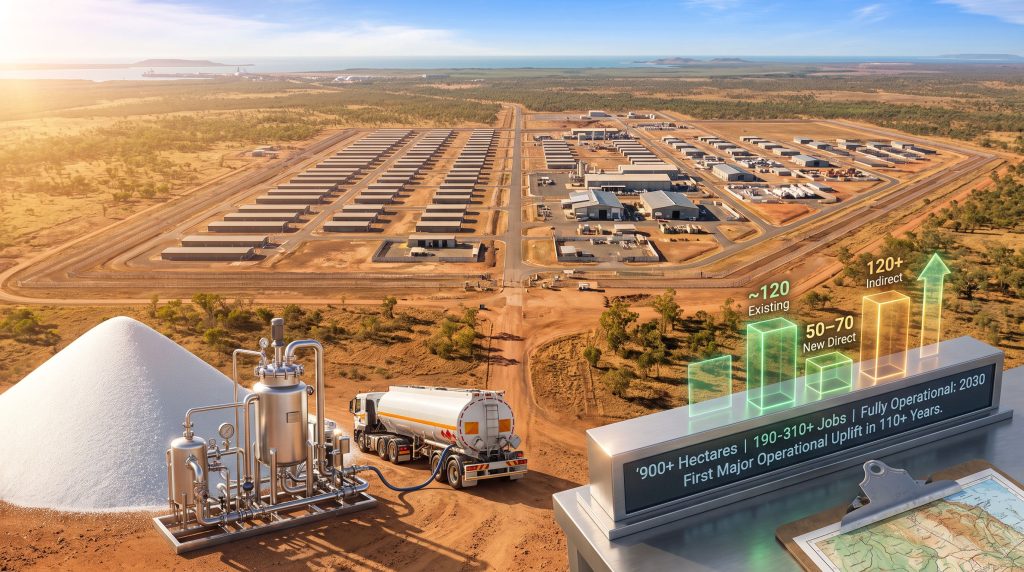
The Bajool Explosives Reserve expansion carries a meaningful employment and economic footprint for the Rockhampton region and broader Capricornia area. With approximately 120 personnel currently employed on-site, the expanded facility is projected to generate between 50 and 70 additional direct positions once fully operational, according to RSHQ's Rob White. (ABC News, August 2026)
Indirect employment effects across the logistics chain — including road transport, warehousing, and port operations — could add a further 120 or more positions.
| Employment Category | Projected Range |
|---|---|
| Existing on-site workforce | ~120 positions |
| New direct positions (post-expansion) | 50 to 70 positions |
| Indirect logistics chain employment | 120+ positions |
| Total potential employment impact | 190 to 310+ positions |
Beyond direct job creation, the expansion amplifies Port Alma's freight throughput and supports regional contractor activity during the construction phase. In addition, it strengthens the economic case for Central Queensland as a resources services hub. Local councils have separately identified the Bajool reserve as part of a broader argument for increased Australian Defence Force infrastructure investment in the region, though the facility's primary operational focus remains firmly on the commercial mining sector.
Furthermore, the broader uplift in resource and energy exports from Queensland positions the Bajool expansion as a key enabler within a much larger economic picture.
Frequently Asked Questions About the Bajool Explosives Reserve Expansion
What is the Bajool Explosives Reserve used for?
The Bajool Explosives Reserve is a Queensland state government-owned facility that stores, manufactures, and safely disposes of commercial explosives, primarily for the mining industry. It also handles the destruction of seized illegal pyrotechnics, degraded military ordnance, and expired safety flares using industrial incinerator systems on site.
Where is the Bajool Explosives Reserve located?
The reserve is situated approximately 30 kilometres south of Rockhampton in Central Queensland, positioned in close proximity to Port Alma, Australia's highest-volume licensed explosives port.
How large is the Bajool site after its expansion?
Following land acquisition in 2021 and subsequent physical development, the reserve grew from approximately 300 hectares to more than 900 hectares, more than tripling its original footprint.
When will the Bajool expansion be fully operational?
Construction on the expanded precinct is expected to begin in early 2027, with full operational capability targeted for 2030.
Does Bajool supply explosives outside Queensland?
Yes. The reserve's proximity to Port Alma and its position within Queensland's transport network makes it a key distribution point for explosives destined for mining operations in New South Wales and Western Australia.
Key Takeaways: What the Bajool Expansion Signals for Australia's Mining Future
The Bajool Explosives Reserve expansion is not simply a regional infrastructure story. It is, however, a window into the structural demands that Australia's mining future is placing on supply chains that rarely attract public attention. Several broader lessons emerge from this development:
- Demand is structural, not cyclical. The expansion reflects multi-decade planning aligned to Queensland's critical minerals trajectory, not a short-term response to commodity price movements.
- Sovereign infrastructure carries irreplaceable functions. State-owned explosives reserves perform disposal, security, and defence-adjacent roles that commercial operators cannot legally or practically replicate.
- Hard-rock critical minerals mining is more explosives-intensive. The shift in Queensland's extraction profile toward lithium and other critical minerals hosted in harder geological formations means per-tonne explosives demand may rise faster than overall production volumes suggest.
- Long lead times require early investment decisions. The pathway from land acquisition in 2021 to full commissioning in 2030 spans nearly a decade, illustrating the planning horizons inherent in this category of infrastructure.
- Port Alma is the force multiplier. The reserve's direct connection to Australia's highest-volume licensed explosives port transforms Bajool from a regional asset into a nationally significant supply node with interstate reach.
- Australia's AN import dependency is a strategic vulnerability. Expanding domestic processing capacity at Bajool provides partial insulation against global ammonium nitrate supply disruptions.
Disclaimer: This article contains forward-looking projections regarding employment figures, construction timelines, and operational capacity targets. These projections are subject to regulatory, logistical, and economic variables and should not be treated as guaranteed outcomes. Readers should consult primary sources and conduct independent research before drawing conclusions based on forecast data.
Want to Capitalise on the Next Major ASX Mining Discovery Before the Market Moves?
Discovery Alert's proprietary Discovery IQ model delivers real-time alerts on significant ASX mineral discoveries — turning complex resource data into actionable insights for both short-term traders and long-term investors. Explore how historic discoveries have generated substantial returns on Discovery Alert's dedicated discoveries page, and begin your 14-day free trial today to position yourself ahead of the broader market.