August 23, 2026
The Gap Between Discovery and Delivery: Why Reserve Announcements Rarely Tell the Full Story
In hydrocarbon-rich regions with complex geopolitical profiles, the distance between a reserve announcement and actual production is rarely measured in months. It is measured in capital availability, infrastructure maturity, sanctions exposure, and the political will of both producing nations and their potential trading partners. Understanding this gap is essential when evaluating any major upstream disclosure, particularly those originating from economies operating under sustained international restrictions.
The Iran natural gas discovery in Fars Province announced in mid-2026 sits precisely within this analytical framework. The Pazan field, located in Iran's southern geological belt, carries headline figures that would attract serious attention under any circumstances. However, the structural realities surrounding its development tell a story that is considerably more nuanced than the reserve numbers alone suggest.
When big ASX news breaks, our subscribers know first
What the Pazan Field Actually Contains
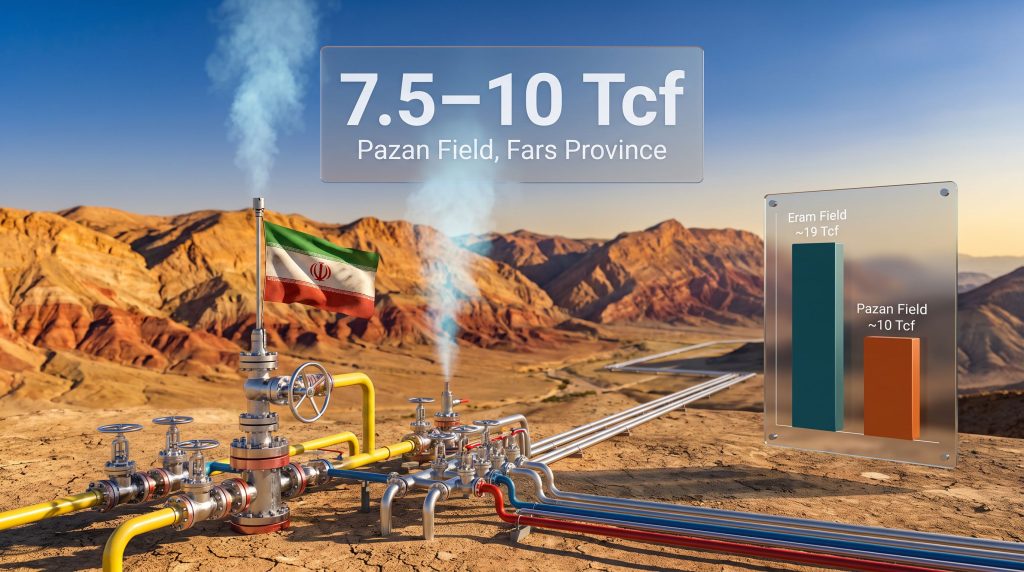
Iranian Oil Minister Mohsen Paknejad confirmed the discovery via state television, citing total gas in place exceeding 7.5 trillion cubic feet (Tcf), with a recoverable portion estimated at approximately 5.7 Tcf. Alternative assessments place the total gas in place figure closer to 10 Tcf, with recoverable volumes potentially reaching 7 Tcf depending on the recovery efficiency applied, which some estimates place around 70%.
The field also contains gas condensate, described by Iranian officials as carrying a combined value of tens of billions of dollars. This liquid hydrocarbon component is commercially significant and, as explored later in this analysis, may ultimately drive development sequencing.
Key Reserve Metrics at a Glance
| Metric | Reported Figure |
|---|---|
| Total Gas in Place (Primary Estimate) | 7.5+ Tcf |
| Recoverable Gas (Primary Estimate) | ~5.7 Tcf |
| Total Gas in Place (Alternative Estimate) | ~10 Tcf |
| Recoverable Gas (Alternative Estimate) | ~7 Tcf |
| Associated Gas Condensate Value | Described as tens of billions of dollars |
| Estimated Time to First Production | Approximately 40 months |
| Field Name | Pazan Field, Fars Province, Southern Iran |
It is worth noting that the variation between the 7.5 Tcf and 10 Tcf estimates reflects the early-stage nature of reserve classification. Further appraisal drilling would be required before a certified, audited resource figure could be established under international reserve reporting standards such as SPE-PRMS.
How Pazan Compares to South Pars
Iranian officials contextualised the Pazan discovery by benchmarking it against South Pars, the world's largest natural gas field, which Iran shares with Qatar across the Persian Gulf. The comparison offered was that Pazan's recoverable gas is equivalent to roughly 15 years of output from a single South Pars development phase.
South Pars comprises 24 development phases in total, which immediately contextualises the relative scale. The entire South Pars structure is estimated to contain approximately 1,800 Tcf of gas in place, meaning Pazan represents a fraction of that mega-structure's capacity. Importantly, Pazan is an onshore, land-based accumulation within the Zagros geological system, structurally and operationally distinct from the offshore South Pars complex.
Why Fars Province Keeps Delivering Large Gas Finds
The Geological Engine: The Zagros Fold Belt
Fars Province sits within the Zagros Fold Belt, one of the most prolific hydrocarbon-generating geological environments in the world. The fold belt's carbonate reservoir systems, formed over millions of years of tectonic compression and sedimentary layering, have historically trapped enormous volumes of both dry gas and gas condensate at commercially accessible depths.
What makes the Fars Province particularly interesting from an exploration standpoint is that it has received comparatively limited upstream investment relative to its offshore counterpart. Furthermore, the majority of Iran's exploration capital and international partnership agreements have historically been directed toward the South Pars complex, leaving the southern onshore basins significantly under-appraised.
A Growing Inventory of Significant Finds
The Pazan discovery is not an isolated event. It follows a pattern of substantial Fars Province gas accumulations being identified over recent years:
- 2019 – Eram Field: Reported to contain approximately 19 Tcf of gas in place, with over 13 Tcf estimated as recoverable. At the time of its announcement, this was characterised as one of Iran's most significant onshore gas discoveries in decades.
- 2026 – Pazan Field: 7.5 to 10 Tcf in place, with recoverable estimates ranging from 5.7 to 7 Tcf, accompanied by a substantial condensate fraction.
The sequential nature of these discoveries implies that the Fars Province geological province remains materially under-explored. Each significant find increases the probability of additional accumulations within the same stratigraphic and structural framework, a concept geologists refer to as play fairway analysis, where one confirmed discovery de-risks nearby prospective structures.
The Barriers That Reserve Numbers Cannot Resolve
Sanctions and the Technology Access Problem
The most persistent constraint on Iranian upstream development is not geological or even financial in the conventional sense. It is the near-total exclusion of international oil companies and technology providers from Iranian project participation, enforced through decades of U.S.-led sanctions architecture. Consequently, sanctions and oil trade dynamics continue to shape the pace and scope of any meaningful upstream development.
This exclusion has tangible operational consequences:
- Modern gas field development relies heavily on advanced compression technology, multilateral well completion techniques, and sophisticated reservoir management software, most of which originate from companies in sanctioned jurisdictions for Iran
- Iran has been forced to develop domestic engineering capability across the entire upstream supply chain, which, while impressive in scope, cannot fully replicate the efficiency gains that international technology partnerships deliver
- Project financing for major upstream development typically involves international debt markets and export credit agencies, both effectively closed to Iranian entities under current sanctions frameworks
The Conflict Damage Variable
The 2026 announcement arrived in the context of significant infrastructure disruption. Military strikes targeting Iranian energy assets, including facilities associated with the South Pars complex, are reported to have eliminated approximately 25% of Iran's daily gas production capacity. Some capacity has since been restored, but the damage created a supply gap that the Iran natural gas discovery in Fars Province cannot bridge within any near-term timeframe.
This context is critical. Iran is simultaneously managing:
- Active infrastructure repair at damaged production facilities
- Government-issued conservation warnings ahead of winter demand peaks
- A domestic gas supply deficit that predates the 2026 conflict
Domestic Demand Is Competing with Every Development Priority
Iran's domestic gas consumption has expanded significantly over the past decade, driven by population growth, heavily subsidised residential energy pricing, and industrial sector demand. The country simultaneously maintains pipeline gas export commitments to Iraq and Turkey under existing long-term agreements, creating a tripartite pressure on available supply: domestic consumption, contractual export obligations, and the aspiration to monetise new reserves.
With Pazan's first production estimated at 40 months from development commencement, and that timeline itself contingent on capital and equipment availability, the field offers no near-term relief to Iran's current supply challenges.
Scenario Analysis: Three Plausible Development Pathways
| Scenario | Enabling Conditions | Likely Outcome |
|---|---|---|
| Accelerated Domestic Development | Sanctions relief, restored foreign technology access | First gas within 40 months; domestic supply stabilised by late 2020s |
| Constrained Self-Funded Development | Sanctions maintained, domestic capital only | Timeline extends to 5-7+ years; condensate monetisation significantly delayed |
| Selective Regional Partnership | Chinese or Russian technical collaboration | Condensate extraction prioritised over full gas development; partial monetisation |
Each scenario carries materially different implications for regional gas markets and for Iran's fiscal position. The condensate-first pathway is arguably the most commercially rational under sanctions conditions, since liquid hydrocarbons are far easier to transport and monetise through informal trade channels than pipeline gas.
Gas Condensate: The Commercial Variable Most Analysis Underweights
Why Condensate Changes the Development Economics
Gas condensate, the light liquid hydrocarbon fraction produced alongside natural gas, is priced against crude oil benchmarks rather than gas indices. This distinction matters enormously in a sanctions-constrained environment where pipeline gas export routes are limited and LNG infrastructure does not exist. In addition, the broader geopolitical supply factors at play in the region further complicate the commercialisation of any new production stream.
Condensate can be stored, transported by tanker, and sold through a wider range of commercial channels than pipeline gas. Iran has historically used South Pars condensate as a critical revenue stream during periods of crude oil export restriction, precisely because its lighter molecular weight and liquid state provide greater logistical flexibility.
The official characterisation of Pazan's condensate volumes as being worth tens of billions of dollars suggests a liquid fraction that could potentially self-fund a meaningful portion of the field's development costs, even without access to international capital markets. In project finance terms, this makes Pazan a condensate-rich gas development, a category that typically attracts faster development sequencing than dry gas accumulations in constrained capital environments.
The next major ASX story will hit our subscribers first
Iran's Position in the Broader Middle East Gas Landscape
Iran holds the second-largest proven natural gas reserves globally, behind Russia. Despite this resource endowment, it has been largely absent from international LNG trade, the fastest-growing segment of global gas markets over the past two decades. The broader geopolitical landscape across the region continues to shape how energy resources are developed, traded, and priced.
Qatar, Iran's co-holder of the shared North Field/South Pars structure, has pursued an aggressively opposite strategy. Qatar is targeting an LNG export capacity of 142 million tonnes per annum (mtpa) by the early 2030s, cementing its position as a dominant supplier to European and Asian markets. Australia and the United States have similarly expanded their LNG export footprints significantly.
Iran lacks operational LNG export terminals, and developing them would require foreign technology, substantial financing, and, most critically, a sanctions framework that permits international commercial engagement. In the absence of these conditions, the most realistic export pathways for Pazan gas remain:
- Existing pipeline corridors to Turkey and Iraq
- A proposed pipeline to Pakistan, which has faced prolonged financing and construction challenges
- Informal condensate export through regional trading networks
Key Takeaways for Understanding the Discovery's Real Significance
What the Pazan Discovery Confirms
- Iran's southern onshore basins contain genuinely substantial undeveloped gas resources, extending well beyond the South Pars offshore complex
- The Zagros Fold Belt's carbonate systems continue to yield commercially significant accumulations in areas that have received limited modern exploration attention
- The condensate fraction adds a liquid hydrocarbon revenue dimension that could meaningfully influence how and when development is sequenced
What the Discovery Does Not Change
- The immediate domestic gas supply deficit Iran faces heading into the 2026-2027 winter season
- The structural under-investment that has accumulated across Iran's energy sector over more than a decade of sanctions pressure
- The approximately 25% production capacity reduction caused by conflict-related infrastructure damage
- The absence of LNG infrastructure required to access international gas markets beyond pipeline neighbours
Furthermore, the commodity market volatility triggered by announcements of this nature tends to subside quickly once investors and analysts assess the structural barriers to monetisation. The Iran natural gas discovery in Fars Province is no exception to this pattern, and the oil price movements observed in the wake of such disclosures are rarely sustained without confirmed production timelines.
The Pazan field is a real and meaningful addition to Iran's long-term reserve inventory. But the path from a Fars Province discovery announcement to gas flowing through domestic pipelines or export corridors is not a technical challenge. It is a geopolitical one, and geopolitical timelines operate on a fundamentally different clock than drilling schedules.
This article is intended for informational purposes only and does not constitute financial or investment advice. Reserve estimates cited reflect early-stage disclosures and have not been independently audited or certified under international reserve reporting standards. Forecasts, scenario projections, and development timelines involve inherent uncertainty and should not be relied upon as predictions of future outcomes.
For ongoing upstream reporting on Middle East energy developments, World Oil provides industry coverage at worldoil.com.
Want to Stay Ahead of the Next Major Mineral Discovery?
While geopolitical complexity governs the timeline of upstream oil and gas developments like Pazan, significant mineral discoveries on the ASX can move with far greater speed — and Discovery Alert's proprietary Discovery IQ model ensures subscribers receive real-time alerts the moment a major discovery is announced. Explore historic examples of exceptional discovery-driven returns on Discovery Alert's dedicated discoveries page, and begin your 14-day free trial today to position yourself ahead of the broader market.