August 22, 2026
When Economic Survival Becomes a Public Health Crisis
Across the global history of infectious disease outbreaks, one variable has proven consistently difficult to control through medical intervention alone: poverty. When daily survival depends on physical presence in a high-risk environment, public health guidance collides head-on with economic necessity. This tension sits at the core of the current Ebola outbreak in eastern Democratic Republic of Congo, where DR Congo miners risk Ebola to make a living — continuing to work through active transmission zones not out of recklessness, but because stopping means watching their families go without food, shelter, and basic necessities.
The situation unfolding in Ituri Province in 2026 represents one of the most structurally complex Ebola responses in the history of a country that has battled the virus more than any other nation on earth. The factor that separates this outbreak from its predecessors is not geography or population density alone. It is the combination of an unvaccinated strain, a mobile informal workforce, and an economic system that offers no safety net to those most exposed.
When big ASX news breaks, our subscribers know first
Ituri Province and the Mongbwalu Mining Hub
The current outbreak is concentrated in Ituri Province, with the artisanal gold mining town of Mongbwalu emerging as a focal point of documented transmission. This region has long attracted a fluid population of miners drawn by artisanal gold deposits, creating dense worker communities that share tools, water points, resting areas, and often sleeping quarters. DR Congo's natural resources have, for decades, drawn workers into precisely these high-risk, high-density environments.
The physical environment of artisanal mining in this region intensifies transmission risk in ways that are structurally distinct from urban outbreak scenarios:
- Underground and semi-enclosed workspaces eliminate the possibility of physical distancing
- Shared equipment and water infrastructure creates consistent surface contact between large numbers of workers
- The absence of formal sanitation facilities at many artisanal sites compounds hygiene risks considerably
- Worker accommodation is typically communal, meaning off-site hours carry similar transmission risk to working hours
Beyond the mine sites themselves, the broader geography of the outbreak matters. Eastern DR Congo sits at a confluence of provincial and international movement corridors. Miners frequently travel from neighbouring provinces or cross into adjacent countries, creating what epidemiologists describe as transmission corridors that extend the functional reach of any single outbreak zone far beyond its point of origin.
The U.S. Centers for Disease Control and Prevention has identified population movement associated with mining activity as one of several structural amplifiers elevating the risk profile of the current outbreak, alongside armed conflict and ongoing displacement of civilian populations.
The Bundibugyo Strain: A Containment Gap With No Easy Answer
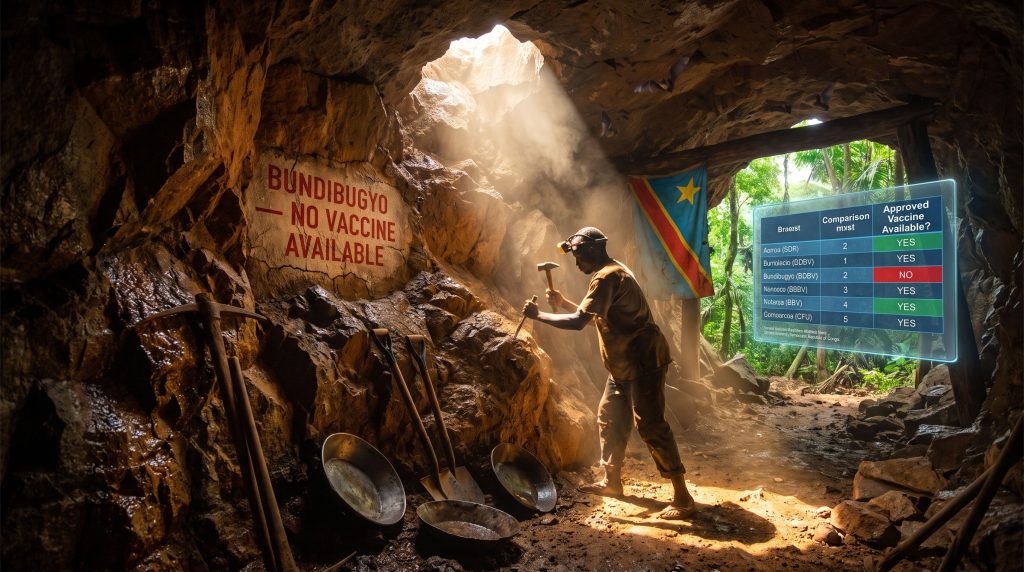
Perhaps the most critical technical distinction between this outbreak and the major DR Congo events of recent years is the causative pathogen. The 2026 Ituri outbreak involves the Bundibugyo ebolavirus strain, a species within the Orthoebolavirus genus that was first identified in western Uganda in 2007. Its key epidemiological feature, in the context of outbreak response, is the complete absence of any approved vaccine or licensed therapeutic targeting it.
This matters enormously when considering the tools available to health authorities on the ground. Compare the medical countermeasure landscape across known Ebola strains:
| Ebola Strain | Approved Vaccine | Approved Treatment |
|---|---|---|
| Zaire (EBOV) | Yes (rVSV-ZEBOV / Ervebo) | Yes (Inmazeb, Ebanga) |
| Bundibugyo (BDBV) | No | No |
| Sudan (SUDV) | Experimental candidates only | No |
| Taï Forest (TAFV) | No | No |
During the devastating 2018 to 2020 North Kivu outbreak, which became the second-largest Ebola event in recorded history, ring vaccination using the approved rVSV-ZEBOV vaccine provided a critical biological backstop to containment efforts. That tool does not exist for Bundibugyo. Every case prevented in the current outbreak must be prevented through behavioural change, contact tracing, physical isolation, and community engagement rather than immunological protection.
The absence of an approved medical countermeasure for the Bundibugyo strain means the entire containment burden falls on non-pharmaceutical interventions operating in one of the most challenging public health environments in the world.
This constraint places extraordinary pressure on community compliance and health worker access. In a population where compliance is structurally constrained by economic necessity, and where health worker access is limited by active insecurity, the gap left by the absent vaccine is profound.
Three Structural Pathways Through Which Mining Accelerates Transmission
The relationship between artisanal mining and Ebola transmission is not incidental. It is mechanistic, operating through at least three distinct and reinforcing pathways.
1. Concentrated Working Conditions
Artisanal mining by its nature gathers large numbers of workers into physically compressed environments. The combination of confined underground spaces, shared tools, and communal rest areas creates near-continuous contact between workers throughout the working day. Standard infection prevention guidance recommending distance and hygiene is functionally impossible to follow in these conditions, even among workers who are fully aware of the risks and motivated to protect themselves.
2. Human-Wildlife Interface at Mine Sites
A lesser-known but epidemiologically significant dimension of mining-linked outbreak risk involves the direct contact between mine workers and wildlife. Bats, particularly fruit bats of the Pteropodidae family, are considered the most probable natural reservoir species for ebolaviruses across multiple strains. Artisanal mining that penetrates cave systems, forested terrain, or disturbed underground environments significantly increases the frequency and intimacy of human-bat contact.
Furthermore, this means active mine sites are not simply amplification environments where existing human-to-human transmission spreads more rapidly. In specific geological and ecological contexts, they may also function as primary spillover environments, where the initial animal-to-human transmission event occurs. The Guardian has reported on how mineral mining and smartphone demand are driving this dangerous interface, offering important context on the systemic pressures shaping outbreak risk. This distinction has significant implications for outbreak origin surveillance and early detection systems.
3. Supply Chain Mobility Extending the Network
The miners themselves represent only one layer of the transmission-relevant population. A secondary network of traders, food vendors, transport operators, equipment suppliers, and middlemen moves continuously between mining sites and regional urban centres. These supply chain workers have lower direct exposure than miners but significantly higher mobility, creating the epidemiological conditions for rapid geographic spread from what might otherwise remain a contained cluster.
Why DR Congo Miners Risk Ebola to Make a Living: The Economic Logic
The framing of continued mining activity as a failure of risk communication misses the core dynamic entirely. Workers near Mongbwalu and similar artisanal sites across Ituri Province are not unaware of Ebola. They are aware of it, they fear it, and many explicitly acknowledge that their working conditions make protection impossible. They continue working because the alternative, in the absence of any income replacement mechanism, is immediate destitution.
Artisanal mining in eastern DR Congo operates entirely outside formal employment structures. There is no sick leave entitlement. There are no employer-provided health protections. There is no government income replacement programme for informal sector workers who voluntarily cease work during health emergencies. The economic calculus facing individual miners is unambiguous:
- Stop working: family loses access to food, housing costs cannot be met, children's nutritional status deteriorates within days
- Continue working: risk Ebola infection in an outbreak with no vaccine and no approved treatment
For a worker with no savings buffer and no alternative income source, this is not a choice between safety and risk. It is a choice between two different categories of immediate harm. The Congolese mining rivalry between global powers has, moreover, intensified extraction pressures across the region, further entrenching the informal workforce's dependence on continued production.
Workers in the region have consistently described continued mining as economically non-negotiable, with many noting that the physical demands of their occupation make hygiene and distancing protocols structurally impossible to follow regardless of personal intention.
This reality reframes the outbreak as a poverty crisis wearing an epidemiological mask. Sustainable containment cannot be achieved through medical and behavioural interventions alone in populations where economic compulsion overrides health-protective behaviour.
The Structural Barriers That Standard Response Playbooks Cannot Overcome
Eastern DR Congo presents a particularly challenging convergence of factors that limit the effectiveness of conventional outbreak response architecture:
| Barrier | Specific Impact on Containment |
|---|---|
| No approved Bundibugyo vaccine | Eliminates ring vaccination as a primary tool |
| Informal, transient workforce | Severely undermines contact tracing accuracy and completeness |
| Armed conflict and insecurity | Restricts health worker access to outbreak areas |
| Cross-border population movement | Expands transmission corridors beyond domestic response capacity |
| Community distrust of health authorities | Reduces uptake of surveillance and isolation interventions |
| Infrastructure deficits | Disrupts cold chain, communications, and medical supply logistics |
The 2018 to 2020 North Kivu outbreak demonstrated how each of these barriers operates in practice. That event lasted nearly two years despite a substantial international response incorporating an approved vaccine, involving the WHO, Médecins Sans Frontières, and numerous UN agencies. The current Bundibugyo outbreak removes the vaccine advantage while retaining every other structural challenge that made the Kivu response so protracted.
The next major ASX story will hit our subscribers first
DR Congo's Long History With Ebola: A Pattern, Not an Anomaly
The nation has recorded more than a dozen Ebola outbreaks since the virus was first identified in 1976 along the Ebola River in what was then Zaire. This repeated exposure reflects not biological peculiarity but structural vulnerability: a combination of dense forest-human interfaces, persistent insecurity, underfunded health systems, and deep economic marginalisation across large population segments.
| Recent Outbreak | Province | Strain | Duration | Vaccine Available |
|---|---|---|---|---|
| 2018 to 2020 Kivu | North Kivu / Ituri | Zaire | Approximately 23 months | Yes |
| 2020 Équateur | Équateur | Zaire | Approximately 3 months | Yes |
| 2022 North Kivu | North Kivu | Zaire | Approximately 2 months | Yes |
| 2026 Ituri (current) | Ituri | Bundibugyo | Ongoing | No |
Each successive outbreak has generated calls for structural investment in health system capacity, economic resilience, and conflict resolution. The degree to which those calls have translated into durable change remains limited, as the persistence of outbreak vulnerability demonstrates. In addition, policy decisions such as the DRC cobalt export ban have created further economic instability for communities already operating without any financial buffer.
What Effective Intervention Actually Requires
Global health analysts increasingly recognise that outbreak containment in economically marginalised resource-extraction communities requires a fundamentally different response architecture than what conventional public health frameworks provide.
Economic stabilisation as a containment mechanism may be the most underutilised tool available. Evidence from various outbreak contexts suggests that targeted short-term income support for workers who voluntarily reduce mobility or enter isolation can meaningfully reduce transmission without the coercive enforcement dynamics that generate community resistance. Food assistance and microfinance buffers, deployed through community channels rather than external agencies, lower the economic cost of compliance enough to make compliance possible.
Community-embedded health infrastructure has demonstrated effectiveness in multiple sub-Saharan African resource-sector outbreak contexts. Rather than deploying health workers as externally visible responders, integrating trained community members as health liaisons within mining populations reduces the distrust barrier significantly. Peer-based monitoring, where miners themselves are equipped and supported to identify and report symptomatic contacts, generates surveillance data that external teams cannot access.
Accelerated Bundibugyo vaccine development represents the most consequential long-term gap to close. Several experimental candidates have been in preclinical or early clinical investigation, but none have advanced to approved status. Given the current outbreak's trajectory, advocacy for expedited clinical pathways and emergency use consideration for Bundibugyo-targeted vaccines is gaining urgency within the global health security community.
Frequently Asked Questions
What distinguishes the Bundibugyo strain from the more commonly known Zaire strain?
The Bundibugyo ebolavirus was first identified during a 2007 outbreak in Uganda. While it shares fundamental biological characteristics with other ebolavirus species, it has a distinct viral glycoprotein structure that means existing Zaire-targeted vaccines do not provide cross-protective immunity. Case fatality rates in the 2007 Uganda event were lower than those typically observed in Zaire outbreaks, though the current DR Congo event is still evolving.
Why is contact tracing particularly difficult in artisanal mining populations?
Artisanal miners are not registered employees. They move between sites, provinces, and countries without documentation. Many work under informal names or are unknown to any administrative record. Identifying, locating, and monitoring all contacts of a confirmed case requires fixed address information and communication access that most informal mining workers do not have.
How does wildlife contact at mine sites create primary spillover risk?
Bats roosting in cave systems disturbed by mining activity are brought into close proximity with workers. Direct contact with bat saliva, blood, or faeces — or with intermediate animal hosts that have themselves been exposed — can introduce the virus into human populations at the point of extraction itself, before any human-to-human transmission has occurred.
What role do international organisations play in the current response?
The WHO, CDC, and established NGOs with operational presence in eastern DR Congo are engaged in the current response. The cobalt export suspension has also complicated the economic backdrop against which health interventions are being deployed. Security constraints significantly limit field access in certain outbreak-affected areas, and the mobile character of the affected workforce complicates the deployment of standard surveillance and isolation protocols.
The Intersection of Human Rights and Epidemiology
The reality that DR Congo miners risk Ebola to make a living is ultimately a story about what happens when economic marginalisation is severe enough to function as a disease transmission mechanism. When workers cannot access the economic conditions necessary to protect themselves, infection risk becomes a direct consequence of poverty rather than a product of ignorance or indifference.
This reframing carries significant implications for how outbreak response is designed and resourced. A public health response that focuses exclusively on behavioural change, case isolation, and contact tracing — without addressing the economic conditions that make compliance impossible for the most exposed populations — is structurally incomplete. Consequently, the US interest in Congo minerals adds yet another geopolitical dimension to a humanitarian crisis that demands far more than conventional outbreak management.
Addressing Ebola in mining communities without addressing the poverty that forces continued exposure treats the symptom while leaving the underlying condition entirely intact.
As the 2026 Ituri outbreak continues, the question confronting international health authorities is not only how to contain a virus with no approved vaccine in a conflict-affected environment. It is whether the global outbreak response architecture is willing to incorporate economic stabilisation as a first-order public health intervention rather than a secondary humanitarian consideration. The BBC has also covered the outbreak's spread and the compounding factors limiting effective response, providing further context on the international dimensions of this evolving crisis.
For further background on the intersection of economic survival and disease risk in DR Congo, Al Jazeera English has reported directly from the region. Their coverage is available at https://aje.news/hmcykv.
This article contains references to ongoing public health developments and epidemiological projections that are subject to change as the situation evolves. Readers are encouraged to consult current WHO and CDC situation reports for the most recent outbreak data.
Want to Track the ASX Mineral Discoveries Shaping the Resources Sector?
Whilst the human cost of resource extraction in conflict-affected regions highlights the complex realities behind global mineral supply chains, the investment implications of major discoveries remain significant. Discovery Alert's proprietary Discovery IQ model delivers real-time alerts on significant ASX mineral discoveries, transforming complex geological data into actionable insights for investors at every experience level — explore Discovery Alert's discoveries page to understand how historic finds have generated substantial market returns, and begin your 14-day free trial today to position yourself ahead of the broader market.