
August 21, 2026
When Emergency Powers Meet Environmental Law: A Federalism Fault Line
The tension between federal emergency authority and state environmental governance has been building across the United States for years. Consent decrees, permitting timelines, and state-level safety approvals have long served as friction points between Washington's energy ambitions and states determined to assert their own regulatory frameworks. What unfolded in a California federal courtroom in August 2026 crystallised that tension into a binding legal precedent — one that could fundamentally redraw jurisdictional boundaries across the U.S. energy sector, and the court upholds Trump order to restart Santa Ynez Unit stands as perhaps the most consequential energy federalism ruling in recent memory.
When big ASX news breaks, our subscribers know first
The Defense Production Act: A Cold War Tool Deployed in a Modern Energy Crisis
Most Americans associate the Defense Production Act with wartime manufacturing mobilisation. Its original framework, built during the early Cold War era, was designed to redirect industrial capacity toward national security needs. What the ruling on the Santa Ynez Unit (SYU) now confirms is that this statute carries sufficient legal weight to compel the reactivation of dormant civilian energy infrastructure, even when state agencies and court-approved consent agreements stand in opposition.
How Did the Emergency Order Come About?
On March 13, 2026, the Department of Energy, under Secretary Chris Wright, issued a formal restart directive for the SYU complex and its associated pipeline network. The triggering rationale was geopolitical rather than routine: the directive cited energy security risks stemming from disruptions to oil tanker traffic through the Strait of Hormuz, a chokepoint through which a significant share of global oil supply flows. By framing the restart as a response to international supply chain vulnerability, the DOE elevated the matter from a permitting dispute to a national security imperative.
The legal mechanism this established is significant. Rather than navigating the conventional permitting pathway under statutes like the National Environmental Policy Act, the federal government used active emergency authority to mandate production restarts. This is a categorically different legal instrument — one that compresses the normal regulatory review cycle entirely. Furthermore, this approach aligns with the broader executive order on American mineral production framework that has reshaped energy governance in 2025 and beyond.
| DPA Provision | Application in the SYU Case |
|---|---|
| Emergency production authority | Mandated restart of offshore platforms and pipeline |
| Federal supremacy over state restrictions | Overrode California and Santa Barbara County objections |
| National security justification | Strait of Hormuz supply disruption cited as trigger |
| Designated federal safety oversight | PHMSA confirmed as sole pipeline authority |
The 2015 Refugio Beach Spill: Why California Refused to Stand Down
To understand why California mounted such a determined legal challenge, it is necessary to revisit the origins of the Consent Decree at the heart of the dispute. In 2015, a corroded segment of a pipeline operated by Plains Pipeline LP ruptured near Refugio State Beach, releasing hundreds of thousands of gallons of crude oil into coastal waters north of Santa Barbara. The environmental damage was substantial, affecting marine ecosystems, wildlife, and coastal communities in ways that reverberated for years afterward.
The 2020 Consent Decree that followed was not a procedural formality. It was a negotiated legal instrument, entered by both state and federal agencies, that resolved civil liability arising from the spill through a combination of $60 million in penalties and damages, alongside a defined set of prerequisites that had to be satisfied before any pipeline restart could be authorised. Embedded within the decree was an explicit acknowledgment of the California State Fire Marshal's role in reviewing and approving any restart of the onshore pipeline system.
California's attorney-general filed suit on March 23, 2026, arguing that Sable Offshore Corp had restarted the Las Flores Pipelines without obtaining the State Fire Marshal approval required under the decree, effectively bypassing a binding court order. From the state's perspective, no federal emergency directive could retrospectively nullify the terms of an agreement that federal agencies had themselves co-signed.
The Core State Argument in Summary
- The Consent Decree was legally binding on all parties, including federal co-signatories
- State Fire Marshal approval was an explicit and non-waivable prerequisite under the decree
- The DOE's emergency order did not extinguish pre-existing legal obligations under a court-approved settlement
- Restarting pipeline operations without satisfying those prerequisites violated both the decree and applicable California state law
What the Court Actually Decided: Jurisdiction, Supremacy, and Safety Oversight
The U.S. District Court for the Central District of California issued its ruling on August 21, 2026, upholding the federal government's authority across three distinct dimensions.
First, the court confirmed that the federal government possessed the legal authority to order the reactivation of SYU and its pipeline infrastructure under emergency powers. Second, it characterised the state-level restrictions as obstacles to federally mandated operations during a declared national energy emergency, effectively invalidating their blocking function. Third, and perhaps most consequentially for regulatory architecture, the court determined that the Department of Transportation's Pipeline and Hazardous Materials Safety Administration (PHMSA) holds exclusive jurisdiction over pipeline safety oversight, displacing the California State Fire Marshal's claimed approval authority.
| Jurisdiction Level | Claimed Authority | Court's Determination |
|---|---|---|
| Federal (DOE via DPA) | Power to mandate restart under emergency | Upheld |
| Federal (PHMSA) | Sole pipeline safety oversight | Confirmed |
| California State Fire Marshal | Restart approval authority under Consent Decree | Superseded |
| Santa Barbara County | Environmental and penalty prerequisites | Overridden |
This third determination carries implications well beyond the SYU dispute. By consolidating pipeline safety authority within PHMSA, the ruling narrows the space in which state agencies can impose additional approval layers on federally regulated pipeline infrastructure. For states with aggressive environmental governance frameworks, this represents a meaningful constraint on regulatory reach. Consequently, the defence production act is proving to be a far broader instrument than many legal observers had previously anticipated.
Military Readiness and the National Security Framing of Civilian Infrastructure
One of the more strategically significant aspects of this legal contest was how the Justice Department characterised the SYU pipeline system. Federal officials presented the infrastructure not merely as a commercial oil asset, but as a component of the military supply chain underpinning operational readiness across the western United States.
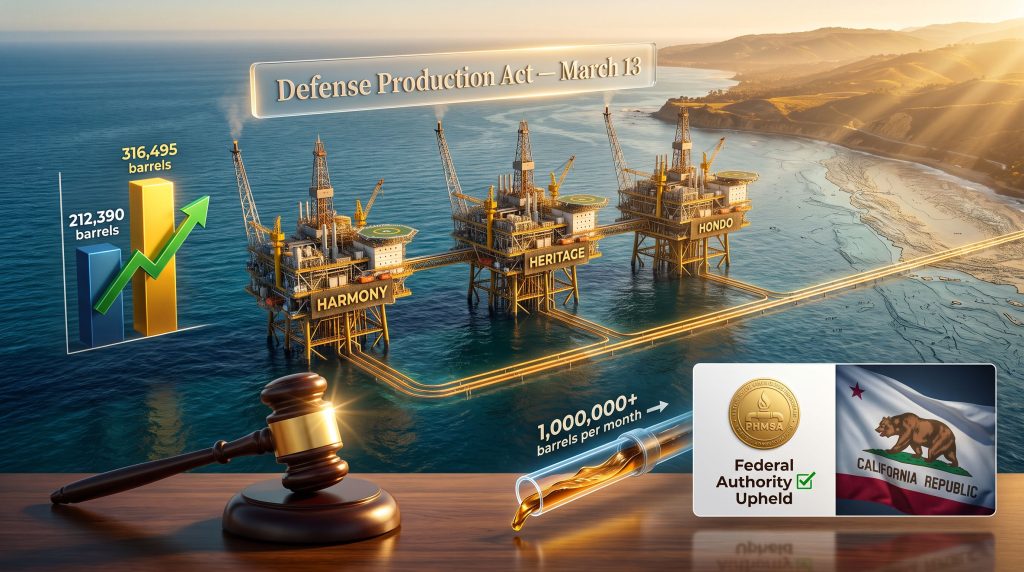
The pipeline system moves in excess of one million barrels of domestically produced crude oil per month from offshore platforms into California. Federal officials argued that reliable operation of this infrastructure is essential to maintaining fuel supplies for more than 32 U.S. military installations across the West Coast. In this framing, any disruption to SYU output carries direct consequences for defence readiness, not merely for commercial energy markets.
"This framing of civilian energy infrastructure as a military-critical supply chain asset is a legally and rhetorically significant development. It substantially broadens the category of assets that emergency powers can be invoked to protect, and it will likely be revisited in future disputes over dormant or restricted energy production facilities."
This is not simply political language. Under the Defense Production Act, the national security nexus is a legal requirement for emergency authority invocation. By establishing a documented connection between SYU output and military installation fuel security, federal officials constructed the legal foundation for DPA application — a foundation the court ultimately accepted. This approach also reflects the wider Trump administration's impact on mining and domestic energy production more broadly.
SYU's Current Production Status: Platforms, Inventory, and the Road to Full Capacity
Understanding where SYU stands operationally provides important context for the economic stakes underpinning this legal battle. The complex comprises three offshore production platforms: Harmony, Heritage, and Hondo. Following the current administration's restart push, Harmony and Heritage have been reactivated. Platform Hondo was projected to resume production in September 2026, per operator Sable Offshore Corp's Q2 2026 report released on August 10.
The production figures from the April to June 2026 quarter illustrate the gap between current output and system capacity. During that period, Sable averaged 723 barrels of oil per day (bopd) in actual production, while crude oil sales amounted to approximately 21,000 bopd, reflecting drawdowns from accumulated inventory rather than live production alone.
Inventory dynamics during the quarter were notable:
- Crude oil held at Las Flores Canyon grew by 49% across the quarter
- Opening inventory stood at 212,390 barrels
- Closing inventory reached 316,495 barrels
- As of August 9, 2026, inventory had moderated to approximately 224,000 barrels
SYU: From Spill to Federal Restart, a Timeline
| Year | Key Event |
|---|---|
| 2015 | Refugio Beach oil spill; SYU production suspended |
| 2020 | Consent Decree entered by state and federal agencies |
| 2022 | Exxon Mobil Corp acquires SYU assets |
| 2024 | Sable Offshore Corp acquires assets from Exxon Mobil |
| March 13, 2026 | DOE issues DPA-based restart directive |
| March 23, 2026 | California attorney-general files legal challenge |
| August 21, 2026 | Federal court upholds restart order |
The next major ASX story will hit our subscribers first
Three Structural Shifts This Ruling Could Accelerate
Viewed through a policy lens, the SYU ruling is less about a single oil field and more about establishing precedents that could reshape how the federal government manages domestic energy production across a range of future scenarios.
-
Expanded DPA applicability to energy infrastructure: The ruling creates a documented legal pathway for invoking emergency powers to override state-level permitting and approval delays on energy projects. Future administrations, regardless of political orientation, may find this template useful when domestic supply goals conflict with state environmental governance.
-
Reduced enforceability of state-participation consent decrees: The finding that a federally declared energy emergency can supersede a Consent Decree — even one co-signed by federal agencies — raises serious questions about the durability of such agreements as regulatory instruments when they conflict with subsequent federal priorities.
-
PHMSA consolidation as the definitive pipeline safety arbiter: Confirming PHMSA's exclusive authority strips state agencies of their ability to impose supplementary approval conditions on interstate pipeline infrastructure. For states like California, Oregon, and Washington, where state agencies have historically played active roles in pipeline oversight, this is a significant jurisdictional retreat.
It is worth noting that this ruling differs structurally from previous federal-state energy disputes. Many earlier conflicts centred on procedural timelines under environmental review statutes. This case hinged on active emergency powers — a fundamentally different legal mechanism that bypasses procedural review entirely rather than simply accelerating it. However, the geopolitical landscape for metals and mining suggests this will not be the last time such powers are deployed in an energy context.
What Comes Next: Appeals, Precedent, and the Ninth Circuit
As of the ruling date, the office of California's attorney-general had not issued a formal public response. The state retains the right to appeal the decision to the Ninth Circuit Court of Appeals, which would extend the legal contest and potentially produce a higher-court ruling on the outer limits of DPA authority over state environmental governance.
A Ninth Circuit determination would carry significant weight. That court's decisions apply across the western United States and would either reinforce or constrain the precedent established by the district court. Legal observers focused on energy federalism will be watching closely, as the outcome could influence how future administrations approach restricted or dormant production assets in climate-ambitious states.
In addition, the 2025 mineral production executive order has already signalled a federal appetite for confronting state-level restrictions on domestic resource extraction. Accordingly, the SYU case may represent an early test of a much broader federal strategy — one that will be further shaped by whatever the Ninth Circuit ultimately decides. Environmental advocates have already raised concerns about compliance with earlier injunctions in this ongoing dispute, suggesting the legal contest is far from resolved.
Disclaimer: This article contains forward-looking statements and analysis based on publicly available information. It does not constitute legal or financial advice. Readers should conduct independent research before making decisions based on regulatory or market developments discussed herein.
Frequently Asked Questions
What is the Santa Ynez Unit?
The Santa Ynez Unit is an offshore oil production complex situated off the California coast, consisting of three production platforms connected to onshore processing and pipeline infrastructure at Las Flores Canyon. It has been largely inactive since the 2015 Refugio Beach pipeline spill.
What legal basis did the federal government use to order the restart?
The Department of Energy invoked the Defense Production Act, citing geopolitical energy security risks connected to disruptions in oil shipping through the Strait of Hormuz as the legal justification for mandating production and pipeline reactivation.
Why did California object to the restart?
The state argued that a 2020 Consent Decree, co-signed by both state and federal agencies, required specific conditions to be met before any pipeline restart, including approval from the California State Fire Marshal. The state alleged these conditions were bypassed following the DOE order.
Which agency now holds pipeline safety authority under this ruling?
The court determined that the Pipeline and Hazardous Materials Safety Administration, a federal body under the Department of Transportation, holds exclusive authority over safety oversight for this pipeline infrastructure, displacing the state's claimed approval role.
How much oil does the SYU system move each month?
According to federal officials, the pipeline system transports more than one million barrels of domestically produced crude oil per month from offshore wells into California.
Can California appeal the ruling?
Yes. California retains the right to appeal to the Ninth Circuit Court of Appeals. A higher-court ruling would carry broader geographic and legal significance, potentially setting a definitive standard for the scope of federal emergency energy powers against state-level environmental governance. The fact that the court upholds Trump order to restart Santa Ynez Unit at the district level does not, therefore, represent the final word on this consequential dispute.
Want to Track the Next Major Resource Discovery Before the Market Moves?
The regulatory shifts reshaping U.S. and global energy and mineral production are creating real investment signals — and Discovery Alert's proprietary Discovery IQ model scans ASX announcements in real time, delivering instant alerts on significant mineral discoveries so subscribers can act ahead of the broader market. Explore how historic discoveries have generated extraordinary returns and begin your 14-day free trial today to secure a genuine market-leading edge.