August 21, 2026
India's Mineral Federalism Fault Line: Why the MMDR Amendment Is Sparking a Political Firestorm
Across India's resource-rich heartland, a long-simmering tension between centralised regulatory authority and state fiscal autonomy is reaching a breaking point. The question of who ultimately controls the revenue flowing from mineral extraction has never been straightforward in India's constitutional framework, but a new legislative move from the Centre has sharpened that dispute into something far more combustible. For states whose budgets are structurally anchored to mineral income, the stakes are not abstract — they are measured in welfare payments, infrastructure contracts, and the daily lives of communities living above some of the world's most valuable geological formations. This contestation, furthermore, mirrors broader global debates around Indigenous mining rights and who benefits from resource extraction.
When big ASX news breaks, our subscribers know first
What the MMDR Amendment Bill 2026 Actually Does
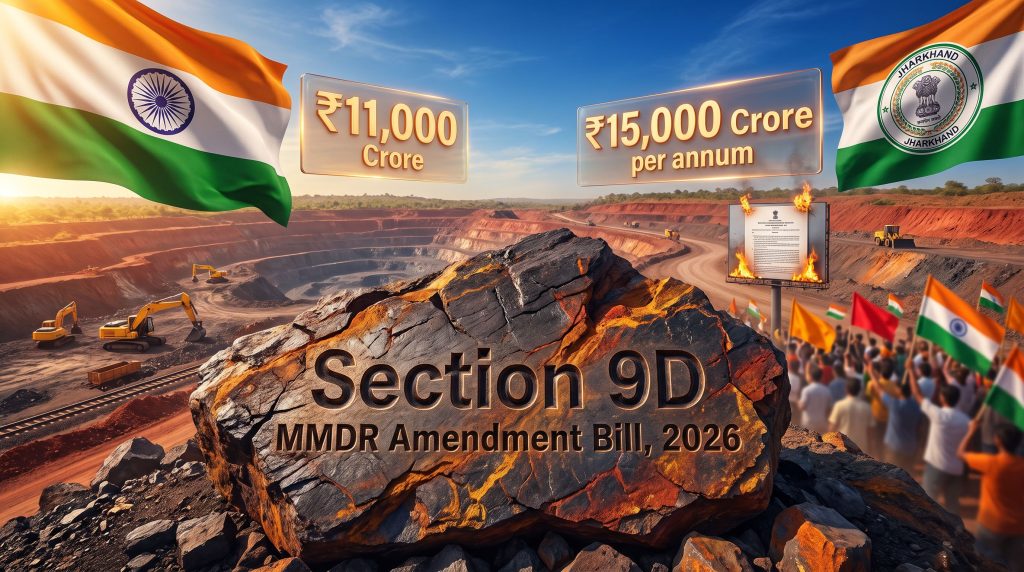
The Mines and Minerals (Development and Regulation) Amendment Bill, 2026, passed by Parliament on August 13, 2026, introduces a provision that has triggered alarm across mineral-producing states. The central mechanism is a proposed Section 9D, which conditions the ability of state governments to independently impose taxes, cess, or additional levies on mineral rights and mineral-bearing lands. Under the new framework, any such state-level fiscal action would be subject to parameters set by the Central government, effectively inserting a federal veto into what has historically been a domain of state legislative competence.
To understand why this matters, it helps to appreciate what the previous MMDR framework allowed. States retained meaningful authority to structure their own mineral taxation regimes alongside the royalty and District Mineral Foundation contributions mandated at the Central level. The amendment does not eliminate state mineral revenues outright, but it places the Centre as the de facto arbiter of how and when additional state-level charges can be applied — a shift that critics argue fundamentally alters the constitutional balance of power over natural resources.
The Constitutional Dimension: More Than a Policy Dispute
The controversy is not purely political — it cuts into the constitutional architecture of Indian federalism. Under the Seventh Schedule of the Constitution, List II, Entry 50 grants states the power to levy taxes on mineral rights, subject to any limitations imposed by Parliament. Critics argue that Section 9D stretches those limitations well beyond what the framers envisaged, effectively subordinating state legislative discretion to Central executive direction.
Beyond the Seventh Schedule, the amendment intersects with Fifth Schedule protections applicable to tribal-majority regions, including large parts of Jharkhand. These provisions are designed to safeguard the governance rights of scheduled tribes over land and natural resources, including the authority of gram sabhas — the constitutionally recognised village assemblies — to participate in decisions affecting their territories. Opponents of the bill contend that centralising mineral taxation authority weakens the practical significance of gram sabha oversight, since revenue streams previously under state and local influence would now be shaped by Central conditions that may not reflect local priorities.
Jharkhand's Fiscal Exposure: Putting Numbers to the Risk
For Jharkhand specifically, the financial implications of the MMDR Amendment are stark. The state government's own assessment puts potential annual revenue losses at approximately ₹11,000 crore, while broader analytical projections suggest the figure could reach as high as ₹15,000 crore per year depending on how Section 9D is interpreted and enforced.
| Revenue Impact Scenario | Estimated Annual Loss |
|---|---|
| State Government Official Estimate | ~₹11,000 crore |
| Broader Policy Research Projections | Up to ~₹15,000 crore |
To contextualise those figures, Jharkhand's dependence on mineral-linked revenues as a proportion of total state income is substantially higher than the national average for non-special category states. Minerals are not a supplementary revenue stream for Jharkhand — they are a fiscal foundation. A shortfall in that range would cascade across the state budget in ways that are difficult to contain:
- Welfare programmes including Maiyan Samman Yojana, a direct benefit transfer scheme targeting women, would face funding pressure
- Old-age pension disbursements relied upon by vulnerable populations could be delayed or reduced
- Capital expenditure on roads, schools, and health infrastructure would likely be deprioritised
- Tribal welfare allocations tied to Fifth Schedule obligations could be compromised
- District Mineral Foundation (DMF) contributions, which fund community development in mining-affected areas, could face downstream pressure as investment sentiment shifts
Compared to other mineral-dependent states such as Odisha, Chhattisgarh, and Madhya Pradesh, Jharkhand's budget has a notably concentrated exposure to mining revenues. Odisha has diversified somewhat through industrial processing zones, while Jharkhand's economic base remains more tightly coupled to raw extraction, making the revenue risk from the amendment structurally more acute. This exposure also has implications for the broader relationship between critical minerals and energy security at the national level.
The Political Coalition Forming Against the Bill
What makes the Jharkhand protest against the MMDR Amendment Bill politically significant is not just the intensity of opposition but the breadth of the coalition driving it. Parties that rarely operate in alignment have found common cause in opposing the legislation.
| Political Party or Group | Stance | Key Actions Announced |
|---|---|---|
| CPI, CPI(M), CPI(ML) Liberation, SUCI, Forward Bloc | Strongly opposed | Week-long protest August 25-31; bill burning; economic blockade threat |
| JMM (ruling party) | Strongly opposed | Mass campaign in Kolhan and mineral-producing zones; CM Hemant Soren leading |
| Congress | Strongly opposed | Phased agitation from block level to state level; federalism framing |
| Central Government (BJP-led) | Proponent | Passed Parliament on August 13, 2026 |
Left parties formalised their position through a joint press conference, announcing a week-long statewide agitation from August 25 to 31, 2026. Chief Minister Hemant Soren's JMM is directing its outreach toward communities in the mineral-heavy Kolhan division, where the human stakes of revenue shortfalls are most immediately felt. Congress has framed the issue as a structural assault on India's federal architecture, announcing a phased escalation from local to state-level protests.
Planned Protest Actions: From Symbolism to Economic Leverage
The protest programme is structured in escalating phases, moving from symbolic actions toward potentially disruptive economic pressure:
- August 25–31: Symbolic burning of the bill's printed text across all villages, blocks, and districts throughout Jharkhand
- Prativaad Diwas events organised by Left party chapters as formal days of civic resistance
- JMM grassroots awareness campaigns targeting workers and communities in active mining zones
- Threatened economic blockade: Disruption of mineral transport including coal dispatch via rail networks
- Jharkhand Bandh and road blockades if the Central government does not withdraw or substantially amend the legislation
The threat to interrupt coal dispatches is not rhetorical flourish. CPI State Secretary Mahendra Pathak made clear in public statements that even a brief halt to coal supplies from Jharkhand would have immediate national energy consequences, framing the protest not as a regional grievance but as a lever capable of affecting the entire country's power supply. This framing transforms the Jharkhand protest against the MMDR Amendment Bill from a state-level political dispute into something with national-level salience.
Jharkhand's Position in India's Mineral Supply Chain
The credibility of that leverage rests on Jharkhand's genuine strategic weight in India's extractive economy. The state hosts approximately 132 coal blocks, a significant portion of which have been allocated to private operators under auction-based leasing frameworks introduced in recent years. Beyond coal, Jharkhand contributes substantially to national output of iron ore, copper, mica, and uranium, making it one of the most mineralogically diverse states in the country.
This concentration creates a two-sided dynamic. On one side, Jharkhand's mineral wealth gives its political leaders genuine bargaining power in any confrontation with the Centre. On the other, the sheer volume of private capital deployed across those 132-plus coal blocks means that prolonged political disruption carries real costs for investors, operators, and the workers employed across the extraction and logistics chain. Questions of mineral wealth and investment stability, consequently, extend well beyond state borders.
Policy uncertainty in mineral-rich jurisdictions consistently raises project risk premiums. When state-Centre revenue frameworks are contested, operators face the prospect of retrospective fiscal changes or shifting compliance obligations — factors that weigh directly on investment decisions and project financing structures.
For mining operators currently holding active leases in Jharkhand, the unresolved dispute creates a layer of regulatory ambiguity that complicates long-term planning. If the state government pursues constitutional challenge or resorts to administrative friction as a negotiating tool, the operational environment for private mining entities could deteriorate regardless of how the legislative dispute ultimately resolves.
A Precedent That Extends Far Beyond Jharkhand
The implications of Section 9D, if upheld, would not stop at Jharkhand's borders. Odisha, Chhattisgarh, Rajasthan, and Madhya Pradesh all maintain significant exposure to mineral revenues, and each would find its future fiscal freedom in the mining sector subject to the same Central conditioning mechanism. The MMDR Amendment effectively establishes a template for how the Centre can structurally reshape state taxation authority in resource sectors without formally overriding constitutional provisions.
This sits within a broader pattern of regulatory consolidation at the Central level across India's extractive industries. The shift toward auction-based lease allocation, introduced through earlier MMDR amendments in 2015 and 2021, already reduced state discretion over which entities receive mining rights. Section 9D extends that centralising logic into the fiscal domain, completing a regulatory architecture in which the Centre sets terms at every major decision point in the mining lifecycle. India's evolving mining geopolitical landscape, furthermore, makes the resolution of these structural tensions increasingly urgent for national competitiveness.
Possible Resolution Pathways
How this standoff resolves will shape mineral governance in India for years to come. Four scenarios are plausible:
- Legislative rollback: Political pressure from multiple mineral-rich states forces the Centre to withdraw or substantially redraft Section 9D
- Supreme Court challenge: State governments pursue constitutional review, with the Court asked to adjudicate the limits of parliamentary restrictions under List II, Entry 50
- Negotiated revenue-sharing formula: A structured agreement between the Centre and mineral-producing states establishes a new framework that preserves a floor of state fiscal autonomy
- Escalation to economic disruption: Protest actions succeed in interrupting mineral supply chains sufficiently to force a political reopening of the legislative question
Each pathway carries different implications for the speed and certainty of resolution. A Supreme Court challenge, while potentially decisive, could take years to resolve, leaving operators and state planners in extended uncertainty. A negotiated formula is, however, politically the most durable outcome — but requires both sides to accept constraints on their preferred positions.
The next major ASX story will hit our subscribers first
What the Gram Sabha Dimension Reveals About the Deeper Stakes
One aspect of this dispute that receives less attention in economic commentary is the gram sabha question. Under Fifth Schedule governance frameworks, tribal communities in scheduled areas retain formal authority over decisions affecting their land and natural resources. This authority is exercised through gram sabhas, which must be consulted on mining approvals and related land-use changes in scheduled areas.
Critics of the MMDR Amendment argue that by removing state-level fiscal discretion, the bill indirectly weakens the practical leverage that tribal communities have in shaping how mineral wealth flows back to them. If states can no longer structure their own cess or levy regimes to channel additional resources toward scheduled area communities, the gram sabha's ability to negotiate meaningful local benefit-sharing arrangements is diminished.
This argument connects the abstract constitutional debate about mineral federalism to very concrete questions about who benefits from the extraction happening beneath communities that often see limited direct returns. India's broader critical materials strategy — outlined in frameworks such as Australia's defence critical minerals approach — demonstrates how resource governance structures can either empower or marginalise local communities depending on how revenue and decision-making authority is distributed.
The Jharkhand protest against the MMDR Amendment Bill therefore cannot be read purely as a fiscal dispute between two levels of government. It reflects a deeper contestation over whether India's mineral governance framework, as it continues to evolve, will preserve or progressively erode the institutional mechanisms through which affected communities, state governments, and local bodies participate in decisions about the resources that define their economic futures.
Disclaimer: This article is intended for informational purposes only and does not constitute financial, legal, or investment advice. Revenue estimates and projected fiscal impacts referenced in this article are based on state government positions and policy research projections and are subject to change. Readers should conduct independent due diligence before drawing conclusions about investment or policy implications.
Want to Track the ASX Mineral Discoveries Shaping the Global Critical Minerals Race?
As India's mineral governance battles reshape global supply chain dynamics, Discovery Alert's proprietary Discovery IQ model instantly identifies significant ASX mineral discoveries across 30-plus commodities — delivering real-time, actionable alerts to both short-term traders and long-term investors before the broader market reacts. Explore historic discovery returns on Discovery Alert's dedicated discoveries page and begin your 14-day free trial today to stay ahead of the next major find.