August 20, 2026
The Geological Gamble Reshaping Latin America's Deepwater Energy Frontier
Beneath the warm waters of the Gulf of Mexico, several kilometres below the seafloor, lies one of the most technically demanding and potentially significant hydrocarbon frontiers in the Western Hemisphere. The race to unlock ultra-deep pre-salt resources has already transformed Brazil into one of the world's fastest-growing oil producers. Now, a landmark cooperation agreement involving the PEMEX Petrobras ultra-deep pre-salt Campeche coast is asking a fundamental question: can that transformation be replicated off Mexico's Campeche coastline?
Understanding what this partnership actually means, and what it does not yet guarantee, requires looking well beyond the headline announcement. Furthermore, the broader context of crude oil price trends and shifting energy geopolitics makes this development particularly significant for analysts and investors alike.
When big ASX news breaks, our subscribers know first
What Pre-Salt Geology Actually Involves
The term "pre-salt" is frequently misunderstood outside specialist circles. It does not refer to drilling into a salt formation. It describes the process of drilling through a thick, high-pressure salt layer to access hydrocarbon-bearing rock sequences that were deposited before the salt itself formed.
These salt layers, which can extend vertically for one to two kilometres, function as near-perfect geological seals. Their low permeability traps oil and gas in the formations beneath, preserving reservoirs over geological timescales that conventional plays cannot match. The challenge, and the opportunity, lies precisely in penetrating those seals safely and economically.
In the Campeche basin, the target source rocks are estimated to be approximately 160 million years old, placing their origin in the Jurassic period. This is geologically older than the source rocks responsible for Brazil's prolific Santos Basin production, which raises a theoretically compelling possibility: a deeper, more mature hydrocarbon kitchen that has had even longer to generate and accumulate oil and gas. Whether reservoir quality and trap geometry are sufficient to convert that organic richness into recoverable resources remains the central unanswered question.
Pre-salt source rock age is one factor in assessing hydrocarbon generation potential, but it is not determinative on its own. Thermal maturity, migration pathways, and structural integrity of the trap are equally critical variables that only drilling and advanced seismic analysis can resolve.
The Salt Layer as Both Asset and Obstacle
What makes pre-salt geology so technically demanding is the dual nature of the salt itself. As a seal, it is invaluable. As a drilling target, however, it is one of the most hostile environments in the upstream industry.
Salt is mechanically unstable under high pressure and temperature conditions. It flows plastically, which means wellbores drilled through thick salt sections can experience lateral squeezing forces that compromise casing integrity. Managing these forces requires:
- Managed pressure drilling (MPD) systems that maintain precise downhole pressure control throughout the salt interval
- Specialised casing programmes with elevated steel grades and thicker walls to resist salt creep
- Real-time wellbore stability modelling to detect and respond to unexpected formation behaviour
- Full-waveform inversion (FWI) and reverse time migration (RTM) seismic processing techniques to image beneath the salt with sufficient resolution to identify viable reservoir targets
Conventional 3D seismic loses significant resolution when signals pass through thick salt, because the velocity contrast at the salt boundary distorts the wavefield. Brazil's Petrobras spent years developing subsalt imaging workflows that are now considered among the most advanced in the global upstream industry. This expertise is a core element of what the cooperation agreement with PEMEX is designed to transfer.
The YAXXTAAB-1 Well: What Mexico Already Knows
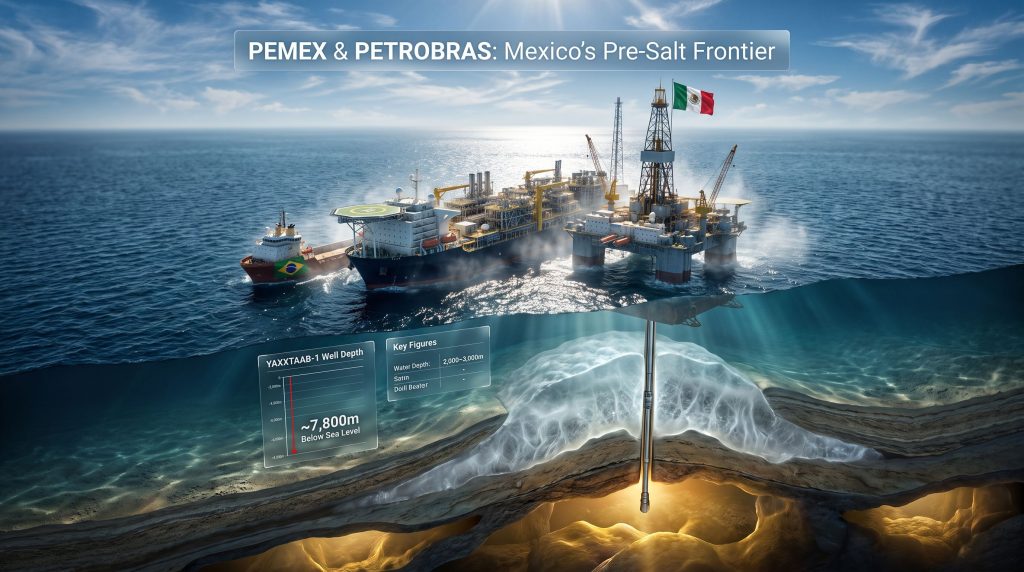
Mexico is not approaching pre-salt exploration as a complete novice. In 2018, PEMEX drilled the YAXXTAAB-1 exploratory well in the Bay of Campeche, reaching a total depth of approximately 7,800 metres below sea level. The well penetrated a confirmed salt layer, validating the geological presence of a pre-salt architecture in the Campeche basin.
The well was declared non-commercial, meaning the tested interval did not encounter hydrocarbons in sufficient quantity or quality to justify development. However, a single non-commercial result carries a specific and limited meaning in frontier exploration. It narrows the hypothesis, identifies what did not work in that specific location, and redirects future efforts toward better-calibrated targets.
A non-commercial well in frontier exploration is not a refutation of the play. It is a data point. The Campeche pre-salt play covers a vast geological area, and YAXXTAAB-1 tested one specific structural configuration at one location. Petrobras's subsalt imaging capabilities may identify targets with more favourable geometry that were not visible in earlier seismic datasets.
The partnership's explicit aim to reprocess existing seismic data using Petrobras's advanced methodologies is therefore one of the most operationally significant elements of the cooperation. Better imaging could reveal structural highs, fault traps, or stratigraphic features that earlier surveys missed. For further context on Petrobras's pre-salt expertise, their operational track record in Brazilian waters provides a compelling reference point.
How the Campeche Basin Compares to Brazil's Pre-Salt Giants
Brazil's Santos Basin pre-salt fields represent the benchmark against which any analogous play will be measured. The numbers are substantial.
| Metric | Brazil Pre-Salt (Santos Basin) | Mexico Campeche (Current Status) |
|---|---|---|
| Proven Reserves | Over 15 billion barrels (Búzios field alone ~10 Bbbl) | Unconfirmed, frontier exploration stage |
| Typical Water Depth | 2,000 to 3,000 metres | Ultra-deep targets exceed 2,000 metres |
| Total Well Depth | Up to 7,500+ metres below sea level | YAXXTAAB-1 reached approximately 7,800 metres |
| Salt Layer Thickness | Up to 2,000 metres | Confirmed present; thickness under evaluation |
| Commercial Status | Active production exceeding 3 million bbl/day | Pre-commercial, MOU evaluation phase |
| Primary Operator | Petrobras | PEMEX, with Petrobras technical cooperation |
Both basins share a critical geological lineage. They formed during the Mesozoic breakup of the Gondwana supercontinent, which created structurally similar rift basin architectures along what is now the Atlantic margin and Gulf of Mexico. Salt deposition in both regions occurred during the Aptian stage, approximately 113 to 125 million years ago, providing the sealing layers that define the pre-salt play concept.
The differences are equally important. Tectonic histories diverged significantly after the initial rift phase. Salt mobility patterns, which affect how reservoirs deform and whether traps remain intact over geological time, differ between the two regions. Overburden thickness and thermal gradient variations also influence reservoir quality in ways that require local calibration rather than direct analogy.
The MOU Framework: Intent Without Commitment
The agreement between PEMEX and Petrobras is structured as a non-binding Memorandum of Understanding. This distinction carries significant weight for anyone assessing what the partnership actually represents at this stage.
| Agreement Parameter | Current Status |
|---|---|
| Agreement Type | Non-binding MOU |
| Confirmed Capital Commitment | None |
| Focus Areas | Exploration, production, refining, natural gas, petrochemicals, technology transfer |
| Geographic Scope | Offshore Campeche, Bay of Campeche |
| Commercial Development | Not confirmed, feasibility and evaluation phase only |
| Petrobras Contribution | Technical expertise, pre-salt imaging methodologies |
| PEMEX Contribution | Sovereign acreage access, operational infrastructure |
An MOU signals mutual interest and establishes a framework for collaboration. Transitioning to a formal joint venture requires independent resource assessments, regulatory approvals within Mexico's constitutional energy framework, and resolution of PEMEX's fiscal constraints. None of these steps are automatic or guaranteed.
PEMEX carries one of the largest debt burdens of any national oil company globally, which structurally limits its capacity to self-fund capital-intensive deepwater programmes. Ultra-deep pre-salt well construction costs routinely fall in the range of US$100 to US$200 million per well, and a statistically meaningful exploration campaign would require multiple wells across different structural targets.
The MOU model may reflect a deliberate strategy: accessing Petrobras's technical resources without requiring immediate capital deployment or triggering equity dilution of national assets, both of which would face significant political and constitutional constraints under Mexico's sovereign energy framework. Consequently, the PEMEX and Petrobras collaboration extends well beyond the pre-salt frontier alone, encompassing refining and downstream opportunities as well.
Three Scenarios for the Partnership's Future
Frontier exploration partnerships of this type rarely follow a single trajectory. Three realistic scenarios frame how this cooperation could evolve.
Scenario 1: Play Confirmation and Commercial Development
Seismic reprocessing identifies structurally compelling targets. New exploratory wells encounter commercial-grade pre-salt reservoirs. A formal joint venture is established with defined equity participation, capital schedules, and development timelines. Mexico's upstream production, which has been declining for over a decade, begins a structural reversal as new ultra-deep fields contribute to national output within a 10 to 15-year development horizon. International capital partners may be invited into specific project tranches.
Scenario 2: Partial Validation with Selective Development
Exploration confirms pre-salt source rocks but reveals that reservoir quality or trap geometry is inconsistent across the basin. Cooperation narrows to specific sub-basins or structural highs where conditions are more favourable. PEMEX accumulates subsurface data assets that inform future licensing rounds even if Petrobras does not proceed to full field development.
Scenario 3: Geological Divergence from the Brazil Analogue
Further drilling and seismic analysis confirm that the Campeche pre-salt play differs fundamentally from Santos Basin conditions. Reservoir systems are either absent or insufficiently developed for commercial extraction. The MOU concludes without a production outcome. Critically, even in this scenario, the technical capability transfer from Petrobras enhances PEMEX's deepwater expertise in ways that benefit future exploration programmes.
The next major ASX story will hit our subscribers first
Latin America's Broader Deepwater Competition
The PEMEX Petrobras ultra-deep pre-salt Campeche coast initiative is emerging within a regional context of intensifying deepwater activity. Brazil's pre-salt production currently surpasses 3 million barrels per day, making it one of the fastest-growing upstream stories in the global oil market and setting a compelling economic precedent for similar geological plays. Indeed, oil's global importance as a strategic resource continues to underpin the urgency surrounding such frontier developments.
Simultaneously, Venezuela has moved to attract international capital to its offshore gas resources. The recent transfer of participation rights for Phase II of the Loran field in Block 2 of the Deltana Platform to a consortium comprising BP Exploration Caribbean, UAE-based XRG PJSC, and Qatar-based UCC Oil and Gas Holding LLC signals renewed appetite from international majors for frontier Latin American assets. The Loran field holds over 4 trillion cubic feet of proven natural gas, making it a material resource base by any global standard. However, Venezuela's energy crisis continues to cast uncertainty over the country's ability to reliably develop such assets at scale.
This regional momentum creates a competitive dynamic that adds strategic urgency to Mexico's pre-salt ambitions. If Campeche's pre-salt potential is confirmed while Brazil continues expanding Santos Basin production, Mexico would be positioned to reclaim relevance as a deepwater investment destination after years of declining output and constrained upstream access for international partners.
For Petrobras, the strategic logic of Mexico participation is equally clear. Success would validate the geological transferability of its pre-salt operational model beyond Brazilian waters, potentially establishing Petrobras as a global deepwater technology exporter with advisory and equity roles in frontier jurisdictions worldwide. Furthermore, broader energy market signals — including WTI and Brent futures — will inevitably influence the pace at which both companies commit capital to deepwater programmes of this scale.
Key Considerations for Assessing This Partnership
Before drawing conclusions about the PEMEX Petrobras ultra-deep pre-salt Campeche coast cooperation, several factors deserve careful weight. In addition, understanding the interplay between geological potential and macro-level factors such as the oil price rally driven by geopolitical forces will be essential for assessing investment timing.
- The YAXXTAAB-1 result demonstrated that the Campeche pre-salt play is technically complex and geologically distinct enough from Brazil's Santos Basin to require independent validation rather than assumption of equivalence
- PEMEX's fiscal position means that even a successful exploration outcome would require significant external financing to transition into full field development, and Mexico's sovereign energy policy constrains the structures through which that financing can be attracted
- Petrobras's pre-salt imaging and drilling methodologies represent genuine technical differentiation in the global upstream industry, developed through decades of commercial operations in the Santos and Campos basins
- The geological age of Campeche's source rocks, at approximately 160 million years, is an intriguing variable that could support a prolific hydrocarbon kitchen, but age alone does not determine commercial viability
- Single exploratory wells, even at depths approaching 7,800 metres, test a narrow slice of a large geological play. The most consequential next steps involve seismic reprocessing and the identification of new drill targets informed by Petrobras's subsalt imaging expertise
This article contains forward-looking analysis and geological assessments that involve significant uncertainty. Frontier exploration outcomes are inherently unpredictable, and no resource estimates should be inferred from the cooperation agreement or prior drilling results discussed above. Readers should not treat this analysis as financial or investment advice.
Ready to Capitalise on the Next Major Energy or Mineral Discovery?
Discovery Alert's proprietary Discovery IQ model delivers real-time alerts on significant ASX mineral discoveries, transforming complex geological and market data into clear, actionable insights for investors at every level — explore historic discoveries and their returns to understand the scale of opportunity, then begin your 14-day free trial to position yourself ahead of the market.