August 20, 2026
Why Remote Industrial Grids Are Forcing a Rethink of Energy Infrastructure Design
The way energy infrastructure is planned, financed, and operated in remote industrial environments bears almost no resemblance to how it works in grid-connected urban settings. In isolated mining corridors, the absence of a fallback grid connection transforms every design decision into a reliability calculation. There is no capacity market to draw from, no interconnection to lean on during generation shortfalls, and no consumer base to spread fixed costs across beyond the mining operations themselves. This structural reality is quietly driving one of the more consequential infrastructure experiments in Australia's resources sector, and the APA solar BESS plan Queensland mining industry is watching most closely sits in the heart of the state's northwest.
When big ASX news breaks, our subscribers know first
The North West Power System: An Energy Island With Outsized Demand
Why NWPS Isolation Changes Everything
The North West Power System is one of Australia's more unusual electricity networks. It sits entirely outside the National Electricity Market, serving a cluster of major mining and industrial operations in Queensland's northwest without any physical interconnection to the broader grid. This isolation is not simply a logistical inconvenience. It fundamentally alters the economics of every energy technology deployed within it.
In a NEM-connected environment, a solar farm that generates more power than is immediately needed can export that surplus to adjacent regions. In the NWPS, excess generation has nowhere to go unless there is storage capacity to absorb it. Equally, any shortfall in generation must be covered locally, which has historically meant gas-fired or diesel generation running as continuous backup. The cost consequences of this structure compound over time through fuel price exposure, logistics premiums for remote supply chains, and the carbon liability that increasingly flows from fossil fuel-dependent operations.
Mining operations in the Mount Isa region require power that is not merely available but reliably available at all hours and at consistent quality. Voltage fluctuations and frequency deviations that might be absorbed invisibly in a large interconnected grid can cause real operational disruptions in an isolated system running sensitive processing equipment underground. This is the specific technical problem that hybrid solar-plus-storage infrastructure is architected to solve. Furthermore, renewable energy in mining contexts like this one is increasingly viewed as a structural necessity rather than a sustainability preference.
The Solar Resource Advantage That Changes the Economics
One underappreciated factor in the NWPS renewable energy equation is the exceptional solar resource available across northwest Queensland. The region consistently records among the highest solar irradiance levels in Australia, with global horizontal irradiance figures that materially outperform southeast Queensland, South Australia, or Victoria. In practical terms, this means a given panel capacity in the Mount Isa region generates significantly more energy per year than the same installation further south, reducing the effective cost per megawatt-hour delivered and improving the economics of both the solar farm and the co-located battery system it charges.
Sybella Creek Solar Farm and BESS: A Technical Breakdown
Project Specifications at a Glance
| Parameter | Detail |
|---|---|
| Project Name | Sybella Creek Solar Farm and BESS |
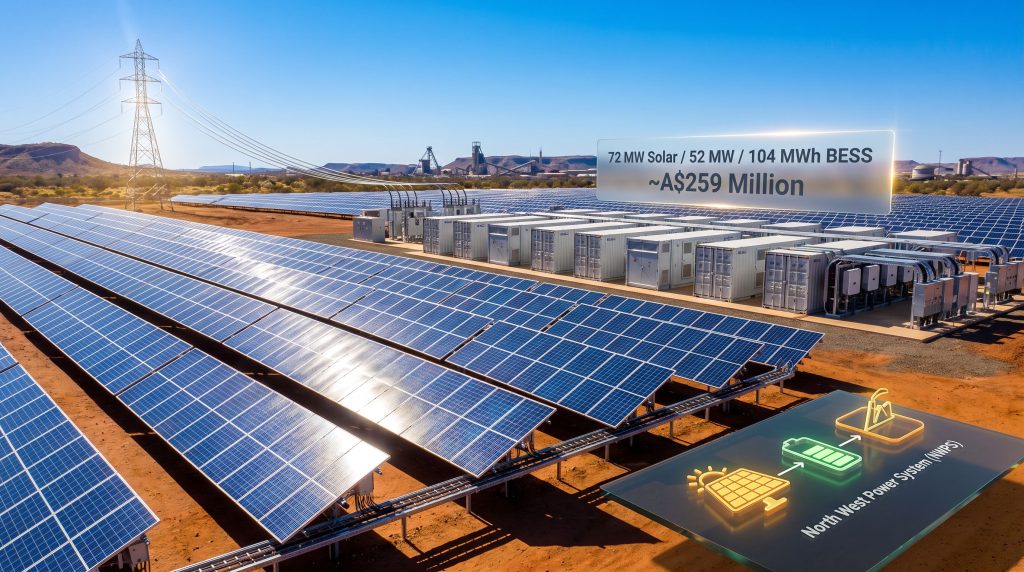
| Solar Capacity | 72 MW |
| Battery Storage Capacity | 52 MW / 104 MWh |
| Total Estimated Investment | ~A$259 million (approx. USD 184 million) |
| Primary Energy Offtake Customer | Ernest Henry Mining (Evolution Mining) |
| Grid System | North West Power System (NWPS), Queensland |
| Construction Start (Target) | Late 2026 |
| Projected Commissioning | Mid-2028 |
| Developer / Owner / Operator | APA Group |
How the 72 MW Solar Array Is Calibrated for Mining Load Profiles
Sizing a solar array for a remote mining operation is a more constrained optimisation problem than sizing one for a grid-connected commercial or utility application. The 72 MW figure is not simply a function of available land or panel economics. It reflects the interaction between the mine's daytime consumption profile, the charging requirements of the co-located BESS, and the physical generation ceiling beyond which curtailment becomes unavoidable without additional storage.
A hard-rock underground mine like Ernest Henry has a relatively stable and predictable demand curve compared to, say, a port or processing hub with variable throughput. Ventilation systems, dewatering infrastructure, hoisting equipment, and processing circuits run continuously at relatively consistent loads. This predictability is actually an advantage in solar array sizing because it allows designers to match generation output more precisely to consumption without over-engineering the system for demand variability.
The high irradiance environment of northwest Queensland reduces the land area and panel count required per megawatt of output, compressing the civil works component of the capital budget relative to less favourable solar geographies. This is a non-trivial advantage when the site is remote and every piece of equipment and every tonne of structural steel must be transported considerable distances. APA's announcement to construct and operate the Sybella Creek Solar Farm and BESS outlines the scale and ambition of this undertaking in full.
Decoding the 52 MW / 104 MWh BESS Configuration
The battery specification at Sybella Creek is a 2-hour duration system, meaning the 52 MW of discharge power capacity can be sustained for exactly two hours before the 104 MWh of stored energy is fully depleted. This duration choice is deliberate and reflects the specific operational role the BESS plays within the broader energy system rather than any compromise on ambition.
Technical Note: In isolated grid environments where gas-fired generation remains available as a longer-duration fallback, a 2-hour BESS is typically optimised for peak shaving, solar firming during afternoon ramp-down periods, and short-duration grid stability services rather than overnight baseload supply. The integration of APA's existing gas infrastructure in the region means the BESS does not need to carry the overnight load on its own.
The battery system provides several simultaneous services within the NWPS:
- Frequency regulation: Responding within milliseconds to generation-load imbalances to maintain grid frequency within acceptable bounds
- Voltage support: Injecting or absorbing reactive power to stabilise voltage across the network
- Solar firming: Storing excess midday generation for dispatch during the late-afternoon solar ramp-down when generation falls but operational demand remains high
- Contingency reserve: Providing immediate backup power in the event of a sudden generation trip or transmission fault
Critically, these grid stability services benefit every user connected to the NWPS, not only the primary offtake customer. This system-wide value is an important but often overlooked dimension of the project's economic contribution.
APA Group's Evolving Queensland Mining Energy Portfolio
From Dugald River to Sybella Creek: An Infrastructure Maturation Story
| Project | Solar Capacity | BESS | Customer(s) | Status |
|---|---|---|---|---|
| Dugald River Solar Farm (Stage 1 + 2) | 88 MW total | None | MMG, Mount Isa Mines, New Century Resources | Operating |
| Sybella Creek Solar Farm + BESS | 72 MW | 52 MW / 104 MWh | Ernest Henry Mining (Evolution Mining) | Development (FID ~2026) |
APA's Dugald River Solar Farm demonstrated that the build-own-operate model for mining energy supply in the NWPS is commercially viable at scale. Securing anchor offtake customers, financing the construction through contracted revenue streams, and retaining long-term operational control of the asset created a repeatable template. Sybella Creek is the next generation of that template, upgraded with battery storage to deliver a fundamentally more complete energy product. Indeed, APA Group's delivery of solar power to the Dugald River mine provided an important proof of concept for this broader strategy.
The transition from solar-only to solar-plus-storage is not cosmetic. It represents a meaningful shift in what an infrastructure developer can promise a mining customer. A solar-only supply agreement inherently comes with caveats about intermittency and backup requirements. A firmed renewable supply agreement backed by a BESS eliminates those caveats during the battery's operating window, delivering dispatchable power that behaves more like conventional generation from the mining operator's perspective.
The Gas-Solar-Battery Triad: A Less Obvious But Critical Design Feature
One of the less widely discussed aspects of APA's approach in the NWPS is the deliberate integration of gas infrastructure as a system complement rather than a system competitor to solar and storage. APA operates significant gas transmission and distribution assets in Queensland, including infrastructure that serves the Mount Isa region. Rather than designing Sybella Creek as a standalone renewable microgrid attempting full decarbonisation in isolation, the project is architected as a gas-solar-battery triad.
This design philosophy has a direct impact on project economics. By allowing gas to continue fulfilling the overnight baseload role, the required battery duration drops from what would otherwise need to be eight to twelve hours of storage down to two hours. That reduction in duration requirement translates to a material reduction in battery capital cost, improving the overall project return profile and reducing the financing risk that lenders must price into the deal. The broader mining energy transition across Australia is producing similar hybrid architectures in other remote regions.
Key Insight: The commercial viability of the APA solar BESS plan in Queensland mining is partly a function of what the system does not attempt to do. Accepting gas as a system complement rather than treating renewables as a complete replacement allows the project to deliver high renewable penetration at a cost structure that remains financeable in a remote location.
Ernest Henry Mining: Understanding the Anchor Customer
The Mine's Strategic Importance to the Offtake Agreement
Ernest Henry Mining is a copper-gold underground operation situated near Cloncurry in northwest Queensland, operated by Evolution Mining. The deposit was originally mined as an open-cut operation before transitioning to underground extraction, which extended the mine life substantially and significantly increased its energy intensity. Underground mining requires continuous ventilation, dewatering, and hoisting power that cannot be interrupted without serious operational and safety consequences.
Evolution Mining has been progressively investing in the underground resource at Ernest Henry, with resource and reserve extensions pointing to a mine life that extends well into the 2030s and potentially beyond. This long-dated operational horizon is precisely what makes a long-term energy supply agreement with APA commercially rational for both parties. The mine needs price-stable, reliable energy for decades. APA needs contracted revenue certainty over a sufficiently long period to underpin the A$259 million capital deployment.
Why Mining Companies Are Structuring Long-Term Renewable Energy Agreements Now
Three converging pressures are driving mining companies toward contracted renewable energy supply:
- Scope 2 emissions obligations: Major mining companies including Evolution Mining face increasing investor and regulatory scrutiny of their indirect emissions from purchased electricity. A contracted renewable supply agreement at the site level directly reduces reported Scope 2 emissions, a metric that increasingly flows into capital allocation decisions by institutional investors.
- Energy cost predictability: Fuel price volatility introduces earnings uncertainty that is particularly damaging to mine economic modelling. A fixed-price or indexed energy supply agreement converts a variable cost into a more predictable one, improving the quality of long-term mine planning.
- Mine life alignment: For a mine investing in underground resource extension, locking in energy supply for the extended mine life at the point of commitment avoids the risk of future energy cost escalation undermining the economics of the resource extension investment.
Moreover, the surge in critical minerals demand globally is adding further urgency to securing stable, low-emission energy at copper and gold operations like Ernest Henry.
Capital Architecture: How A$259 Million Gets Allocated
Indicative Cost Breakdown for Remote Solar-BESS Projects
| Cost Category | Typical Share of Total CapEx | Estimated Sybella Creek Range |
|---|---|---|
| Solar PV Array (panels, racking, wiring) | 35-45% | ~A$90-116M |
| Battery Energy Storage System (cells, inverters, enclosures) | 25-35% | ~A$65-91M |
| Grid Connection and Switchyard Infrastructure | 10-15% | ~A$26-39M |
| Civil Works, Roads, Fencing, Site Preparation | 8-12% | ~A$21-31M |
| Engineering, Procurement and Construction Management | 5-8% | ~A$13-21M |
Note: These figures are indicative estimates based on industry benchmarks for comparable Australian remote solar-BESS projects. APA Group has not publicly disaggregated the A$259 million total investment figure. Readers should treat these allocations as illustrative rather than confirmed.
Remote Location Premiums: The Hidden Cost Driver
Published capital cost benchmarks for utility-scale solar and BESS projects in Australia typically reflect southeast Queensland or New South Wales conditions. The Mount Isa region is a materially different environment from a logistics and construction cost perspective.
The specific cost pressures in this geography include:
- Labour accommodation and mobilisation costs for a workforce that must be flown or driven to a remote site
- Equipment transport premiums for oversized and heavy components including transformer units, BESS enclosures, and inverter stations
- Extended supply chains for construction materials that may need to travel over 900 kilometres from Brisbane
- NWPS-specific grid connection engineering requirements that differ from NEM-standard connection processes
- Higher financing costs associated with remote project risk premiums applied by lenders
These factors collectively explain why the per-megawatt capital cost at Sybella Creek will be higher than for a comparable project closer to the NEM, and why the A$259 million total for 72 MW of solar and 52 MW of storage is not directly comparable to headline cost figures from southeast Australian projects.
The next major ASX story will hit our subscribers first
Emissions and System Benefits: Quantifying the NWPS Impact
Estimated Generation and Decarbonisation Contribution
A 72 MW solar installation operating in the high-irradiance environment of northwest Queensland, assuming a capacity factor in the range of 20-24%, can be expected to generate approximately 130,000 to 150,000 MWh per year. Against the current emissions intensity of gas-fired generation in the NWPS, this volume of renewable output could displace an estimated 60,000 to 80,000 tonnes of CO2-equivalent per year, though the precise figure depends on the actual fuel mix displaced under different operating scenarios.
The BESS component improves this outcome by reducing solar curtailment. Without storage, some portion of midday solar generation exceeds immediate demand and must be wasted. The 104 MWh battery captures a meaningful share of that otherwise curtailed energy and makes it available during periods of higher demand or lower solar output, improving the effective renewable utilisation rate of the overall system. Consequently, the mining decarbonisation benefits of projects like Sybella Creek extend well beyond a single site's emissions footprint.
Competing Energy Models for Remote Queensland Mining
How the BOO Approach Stacks Up
| Model | Capital Ownership | Renewable Integration | Risk Profile for Miner | Example |
|---|---|---|---|---|
| APA Build-Own-Operate (BOO) | Infrastructure developer | High: solar + BESS + gas triad | Low: energy risk transferred | Sybella Creek / Dugald River |
| Mining Company Self-Build | Mining operator | Moderate: operator-dependent | High: capital and operational risk retained | Fortescue Pilbara renewables |
| Third-Party PPA (NEM-connected) | Independent power producer | Variable | Moderate: price risk exposure | Not applicable in NWPS context |
| Legacy Gas or Diesel Generation | Mining operator | None | High: fuel price and carbon exposure | Historical Mount Isa operations |
The BOO model's growing dominance in remote Australian mining energy reflects a fundamental shift in how mining companies think about capital allocation. Energy infrastructure, while essential, is not a core mining competency and does not generate the exploration or resource upside that justifies the mining company's cost of capital. Transferring ownership and operational risk to an infrastructure specialist with a lower cost of capital and dedicated energy management expertise reduces the total cost of energy delivered while freeing mining balance sheet capacity for resource development. However, Australia's resource energy challenges mean that this transition is rarely straightforward.
What Sybella Creek Signals About the Future of Queensland Mining Energy
Three Structural Trends This Project Confirms
- Firmed renewables are becoming the standard product: Mining customers in remote Queensland are no longer accepting intermittent solar supply as a complete energy solution. Battery storage is increasingly a baseline requirement rather than an optional upgrade, and developers who cannot offer a firmed product are at a competitive disadvantage in tendering for new mining energy contracts.
- Infrastructure developers are consolidating their positions in mining energy: APA's sequential project development in the NWPS, from Dugald River to Sybella Creek, illustrates how an established operational presence creates compounding competitive advantages. Knowledge of the local grid, existing relationships with the network operator, and proven construction capability in the region all reduce the risk premium that new entrants must absorb.
- The gas-solar-battery hybrid model is likely to expand: The triad architecture deployed at Sybella Creek represents a pragmatic middle path between full fossil fuel dependency and full renewable self-sufficiency. For remote industrial grids where overnight baseload is difficult to serve from solar and storage alone at acceptable cost, this hybrid approach may define the dominant energy model through the late 2020s.
Forward-Looking Perspective: As Queensland's mining sector faces mounting pressure to reduce Scope 2 emissions through the late 2020s and into the 2030s, the pipeline of firmed renewable energy supply agreements in remote mining regions is expected to grow substantially. Developers with established operational presence and integrated infrastructure portfolios in regions like the NWPS are structurally positioned to capture a disproportionate share of that demand. This article reflects current publicly available information. Forecasts, timelines, and financial projections are subject to change and should not be construed as financial advice.
Frequently Asked Questions: APA Solar BESS Plan Queensland Mining
What is the Sybella Creek Solar Farm and BESS project?
Sybella Creek is a 72 MW solar farm paired with a 52 MW / 104 MWh battery energy storage system being developed by APA Group in the Mount Isa region of Queensland. Designed to supply firmed renewable energy to Ernest Henry Mining, operated by Evolution Mining, and to provide grid stability services across the North West Power System, the project carries a total estimated investment of approximately A$259 million. Construction is targeted to commence in late 2026, with commercial operation expected by mid-2028.
Why does the project include battery storage rather than solar only?
The NWPS is an isolated grid without connection to the National Electricity Market. Solar generation alone cannot serve mining operations through non-generation periods, and excess midday generation would be curtailed without storage capacity to absorb it. The 104 MWh BESS allows excess solar energy to be stored and dispatched when generation is unavailable, provides frequency regulation and voltage support services to the entire NWPS, and reduces the system's dependence on gas-fired backup generation.
How does Sybella Creek compare to APA's earlier Dugald River Solar Farm?
The Dugald River Solar Farm, which reached 88 MW across two development stages and supplies MMG, Mount Isa Mines, and New Century Resources, is a solar-only asset with no battery storage component. Sybella Creek represents the next generation of APA's NWPS offering, adding a significant BESS component to deliver dispatchable rather than purely intermittent renewable energy. The progression from solar-only to firmed solar-plus-storage reflects both the evolution of customer expectations and the improving economics of battery technology.
What is Ernest Henry Mining and why is it the anchor customer for this project?
Ernest Henry Mining is a copper-gold underground operation near Cloncurry in northwest Queensland, operated by Evolution Mining. As an underground mine with continuous ventilation, dewatering, and processing requirements, it is a large and stable energy consumer whose demand profile aligns well with solar-BESS supply. Evolution Mining's ongoing investment in underground resource extension at Ernest Henry points to a mine life extending into the 2030s and potentially beyond, providing the long-term revenue certainty that underpins APA's capital commitment to the project.
Want to Know Which ASX Mining Companies Are Securing Tomorrow's Critical Mineral Discoveries Today?
As Australia's remote mining sector accelerates its shift toward firmed renewable energy and long-term operational investment — exemplified by projects like the Sybella Creek Solar Farm — the underlying demand for copper, gold, and other critical minerals continues to drive significant exploration activity across the ASX. Discovery Alert's proprietary Discovery IQ model scans ASX announcements in real time, instantly identifying significant mineral discoveries and translating complex data into actionable insights for investors at every level — explore Discovery Alert's discoveries page to see the historic returns major finds have delivered, and begin a 14-day free trial to position yourself ahead of the broader market.