August 20, 2026
The Strategic Fault Lines Beneath Australia's Nickel Processing Crisis
When a nation's last facility capable of processing an entire class of strategic metal goes dark, the silence it leaves behind is not merely industrial — it is geopolitical. Across global supply chains, the ability to smelt and refine critical minerals domestically has become an increasingly contested sovereign capability, one that takes decades and billions of dollars to build, and can be lost within a single commodity cycle. Australia now finds itself at precisely this juncture, confronting a question that extends far beyond one facility in the Western Australian Goldfields: what is domestic critical mineral processing actually worth, and who is responsible for preserving it?
The Kalgoorlie Nickel Smelter bailout debate sits at the centre of this question, and the answers being offered — or deliberately withheld — will shape Australian industrial policy for a generation.
When big ASX news breaks, our subscribers know first
Fifty-One Years of Processing, One Decision Point
Built during the resources nationalism era of the early 1970s and officially opened in 1973, the Kalgoorlie Nickel Smelter operated continuously for over five decades as the backbone of Australia's integrated nickel supply chain. As the anchor processing node within BHP's Nickel West division, it converted ore from multiple Western Australian mine sites into a high-grade nickel matte product destined for international refining and, ultimately, battery and stainless steel manufacturing.
The smelter's suspension in late 2024 was not simply the closure of one building. It severed an entire downstream processing chain that stretched from the Goldfields to global markets. Without a functioning smelter, Australian nickel ore producers are left without a domestic processing pathway, forcing any future production into either export as raw or partially processed material, or abandonment entirely.
This distinction matters enormously from both an economic and strategic standpoint. Ore exports capture a fraction of the value that processed metal commands, and they surrender the technical capability and workforce knowledge that cannot be easily reconstituted once dispersed.
The Workforce and Financial Dimensions of the Suspension
At peak operations, BHP's Nickel West division employed approximately 3,500 workers across its integrated network of mines, concentrators, and processing facilities. When the smelter entered care and maintenance, only a skeletal crew remained on site. The human displacement across Kalgoorlie-Boulder and surrounding communities was immediate and substantial.
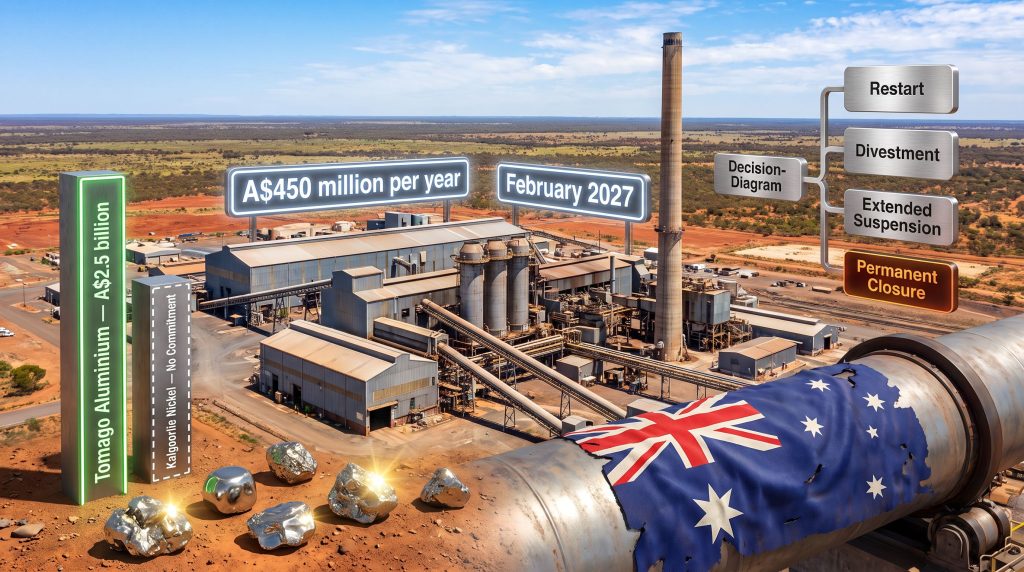
BHP established a A$20 million community fund for affected towns, a gesture of social responsibility rather than a pathway to restart. Separately, the company committed to spending approximately A$450 million per year to maintain the smelter in a condition from which it could theoretically be restarted, preserving optionality while deferring the harder commercial question. A formal review of Nickel West's future is expected to conclude by February 2027.
The Anatomy of Australia's Smelter Support Landscape
To understand why the Kalgoorlie Nickel Smelter bailout debate has become politically charged, it is essential to map what the federal government has already committed elsewhere.
| Facility | Metal | Government Support | Outcome |
|---|---|---|---|
| Tomago Aluminium (NSW) | Aluminium | A$2.5 billion | Secured (August 2026) |
| Glencore Mount Isa | Copper | Undisclosed package | Supported |
| Nyrstar (Tasmania and South Australia) | Zinc | Feasibility funding | Supported |
| Kalgoorlie Nickel Smelter (WA) | Nickel | No commitment made | Under review |
The cumulative federal commitment to heavy industrial smelting infrastructure has surpassed A$4 billion when the Tomago Aluminium deal is included. Each of the supported facilities processes a metal that carries strategic and industrial significance. Furthermore, nickel was formally added to Australia's critical minerals strategy list in February 2024 — the same year the smelter was suspended — making the absence of equivalent support a glaring inconsistency that has not gone unnoticed in political circles.
Federal member for O'Connor Rick Wilson has made this inconsistency central to his advocacy, arguing publicly that workers in the Western Australian Goldfields should not be treated as less economically valuable than those in the Hunter Valley. His position frames the issue as one of geographic equity within a national industrial policy framework. Industry Minister Tim Ayres has acknowledged nickel's strategic importance without committing to a financial rescue package, describing the Commonwealth's approach as one of collaborative engagement with state governments and facility owners, according to ABC News reporting from August 2026.
The Geographic Equity Dimension
The pattern of federal support for east coast smelting assets while Western Australia's nickel processing infrastructure remains unassisted raises legitimate questions about how critical mineral policy is applied in practice. The formal classification of nickel as a critical mineral creates an implicit obligation to treat it with strategic consistency, yet the response to the smelter's suspension has been markedly different from the interventions mounted for aluminium, copper, and zinc.
This is not merely a political talking point — the structural argument has economic substance. Smelting capacity represents what economists describe as a natural monopoly in a regional context: once the single facility serving a geographic area closes, the market cannot self-organise to replace it because no private actor can justify the capital outlay without guaranteed feedstock and price certainty. The government support given to other smelters implicitly recognised this dynamic. Applying it selectively creates a two-tier critical minerals strategy, one that prioritises some metals over others despite comparable strategic classifications.
Four Pathways to February 2027
BHP's annual report, released in August 2026 following the company's announcement of a US$9.8 billion profit for the 2025-26 financial year, formally outlined the options under consideration for Nickel West. Four distinct scenarios are in play, each carrying materially different consequences.
Pathway One: Government-Supported Restart
A negotiated package involving federal and Western Australian state government contributions could theoretically underpin a restart, following a model broadly analogous to the Tomago Aluminium deal. The key variables are price, feedstock, and political will. A credible nickel market recovery trajectory would be required to justify public investment, and the feedstock question — discussed below — represents the most acute structural challenge. Critically, BHP declined taxpayer support when it initially announced the suspension in 2024, which complicates any government-led rescue pathway. Any restart conversation now requires BHP to reverse that position.
Pathway Two: Divestment to a Specialist Operator
BHP's annual report explicitly flagged divestment of Western Australian nickel assets as one option under active assessment. A smaller, specialist operator might be willing to run the smelter at reduced throughput and lower overheads than a major miner of BHP's scale requires. However, any incoming operator would immediately confront the same feedstock problem: with the surrounding mine ecosystem contracting rapidly, where does the ore come from?
Pathway Three: Extended Suspension
If no commercial or political resolution emerges before February 2027, BHP may choose to extend the care and maintenance period rather than force a binary decision. This preserves optionality but continues to consume approximately A$450 million annually in holding costs while delivering no productive output and no resolution for affected communities.
Pathway Four: Permanent Closure
The most consequential outcome would be a formal decision to permanently close and write down the Kalgoorlie Nickel Smelter. This scenario is not speculative: the trajectory of the surrounding mine landscape makes it increasingly plausible. Permanent closure would represent the end of integrated nickel processing in Australia, with consequences for sovereign industrial capability that would take decades and extraordinary capital to reverse.
The Collapsing Feedstock Base: A Problem No Bailout Can Easily Fix
The Kalgoorlie Nickel Smelter bailout debate tends to focus on the facility itself, but the more structurally challenging problem is the ore supply that would feed a restarted smelter. Two of Western Australia's remaining nickel operations have deteriorated dramatically.
| Operation | Owner | Status as of August 2026 |
|---|---|---|
| Murrin Murrin nickel-cobalt | Glencore | Written down to zero value (US$457 million impairment) |
| Nova nickel-copper | IGO | Scheduled closure end of 2026; converting to lithium processing |
| Nickel West integrated operations | BHP | Care and maintenance; review due February 2027 |
Glencore announced to the London Stock Exchange on 5 August 2026 that it had impaired the entire carrying value of its Murrin Murrin operation, writing it down by US$457 million to zero. This is a market signal of extraordinary severity. A zero valuation means Glencore's internal assessment is that Murrin Murrin has no recoverable economic value under current or near-term anticipated market conditions.
IGO's Nova mine is scheduled to cease nickel production by the end of 2026, with the site infrastructure being repurposed for lithium processing. This conversion illustrates how capital is migrating within the critical minerals space from nickel toward lithium — a shift driven by commodity price differentials and battery technology demand patterns.
Analytical insight: The feedstock problem is arguably more decisive than the political question. If Murrin Murrin produces nothing and Nova has converted to lithium, the Kalgoorlie smelter would require either new mine development or imported ore concentrates to operate. Neither pathway is commercially straightforward in a depressed nickel price environment.
Understanding Why Nickel Prices Collapsed
The structural cause of the Western Australian nickel crisis is Indonesian nickel expansion, which has expanded at a pace that fundamentally repriced global nickel markets. Indonesian operators, often backed by Chinese processing capital, have deployed high-pressure acid leach (HPAL) technology to extract nickel from low-grade laterite deposits at costs that undercut Australian sulphide producers significantly.
This is a geologically important distinction that often gets overlooked in policy discussions. Australian nickel is predominantly sulphide-hosted, meaning the ore is processed through conventional flotation and smelting pathways that have well-understood metallurgical characteristics and produce a high-purity nickel matte. Indonesian laterite production uses a fundamentally different chemical extraction pathway — HPAL — which is capital-intensive to build but capable of processing much larger ore volumes at lower cash costs once operational. The resulting product, mixed hydroxide precipitate (MHP), is increasingly accepted by battery cathode manufacturers, further eroding the market position of traditional smelter-grade nickel matte.
The anticipated demand surge from electric vehicle adoption has not materialised quickly enough to absorb this supply expansion. EV battery cathode chemistry has also evolved, with lithium iron phosphate (LFP) batteries — which contain no nickel — capturing a growing share of global EV production, particularly in China. This technology shift has temporarily suppressed nickel price trends relative to the assumptions that underpinned investment decisions made during the preceding boom.
Should Governments Intervene? The Structural Policy Debate
The case for a Kalgoorlie Nickel Smelter bailout rests on three interconnected arguments:
- Irreversibility: Smelting infrastructure, once permanently closed, requires extraordinary capital and years of lead time to rebuild. The sovereign capability loss is asymmetric: easy to destroy, very difficult to recreate.
- Strategic consistency: Nickel's critical mineral classification should carry policy weight equivalent to that applied to aluminium, copper, and zinc. Differential treatment requires explicit justification.
- Community obligation: Kalgoorlie-Boulder and surrounding Goldfields communities have structured their economies around nickel processing for over fifty years. The social costs of abrupt industrial withdrawal extend far beyond the immediate workforce.
The counterargument, articulated with notable candour by Kalgoorlie-Boulder mayor Glenn Wilson in his capacity as chair of the Australian Mining Cities Alliance, is that one-off financial interventions without accompanying structural reform simply defer an inevitable reckoning. His concern, as reported by ABC News, is that government handouts function as temporary relief rather than genuine solutions, raising the question of whether prolonging operations through subsidies ultimately serves communities if the underlying economics remain unviable.
This tension between strategic sovereign interests and fiscal sustainability defines the hardest dimension of the policy problem. A credible intervention framework would need to address structural cost competitiveness, particularly energy costs, alongside any capital support. One-off grants to an operation that remains structurally uncompetitive will not resolve the underlying market dynamics.
What a Credible Support Framework Would Need to Include
- Feedstock security agreements confirming ore supply volumes from operating mines before any restart capital is committed.
- Milestone-linked funding tied to verified production targets and employment outcomes rather than open-ended operating subsidies.
- Structural energy cost reform providing durable relief for energy-intensive industrial users, rather than one-off capital grants.
- Parallel transition investment in workforce retraining and regional economic diversification, regardless of the smelter's ultimate outcome.
- Clear sunset provisions defining the conditions under which public support would cease, preventing indefinite subsidy dependency.
The next major ASX story will hit our subscribers first
The February 2027 Clock
Six months separate the current moment from BHP's formal decision deadline. In that window, the Australian government must decide whether nickel processing constitutes a sovereign industrial capability worth preserving at public expense, or whether market forces should be allowed to determine the outcome. Neither answer is without significant consequence.
The Kalgoorlie Nickel Smelter bailout question is, at its core, a test of whether downstream battery metals processing and broader critical mineral strategy has operational depth or remains aspirational. Listing a mineral as critical is straightforward. Maintaining the industrial infrastructure required to process it domestically — through a commodity downturn driven by forces largely outside Australian control — is a different and considerably harder proposition.
This article is intended for informational purposes only and does not constitute financial or investment advice. All financial figures, timelines, and corporate decisions referenced are drawn from publicly available sources including ASX disclosures and ABC News reporting. Commodity markets are inherently uncertain, and forward-looking scenarios discussed in this article involve assumptions that may not eventuate.
Want to Track the Next Major ASX Mineral Discovery Before the Market Moves?
Discovery Alert's proprietary Discovery IQ model delivers real-time alerts on significant ASX mineral discoveries — instantly translating complex mineral data into actionable opportunities for investors at every experience level. Explore why historic discoveries have generated extraordinary returns on Discovery Alert's dedicated discoveries page, and begin your 14-day free trial today to position yourself ahead of the broader market.