August 20, 2026
The Hidden Economics of Industrial Fuel: Why Performance Diesel Is Reshaping Mining Cost Structures
Heavy industry has long treated diesel as a fixed input cost rather than a performance variable. In capital-intensive sectors like mining, where margins are squeezed by commodity price pressures, currency volatility, and relentless logistics pressure, fuel has historically been purchased on price and volume rather than engineered efficiency. That assumption is now being challenged in a fundamental way across Brazil's mining landscape, where real-world pilot programmes are demonstrating that the grade and composition of diesel can meaningfully alter the economics of an entire mining operation.
The emergence of performance-grade diesel formulations specifically designed for heavy industrial fleets marks a structural shift in how fuel distributors compete for large B2B accounts. Rather than undercutting rivals on per-litre pricing, the new competitive battleground is measurable operational value, including fuel economy, equipment longevity, and maintenance interval reduction. For miners burning millions of litres annually, even fractional efficiency gains compound into significant cost advantages.
When big ASX news breaks, our subscribers know first
What Actually Separates Premium Diesel From Standard Grades
To understand why Vibra premium diesel sales to Vale miners have attracted serious industry attention, it helps to understand what chemically distinguishes performance-grade diesel from its standard equivalents. This is not simply a marketing distinction.
Standard diesel sold in Brazil must comply with national blending mandates, which require a minimum biodiesel content under the country's mandatory biodiesel framework. However, compliance-grade diesel can be formulated with biodiesel that carries impurities, including residual water content, oxidation products, and biological contaminants, all of which degrade over time and accelerate wear on fuel system components.
Premium diesel formulations like Supera Plus address these limitations through several technical interventions:
- Higher-purity biodiesel feedstocks with fewer contaminants, reducing fuel system degradation
- Cetane boosters that improve ignition quality and combustion completeness, directly reducing unburned fuel per cycle
- Corrosion inhibitors that protect fuel injectors, lines, and tank internals from oxidative damage
- Oxidation inhibitors that extend fuel stability during storage and use, particularly in high-temperature mining environments
Each of these components addresses a specific failure mode in large diesel engines operating under continuous heavy loads. The combination produces measurable improvements in consumption efficiency and mechanical durability, both of which matter enormously at mining scale.
How Did Vibra Premium Diesel Sales to Vale Miners Perform in Real-World Conditions?
The commercial case for premium diesel in Brazilian mining rests heavily on two documented pilot programmes conducted at Vale operations in Pará state, one of Brazil's most productive mining regions.
Salobo Mine: Copper-Gold Operations
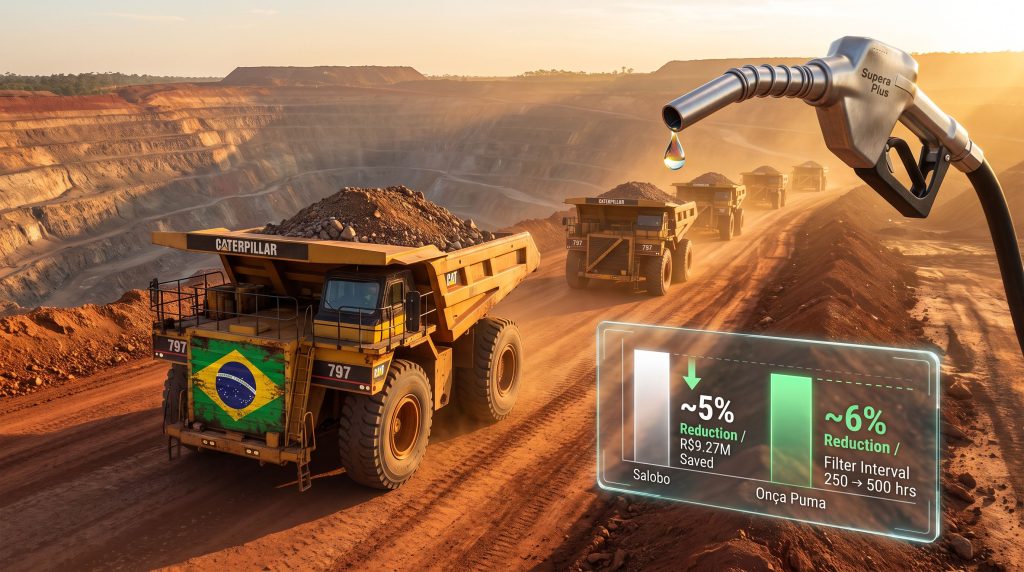
Vale Base Metals' Salobo operation is one of the largest copper-gold mines in Latin America by throughput, making it a credible high-stakes testing environment. During the pilot programme at Salobo, Supera Plus diesel delivered a measured fuel consumption reduction of approximately 5% across the fleet. When annualised and projected across the full operational fuel volume, this efficiency gain translated to estimated annual savings of R$9.27 million, equivalent to roughly USD $1.79 million at the exchange rate prevailing at the time of reporting (approximately R$5.17 per USD).
This is not a trivial figure. For context, it represents savings generated purely from fuel efficiency, before accounting for any reduction in maintenance expenditure or downtime avoidance. Furthermore, these results were achieved under continuous heavy-load conditions, lending considerable credibility to the reported figures.
Onça Puma Mine: Nickel Ore Transport
At Vale's Onça Puma nickel operation, also located in Pará state, the performance metrics were even more pronounced. Ore transport fleets recorded a 6% reduction in diesel consumption, which in a logistics-intensive nickel operation with high vehicle utilisation rates represents a substantial improvement in cost per tonne of material moved.
The more striking result at Onça Puma, however, was the maintenance interval data. The filter change cycle extended from 250 hours to 500 hours, representing a complete doubling of maintenance-free operating time. In continuous-operation mining environments running multiple shifts around the clock, this is commercially significant beyond the simple maintenance cost reduction.
Doubling the filter change interval is not merely an incremental maintenance saving. In high-throughput mining, equipment availability is a direct determinant of production output. Every hour of reduced downtime during scheduled maintenance translates into additional tonnes processed, and at prevailing copper, gold, and nickel prices, that incremental throughput carries real revenue value.
Side-by-Side Performance Comparison
| Metric | Salobo Mine | Onça Puma Mine |
|---|---|---|
| Primary Commodity | Copper-gold | Nickel |
| Fuel Consumption Reduction | ~5% | ~6% |
| Estimated Annual Savings | R$9.27M (~USD $1.79M) | Not yet disclosed |
| Filter Change Interval | Baseline (standard) | Extended: 250 to 500 hours |
| Operation Type | Open-pit extraction | Ore transport logistics |
| State | Pará, Brazil | Pará, Brazil |
The Business Architecture Behind Vibra's B2B Mining Strategy
Market Position and Scale
Vibra's footprint in Brazil's mining fuel market is already substantial. The company supplies approximately 1.7 million cubic metres of diesel to mining clients annually, representing roughly 20% of its total B2B diesel sales volume. Within the mining segment specifically, Vibra holds close to 60% market share, a dominant position that creates both strategic leverage and a clear obligation to defend margin through product differentiation rather than price competition alone.
At 60% market share, aggressive price-based competition from rivals would disproportionately damage Vibra's revenue base before affecting smaller competitors. Premium product performance, validated through documented pilot results, offers a more sustainable competitive defence. Notably, direct diesel sales in Brazil have surged following significant supply agreements, illustrating how competitive this market has become.
EBITDA Growth Signals Margin Expansion Is Already Working
Vibra's B2B division reported adjusted EBITDA of R$1.7 billion in the second quarter, representing a 142% year-on-year increase. While this growth reflects multiple factors across the B2B portfolio, the scale of the improvement signals that margin expansion through premium product mix is already contributing meaningfully to divisional profitability. Volume growth alone does not produce EBITDA improvements of that magnitude.
The strategic logic here is well-established in industrial markets: when a supplier can demonstrate quantifiable value delivered to the customer's own cost structure, the conversation shifts from price per litre to total cost of ownership, and that is a conversation where premium products can consistently win.
Why Mining Is the Right Validation Environment
Mining operations offer several structural advantages as proving grounds for performance fuel products:
- Measurable metrics: fuel consumption per tonne of material moved can be tracked with precision
- Large fleet sizes: results are statistically robust across hundreds of vehicles
- High fuel volumes: efficiency improvements generate financially material savings even at small percentages
- Continuous operation: maintenance interval improvements translate directly into uptime gains
- Documented ESG obligations: listed mining companies have strong incentives to report measurable efficiency improvements
These characteristics make it straightforward to construct a credible return-on-investment case, which Vibra can then replicate as a commercial template when approaching agribusiness operators, industrial logistics companies, and infrastructure contractors running similarly fuel-intensive fleets.
Evaluating Premium Diesel ROI: A Framework for Mining Operators
For mining operators considering a transition to performance-grade diesel, the financial evaluation follows a logical sequence:
- Establish baseline consumption data by measuring current diesel volumes per equipment category and operational shift across a defined period
- Conduct a controlled pilot by isolating a specific fleet segment and running premium fuel under conditions as close as possible to the baseline scenario
- Measure the consumption delta by calculating the percentage reduction in litres consumed per tonne of material moved or per operational hour
- Quantify the maintenance savings by tracking filter change intervals, injector performance data, and any reduction in unplanned downtime events
- Annualise the financial impact by projecting efficiency gains and maintenance savings across the full operating fleet and full calendar year
- Compare against the premium price differential to assess whether the per-litre cost premium is offset by the operational savings generated
- Model the breakeven point to determine at what consumption reduction percentage the premium product becomes financially self-funding
Hypothetical scenario: A mid-sized open-pit copper operation running 80 haul trucks and consuming 50 million litres annually could realise between R$4 million and R$10 million in annual fuel savings at a 5% to 6% efficiency improvement, before any maintenance interval benefits are factored into the calculation.
Key Variables That Determine ROI Magnitude
- Total fleet size and the proportion of high-consumption heavy haul equipment
- Annual operating hours per unit, with higher utilisation amplifying both savings and maintenance benefits
- Baseline diesel procurement price and any existing volume discount arrangements
- Prevailing maintenance labour rates and spare parts costs for filters and injectors
- Proximity to premium fuel supply infrastructure and associated logistics costs
Brazil's Regulatory Biodiesel Framework and Its Interaction With Premium Formulations
Brazil operates one of the world's most structured mandatory biodiesel blending regimes. All diesel sold domestically must incorporate a minimum biodiesel content, with the blend mandate progressively increasing over time as part of the country's domestic energy and agricultural policy framework. This applies equally to premium and standard diesel products.
What distinguishes premium formulations within this regulatory context is not the biodiesel content percentage but the quality of the biodiesel used. Higher-purity biodiesel with lower contamination levels produces cleaner combustion, reduces injector fouling, and generates fewer particulate byproducts, all of which contribute to improved emissions profiles. For listed mining companies with scope 1 emissions reduction targets embedded in their ESG reporting frameworks, this creates an additional non-financial rationale for premium fuel adoption. This intersects closely with broader mining decarbonisation benefits that the sector is increasingly recognising.
The intersection of fuel quality, mandatory blending policy, and corporate emissions commitments creates a compounding incentive structure that may accelerate premium diesel penetration in mining beyond what pure cost economics alone would predict.
The next major ASX story will hit our subscribers first
The Competitive Landscape for Brazil's Industrial Diesel Supply
Vibra's nearly 60% share of Brazil's mining diesel market is a formidable competitive position, but it is not impenetrable. Petrobras maintains direct supply relationships with major industrial customers as a structural feature of the Brazilian fuel market, and smaller regional distributors compete on logistics proximity and pricing flexibility in certain geographies.
The strategic significance of the Vale pilot programmes is that they reframe the competitive question. When a fuel supplier can present documented evidence that its product reduced diesel consumption by 5% to 6% and doubled filter change intervals at two of the largest mining operations in the country, procurement decisions become harder to make on price alone. Performance validation creates switching costs that pure commodity supply relationships do not.
This dynamic, converting transactional fuel supply into performance-anchored operational partnerships, is precisely the model that Vibra's B2B division appears to be pursuing as its long-term competitive strategy. In addition, data-driven mining operations are increasingly enabling procurement teams to validate these performance claims with far greater precision than was previously possible.
Sector Expansion: From Mining Validation to Broader Industrial Penetration
Vibra's executive leadership has confirmed plans to extend premium diesel products beyond mining into agribusiness, industrial operations, and logistics. Each of these sectors shares structural characteristics with mining that make the premium fuel value proposition transferable:
- Agribusiness: large seasonal fuel consumption, equipment operating under sustained load, and strong sensitivity to unplanned downtime during harvest windows
- Industrial operations: continuous-process facilities with predictable fuel volumes and measurable efficiency benchmarks
- Logistics and freight: high annual mileage, fuel as a dominant operating cost, and strong interest in consumption reduction at scale
The mining pilots provide what no marketing claim alone can deliver: third-party validated, real-world performance data from recognised mining operators. That evidence base materially lowers the commercial risk for procurement teams in adjacent sectors evaluating a switch to premium fuel. Furthermore, the broader mining electrification trend suggests that premium fuel efficiency is part of a wider transitional strategy rather than an end point in itself.
Frequently Asked Questions: Premium Diesel in Brazilian Mining Operations
What makes Supera Plus diesel technically distinct from additivated standard diesel?
Supera Plus is formulated with higher-purity biodiesel feedstocks that carry fewer biological and oxidative contaminants, combined with cetane-enhancing additives that improve ignition quality, corrosion inhibitors that protect fuel system components, and oxidation inhibitors that extend fuel stability. Standard additivated diesel typically addresses one or two of these dimensions; Supera Plus targets all of them simultaneously with the specific demands of heavy mining equipment in mind.
How does the Onça Puma filter interval improvement translate into operational value?
Extending filter replacement from every 250 hours to every 500 hours effectively halves the number of scheduled maintenance interventions per unit per year. For a fleet of dozens or hundreds of vehicles operating continuously across multiple shifts, this reduces both direct maintenance expenditure and, critically, the cumulative hours of equipment downtime associated with filter service. In a high-throughput mining operation, availability is production, and production is revenue. Consequently, energy solutions for mining that reduce operational disruption are gaining significant traction across the sector.
Is the 142% EBITDA increase in Vibra's B2B division entirely attributable to premium diesel?
No. The 142% year-on-year increase in adjusted EBITDA to R$1.7 billion in the second quarter reflects performance across Vibra's entire B2B portfolio, which encompasses multiple product categories and customer segments. Premium diesel is a contributing factor to margin improvement, but attributing the full increase to a single product would overstate the case. The figure is significant because it demonstrates that the B2B division's overall margin architecture is improving, of which premium product mix is one driver.
Why has mining been chosen as the initial expansion sector rather than agribusiness or logistics?
Mining offers the most favourable conditions for rigorous performance validation: continuous operation, measurable fuel consumption per unit of output, large fleet sizes that produce statistically meaningful data, and sophisticated procurement teams capable of evaluating total cost of ownership models. Successfully demonstrating performance in this demanding environment provides the most credible possible evidence base for expansion into other sectors. The ICMM's work on zero-emission vehicles further illustrates why performance benchmarking in mining carries such weight across the broader industry.
Disclaimer: This article is intended for informational purposes only and does not constitute financial, investment, or commodity purchasing advice. Financial projections, efficiency estimates, and scenario analyses presented are based on publicly reported pilot data and hypothetical modelling. Readers should conduct their own due diligence before making any financial or procurement decisions.
Want to Capitalise on the Mining Sector's Most Significant Discoveries Before the Broader Market?
Discovery Alert's proprietary Discovery IQ model delivers real-time alerts on significant ASX mineral discoveries — instantly translating complex data into actionable opportunities for both short-term traders and long-term investors. Explore how historic discoveries have generated extraordinary returns on Discovery Alert's dedicated discoveries page, and begin your 14-day free trial today to position yourself ahead of the market.