August 14, 2026
The OEM Service Revolution Reshaping Latin American Mining
The economics of mining equipment ownership have undergone a quiet but fundamental transformation over the past decade. As ore bodies grow deeper, processing circuits become more complex, and commodity cycles compress decision timelines, the question of where an OEM's service capability sits geographically has shifted from a secondary consideration to a primary investment thesis. For equipment manufacturers serving Latin America's vast mineral wealth, the traditional model of centralised support delivered from distant hubs is increasingly incompatible with the operational realities facing modern mine sites.
This structural tension between where mining output is generated and where technical support has historically been concentrated has created a measurable cost burden for operators across the Andean corridor. It is within this context that Metso's EUR 45 million (approximately USD 52 million) Metso South America service centre investment programme deserves careful examination, not merely as a capital expenditure announcement, but as a signal of where the global OEM industry is heading.
When big ASX news breaks, our subscribers know first
Breaking Down the EUR 45 Million Commitment
Understanding the scale of this investment requires placing it within both Metso's broader capital allocation framework and the operational geography it is designed to serve. The total commitment did not arrive as a single deployment but has been structured across multiple tranches, each targeting specific capability gaps.
Key Investment Snapshot
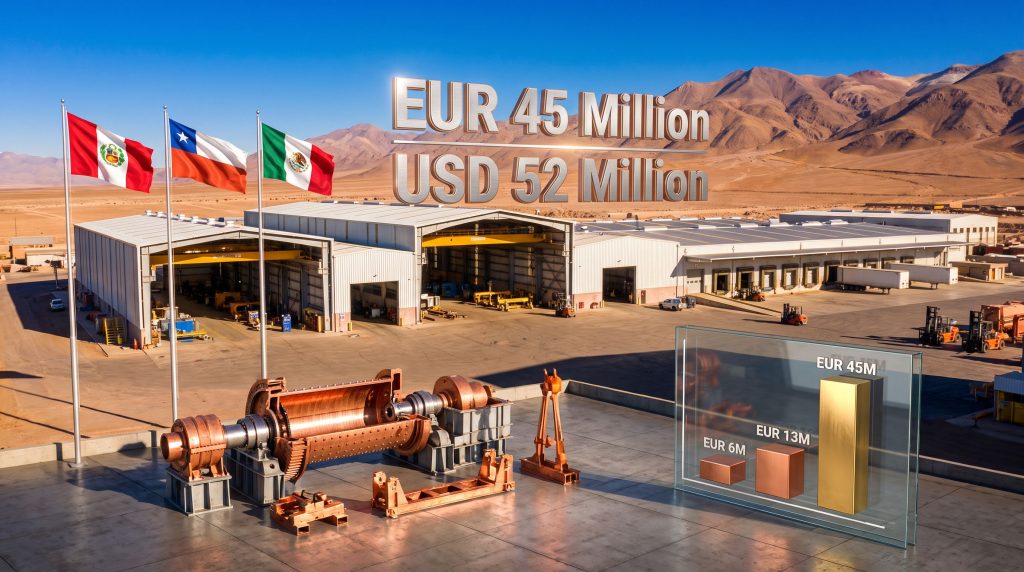
Metso's total declared service infrastructure investment across South America has reached approximately EUR 45 million (USD 52 million), with earlier tranches including a EUR 6 million allocation for new centres in Peru and Mexico, and a EUR 13 million expansion targeting Antofagasta, Chile and Arequipa, Peru specifically to upgrade heavy equipment servicing capabilities.
The phased nature of this capital deployment is itself strategically significant. Rather than committing the full sum to a single greenfield facility, Metso has built capability incrementally, allowing each tranche to respond to demonstrated operational demand. The EUR 6 million tranche established the foundational network presence in Peru and Mexico, while the subsequent EUR 13 million directed at Antofagasta and Arequipa represented a capacity deepening exercise, adding precision machining capability and heavy-lift infrastructure for large-format processing equipment.
What EUR 45 million buys in mining service infrastructure is worth unpacking in practical terms:
- Lifting capacity systems capable of handling multi-tonne mill components, crushers, and drive assemblies without requiring equipment to be transported to distant repair facilities
- CNC machining centres enabling on-site precision engineering of wear-critical components to OEM specifications
- Spare-parts warehousing with climate-controlled storage for sensitive consumables and fast-moving wear parts
- Technical training facilities for both Metso field specialists and mine operator maintenance teams
- Diagnostic and condition monitoring infrastructure to support predictive maintenance programmes across the regional customer base
Country-by-Country Breakdown: Where Metso Is Deploying Service Capital
Peru: Arequipa as an Andean Service Anchor
Arequipa's selection as Peru's primary service hub reflects both its geographic logic and its economic importance to the country's mining sector. Positioned at the intersection of major copper and gold mining corridors in southern Peru, the city provides logistical reach across one of the most mineralogically productive regions in South America.
Peru ranks among the world's top five copper producers and holds significant gold, silver, zinc, and lead resources. The concentration of large-scale processing operations in its southern provinces creates sustained demand for heavy equipment servicing that a Lima-based or offshore support model cannot efficiently address. The Arequipa facility's upgraded lifting and machining capabilities are specifically designed to enable on-site rebuilding of major assemblies, reducing the time equipment spends off the processing circuit.
Chile: A Dual-Node Strategy for the World's Premier Copper Geography
Chile accounts for roughly 27% of global copper production, according to the US Geological Survey, making the Atacama and surrounding regions the single most important geography for copper-focused OEM service strategy anywhere on earth. Metso's Chilean approach involves two distinct nodes serving complementary functions.
Antofagasta serves as the northern operational hub, positioned to support the dense concentration of large copper concentrators and heap leach operations that characterise the region. The capacity expansion here targets heavy equipment servicing, bringing rebuild capability closer to operations that would otherwise face multi-day logistics delays for component repair.
Viña del Mar, where Metso opened a distribution centre in June 2024, performs a different but equally critical function. Rather than focusing on heavy component repair, this facility prioritises spare-parts availability and delivery performance, functioning as a logistics node that compresses lead times for customers across Chile and potentially broader South America.
The dual-node architecture is notable because it acknowledges that service infrastructure is not monolithic. Different facility types solve different problems, and the combination of a heavy-capability workshop in the north with a parts-logistics hub further south creates a more complete service offering than either facility could deliver independently.
Mexico: Network Breadth Beyond South America Proper
Mexico's inclusion in the EUR 6 million initial tranche extends the geographic logic of this programme beyond South America's formal boundaries. While Mexico operates within a distinct regulatory and mining culture from its Andean counterparts, its inclusion underscores Metso's intent to build an integrated Americas service architecture rather than a collection of isolated national facilities.
| Country | Key Location(s) | Investment Focus | Strategic Function |
|---|---|---|---|
| Peru | Arequipa | Machining, lifting capacity, parts distribution | Andean mining belt hub |
| Chile | Antofagasta, Viña del Mar | Capacity expansion, spare-parts logistics | Copper corridor coverage |
| Mexico | TBC | New service centre | Americas network node |
What Is Actually Driving This Investment?
Copper's Structural Demand Position and Its Geographic Reality
The energy transition has fundamentally altered the long-term demand calculus for copper. Electric vehicles require roughly three to four times more copper than conventional internal combustion engine vehicles, and grid infrastructure buildout for renewable energy generation is similarly copper-intensive. Furthermore, the energy transition metals demand outlook continues to intensify, with the International Energy Agency projecting that copper demand could increase significantly under accelerated decarbonisation scenarios, with supply remaining geographically constrained to a handful of producing nations.
Chile and Peru represent the dominant contributors to that constrained supply. This structural demand outlook makes service disruptions at Andean copper operations increasingly costly in a macro sense, which feeds directly into the investment case for proximity-based OEM support infrastructure.
The Shift from Reactive to Predictive Service Models
Perhaps the less-discussed but more consequential driver behind this investment is the industry's migration toward predictive and condition-based maintenance frameworks. Traditional reactive maintenance, where equipment is serviced after failure, is incompatible with the production intensity targets that large copper and gold operations now operate against.
Regional service centres are increasingly functioning as data and diagnostic hubs, not merely warehouses and workshops. Data-driven mining operations are reshaping how OEM technical specialists are embedded within same-day travel distance of a mine site, enabling condition monitoring data to be acted upon in hours rather than days. This transforms the service centre from a cost of operation into a tool for revenue protection.
For large copper concentrators operating at full utilisation, unplanned downtime costs can exceed USD 1 million per day in lost production value. In this context, the capital cost of a regional service centre is recoverable through a relatively small number of avoided shutdown events across a customer base.
Competitive Dynamics Accelerating the Build-Out Timeline
Metso does not operate in a vacuum. Competitors including FLSmidth, Sandvik, and Weir Group have each been investing in regional service presence across Latin America, recognising the same demand signals. FLSmidth, for example, has publicly communicated growth in its aftermarket and services division as a strategic priority, with Latin America representing a key geography for that expansion.
This competitive dynamic likely accelerates the pace of Metso's own deployment. First-mover advantages in regional service networks are meaningful because mine operators tend to develop long-term maintenance relationships with OEMs who can demonstrate consistent local support. Once a service relationship is established and embedded in a mine's maintenance planning, switching costs are significant.
How a Regional Mining Service Centre Actually Functions
The Operational Architecture of In-Region OEM Support
Understanding why proximity matters requires a clear picture of what these facilities actually do and how they reduce the total cost of equipment ownership for mine operators.
Step-by-Step: How a Regional Service Centre Reduces Mine Downtime
- Proximity stocking – Critical wear parts and consumables are held within same-day delivery range of active mine sites, eliminating the customs delays, freight costs, and lead times associated with international parts sourcing
- In-region diagnostics – Technical specialists can be deployed to a mine site rapidly without international travel delays or associated costs, enabling faster fault identification and resolution planning
- Component rebuild capability – Major assemblies including mill liners, crusher mantles, pump casings, and drive systems can be repaired locally rather than shipped to distant OEM facilities, dramatically reducing turnaround time
- Predictive maintenance integration – Service centres function as regional data hubs for equipment health monitoring, allowing condition trends to be tracked and addressed proactively before failure events occur
- Training delivery – Both centre-based and on-site training for mine operator maintenance personnel reduces human-error-driven downtime and improves the quality of routine maintenance carried out by site staff
Why Lifting Capacity Is a Specific Infrastructure Constraint
One aspect of service centre capability that receives insufficient attention is the physical infrastructure required to handle large mining equipment components. A SAG mill shell section, a large crusher mainframe, or a high-pressure grinding roll assembly can weigh tens of tonnes and require specialised overhead crane capacity, floor loading specifications, and handling equipment that is fundamentally different from standard industrial workshop infrastructure.
When Metso specifies lifting capacity upgrades at Arequipa and Antofagasta, this represents the installation of infrastructure that enables the servicing of the largest and most capital-intensive equipment categories. Consequently, this removes a critical bottleneck that would otherwise force mine operators to either transport equipment internationally or accept extended downtimes awaiting mobile specialist teams from overseas. The crusher liner strategy for managing wear parts procurement is one such area where local rebuild capability delivers tangible operational savings.
Americas Service Architecture: The Broader Network Context
Metso's South America service centre investment does not exist in isolation. The company has also been developing service infrastructure across North America, including facilities in Mesa, Arizona and a forthcoming centre in Prince George, Canada. These facilities serve different commodity profiles and mine types but form part of the same overarching strategy of embedding service capability within regional mining ecosystems.
| Region | Key Facility | Primary Commodity Focus | Investment Status |
|---|---|---|---|
| South America | Arequipa, Antofagasta, Viña del Mar | Copper, gold, lithium | Active, EUR 45M committed |
| North America | Mesa, Arizona | Diversified hard rock | Active, new service and training centre |
| North America | Prince George, Canada | Base metals | Forthcoming |
The contrast between North and South American investment rationale is instructive. North American operations tend to be more geographically distributed, with a wider variety of commodity types and more mature existing service ecosystems. South American investment, however, is driven by higher operational intensity within more concentrated geographies, where the density of large-scale copper and gold processing creates a more compelling case for specialised, high-capability service infrastructure.
The next major ASX story will hit our subscribers first
Implications for Mining Operators Across the Region
What Changes for Maintenance Planning and Procurement
For mine operators, the practical implications of expanded OEM service presence extend beyond faster spare parts delivery. The availability of in-region technical expertise changes how maintenance contracts can be structured, enabling performance-based agreements where the OEM shares accountability for equipment availability metrics rather than simply supplying parts and reactive repair services.
This shift toward outcome-based service contracting is a trend observable across the global mining OEM sector. It requires the OEM to have sufficient local capability to genuinely influence equipment performance, which in turn requires the physical and human infrastructure that these service centre investments are building. In addition, mining efficiency gains achieved through embedded regional support are increasingly being measured and reported as tangible productivity outcomes by major operators.
Cost Modelling Considerations for Operators
The financial calculus for mine operators evaluating OEM service partnerships in the context of this expanded regional infrastructure includes several factors worth modelling explicitly:
- Inventory carrying cost reduction as regional stocking by the OEM reduces the need for operators to maintain large on-site spare-parts inventories
- Unplanned downtime frequency reduction through faster response times and predictive maintenance programmes
- Component lifecycle extension through higher-quality rebuild work performed to OEM specifications rather than generic workshop standards
- Training investment efficiency as proximity to a technical training facility reduces the cost and logistical complexity of maintaining a well-trained maintenance workforce
The Regionalisation Imperative: Where OEM Strategy Is Heading
The Metso South America service centre investment programme reflects a broader structural shift in how global mining equipment manufacturers are conceptualising their service businesses. The era of centralised, export-based support is giving way to embedded, in-region service ecosystems that are designed to function as genuine operational partners to mine sites rather than remote suppliers.
This transition is being accelerated by three converging forces:
- The geographic concentration of critical mineral production in regions with historically underdeveloped OEM service infrastructure
- The increasing operational complexity of modern mining equipment, which demands more specialised and more frequent intervention
- The growing sophistication of mine operators in demanding accountability from equipment suppliers for performance outcomes, not just hardware supply
Furthermore, the copper supply crunch anticipated across the coming decade places additional urgency on minimising any preventable production disruption at major Andean operations. For investors and industry observers tracking the evolution of the mining services sector, the capital being deployed by Metso and its competitors in South America represents an early and committed answer to a question that the industry will be grappling with for the next two decades: what does responsible, effective OEM partnership look like in the geographies where the world's critical mineral supply chains are actually located?
The mining decarbonisation benefits associated with locally maintained, optimally performing equipment also increasingly factor into the investment rationale, as regulators and investors apply greater scrutiny to operational efficiency and emissions performance across the sector.
Frequently Asked Questions: Metso South America Service Centre Investment
What is the total value of Metso's South America service centre investment?
Metso has committed approximately EUR 45 million (USD 52 million) to modernising and expanding its service centre network across South America, with individual tranches including EUR 6 million for new facilities in Peru and Mexico, and EUR 13 million for capacity upgrades in Antofagasta, Chile and Arequipa, Peru.
Which countries are included in Metso's South America service expansion?
The primary locations identified include Peru (Arequipa), Chile (Antofagasta and Viña del Mar), with Mexico also included in the broader Americas investment tranche.
What capabilities are being added to Metso's South American service centres?
Upgrades include increased lifting capacity for large mining equipment, expanded machining capabilities for precision component repair, and improved spare-parts warehousing and distribution logistics.
When did Metso open its Viña del Mar distribution centre?
Metso opened its Viña del Mar distribution centre in June 2024, targeting improved delivery performance and spare-parts availability for customers across Chile and South America.
Why is Metso investing heavily in South America specifically?
South America hosts some of the world's highest-density copper, gold, and lithium mining operations, particularly in Peru and Chile. The investment reflects both the region's growing production volumes and the strategic imperative to provide localised, rapid-response technical support to reduce operator downtime costs.
How does a regional service centre reduce mine downtime costs?
By positioning critical spare parts, technical specialists, and component rebuild capability within same-day logistics reach of active mine sites, regional service centres eliminate the delays associated with international parts sourcing and offshore specialist deployment. For high-utilisation processing operations, this proximity can represent material reductions in the frequency and duration of unplanned equipment outages.
Readers seeking additional context on mining equipment servicing trends and OEM investment strategies in Latin America may find value in exploring related industry coverage available through Global Mining Review, which provides ongoing technical reporting on processing equipment and services across the Americas.
Want to Stay Ahead of the Next Major Mineral Discovery in the Americas?
While OEM service infrastructure reshapes operational efficiency across Latin America's copper and gold corridors, Discovery Alert's proprietary Discovery IQ model delivers real-time alerts the moment significant ASX mineral discoveries are announced — transforming complex geological data into actionable investment insights for both traders and long-term investors. Explore historic discoveries and the substantial returns they generated, then begin your 14-day free trial at Discovery Alert to position yourself ahead of the broader market.