August 9, 2026
The Economics of Wear: Why Crusher Liner Strategy Is Reshaping Mining Procurement
In high-throughput hard rock mining, the economics of attrition are relentless. Every tonne of copper ore, every pass through a secondary crusher, and every hour of production pressure quietly erodes the steel liners that make the entire process possible. The Metso South American crusher wear parts deal exemplifies how wear consumables represent one of the most consequential recurring cost lines in any operation. The way those consumables are sourced, managed, and optimised is undergoing a fundamental transformation across South America's most productive mining regions.
When big ASX news breaks, our subscribers know first
How South American Mining Operations Are Changing the Way They Buy Wear Parts
From Spot Purchasing to Strategic Supply Frameworks
For much of the industry's history, crusher wear parts procurement operated on a relatively simple logic: buy when needed, compare prices, repeat. This transactional approach served adequately when processing volumes were lower and equipment complexity was manageable. Today, however, the calculus has shifted considerably.
South American copper and gold operations have grown to a scale where a single unplanned crusher shutdown can eliminate hundreds of thousands of dollars in daily production value. In this context, the sourcing model for wear parts is no longer a procurement decision — it is an operational risk management decision. Understanding mining project economics helps contextualise why this shift matters so profoundly.
A structural move is underway across the region toward multi-year, performance-oriented supply agreements that go well beyond parts delivery. These frameworks embed OEM technical expertise directly into the site, align supplier incentives with operational outcomes, and replace reactive maintenance with planned, data-informed wear management.
Why South America's Ore Bodies Demand More From Wear Solutions
The geological character of South American ore deposits creates particularly demanding conditions for crusher wear components. Several factors combine to accelerate liner degradation in this region:
- The dominant copper porphyry deposits across the Andean cordillera in Chile and Peru carry high silica content and hard, abrasive gangue mineralogy that accelerates steel liner wear at rates significantly above global averages
- Iron ore operations in Brazil's Carajas and Minas Gerais regions process extremely hard itabirite and hematite ores that impose high crushing forces on liner surfaces
- Continuous processing regimes, driven by large throughput targets, mean that wear accumulation is constant rather than cyclical
- Elevation and arid conditions at Atacama-adjacent operations create additional logistical complexity around parts supply and maintenance scheduling
South America accounts for a disproportionately large share of global crusher wear parts consumption. The combination of ore hardness, processing scale, and operational continuity requirements makes the region one of the most demanding wear environments on the planet.
Understanding the Metso South American Crusher Wear Parts Deal
What Was Agreed and Why It Represents a Significant Benchmark
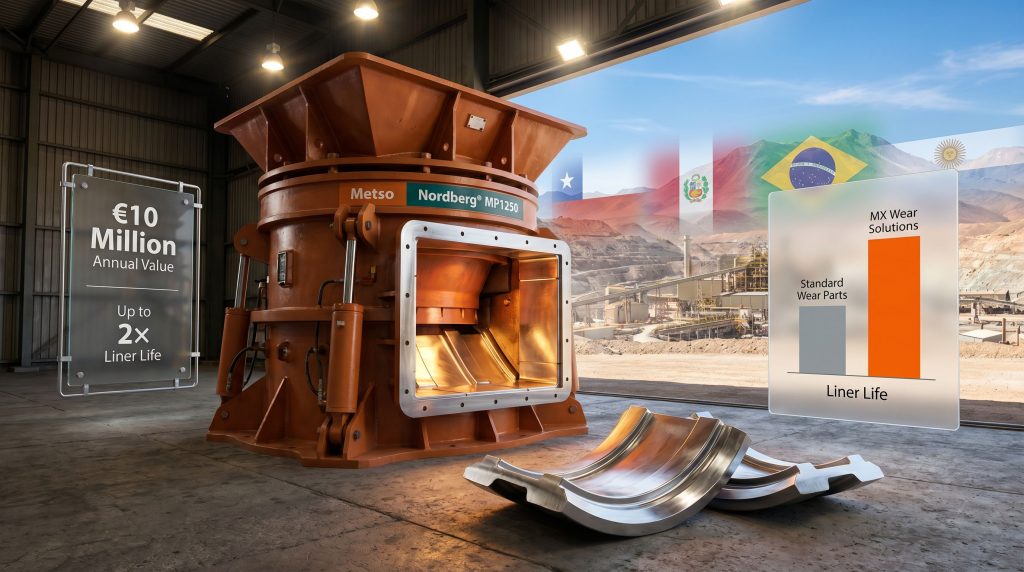
Metso has secured a three-year agreement to continue supplying MX crusher wear parts to a major mining company operating in South America. The agreement carries an annual value of approximately €10 million, equivalent to roughly AUD $16.45 million per year, bringing the total contract value across the full term to approximately €30 million (~AUD $49.3 million). This positions the arrangement among Metso's largest crusher wear parts commitments globally.
Initial deliveries under the renewed programme were booked within Metso's Minerals segment Q1 2026 orders received, confirming that the commercial framework was operationalised from the first quarter of 2026.
What makes this deal particularly notable is not simply its size. It is the depth of integration it embodies — this is not a purchase order for steel liners. It is a structured operational partnership that encompasses inventory management, engineering support, and collaborative technology development over a sustained multi-year period.
The Four Pillars of the Agreement's Scope
The supply arrangement is structured around four operational layers that distinguish it from conventional aftermarket procurement:
- Dedicated on-site inventory management — stock levels are calibrated to actual consumption rates at the customer's site, eliminating supply chain lag and reducing the risk of critical stockouts during planned maintenance windows
- Joint technology development — collaborative engineering work between Metso and the customer to optimise wear part geometry and alloy composition for site-specific ore conditions and crushing parameters
- On-site engineering support — technical specialists monitor wear patterns in real time, adjust liner profiles between campaigns, and work to extend overall liner service life across the contract term
- Structured performance monitoring — continuous data collection and analysis feeds back into wear optimisation, creating an improvement loop that compounds in value the longer the relationship continues
MX Wear Technology: What Sets It Apart From Conventional Liner Solutions
The Engineering Logic Behind Extended Liner Life
MX wear solutions are designed specifically for the performance demands of high-reduction secondary and tertiary crushing environments. The technology targets the primary cost driver in these circuits: the frequency at which liners must be replaced. Furthermore, the data-driven mining operations approach increasingly underpins how these solutions are deployed and monitored across modern sites.
In standard wear part configurations, liner degradation in hard rock secondary crushing applications follows a relatively predictable curve. However, replacement intervals are often constrained by conservative maintenance scheduling that prioritises avoiding unplanned failure over maximising campaign length. MX solutions are engineered to deliver up to twice the liner service life of conventional wear parts in comparable applications.
The practical implications of doubling liner life are substantial. Each avoided liner changeout represents:
- Elimination of a planned production shutdown, typically ranging from 12 to 24 hours in duration for large secondary crushers
- Reduction in the cumulative labour hours required for high-risk confined space work within crusher chambers
- Lower total parts consumption and associated procurement, logistics, and inventory holding costs over the contract period
- Improved circuit availability and more predictable throughput for downstream processing stages
Nordberg MP1250 Cone Crushers: The Platform at the Centre of the Agreement
The supply agreement is structured around wear parts for Nordberg MP1250 cone crushers, a platform that represents the upper tier of secondary crushing capability in large-scale hard rock operations. The MP1250 is characterised by high crushing force output, a large cavity volume suited to high-tonnage feed, and mechanical design optimised for continuous operation in abrasive ore environments.
Optimising wear part performance specifically for the MP1250's crushing geometry and force profile is technically non-trivial. Liner profiles must be matched to cavity geometry, feed size distribution, and target product gradation simultaneously. Consequently, this is precisely why OEM-developed, site-specific wear solutions carry a performance advantage over generic aftermarket alternatives.
Comparative Performance: MX vs. Standard Liner Solutions
| Performance Metric | Standard Wear Parts | MX Wear Solutions |
|---|---|---|
| Estimated Liner Life | Baseline | Up to 2x longer |
| Maintenance Shutdown Frequency | Higher | Significantly reduced |
| Equipment Availability | Standard | Improved |
| Engineering Support | Typically excluded | Integrated |
| On-Site Inventory Management | Customer-managed | OEM-managed |
| Alloy Customisation for Site Ore | Generic formulation | Site-specific development |
The Operational and Safety Case for Fewer Liner Changeouts
Production Recovery at Scale
The production value of extended liner campaigns becomes significant when modelled across large-scale operations. Consider a copper concentrator processing 80,000 tonnes per day on Nordberg MP1250 crushers. Under standard wear parts, liner changes required every six weeks at 18-hour shutdown intervals consume approximately 156 hours of production time annually per crusher.
Under MX wear solutions with doubled liner life, the same crusher could operate for approximately 12 weeks between changeouts, recovering roughly 78 hours of production time per year on that unit alone. For operations running multiple MP1250 crushers in parallel, the cumulative production recovery across a fleet is material against any annual revenue figure.
Workforce Safety and Confined Space Risk Reduction
Beyond the financial case, fewer liner changeouts deliver a workforce safety dividend that is increasingly weighted in operational decision-making. Crusher liner replacement is among the higher-risk maintenance tasks in mineral processing:
- It requires entry into crusher chambers, which are classified as confined spaces under most jurisdictional safety frameworks
- Heavy liner components, often exceeding several hundred kilograms per section, create significant manual handling and rigging hazards
- Residual ore and dust within crusher cavities present additional respiratory and slip hazards for maintenance personnel
Reducing the frequency of these tasks through extended liner campaigns directly lowers the annual count of high-risk maintenance events. When combined with predictive wear monitoring that replaces reactive entry with planned, controlled changeouts, the safety case for MX wear solutions becomes as compelling as the economic argument.
What This Deal Reveals About OEM Aftermarket Strategy
Aftermarket Revenue as a Business Model Anchor
The mining equipment industry has been undergoing a quiet but significant structural shift over the past decade. Capital equipment sales, while high in absolute value, are cyclical, margin-compressed, and increasingly contested by lower-cost manufacturers. Aftermarket services and consumables, by contrast, offer recurring revenue, higher margin profiles, and customer relationships that persist long after the original equipment sale.
A €10 million annual wear parts agreement that locks in three years of supply, supported by on-site engineering presence and joint technology development, is a fundamentally different commercial asset than a one-time crusher sale. It creates:
- Predictable revenue that supports manufacturing capacity planning and financial forecasting
- Deep customer integration that raises switching costs and protects the supply relationship from competitive tendering
- Proprietary technical knowledge about site-specific ore conditions and wear behaviour that is difficult for competitors to replicate or displace
The Switching Cost Architecture of Integrated Aftermarket Agreements
One of the less-discussed dynamics of multi-year OEM wear parts agreements is how they structurally embed the supplier within the customer's operational fabric. When an OEM is managing on-site inventory, attending maintenance windows, collecting wear data, and co-developing liner geometries tailored to that specific ore body, the practical cost of transitioning to an alternative supplier extends well beyond price comparison.
This switching cost architecture is not accidental. It is the deliberate commercial logic of integrated aftermarket strategy, and it explains why agreements of this type, once established, tend to be renewed rather than rebid. In addition, this model reflects broader mining industry evolution toward deeper OEM-operator integration at every level of the value chain.
The next major ASX story will hit our subscribers first
Procurement Model Comparison: Understanding the Trade-offs
| Procurement Model | Advantages | Limitations |
|---|---|---|
| OEM Long-Term Agreement | Technical continuity, performance integration, embedded support | Higher unit cost, single-source dependency |
| Third-Party Aftermarket Supply | Competitive pricing, supply flexibility | Variable quality, no engineering integration |
| Hybrid or Blended Approach | Cost optimisation, risk distribution | Inventory complexity, divided accountability |
The Metso South American crusher wear parts deal is a clear expression of the first model. For operations where liner performance directly constrains throughput and safety outcomes, the premium attached to OEM integration is increasingly justified by the total cost of ownership calculation rather than the unit price comparison.
Emerging Trends Shaping Wear Parts Markets Across the Region
Digital Wear Monitoring and the Move Toward Predictive Management
The next evolution in crusher wear management is already emerging in leading operations across Chile, Peru, and Brazil. Rather than relying on scheduled inspection intervals or visual assessment to determine liner change timing, advanced operations are integrating:
- Embedded wear sensors within liner profiles that transmit real-time thickness and wear rate data to control systems
- Digital twin modelling that replicates crusher cavity geometry and predicts liner profile evolution based on current ore hardness and feed rate data
- Machine learning algorithms trained on historical wear campaigns to forecast optimal changeout timing with increasing accuracy over successive campaigns
These capabilities transform wear management from a maintenance function into a process optimisation tool. Furthermore, they align naturally with the kind of structured performance monitoring embedded in long-term OEM agreements, and reflect the broader push toward mining efficiency gains through intelligent, connected systems.
Alloy Innovation for Andean Ore Characteristics
One of the least publicly discussed areas of competitive differentiation in crusher wear parts is metallurgical composition. The Andean copper porphyry ore bodies that dominate South American copper production present a specific challenge: highly abrasive silica-bearing gangue minerals that impose both abrasive and impact wear mechanisms simultaneously on crusher liners.
Standard high-manganese steel liners, which have been the industry workhorse for over a century, work-harden under impact loading but can perform sub-optimally under pure abrasion conditions. Advanced alloy compositions blending chromium, molybdenum, and carbide reinforcement phases are being developed to address this dual wear mechanism more effectively. These innovations are closely tied to evolving copper market trends that are placing new demands on processing infrastructure across the region.
Site-specific alloy development for particular ore body mineralogy represents one of the deepest competitive advantages available to OEM wear parts suppliers. Once a formulation is proven effective at a specific operation, it becomes effectively proprietary to that site relationship.
Commodity Cycle Resilience of Wear Parts Expenditure
Unlike capital equipment investment, which tends to compress sharply during commodity downturns, crusher wear parts consumption is relatively inelastic to commodity price cycles. As long as an operation is processing ore, wear consumables must be purchased. This makes long-term wear parts agreements a structurally more resilient revenue stream than equipment sales through commodity cycles.
The €10 million annual commitment embedded in this agreement reflects a baseload operational expenditure that the customer must incur regardless of copper price movements, making the revenue predictability of the agreement particularly robust from a supplier perspective. For further context on how Metso is investing in crusher wear parts manufacturing to meet growing global demand, the strategic rationale becomes even clearer.
Frequently Asked Questions: Metso Crusher Wear Parts Deal in South America
What is the total value of the Metso South American crusher wear parts agreement?
The agreement is valued at approximately €10 million per year (around AUD $16.45 million annually). Across the full three-year term, the total contract value reaches approximately €30 million, equivalent to roughly AUD $49.3 million.
Which crusher platform does the agreement cover?
The supply agreement centres on wear parts for Nordberg MP1250 cone crushers, a high-capacity secondary crushing platform widely deployed in large-scale hard rock mining operations across South America.
What makes MX wear parts different from standard crusher liners?
MX wear solutions are engineered to extend liner service life by up to double compared to conventional wear parts in secondary crushing applications. This reduces maintenance shutdown frequency and improves overall circuit availability.
When did deliveries under this agreement begin?
Initial deliveries were recorded within Metso's Minerals segment Q1 2026 orders received, confirming the agreement was commercially active from early 2026.
Does the agreement include services beyond physical parts supply?
Yes. The scope includes on-site inventory management, joint technology development, engineering support, and structured performance monitoring — making it a comprehensive operational partnership rather than a transactional supply arrangement.
Why are long-term OEM wear parts agreements becoming more common in South America?
The combination of high-abrasion Andean ore bodies, large-scale processing throughput, increasing safety scrutiny on maintenance activities, and pressure to reduce total cost of ownership is driving South American mining operators toward integrated, performance-linked supply frameworks.
Key Takeaways: What the Metso Deal Signals for the Mining Equipment Aftermarket
- Annual value of €10 million establishes this as one of Metso's most significant crusher wear commitments globally, reflecting the strategic weight of South America's processing-intensive mining sector
- MX technology's doubled liner life creates compounding operational and financial benefits that justify the premium OEM partnership model over price-driven aftermarket sourcing
- Four-layer service integration covering inventory, engineering, joint development, and performance monitoring creates durable competitive moats for the supply relationship
- Safety benefits are quantifiable and material — fewer liner changeouts directly reduce confined space entry events and heavy handling incidents across maintenance crews
- Aftermarket strategy is reshaping OEM business models globally, with recurring wear parts revenue increasingly valued as a higher-quality earnings stream than cyclical capital equipment sales
- Andean ore mineralogy presents unique challenges that reward site-specific alloy and geometry development, creating technical differentiation that generic aftermarket suppliers are structurally unable to replicate
Disclaimer: This article contains forward-looking statements, scenario projections, and financial analysis based on publicly available information. Readers should conduct their own research before making any investment or procurement decisions. Currency conversions are approximate and subject to exchange rate movements.
Want to Identify the Next Major ASX Mining Discovery Before the Market Does?
Discovery Alert's proprietary Discovery IQ model scans ASX announcements in real time, instantly alerting subscribers to significant mineral discoveries across copper, gold, and more than 30 other commodities — transforming complex data into actionable investment opportunities. Explore historic discoveries and their remarkable returns, then begin your 14-day free trial at Discovery Alert to position yourself ahead of the market.