August 14, 2026
India's Aluminium Ambitions and the Eastern Industrial Frontier
For decades, the global aluminium industry has been shaped by a simple but powerful logic: whoever controls cheap, reliable energy and upstream mineral supply controls the economics of the metal. China built its dominance on exactly this foundation, combining captive coal power with integrated bauxite-to-aluminium chains to capture more than 55% of world primary aluminium output. Now, a convergence of capital, geology, and industrial strategy is positioning India's eastern coastline as the most credible challenger to that dominance to emerge in a generation.
Odisha sits at the epicentre of this shift. Rich in bauxite, connected by deepwater port infrastructure, and increasingly attractive to sovereign-linked foreign capital, the state is drawing the kind of vertically integrated industrial investment that typically defines a country's transition from raw material exporter to finished goods producer. The scale of what is now being proposed around the Adani Odisha aluminium nuclear power project represents not just a corporate expansion, but a structural repositioning of India within the global metals hierarchy.
When big ASX news breaks, our subscribers know first
What Makes Odisha Strategically Irreplaceable for Heavy Industry?
Odisha's case as an industrial hub rests on several reinforcing advantages that are difficult to replicate elsewhere in India. The state holds some of the country's most significant bauxite deposits, particularly across the Eastern Ghats mineral belt. Bauxite quality matters enormously in aluminium economics: higher-grade ore with lower silica and reactive silica content reduces refining costs and improves alumina yield per tonne processed.
Odisha's deposits have long been recognised for their favourable alumina-to-silica ratios, which translate directly into lower caustic soda consumption during the Bayer refining process — a key cost variable in alumina production. In addition, global bauxite production patterns are shifting, with India increasingly recognised as a critical source of quality ore for future refining capacity.
Beyond the mineral endowment, Odisha offers logistics infrastructure that few Indian states can match:
- The Dhamra Port, already operational under Adani Group management, provides a deepwater gateway capable of handling bulk commodity imports and exports at scale
- Rail connectivity through the East Coast Railway network links interior mineral regions to coastal processing and export facilities
- Proximity to growing industrial demand centres in southern and central India reduces inland freight costs for finished aluminium products
- The state's coastline reduces reliance on overland transport for raw material imports, including supplementary bauxite if domestic supply requires augmentation
Odisha's state government has actively pursued large-scale industrial memoranda of understanding (MoUs), creating a policy environment that has consistently attracted capital into mining, metals, and energy. This MoU framework does not substitute for regulatory approvals or guarantee project execution, but it establishes a formal commitment architecture that signals seriousness on both sides of the investment relationship.
What Is the Adani-IHC Odisha Aluminium Project and Why Does It Matter?
Project Scale and Structural Overview
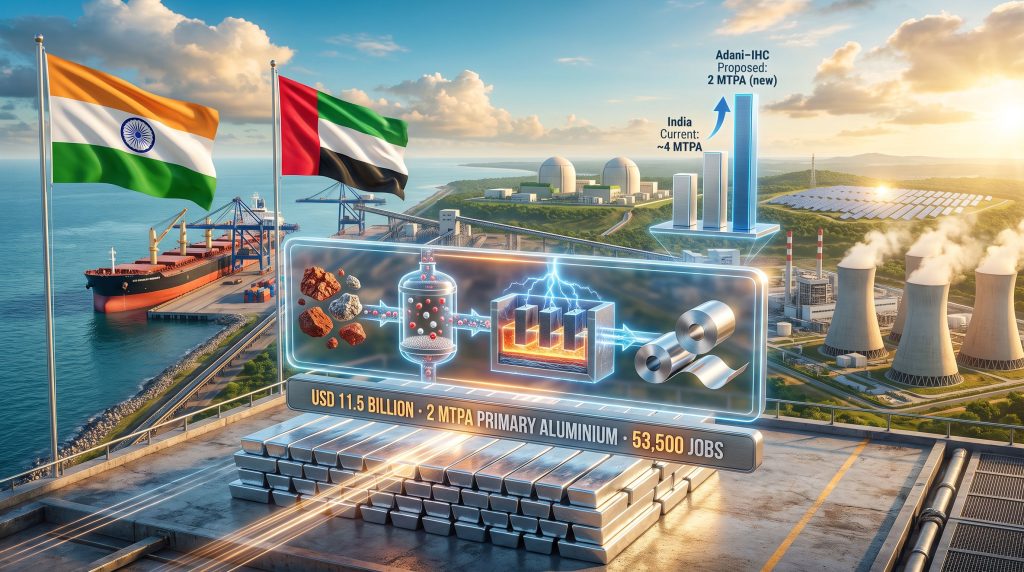
The centrepiece of the current investment wave is a USD 11.5 billion integrated aluminium complex proposed through a 50:50 joint venture between Adani Enterprises and International Resources Holding (IRH), an Abu Dhabi-based entity linked to International Holding Company (IHC). The two parties have formalised their commitment through an MoU with the Odisha state government.
| Component | Capacity or Scale |
|---|---|
| Alumina Refinery | 4 million tonnes per annum (MTPA) |
| Primary Aluminium Smelter | 2 MTPA |
| Downstream Aluminium Manufacturing | 1 MTPA |
| Captive Power Plant | 4,000 MW |
| Green Energy Component | ~400 MW |
| Total Estimated Investment | USD 11.5 billion |
| Projected Employment | ~53,500 jobs (construction + operations) |
| Project Timeline | Approximately 4 to 5 years |
At this scale, the complex would be among the largest single-site foreign direct investment proposals in India's metals and manufacturing history, combining upstream mineral processing, mid-stream refining, and downstream fabrication under a single integrated footprint.
The Joint Venture Architecture: Adani and Abu Dhabi's IRH
The 50:50 joint venture structure between Adani Enterprises and IRH reflects a broader pattern of Gulf sovereign-linked capital diversifying into industrial manufacturing partnerships with Indian conglomerates. IRH, connected to IHC, represents a class of Abu Dhabi investment vehicles that have been systematically expanding exposure to hard commodity processing, logistics, and energy infrastructure across Asia and Africa.
This partnership signals something important for India's FDI landscape in the metallurgy sector. Gulf capital is no longer content to participate only in oil-linked trade or financial instruments. The appetite for ownership stakes in physical industrial infrastructure, particularly in economies with large domestic consumption growth stories, has become a defining feature of Abu Dhabi's investment posture in recent years. The National News reports that this pact represents one of the most significant UAE-India industrial commitments to date.
"At USD 11.5 billion, the Adani-IHC Odisha aluminium complex is positioned among the largest single-site FDI proposals in India's metals and manufacturing history, combining upstream mining, mid-stream refining, and downstream fabrication under one integrated footprint."
How Does the Integrated Aluminium Value Chain Work in This Project?
From Bauxite to Finished Product: A Vertical Integration Model
Understanding why this project matters requires understanding how aluminium is actually made and where value is created or lost at each stage of production.
Stage 1 – Bauxite Mining: Odisha's mineral-rich geology provides the raw material foundation. Bauxite ore, typically containing 40–60% aluminium oxide by weight, is extracted and prepared for refining. The Bayer Process uses hot caustic soda to dissolve the alumina content from bauxite, leaving behind a waste residue known as red mud. The efficiency of this process is heavily influenced by ore grade and reactive silica content.
Stage 2 – Alumina Refining: The proposed 4 MTPA refinery converts raw bauxite into aluminium oxide (alumina), a white powder that serves as the feedstock for smelting. Approximately 2 to 3 tonnes of bauxite are required to produce one tonne of alumina, depending on ore quality.
Stage 3 – Primary Smelting: The proposed 2 MTPA smelter converts alumina into primary aluminium metal through the Hall-Heroult electrolytic process. This is the most energy-intensive stage of the entire value chain. Each tonne of primary aluminium requires approximately 13,000 to 15,000 kilowatt-hours of electricity, which is why energy cost and reliability are the dominant variables in smelter economics.
Stage 4 – Downstream Manufacturing: The proposed 1 MTPA downstream park would produce semi-fabricated and finished aluminium products including rolled sheets, extrusions, wire rods, and castings for industrial end-users across automotive, construction, packaging, and energy sectors.
Why Vertical Integration Is a Competitive Advantage
The economic logic of vertical integration in aluminium is compelling for several reasons. Furthermore, the model directly addresses the structural vulnerabilities that have historically constrained Indian aluminium producers:
- Each stage of the chain carries different price volatility. Bauxite prices are relatively stable; alumina and primary aluminium prices fluctuate more sharply. Integration buffers the impact of commodity cycles on overall project returns
- Co-locating energy-intensive smelting with captive power generation eliminates the grid transmission margin and reduces exposure to industrial power tariff volatility
- A fully integrated complex creates a self-reinforcing industrial ecosystem, attracting ancillary manufacturers, spare parts suppliers, and downstream fabricators to locate nearby
- India's strategic ambition to move up the aluminium value chain from raw ore exporter to finished goods producer aligns directly with this integrated model
What Is the Energy Strategy Behind the Odisha Industrial Complex?
A Hybrid Power Model Designed for Industrial Scale
Aluminium smelting is not merely energy-intensive — it is energy-dependent. A smelter cannot tolerate power interruptions without risking solidification of the molten metal in electrolytic cells, causing catastrophic and expensive damage. This operational reality means that energy reliability is not a preference but an absolute technical requirement.
The proposed energy architecture for the Odisha complex reflects this constraint directly.
| Power Source | Capacity |
|---|---|
| Captive Thermal Power Plant | 4,000 MW |
| Green / Renewable Energy Component | ~400 MW |
| Nuclear Power Plants (proposed, 2 units) | ~3,000 MW each (6,000 MW total) |
| Combined Available Capacity | ~10,400 MW |
| Estimated Annual Energy Requirement | 40.3 to 49.6 TWh per year |
| Estimated Annual Energy Generation | ~91.1 TWh per year |
The proposed power mix is designed to provide reliable electricity for the energy-intensive operations while increasing the use of renewable energy within the overall generation portfolio. The surplus generation capacity above the complex's own requirements — estimated at roughly 91.1 TWh annual output against a requirement of 40.3 to 49.6 TWh — creates significant potential for broader regional energy supply.
Why Nuclear Power Is Central to Adani's Long-Term Odisha Energy Vision
The proposal for two nuclear power plants, each rated at approximately 3,000 MW, represents the most strategically significant and technically complex element of the broader Odisha industrial blueprint. Nuclear power offers something that no other generation technology can match for aluminium smelting: dispatchable, weather-independent, carbon-free baseload power available around the clock.
Unlike solar or wind, nuclear output does not fluctuate with weather conditions, making it technically ideal as the backbone power source for continuous electrolytic processes. Key considerations around the nuclear proposal include:
- Any nuclear power plant development in India requires clearance from the Atomic Energy Regulatory Board (AERB) and the Department of Atomic Energy (DAE), both of which operate under strict technical and safety frameworks
- Global nuclear construction lead times typically range from 10 to 15 years between project proposal and grid commissioning, meaning the nuclear component operates on a completely different timeline to the aluminium complex
- The nuclear proposal is currently at the discussion and feasibility stage, with land acquisition, environmental clearance, and regulatory approvals all pending
- Surplus nuclear generation beyond the aluminium complex's requirements could serve Odisha's broader industrial and residential grid, creating a long-term regional energy security dividend
"The nuclear power proposal is a separate investment track from the aluminium complex. Combined, Adani's Odisha energy and industrial proposals represent an estimated investment of approximately Rs 1.5 lakh crore across all components, making it one of the most capital-intensive state-level industrial programmes in India's post-independence history."
Pumped Storage and Solar: Completing the Renewable Layer
Beyond the captive thermal plant and the nuclear proposal, Adani has also discussed large-scale pumped hydro energy storage and solar energy infrastructure as part of the broader Odisha energy roadmap. Pumped storage functions as a grid-scale battery, using surplus power during low-demand periods to pump water uphill, then releasing it through turbines during peak demand. This makes it an essential balancing mechanism for a generation mix that includes intermittent renewables.
The green energy component of approximately 400 MW, combining solar with pumped storage balancing, also carries commercial significance beyond operational efficiency. The global aluminium market is increasingly bifurcating between standard primary metal and low-carbon certified aluminium, with European buyers in particular now pricing green metals pricing trends at a premium due to the EU's Carbon Border Adjustment Mechanism (CBAM). Access to renewable-sourced electricity opens the door to green aluminium certification, which could command meaningful price premiums in export markets.
What Is the INR 800 Billion Coal Gasification Proposal in Sundargarh?
Coal-to-Chemicals: A Parallel Industrial Investment Track
Running parallel to the aluminium and energy proposals is a separate industrial initiative in Sundargarh district, a region with established coal resource access. Adani Group has proposed an integrated coal gasification and coal-to-chemicals facility carrying an estimated investment of INR 800 billion, equivalent to approximately USD 8.38 billion.
Coal gasification converts solid coal into synthesis gas (syngas), a mixture of hydrogen and carbon monoxide that can be used as an industrial fuel or as a chemical feedstock for producing ammonia, methanol, and other industrial chemicals. This shifts coal's role from a combustion fuel toward a chemical raw material, theoretically reducing direct emissions compared to direct burning while creating industrial value-added outputs.
The strategic rationale for Sundargarh includes:
- Reducing India's dependence on imported petrochemical feedstocks by converting domestic coal into chemical intermediates
- Creating industrial linkages between the coal gasification outputs and the broader Odisha manufacturing base, including potential feedstock supply to aluminium and other energy-intensive industries
- Leveraging Sundargarh's existing coal logistics and mining infrastructure to reduce input costs
How Coal Gasification Connects to the Broader Odisha Industrial Ecosystem
The syngas and chemical outputs from gasification can serve as industrial inputs for downstream manufacturing, creating a degree of raw material self-sufficiency for the wider complex. However, coal gasification projects face increasing scrutiny under India's evolving climate commitments, and detailed Environmental Impact Assessments (EIAs) will be mandatory before any construction can proceed.
"While coal gasification is positioned as a transitional energy and chemical technology in India's industrial policy, its long-term viability will depend on the pace of India's energy transition and the trajectory of emissions regulations at both state and central government levels."
The next major ASX story will hit our subscribers first
How Does Dhamra Port Fit Into Adani's Odisha Industrial Network?
Infrastructure as the Connective Tissue of an Industrial Ecosystem
A critical but often underappreciated element of the entire Odisha industrial thesis is the pre-existing port infrastructure at Dhamra. Adani Group's operational presence at Dhamra Port on Odisha's northeastern coast provides a logistics gateway that most greenfield industrial proposals lack at inception.
For the aluminium complex specifically, Dhamra's port capabilities serve several functions:
- Import corridors for supplementary raw materials, including bauxite, caustic soda for refining, and capital equipment during construction phases
- Export pathways for primary aluminium ingots, rolled products, and downstream fabricated goods destined for international markets
- Chemical feedstock import capability to support the coal gasification complex if required
- Port-to-plant connectivity that reduces logistics costs across the integrated industrial network
Perhaps most significantly, Dhamra's presence repositions Odisha from a state that historically exported raw ore at low value to one capable of exporting high-value processed metals and fabricated industrial products. This shift in the export value profile is precisely what India's industrial policy has sought to achieve across multiple sectors for decades.
What Are the Key Risks and Regulatory Hurdles Facing These Projects?
A Multi-Dimensional Risk Assessment
The ambition embedded in these proposals is matched by the complexity of bringing them to fruition. A realistic assessment of the risk landscape is essential for understanding what distinguishes an announced industrial vision from an operating industrial complex.
Land Acquisition and Community Displacement
Large-scale industrial projects in Odisha have historically encountered significant land acquisition challenges, particularly in areas where tribal land rights under Schedule V of the Indian Constitution apply. The Right to Fair Compensation and Transparency in Land Acquisition, Rehabilitation and Resettlement Act, 2013 imposes specific consent thresholds and resettlement obligations that can add years to project timelines when community opposition arises.
Regulatory Approval Pathways
- Nuclear power plants require AERB and DAE clearances, processes that have no expedited track regardless of investment scale
- Environmental Impact Assessments are mandatory for each component: bauxite mining, the alumina refinery, the smelter, and each power plant
- Forest and environmental clearances from the Ministry of Environment, Forest and Climate Change (MoEFCC) are required wherever project footprints intersect with classified forest land
- Coal gasification facilities face additional scrutiny given India's international climate commitments under the Paris Agreement
Project Timeline Risks
The indicative 4 to 5 year timeline for the aluminium complex assumes smooth regulatory progression, a historically optimistic assumption for integrated industrial projects of this scale in India. Nuclear development globally carries lead times of 10 to 15 years from proposal to first power generation.
Capital and Joint Venture Execution Risk
Sustaining a 50:50 joint venture across a multi-billion dollar, multi-phase project requires robust governance structures, aligned decision-making frameworks, and the ability to absorb investment phasing adjustments if global aluminium prices soften or financing conditions tighten. Currency risk between Indian rupee project costs and US dollar commodity revenues adds an additional layer of financial complexity.
"All major components of the Adani Odisha aluminium nuclear power project framework — including the aluminium complex, nuclear plants, and coal gasification facility — remain at the proposal, MoU, or early planning stage. No construction commencement has been confirmed as of the date of this analysis."
How Does This Project Compare to India's Existing Aluminium Industry?
Benchmarking the Odisha Complex Against India's Current Aluminium Landscape
| Metric | Adani-IHC Odisha Project (Proposed) | India's Current Capacity (Approximate) |
|---|---|---|
| Primary Aluminium Capacity | 2 MTPA | ~4 MTPA (total national) |
| Alumina Refining Capacity | 4 MTPA | ~7 to 8 MTPA (total national) |
| Downstream Capacity | 1 MTPA | Fragmented across multiple producers |
| Investment Scale | USD 11.5 billion | N/A (cumulative historic investment) |
| Captive Power | 4,000 MW + nuclear (proposed) | Varies by producer |
If commissioned at full nameplate capacity, the proposed smelter alone would increase India's primary aluminium production by approximately 50%. India currently imports meaningful volumes of aluminium to bridge the gap between domestic production and consumption, a gap that has been widening as demand from the automotive, construction, packaging, and renewable energy sectors accelerates.
The downstream manufacturing component is particularly significant. India's downstream aluminium sector has historically been fragmented, characterised by smaller producers serving domestic industrial customers rather than integrated export-oriented manufacturing parks. Consequently, a 1 MTPA downstream facility co-located with a 2 MTPA smelter would create the kind of integrated production scale that allows India to compete directly with leading aluminium mining companies and Gulf-based producers in global semi-fabricated aluminium export markets.
What Does This Mean for India's Aluminium Supply Chain and Global Trade Position?
Strategic Implications for the Aluminium Industry
India's aluminium consumption trajectory is being driven by several structural demand forces that are unlikely to reverse:
- Automotive lightweighting: India's passenger vehicle and commercial vehicle sectors are increasing aluminium content per vehicle to improve fuel efficiency and meet evolving emission standards
- Renewable energy infrastructure: Solar panel frames, mounting structures, and transmission cable are consuming growing volumes of primary and secondary aluminium
- Construction and packaging: Urbanisation and the rise of processed food distribution networks are expanding aluminium demand in both sectors
- Electric vehicles: EV battery housings, structural components, and power electronics all favour aluminium for its weight-to-strength ratio
A fully integrated 2 MTPA smelter in Odisha would make the state one of the largest single-site aluminium production centres anywhere in Asia. The green energy component, even at approximately 400 MW, opens certification pathways for low-carbon aluminium that commands price premiums in European markets where the Carbon Border Adjustment Mechanism is now creating real financial incentives for buyers to source from lower-emission producers.
The Broader Geopolitical Context
China's dominance in global primary aluminium production, accounting for over 55% of world output, creates a clear strategic motivation for both India and its investment partners to develop credible alternative supply bases. Understanding China's industrial metals market helps contextualise why the Adani-IRH partnership is generating such significant international interest, reflecting a deepening India-UAE industrial relationship that extends beyond traditional energy trade.
India's Production-Linked Incentive (PLI) schemes and the broader Make in India policy framework create a supportive backdrop for large-scale metals manufacturing investment. While these frameworks do not constitute project-specific government backing for the Odisha proposals, they do represent a policy environment designed to attract and retain exactly the kind of capital-intensive, job-creating industrial investment that the Adani-IHC complex represents.
Frequently Asked Questions: Adani Odisha Aluminium and Nuclear Power Project
What is the total investment value of Adani's Odisha industrial proposals?
The aluminium complex carries an estimated investment of USD 11.5 billion. Including the proposed nuclear power plants and the INR 800 billion (approximately USD 8.38 billion) coal gasification facility in Sundargarh, total proposed investment across all Odisha-linked projects approaches approximately Rs 1.5 lakh crore.
Who is Adani's partner in the Odisha aluminium project?
The project is structured as a 50:50 joint venture between Adani Enterprises and International Resources Holding (IRH), an Abu Dhabi-based entity linked to International Holding Company (IHC).
How many jobs will the Odisha aluminium project create?
The project is projected to generate approximately 53,500 jobs spanning both construction and operational phases of the complex.
What is the capacity of the proposed aluminium complex?
The complex is designed to deliver 4 MTPA of alumina refining, 2 MTPA of primary aluminium smelting, and 1 MTPA of downstream aluminium manufacturing.
Are the nuclear power plants part of the aluminium project?
No. The nuclear power proposal, comprising two plants of approximately 3,000 MW each, is a separate investment track. However, the energy output from these facilities could support the broader Odisha industrial ecosystem, including the aluminium complex, over the long term.
What stage are these projects currently at?
As of the latest available information, all major components remain at the MoU, proposal, or early planning stage. Regulatory approvals, land acquisition, environmental clearances, and financing arrangements are all pending.
What power sources will the aluminium complex use?
The aluminium complex is planned to draw from a 4,000 MW captive power plant and approximately 400 MW of green energy, with nuclear power proposed as a longer-term baseload energy source for the broader industrial region.
Key Takeaways: Odisha's Industrial Transformation and What Comes Next
The proposals now clustered around the Adani Odisha aluminium nuclear power project framework represent the most concentrated single-state industrial investment programme India has seen in the metals sector. Several conclusions emerge from a thorough analysis of the project architecture:
- Odisha's combination of bauxite geology, port infrastructure, and policy openness to large MoU commitments creates a genuinely differentiated investment location within India
- The vertical integration model from bauxite mining through to downstream aluminium fabrication, if executed, would shift India's position in global aluminium trade from net importer to credible exporter of finished metal products
- The energy strategy, particularly the nuclear component, carries the most long-term strategic significance but also the longest execution timeline and greatest regulatory complexity
- The coal gasification proposal in Sundargarh adds a chemical manufacturing dimension to what would otherwise be a purely metals-focused industrial cluster, creating potential feedstock synergies but also additional regulatory and climate risk
- Execution risk remains the defining variable: the distance between a signed MoU and a commissioned smelter in India involves land, environment, finance, and governance challenges that have derailed comparably ambitious proposals in the past
For the global aluminium industry, a successfully commissioned Odisha complex would introduce a significant new vertically integrated producer into the Asian supply chain at a time when the market is actively searching for non-Chinese sources of primary metal and downstream fabricated products. Whether the vision translates into operational infrastructure will depend on decisions and approvals that extend well beyond any single investment announcement.
Want to Track the Next Major Mineral Discovery Before the Market Catches On?
India's industrial transformation is reshaping global commodity demand at scale — and significant mineral discoveries that feed these supply chains can generate extraordinary returns for investors who move early. Discovery Alert's proprietary Discovery IQ model delivers real-time ASX alerts the moment a significant mineral discovery is announced, turning complex geological data into clear, actionable insights across more than 30 commodities. Explore historic discovery returns to understand the opportunity, then begin your 14-day free trial to position yourself ahead of the market.