August 14, 2026
The Global Forces Reshaping How Mining Companies Think About Growth
Few industries reveal structural economic pressures as clearly as mining. Capital cycles, commodity price swings, geopolitical supply disruptions, and the accelerating demand for critical minerals have collectively pushed mining into a period of genuine strategic reckoning. The old playbook of chasing volume growth at any cost has given way to a more disciplined, margin-focused approach that prioritises execution certainty, jurisdictional quality, and long-duration asset value. Understanding how the world's best mining operators are navigating this environment is precisely the conversation that the IMARC mining conference Sydney was built to host.
When big ASX news breaks, our subscribers know first
IMARC 2026 at a Glance: Dates, Venue, and Scale
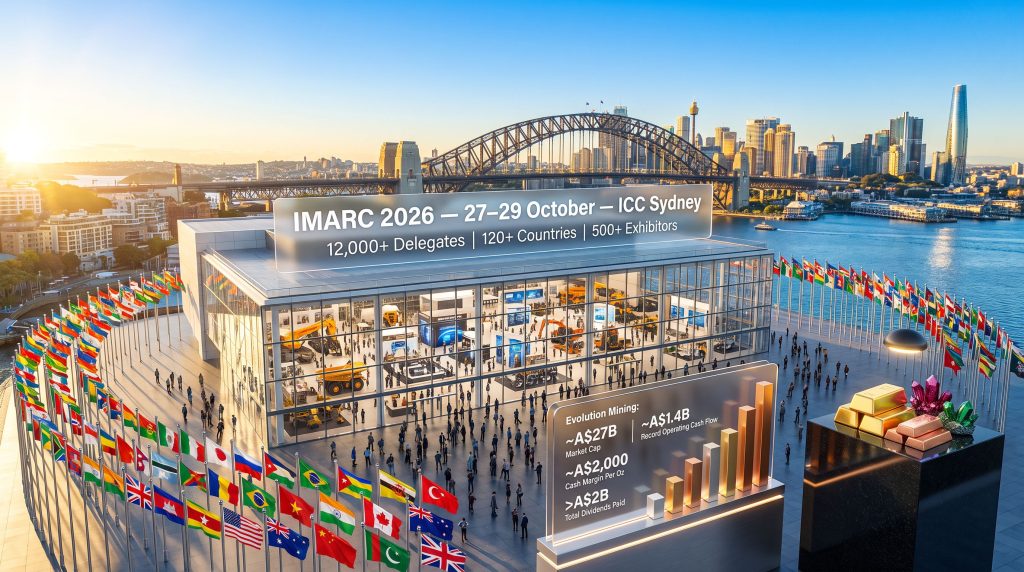
The International Mining and Resources Conference and Expo returns to ICC Sydney from 27 to 29 October 2026, bringing together what is expected to be a record-breaking gathering of global resources industry participants. Located at 14 Darling Drive in Sydney's Darling Harbour precinct, the ICC provides one of the Asia-Pacific region's most capable convention and exhibition facilities, with the infrastructure to accommodate the full scope of what IMARC has become.
The numbers behind the 2026 event tell a story of genuine scale:
- 12,000+ delegates expected across three days
- 120+ countries represented in the attendee base
- 500+ exhibitors and solution providers across the expo floor
- 20,000 sqm of exhibition space dedicated to mining equipment, technology, and services
- 50+ national government delegations, including all Australian state and territory administrations
- 500+ speakers drawn from across the full industry value chain
The conference serves as the centrepiece of Australia's International Mining Week, a broader programme of events that makes Sydney one of the world's most concentrated hubs for mining intelligence during that October window.
Who Attends the IMARC Mining Conference Sydney?
The delegate mix at IMARC is one of the event's most distinctive features. Unlike narrowly focused commodity conferences, IMARC draws participants from every segment of the value chain, creating a cross-sector environment that facilitates both technical knowledge exchange and commercial deal-making.
| Delegate Category | Representative Examples |
|---|---|
| Mining Operators | Major gold, copper, coal, and rare earths producers |
| Technology and Equipment Providers | METS companies across 500+ exhibitor slots |
| Government Delegations | Representatives from 50+ nations including all Australian states |
| Investors and Capital Allocators | Royalty companies, commodity traders, institutional funds |
| Industry Bodies and Policy Advisors | Global transparency initiatives, critical minerals envoys |
The Central Strategic Question Driving the 2026 Agenda
EY's Global Head of Mining and Metals, Paul Mitchell, has articulated what he describes as the defining challenge facing mining leadership in 2026: how to deliver reliable growth when supply constraints are deepening, cost structures are higher than prior cycles, and volatility has become a semi-permanent feature of the operating environment rather than an exception to it.
The answer, Mitchell argues, requires a fundamental shift in how miners think about capital deployment. Discipline and execution certainty have become the dominant metrics, replacing the volume-first thinking that characterised the last commodity supercycle. This framing is not merely rhetorical. It reflects genuine structural pressure across the industry.
Three forces are driving this recalibration, furthermore illustrating why mining industry consolidation has accelerated in recent years:
- Capital discipline in a higher-cost, lower-liquidity funding environment where investor scrutiny of project returns has intensified
- Execution certainty as project complexity increases due to deeper orebodies, more remote locations, and tighter community and regulatory expectations
- Volatility management across intersecting commodity cycles, energy costs, and geopolitical supply chain risks
The practical implication is that operational excellence has replaced volume growth as the KPI that matters most to institutional investors and boards. Companies that can demonstrate consistent margin superiority are commanding structural valuation premiums over peers that simply report higher output numbers.
Who Is Speaking at IMARC 2026?
Industry Operators: Execution-Focused Leadership on Display
The operator roster at IMARC 2026 reflects the diversity of the modern mining industry, spanning gold, copper, iron ore, coal, rare earths, and contract mining services.
| Speaker | Organisation | Role |
|---|---|---|
| Marley Palin | BHP | Vice President, Innovation |
| Katie Charuga | Fortescue | Director, Integrated Operations |
| Ion Hann | Agnico Eagle (Australian Operations) | Vice President |
| Elsabe Muller | Alcoa Australia | President |
| Lawrie Conway | Evolution Mining | Chief Executive Officer |
| Jake Klein | Endura Mining | Executive Chair |
| Tony Egan | Glencore | Project Governance Manager |
| Chad Burrows | Hancock Iron Ore | Head of Digital Innovation |
| Daniel Havas | Lynas Rare Earths | VP Strategy |
| Misha Fazen | Whitehaven Coal | Group Systems, Data and AI HSE Manager |
| Vanessa Torres | Perenti | Chief Executive Officer |
Policy, Investment, and Global Governance Voices
Alongside the operational leadership contingent, IMARC 2026 has assembled a policy and investment speaker lineup that reflects the increasingly geopolitical nature of the mining industry. In particular, the mining geopolitics dimension of the 2026 programme is more prominent than in any previous edition of the conference.
| Speaker | Organisation | Focus Area |
|---|---|---|
| Maria van der Hoeven | Extractive Industries Transparency Initiative | Governance and Transparency |
| Gracelin Baskaran | Center for Strategic and International Studies (Washington) | Critical Minerals Security |
| Benjamin Gallezot | French Government | Critical Minerals Envoy |
| Terry Heymann | World Gold Council | Strategy |
| Abigail Hunter | Securing America's Future Energy (SAFE) | Energy Security |
| Mark Kristoff | Traxys | Commodity Trading |
| Kevin McElligott | Franco-Nevada Australia | Royalty Finance |
| Jason Chang | EMR Capital | Mining Investment |
| Rick Rule | Independent | Mining Investment Strategy |
The presence of national critical minerals envoys from both France and the United States alongside Washington-based geopolitical analysts signals that the IMARC mining conference Sydney has evolved well beyond its operational origins. It now functions as a parallel forum for supply chain strategy and minerals diplomacy.
How Leading Mining Companies Are Delivering Superior Returns
Agnico Eagle: The Tier-One Jurisdiction Philosophy
Agnico Eagle's Australian operations VP Ion Hann has articulated a strategy that the company describes as straightforward in principle but demanding in execution. The framework rests on two non-negotiable pillars.
The first is jurisdictional quality. Agnico Eagle operates exclusively in regions where rule of law, tenure security, and community relationships are structurally embedded rather than politically contingent. This deliberately limits the addressable project universe but eliminates a category of risk that has destroyed capital for other operators.
The second pillar is orebody longevity. Rather than optimising single-mine economics, Agnico Eagle targets geological systems capable of sustaining multiple mine developments across multiple decades. The company embeds itself in regional communities and uses that local presence as the foundation for long-duration exploration and development pipelines.
Australia figures prominently in this framework. Agnico Eagle holds the only modern processing plant of meaningful scale in the Central Victorian goldfield at Fosterville, and the company's assessment of the broader Bendigo goldfield is striking. Based on geological analysis of the Victorian goldfield system, Agnico Eagle believes the volume of gold yet to be discovered beneath the region is comparable to everything that has already been extracted from Bendigo historically.
That is a substantial claim about a goldfield that has been producing since the 1850s and yielded tens of millions of ounces over its known history. The company is also monitoring Pine Creek in the Northern Territory as a potential future growth vector, further demonstrating the regional embedding approach that defines its strategy.
Evolution Mining: Margin Leadership as a Structural Advantage
Evolution Mining's story over its 17-year corporate life represents one of the most instructive case studies in disciplined capital allocation within the Australian gold sector. The company, now carrying a market capitalisation of approximately A$27 billion, has built its track record on a consistent philosophy: margin superiority matters more than production scale.
The numbers that underpin this approach are compelling:
| Metric | Evolution Mining Performance |
|---|---|
| Corporate Lifespan | 17 years |
| Market Capitalisation | ~A$27 billion |
| 2026 Record Operating Cash Flow | ~A$1.4 billion |
| Cash Margin Per Gold Ounce | ~A$2,000 (after A$1.1B reinvestment) |
| Average Annual Return on Investment | ~18% per annum |
| Production Growth | ~3x increase over 10 years of acquisitions |
| Ore Reserve Growth (per share) | +43% over 17-year corporate life |
| Total Dividends Paid | More than A$2 billion |
| Shareholder Return Policy | 50% of free cash flow returned |
A 12-year industry analysis conducted by Canaccord Genuity examined gold producer margins from 2015 through to the present, and found that while sector-average margins have been on a rising trend, Evolution Mining exceeded that industry average in every single year across that period. The company's cash generation per ounce has been consistently superior to comparable peers throughout what is actually a structurally favourable period for the entire sector.
The copper diversification strategy adds another layer of resilience. Through ownership of Northparkes in New South Wales and Ernest Henry in Queensland, Evolution generates approximately 20% of its revenue from copper-equivalent income. This natural hedge against gold price volatility provides meaningful earnings stability during periods when gold underperforms.
CEO Lawrie Conway has been direct about the philosophy: in a gold market offering strong pricing, the most defensible business model is one with structurally high margins rather than structurally high volumes. Growing reserves per share by 43% over 17 years while simultaneously tripling production and paying out more than A$2 billion in dividends reflects an unusual degree of capital allocation discipline.
The Workforce Dimension: Culture as a Competitive Asset
IMDEX and the New Employee Value Proposition in Mining Technology
The talent competition in mining and mining technology has intensified significantly as salary levels have risen across both sectors. IMDEX, the mining technology sector's first publicly listed company to reach a A$2 billion market capitalisation, has made a deliberate move to differentiate its employment offering rather than compete purely on compensation.
In August 2026, the company announced it was doubling its paid parental leave entitlement to 24 weeks, extending the enhanced benefit to its approximately 830 employees across more than 40 countries. The policy applies to the 65% of its workforce located outside Australia, making it a genuinely global workforce investment rather than a domestic compliance exercise.
The company's people leadership framed this decision around a principle that reflects broader thinking in human capital management: organisations that wait until they experience a talent crisis before improving their employee value proposition are already behind. Three dimensions of workforce expectation are driving this evolution across high-salary sectors like mining technology:
- Culture – values alignment, psychological safety, and genuine inclusion rather than performative commitments
- Flexibility – adaptable working arrangements that acknowledge employees have meaningful lives outside work across all career stages
- Employee benefits – support structures that are life-stage relevant, financially meaningful, and inclusive across diverse workforce demographics
Parental leave sits at the intersection of all three. It signals cultural values, enables life-stage flexibility, and provides a tangible financial benefit that resonates with a workforce that skews younger in technology roles. For a company operating across 40+ countries with varying baseline standards, extending a globally consistent premium benefit also communicates something important about how the organisation views its international workforce.
The next major ASX story will hit our subscribers first
What the METS Expo Delivers for Mining Operators
The 20,000 sqm expo floor at IMARC 2026 is where the conference's deal-making function becomes most tangible. More than 500 of the world's leading mining equipment, technology, and services companies will present products and solutions directly to operational decision-makers. Consequently, AI mining efficiency tools and platforms are among the most prominent categories represented on the exhibition floor this year.
For site operators specifically, IMARC has created structured access pathways that remove the cost barrier:
- The Mining Guest Pass provides eligible site operators, leaders, and teams with complimentary access to both the conference and exhibition
- The Mining Operators and Capability (MOC) Program offers structured engagement opportunities beyond general floor access
- MOC Courses provide technical and operational development content
- The Hosted Buyer Program facilitates targeted connections between operators and relevant technology providers
These programmes reflect IMARC's understanding that the conference's value to the broader industry depends on ensuring operational practitioners are present alongside the executives, investors, and technology providers who make up the bulk of the paying delegate base.
Critical Minerals, Geopolitics, and IMARC's Evolving Identity
The presence of France's critical minerals envoy, a Washington-based minerals security analyst from the Center for Strategic and International Studies, and the executive director of Securing America's Future Energy on the same programme as gold producers and iron ore operators marks a genuine evolution in what the IMARC mining conference Sydney represents.
Critical minerals demand has transitioned from a niche policy discussion into a mainstream strategic concern for governments across the developed world. The anxiety driving this shift is structural rather than cyclical: advanced economies have recognised that the raw material inputs for energy transition technologies, defence systems, and digital infrastructure are heavily concentrated in a small number of producing jurisdictions and processing countries.
Government delegations from more than 50 nations attending IMARC 2026 are not simply there to observe. They are engaged in active investment attraction, supply chain partnership development, and policy benchmarking. This governmental dimension transforms the conference from a purely commercial event into a forum where national resource strategies are tested against market realities. In addition, mining finance trends from emerging markets are increasingly informing how developed economies approach supply chain resilience planning.
Five Strategic Signals Emerging from the 2026 Program
The shape of the IMARC 2026 agenda, viewed collectively, points to several shifts in how the global mining industry is positioning itself for the next phase of the commodity cycle:
- Capital discipline has replaced volume ambition as the primary growth metric across major producers, with margin per unit of production carrying more weight than headline output figures
- Jurisdictional quality is being re-evaluated globally as geopolitical risk increases and the cost of operating in complex regulatory environments rises
- Critical minerals diplomacy has become a mainstream conference topic, with national envoys and geopolitical analysts now occupying the same speaking programme as mine operators
- Workforce culture is emerging as a competitive differentiator alongside financial returns, particularly as the mining technology sector competes with broader tech industry for skilled professionals
- Technology integration is accelerating across the full value chain, from AI-driven health and safety management systems to digital operations platforms that connect remote sites with centralised analytics
Frequently Asked Questions: IMARC Mining Conference Sydney
What is the IMARC mining conference?
IMARC, the International Mining and Resources Conference and Expo, is Australia's largest annual mining event. It brings together operators, investors, technology providers, and government delegations from more than 120 countries to examine the future direction of the global resources sector.
Where is IMARC held in Sydney?
IMARC takes place at ICC Sydney, located at 14 Darling Drive, Sydney, New South Wales, in the Darling Harbour precinct.
When is IMARC 2026?
The 2026 event runs from 27 to 29 October 2026.
How many people attend IMARC?
The 2026 event is tracking toward record attendance, with more than 12,000 delegates expected from over 120 countries.
Can mining operators attend IMARC for free?
Yes. Eligible site operators, leaders, and teams can apply for a Mining Guest Pass providing complimentary access to both the conference and exhibition components of the event.
What topics does IMARC 2026 cover?
Core themes include operational excellence, technology and digital innovation, critical minerals strategy, project development and delivery, investment returns, workforce culture, and global geopolitical risk.
How many exhibitors participate in IMARC?
More than 500 mining equipment, technology, and services companies are expected to exhibit across the 20,000 sqm expo floor, making it one of the largest dedicated mining industry exhibitions in the Asia-Pacific region.
Disclaimer: Financial figures, attendance estimates, and corporate performance data referenced in this article are drawn from publicly available sources and company disclosures. Forward-looking statements and production or financial projections involve inherent uncertainty and should not be construed as investment advice. Past performance of individual companies is not a reliable indicator of future results. Readers should conduct independent research before making any investment decisions.
For ongoing coverage of IMARC 2026 programming, speaker announcements, and registration updates, the Australian Mining Review publishes regular resources sector news at australianminingreview.com.au.
Want to Catch the Next Major ASX Mineral Discovery Before the Market Does?
Discovery Alert's proprietary Discovery IQ model delivers real-time alerts on significant ASX mineral discoveries, turning complex geological data across 30+ commodities into clear, actionable investment insights — ideal for both short-term traders and long-term investors seeking a market-leading edge. Explore why historic mineral discoveries have generated extraordinary returns and begin your 14-day free trial today to position yourself ahead of the broader market.