August 14, 2026
Perth, the Pilbara, and the Power of Proximity: Why WA Mining Defines Industry Direction
Few sectors in the world concentrate decision-making authority quite like Australian mining does within a single metropolitan area. While the ore bodies themselves stretch across thousands of kilometres of Western Australian terrain, the contracts, capital allocation decisions, procurement approvals, and technology investments that shape those operations are largely resolved within a compact corridor of Perth's central business district.
The headquarters of BHP and Rio Tinto occupy buildings just streets apart in Perth's CBD. Mineral Resources, Newmont's Australian operations, and dozens of major contractors and service firms are similarly concentrated in the same urban zone. This geographic compression of executive authority creates a procurement environment unlike anything available through digital channels or interstate events. It also explains why the WA Mining Conference and Exhibition has become the most strategically valuable gathering on the Australian mining industry calendar.
When big ASX news breaks, our subscribers know first
What Is the WA Mining Conference and Exhibition?
The WA Mining Conference and Exhibition is Western Australia's flagship annual mining industry event, organised by Prime Creative Media and held at the Perth Convention and Exhibition Centre. The format combines a free-access exhibition floor with a separately ticketed conference program, networking sessions, and sector-specific seminars designed to move knowledge from presentation stage to commercial conversation with minimal delay.
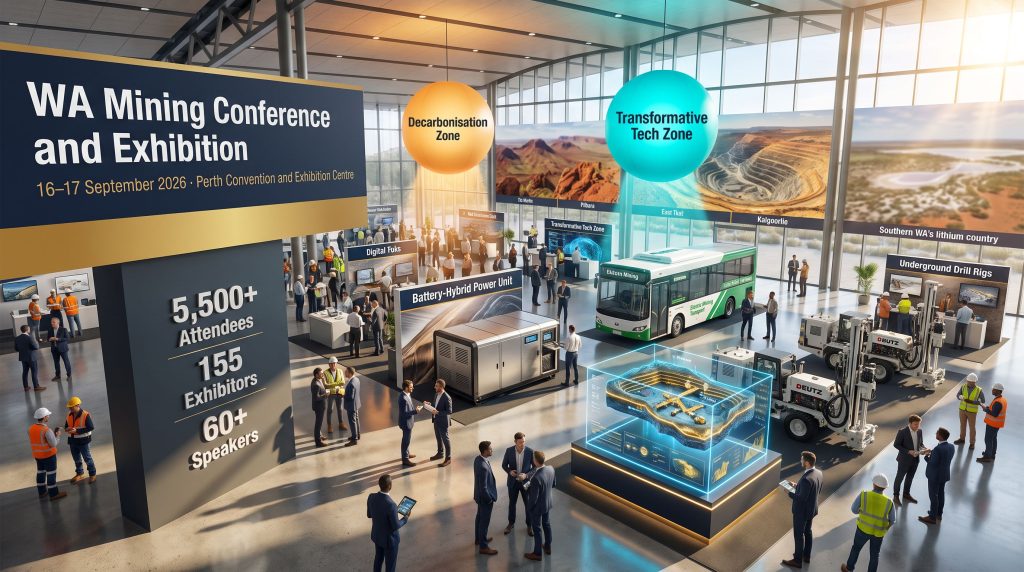
The 2026 edition is scheduled for 16 and 17 September at the Perth Convention and Exhibition Centre. The numbers from the 2025 event illustrate the scale of demand. For a broader WA Mining event preview, the context behind these figures becomes even clearer:
| Detail | 2026 Information |
|---|---|
| Event Name | WA Mining Conference and Exhibition |
| Date | 16–17 September 2026 |
| Venue | Perth Convention and Exhibition Centre |
| Organiser | Prime Creative Media |
| 2025 Attendance | 5,500+ attendees |
| 2025 Exhibitors | 155 exhibitors |
| 2025 Conference Speakers | 60+ speakers |
| Attendees with Purchasing Authority | ~50% |
The event has sold out in consecutive years, a signal that industry appetite for face-to-face engagement with suppliers and peers has not softened despite the proliferation of digital procurement channels. Critically, approximately half of the 2025 attendee base held active purchasing authority, a conversion metric that rivals or exceeds most comparable B2B events in the resources sector globally.
The Geography Behind the Gathering
Understanding why this event carries the weight it does requires understanding how Western Australia's mining economy actually functions. The Pilbara generates iron ore on a scale that makes it one of the most productive mining regions on the planet. The Goldfields around Kalgoorlie remain central to Australia's gold output. The state's southern regions have emerged as a focal point for lithium operations tied to the global battery supply chain.
Each of these commodity domains operates under a different set of geological conditions, cost pressures, and procurement priorities. Yet the executive and operational decision-making for nearly all of them flows back through Perth. That centralisation makes a Perth-based exhibition uniquely efficient for suppliers, who can access procurement leads across multiple commodity verticals within a single two-day window, something that would otherwise require months of individual site visits across hundreds of kilometres. Furthermore, the WA resources sector impact on national economic output reinforces just how significant this concentration of decision-making truly is.
How the WA Mining Conference and Exhibition Compares to Other Australian Events
Australia's mining events calendar is reasonably well populated. Queensland Mining Expo covers the east coast market, AIMEX addresses broader mining and quarrying audiences, and various commodity-specific conferences serve niche segments. What distinguishes the WA Mining Conference and Exhibition is the concentration of purchasing authority among its attendees combined with its physical proximity to where the sector's biggest operators are headquartered.
East coast events, while valuable, require Western Australia-based procurement leads to travel. Many do not. The supplier who exhibits in Perth encounters decision-makers in their home operating environment, often between other scheduled meetings, with the mental bandwidth to evaluate solutions properly rather than in passing.
The relationship continuity dimension also matters. Exhibitors who return annually build familiarity with procurement teams across successive editions, compressing the trust-building timeline that typically precedes high-value supplier contracts. In capital-intensive industries like mining, where equipment and service decisions carry multi-million-dollar consequences, that accumulated relationship equity is commercially significant. In addition, the broader WA resources contribution to national GDP underscores why getting procurement relationships right in this market matters so profoundly.
What Themes Are Driving the 2026 WA Mining Conference Agenda?
Decarbonisation as Operational Infrastructure, Not Aspiration
The most structurally significant shift visible in the 2026 program is the elevation of decarbonisation from a conference topic to a dedicated exhibition zone. This reflects a broader industry transition: emissions reduction targets have moved from aspirational sustainability commitments to embedded procurement criteria. Operators are now requiring suppliers to demonstrate how their products contribute to measurable emissions outcomes, not simply whether they are compatible with existing systems. For context on how these mining electrification trends are reshaping the sector, the shift is both rapid and far-reaching.
The Decarbonisation Zone at the 2026 event brings together technologies responding to this tightening operational requirement across two key areas: power and transport.
On the power side, Pitmaster, a privately owned Australian company, is exhibiting mine-specification lighting towers, power generation units, battery-hybrid systems, diesel generation sets, and Battery Energy Storage Systems (BESS) purpose-built for the harsh environmental and operational conditions of Australian industrial and mining sites. The distinction between off-the-shelf power equipment and mine-spec hardware is meaningful in practice. Remote Australian mine sites contend with extreme temperature ranges, dust ingress, vibration from heavy equipment, and isolation from grid infrastructure, conditions that eliminate a substantial proportion of commercially available equipment from practical consideration.
Workforce transport electrification occupies the same zone. VDI Australia, the national distributor of Yutong buses and coaches, is presenting a range spanning 23 to 57 seat capacity configurations, available in either Euro 6 diesel or full-electric powertrain formats. Each variant is engineered for Australian conditions and supported by a national service network, a procurement consideration that is often underweighted in initial evaluations but becomes critical when a vehicle breaks down 200 kilometres from the nearest service centre.
International OEM Market Entry: A Credibility Signal for the Sector
One of the more noteworthy developments for the 2026 event is the Australian market launch of GST Mining Machines, a South African original equipment manufacturer with more than two decades of operational history supplying underground mining equipment to major global operators including Anglo American, Glencore, Harmony, Samancor, and West Wits.
The company operates a fleet of more than 400 mechanised machines across global mine sites and builds its underground systems around a set of engineering specifications selected for their proven harsh-environment reliability:
- Deutz engine platforms, widely regarded for their air-cooled and water-cooled durability in remote and underground conditions
- Bosch Rexroth hydraulic systems, an industry benchmark for precision hydraulic control in demanding applications
- Montabert HC28 drifter technology, used in the company's drill rig configurations for underground rock drilling operations
The decision by an OEM of this profile to use the WA Mining Conference and Exhibition as its Australian launch platform speaks to the event's standing as a credible market entry point for international suppliers seeking to establish distribution and service relationships with Australian operators.
What Emerging Technologies Will Be Showcased at WA Mining 2026?
Digital Engineering and Simulation: Thirty Years of Applied Expertise
The Transformative Tech Zone functions as an early-access environment for site-ready innovation, and the exhibitor profile for 2026 illustrates how extensively the definition of mining technology has expanded beyond physical equipment.
LEAP Australia brings three decades of applied digital engineering to the exhibition floor. The company's work spans multiple simulation disciplines that are increasingly central to modern mining engineering practice:
- Particle and discrete element modelling (DEM) for bulk materials handling equipment, used to simulate how bulk solids behave under real operating conditions before physical prototypes are built
- Multi-physics simulation covering flow, thermal, structural, and fatigue analysis, allowing engineers to model how equipment will perform under combined physical stresses
- 3D computer-aided design (CAD) and product lifecycle management (PLM) for engineering documentation and design continuity
- Digital twin development for operational asset management, creating virtual replicas of physical assets that update in real time from sensor data
The software ecosystem LEAP Australia works within includes platforms from Ansys, Synopsys, and PTC, vendors whose tools are embedded across aerospace, automotive, and industrial engineering globally. Their application to the mining and minerals sector, where bulk materials handling alone involves extraordinary complexity in flow dynamics and structural loading, represents a significant capability transfer.
Integrated Mine Planning: Closing the Data Silo Problem
One of the least visible but most consequential inefficiencies in large mining operations is the fragmentation of data across functional departments. Geology, mining operations, processing, maintenance, logistics, workforce management, and finance typically each carry their own data systems, reporting cadences, and planning horizons. The result is that decisions made in one domain routinely create unforeseen consequences in another.
Cubewise addresses this problem through specialisation in IBM Planning Analytics, a platform designed to integrate mine-wide data into a single operational view. The planning coverage runs from long-range mine schedules through medium-term production plans to weekly operational forecasts and executive financial reporting. The practical implication is that a change in geological assumptions can flow through to financial projections automatically, rather than requiring a manual reconciliation cycle that typically takes days and introduces human error.
AI-Native Operating Systems for Mining Contractors
DrilLedger is bringing an AI-native operating system to the Transformative Tech Zone that targets the administrative burden carried by mining contractors, a cost centre that rarely receives the same analytical attention as operational expenditure but can be equally limiting for business growth. The broader potential of AI mining efficiency tools is already being felt across the sector, and DrilLedger's platform represents a practical application of that capability at contractor level.
The platform deploys 17 specialised AI agents across four operational desks:
- People and workforce management covering rostering, compliance, and personnel administration
- Safety and compliance monitoring tracking regulatory obligations and incident reporting
- Operations and maintenance coordination managing work orders, equipment status, and scheduling
- Commercial and financial administration handling invoicing, contracts, and cost tracking
The efficiency case the company presents is specific: automating these administrative functions allows a contractor to absorb additional sites, contracts, or workforce intakes without expanding head office staff, with the recovered administrative labour valued at more than $500,000 per year per operation. For contractors operating at margins typical of the mining services sector, that figure represents a structurally meaningful improvement in profitability per contract.
Organisational Intelligence: The Knowledge Retention Problem
A less discussed but commercially significant challenge in the mining sector is the loss of institutional knowledge when experienced personnel leave. In complex mine sites where operational decisions carry consequences measured in millions of dollars, the tacit knowledge held by senior engineers, metallurgists, and mine planners represents an asset that rarely appears on a balance sheet but profoundly affects operational continuity.
Paul Peter, with more than three decades of experience helping mining organisations navigate high-stakes operational decisions, is presenting an exclusive first look at Remi, an organisational intelligence platform designed to connect information, expertise, and decision context across distributed mine sites. The platform's core proposition is that it preserves institutional memory through documented decision frameworks, enabling organisations to retain operational intelligence that would otherwise leave when key personnel move on.
This capability is particularly relevant in the current environment, where experienced mining professionals are in high demand and workforce mobility is elevated across the sector.
Heavy Transport Engineering: The Physical Backbone
JOST Australia, part of the global JOST World network, represents the hardware dimension of the Transformative Tech Zone. The company exhibits engineered heavy-transport components including fifth wheels, landing gear, turntables, hydraulic systems, towing equipment, and safety couplings, each adapted to Australian operating conditions. These components form the physical connection points within mining supply chains, and their engineering specification directly affects transport reliability on haul roads where downtime carries significant cost consequences.
How Should Suppliers Approach the WA Mining Exhibition Floor?
Strategic Positioning for Western Australian Market Entry
For suppliers entering the Western Australian market, the exhibition floor offers something that field sales visits and digital marketing cannot replicate: compressed access to a concentrated buyer population. An operator attending the event can benchmark competing solutions from multiple suppliers within a single morning, ask technical questions, and observe live demonstrations before returning to site to initiate procurement conversations.
The commodity diversity of Western Australia's mining sector means that exhibitors willing to adapt their messaging across iron ore, gold, and lithium procurement contexts will extract disproportionate value from the event. No two operations share identical pressures, and the ability to reframe a product's value proposition in real time, based on the specific operational context a visitor describes, is what separates effective exhibitors from those who collect business cards without advancing commercial relationships.
The Conference-to-Floor Conversion Pathway
The physical layout of the Perth Convention and Exhibition Centre creates a dynamic that is structurally unique to this event. The conference theatre and the exhibition floor are within close walking distance of each other, which means that a question raised during a presentation can become a direct supplier conversation within minutes. A procurement lead who hears a speaker discuss a specific operational challenge, and then walks past an exhibitor addressing that exact challenge, is operating in a significantly higher intent state than one who encounters the same exhibitor through a cold digital channel.
Pre-event preparation amplifies this dynamic further. Suppliers who study the conference program, identify sessions whose themes align with their solutions, and position themselves accordingly on the exhibition floor are more likely to intercept high-intent buyers during the natural post-session flow. Those planning ahead can review the full official event details to ensure their preparation is as targeted as possible.
The next major ASX story will hit our subscribers first
Who Should Attend the WA Mining Conference and Exhibition in 2026?
| Attendee Type | Primary Value Proposition |
|---|---|
| Mining Executives | Strategic networking, market intelligence, peer benchmarking |
| Procurement and Operations Leaders | Direct supplier access, live equipment evaluation |
| Engineers and Technical Specialists | Simulation, digital twin, and design technology exposure |
| Mining Contractors and Service Providers | New client acquisition, existing client relationship management |
| International OEMs and Suppliers | Australian market entry, brand positioning, distribution partnerships |
| Government and Regulatory Stakeholders | Industry engagement, policy alignment, ESG progress monitoring |
First-time exhibitors should consider booth placement relative to the two dedicated zones. The Decarbonisation Zone and the Transformative Tech Zone each attract distinct visitor profiles, and positioning within the appropriate zone significantly affects the quality of foot traffic. Post-event follow-up frameworks matter equally: the compressed format of a two-day exhibition means that the commercial value of conversations made on the floor is largely determined by the quality of engagement that follows in the weeks after.
The Broader Strategic Value of WA Mining for Australia's Resource Sector
Annual Gatherings as Intelligence Infrastructure
In a sector where mine sites are routinely hundreds of kilometres from corporate headquarters, concentrated industry events serve a function that extends beyond networking. They operate as intelligence infrastructure, compressing into two days the market awareness that would otherwise take months of distributed relationship-building to accumulate.
Attendees who participate across multiple successive editions gain something additionally valuable: a longitudinal view of technology adoption curves and supplier evolution. The exhibitor mix at any given year's WA Mining Conference and Exhibition is itself a leading indicator of where operational and capital focus is moving across the sector. The growing prominence of AI platforms, digital twins, and integrated planning tools in the 2026 program, relative to equipment-only exhibitions of earlier years, signals a structural shift in how Western Australian mining operators are conceptualising operational efficiency.
What the 2026 Edition Signals for Mining's Next Phase
Consecutive sell-outs are not simply an event management achievement. They reflect sustained industry investment appetite and a recognition that the procurement relationships and market intelligence available at the WA Mining Conference and Exhibition cannot be efficiently replicated through alternative channels.
The three structural themes visible across the 2026 program — decarbonisation, digital integration, and workforce and organisational intelligence — are not independent trends. They are converging pressures that collectively describe the operating environment Australian mining will inhabit for the foreseeable future. Events that place suppliers and buyers within the same physical space, at the moment those pressures are being actively managed, occupy a position in the procurement cycle that no digital platform has yet been able to displace. Those interested in registering or planning attendance can find further detail through the PCEC event listing for the 2026 edition.
Readers seeking additional coverage of Western Australian mining industry events and sector developments can explore related editorial content published by Australian Mining at australianmining.com.au, including event previews, exhibitor profiles, and technology features aligned with the WA Mining Conference and Exhibition program.
This article contains forward-looking assessments of industry trends and event outcomes. Readers should note that exhibitor participation, attendance figures, and event formats are subject to change. This content is informational in nature and does not constitute financial or investment advice.
Want to Spot the Next Major ASX Mineral Discovery Before the Market Moves?
While WA Mining 2026 showcases where the sector is heading operationally, Discovery Alert's proprietary Discovery IQ model ensures investors are positioned ahead of significant ASX mineral discoveries the moment they are announced — explore the historic returns major discoveries have generated and begin a 14-day free trial to secure a real-time market advantage.