August 14, 2026
The Industrial Crossroads: Why Commodity Exporters Must Choose a Different Path
For most of the twentieth century, resource-rich nations operated on a simple economic premise: extract what lies underground, ship it abroad, and collect revenue at the border. That model built ports, roads, and government budgets, but it rarely built industries. The nations that transformed their resource wealth into lasting economic power did so by asking a different question, not what they could extract, but what they could make from what they extracted.
South Africa stands at precisely this crossroads. Its mineral endowment is extraordinary, spanning platinum group metals (PGMs), iron ore, manganese, chromite, vanadium, and a suite of critical minerals demand increasingly central to the global energy transition. Yet for decades, the dominant export profile has remained oriented toward primary and semi-processed materials, with value capture occurring elsewhere, in refineries, manufacturing facilities, and technology laboratories in Europe, Asia, and North America.
The case for accelerating the local development of value-adding technology in South Africa has never been stronger, and several recent domestic breakthroughs demonstrate that the capability already exists.
When big ASX news breaks, our subscribers know first
Three Milestones That Signal a Turning Point
Before examining the structural barriers and policy landscape, it is worth grounding the discussion in concrete technological progress already achieved on South African soil.
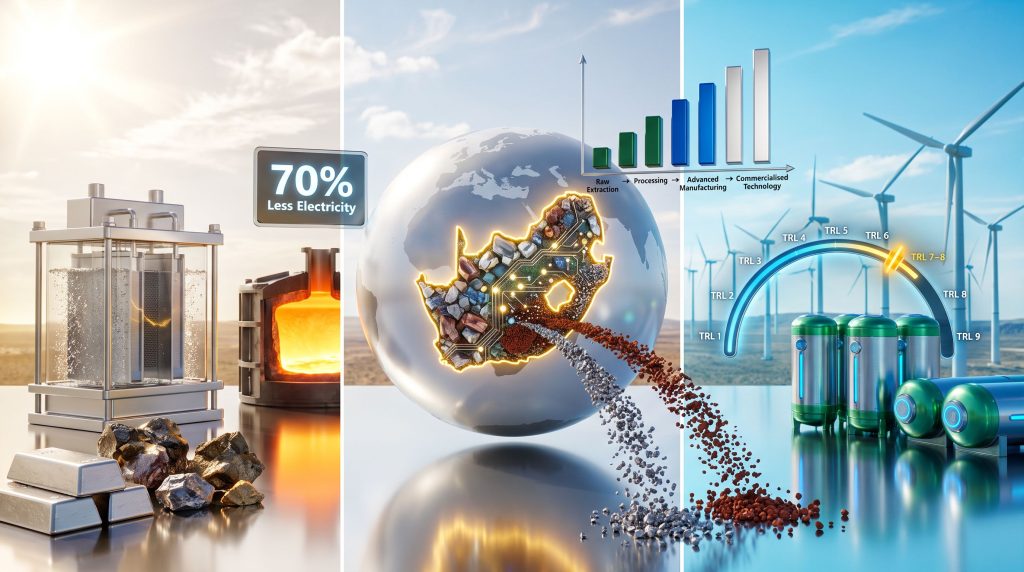
First, a locally developed 2 kW proton exchange membrane (PEM) electrolyser system has reached commissioning stage, the product of cross-sector collaboration between research institutions and industrial partners. This is not a purchased or licensed foreign system assembled domestically. It is South African-originated hydrogen technology.
Second, a new South African smelting process has been developed that requires 70% less electricity than conventional smelting methods. In a country where electricity constraints have historically suppressed industrial competitiveness, this is not merely an engineering achievement but a potential structural shift in how South African mineral processing can be positioned globally.
Third, domestically advanced ultra-high-dense-media separation (UHDMS) processing technology is now positioned to significantly increase the proportion of premium-grade iron ore produced from South African deposits, directly relevant to a global steel industry increasingly rewarding high-grade, low-impurity feedstock.
These three examples share a common characteristic: they represent genuine technology development, not assembly of imported components, but South African design, engineering, and intellectual property.
Understanding the Value Chain: From Rock to Revenue
The distinction between raw extraction and value-adding technology development is often misunderstood, even in policy circles. A simplified way to visualise the progression:
| Stage | Activity | Value Captured Locally |
|---|---|---|
| Stage 1 | Raw extraction and ore mining | Minimal |
| Stage 2 | Basic beneficiation and processing | Low to moderate |
| Stage 3 | Advanced manufacturing and refining | Moderate to high |
| Stage 4 | Technology design and IP commercialisation | Maximum |
South Africa has a well-developed Stage 1 and improving Stage 2 capability. The ambition, and the opportunity, lies in progressing systematically toward Stages 3 and 4. The difference between exporting raw chrome ore and exporting a locally designed furnace technology capable of processing chrome ore at 70% lower energy cost illustrates the magnitude of value being left on the table.
Where South Africa Holds a Natural Technology Advantage
Not every technology sector is equally accessible to every nation. Successful industrial upgrading historically concentrates in areas where existing resource or knowledge endowments create a defensible starting position. South Africa has several such positions.
Platinum Group Metals and the Hydrogen Technology Connection
South Africa holds an estimated 70 to 80 percent of global PGM reserves, according to the United States Geological Survey. PGMs, particularly platinum and iridium, are critical components in PEM electrolyser technology membrane electrode assemblies and in hydrogen fuel cell stacks. This creates an unusual strategic alignment: the country that supplies the raw material for hydrogen technology also has the industrial and research infrastructure to develop that technology domestically.
South Africa's PGM resource base gives it a material cost advantage in developing PEM electrolyser and fuel cell technology that no other nation can easily replicate. The feedstock and the intellectual opportunity sit in the same geography.
The commissioning of a locally developed 2 kW PEM electrolyser is a relatively modest scale milestone, but Technology Readiness Level (TRL) frameworks contextualise its importance. Reaching a commissioned working system at TRL 7 to 8 represents crossing one of the most difficult thresholds in industrial technology development.
Energy-Efficient Smelting: Turning a Structural Weakness into an Advantage
South Africa's constrained electricity supply has historically been framed as a competitiveness liability. The development of a smelting process requiring 70% less power reframes that liability as an innovation driver. Technologies developed under resource constraints often prove highly exportable to markets facing similar limitations, including across sub-Saharan Africa and other emerging industrial economies.
Energy-efficient smelting is also directly aligned with global ESG investment criteria. As steelmakers, battery manufacturers, and industrial processors face mounting pressure to reduce Scope 3 emissions across their supply chains, low-energy processing inputs will increasingly command premium positioning. Furthermore, the green iron production movement globally is accelerating demand for precisely these kinds of lower-emissions processing solutions.
UHDMS and the Premium Iron Ore Opportunity
The global iron ore market has undergone a significant quality bifurcation. As electric arc furnace (EAF) steelmaking expands and blast furnace operators seek to reduce coking coal consumption, demand for high-grade iron ore with low silica and alumina content has grown substantially. Benchmark iron ore pricing increasingly reflects a grade premium, with high-grade material (above 65% Fe) commanding meaningful price differentials over standard 62% Fe benchmark grades.
Ultra-high-dense-media separation works by exploiting density differences between iron-bearing minerals and gangue material, enabling far more precise separation than conventional jigging or spiral concentration. Domestically advancing this technology positions South Africa to compete more effectively against Australian and Brazilian producers in the high-value segment of the iron ore market. In addition, the broader green iron production shift occurring internationally underscores how premium feedstock quality is becoming a decisive competitive variable.
The Policy Framework: What Exists and Where the Gaps Are
Technology Localisation Programme and Industrial Support Architecture
South Africa's Department of Trade, Industry and Competition (DTIC) administers the Technology Localisation Programme (TLP), which provides support across skills transfer, equipment access, manufacturing system design, and grants for technologies approaching commercial readiness. When connected to local procurement mandates, this creates a demand-side pull that can anchor early market access for domestically developed products.
The Technology Stations Programme links universities and small manufacturers to shared prototyping facilities and engineering expertise, reducing capital barriers for early-stage innovators. The Technology Innovation Agency (TIA) provides bridge funding between research outputs and commercial deployment. According to TIA's published framework, this bridge funding is structured to specifically address the most vulnerable transition periods in a technology's commercialisation journey.
The TRL Valley of Death: Where Innovation Goes to Stall
Despite these programmes, a critical funding gap persists between proof-of-concept (TRL 4 to 6) and pre-commercial demonstration (TRL 7 to 8). This is where the majority of South African innovations stall.
| TRL Level | Stage | Support Available |
|---|---|---|
| TRL 1 to 3 | Basic and applied research | University funding, NRF grants |
| TRL 4 to 6 | Proof of concept, prototype, pilot | TIA, Technology Stations |
| TRL 7 to 8 | Demonstration, pre-commercial | Limited, key gap zone |
| TRL 9 | Full commercial deployment | Private sector, development finance |
Closing this gap requires dedicated scale-up financing facilities, stronger procurement linkage to state-owned enterprises, and longer-term policy commitment cycles that extend beyond electoral periods. Consequently, the local development of value-adding technology in South Africa depends as much on institutional design as it does on scientific capability.
Lessons From Peer Economies
South Korea's transformation from a technology importer to a global exporter of industrial, automotive, and electronics technology occurred over roughly three decades through deliberate state-anchored industrial policy. Malaysia built export-competitive electronics manufacturing through SEZ clustering and deliberate skills investment. Brazil's local content requirements in oil and gas created real industrial capability, though also demonstrated the risk of poorly designed mandates creating rent-seeking rather than genuine capability.
The selective lesson for South Africa is that consistency of commitment matters more than the specific instrument chosen. Nations that succeeded in technology upgrading maintained industrial policy direction across multiple government administrations, resisted the temptation to abandon programmes during commodity price upswings, and measured success by commercial outputs rather than programme inputs. Research on technology for development in Africa further reinforces that institutional continuity, rather than any single intervention, is the defining variable in sustained industrial transformation.
The next major ASX story will hit our subscribers first
Frequently Asked Questions
What is a proton exchange membrane electrolyser and why does local development matter?
A PEM electrolyser uses a solid polymer electrolyte membrane to separate water molecules into hydrogen and oxygen using electrical current. Local development matters because it builds domestic IP, reduces import dependency for green hydrogen infrastructure, and leverages South Africa's existing PGM supply chain. Furthermore, advances in hydrogen iron ore reduction globally demonstrate how these technologies are converging with steelmaking in ways that reward early movers.
How does UHDMS technology improve iron ore value?
By separating ore particles through precise density differentials in a high-density liquid medium, UHDMS removes gangue minerals with greater precision than conventional methods, producing a higher iron content product that attracts premium pricing in international steel markets.
What funding options exist for South African technology innovators?
Options include TIA bridge funding, DTIC grants through the TLP, Technology Station prototyping support, DSI research funding, and development finance institution (DFI) facilities for more mature technologies approaching commercial scale.
What distinguishes value-adding technology development from beneficiation?
Beneficiation refers primarily to processing raw materials into higher-value intermediate products. Value-adding technology development extends further, encompassing original design, IP creation, prototyping, and commercialisation of novel industrial solutions with domestic and potentially global market applications.
Measuring What Actually Matters
Too often, industrial policy success is measured by inputs: grants disbursed, programmes launched, institutions established. A more rigorous measurement framework would track:
- Number of domestically developed technologies reaching TRL 9 (full commercial deployment)
- Local content percentage achieved in strategic manufacturing sectors
- Patent filings and IP registrations by South African entities
- Technology export revenue as a proportion of total industrial exports
- Jobs created per successfully commercialised technology
These output metrics force accountability for the full journey from laboratory to market, not merely the early stages that are easier to fund and claim credit for.
The Sustained Commitment That Makes the Difference
South Africa possesses the research infrastructure, resource endowment, and industrial base to become a net exporter of value-adding technology in targeted sectors. The PEM electrolyser commissioning, the energy-efficient smelting breakthrough, and the UHDMS advancement are not isolated curiosities. They are evidence of domestic capability that already exists.
What converts capability into sustained industrial competitiveness is not a single policy instrument or a single investment cycle. It is the institutional confidence to back the local development of value-adding technology in South Africa consistently, from early-stage concept through to full commercial deployment, and the structural linkages that ensure domestically developed technologies can access real markets rather than remaining perpetually at demonstration stage.
The resource is already in the ground. The capability is already in the laboratories and engineering facilities. The remaining variable is whether the institutional and financial architecture will match the ambition that South African innovators have already demonstrated.
Readers seeking deeper coverage of South Africa's industrial technology and beneficiation landscape may find value in the sector reporting published by Mining Weekly at miningweekly.com, which regularly covers emerging technology developments across mining, energy, and critical minerals.
This article contains forward-looking analysis and sector observations intended for informational purposes only. It does not constitute financial or investment advice. Readers should conduct independent research before making any investment or business decisions.
Want to Capitalise on the Next Major Mineral Discovery Before the Broader Market Does?
Discovery Alert's proprietary Discovery IQ model delivers real-time alerts on significant ASX mineral discoveries — instantly translating complex mineral data into actionable opportunities for both short-term traders and long-term investors. Explore historic discoveries and the exceptional returns they generated, then begin your 14-day free trial at Discovery Alert to position yourself ahead of the market.