August 13, 2026
The $6 Trillion Problem Hiding Underground
Roughly 95% of all metal ever mined in human history came from deposits designed around one core assumption: that scale equals efficiency. The bigger the mine, the bigger the mill, and the lower the unit cost per tonne processed. This industrial logic has served the sector well for over a century. But it contains a structural blind spot so large that DIGITAL, Canada's Global Innovation Cluster for digital technologies, has placed a dollar figure on it: approximately $6 trillion in potential metal value locked inside narrow-vein deposits that conventional mining economics simply cannot access profitably.
That figure is not a speculative extrapolation. It represents real mineralisation, already identified, often already drilled, in many cases sitting adjacent to historical workings. The metal is present. The problem is geometry. Narrow veins present a width-to-grade profile that defeats bulk extraction. When a conventional drill-and-blast operation targets a vein system measuring less than a few metres across, significant volumes of surrounding unmineralised host rock must be removed alongside the ore. This dilution effect destroys effective head grades before the material even reaches a processing facility. A deposit grading 15 grams per tonne gold at the vein becomes a 3 gram per tonne feed at the mill once barren rock is factored in.
This is the structural problem that Novamera Surgical Mining and RZOLV Technologies are, independently and now collaboratively, attempting to dismantle from opposite ends of the mining value chain.
When big ASX news breaks, our subscribers know first
What Dilution Actually Does to a High-Grade Deposit
The Geometry of Economic Destruction
To understand why narrow-vein deposits have remained stranded for so long, it helps to visualise the physical reality. Mineralisation in these systems does not occur as a broad, flat, predictable blanket. It occurs in irregular, sometimes steeply dipping, sometimes anastomosing (branching and rejoining) vein networks that can vary in width from centimetres to a few metres over short distances.
Conventional stoping methods address this variability by widening the extraction zone to accommodate drilling and blasting equipment clearances. The minimum practical stope width for most conventional underground methods, even supposedly selective ones like cut-and-fill, is often 1.5 to 2.5 metres or wider. When the vein itself is narrower than this equipment footprint, dilution is not incidental — it is mathematically guaranteed by the geometry of the extraction method.
The consequences cascade through the entire economic model:
- Grade dilution reduces the metal content per tonne of mill feed, increasing the cost per ounce or per tonne of metal recovered.
- Increased haulage and processing volumes raise operating costs without proportionally increasing revenue.
- Larger tailings footprints from processing higher volumes of lower-grade feed create permitting complexity and environmental liability.
- Capital intensity mismatches make it difficult to justify the construction of large centralised mills for small high-grade orebodies.
The core paradox of narrow-vein mining is that the very richness of the deposit creates the expectation of value, while the geometry of the deposit structurally prevents conventional methods from capturing it without destroying the grade that justified development in the first place.
Novamera Surgical Mining: How the Technology Actually Works
From Subsurface Imaging to Selective Extraction
Novamera's Surgical Mining platform addresses the dilution problem by inverting the conventional approach. Rather than designing a fixed extraction geometry and accepting whatever dilution results, the system uses real-time AI-driven subsurface imaging, downhole sensing, and precision trajectory control to guide large-diameter drilling directly along the mineralised path of the vein. Furthermore, the use of downhole geophysics within this framework strengthens the platform's ability to characterise vein geometry before and during extraction.
The analogy to laparoscopic surgery is technically apt. In conventional surgery, accessing an internal target required opening a large incision to accommodate surgeon and instruments. Laparoscopic techniques replaced that with a camera, guidance technology, and purpose-built tools that navigate to the target through minimal incision. Novamera applies the same architectural logic underground: advanced guidance technology navigates the drill path to follow mineralisation, leaving the surrounding host rock largely undisturbed.
The critical engineering challenge this solves is trajectory control in three dimensions under real subsurface conditions. Vein systems change orientation, pinch, swell, and split. A drilling system capable of following those changes in real time, rather than committing to a predetermined geometric plan, is what separates selective extraction from conventional large-diameter drilling. In addition, narrow-reef boring technology provides a useful parallel for understanding how precision directional drilling can be applied to geometrically complex ore systems.
Field Validation: What the Newfoundland Deployment Demonstrated
Novamera has advanced beyond conceptual development. During a field deployment in Newfoundland completed in 2025, the company demonstrated several operationally significant milestones:
- Real-time steering and trajectory control of the drilling system under actual subsurface conditions.
- Operation of a closed-loop water circuit during the deployment, a meaningful environmental performance indicator that speaks directly to the water management challenges of remote narrow-vein operations.
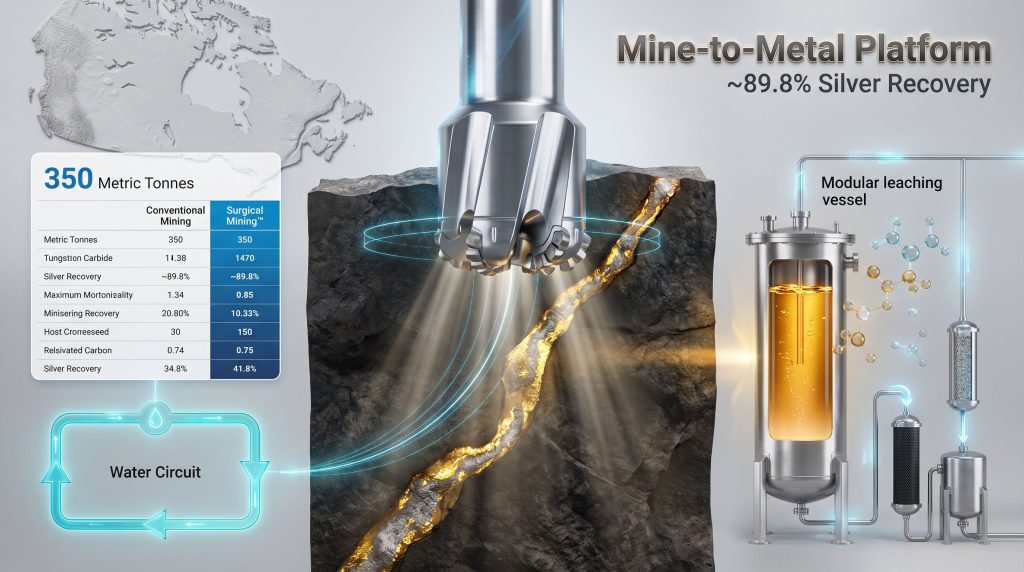
- Extraction of 350 metric tonnes of material for metallurgical evaluation, providing a tangible feed sample set for downstream processing assessment.
The company has also progressed to early commercial engagements, signing a services agreement with Northstar Gold for the Cam Copper Project in Ontario in 2025. This transition from field trial to contracted services represents a meaningful step in the technology commercialisation trajectory.
Surgical Mining vs. Conventional Narrow-Vein Methods
| Method | Dilution Risk | Selectivity | Infrastructure Requirement | Depth Flexibility |
|---|---|---|---|---|
| Cut-and-fill stoping | Moderate | High | Significant underground development | Good |
| Longhole stoping | High in narrow veins | Low | Moderate underground development | Good |
| Shrinkage stoping | Moderate | Moderate | Minimal initial development | Limited |
| Surgical Mining | Low (design intent) | High | No large underground development required | Being evaluated |
RZOLV Technologies: The Chemistry Behind Non-Cyanide Leaching
How the Water-Based Platform Works
RZOLV Technologies approaches the downstream end of the same narrow-vein problem. Where Novamera targets the extraction challenge, RZOLV addresses the processing economics of small, high-grade, geometrically complex feed streams with a hydrometallurgical platform designed from first principles to eliminate cyanide from the leaching stage entirely.
The platform operates through controlled aqueous dissolution. Target metals are leached into solution under carefully managed water chemistry conditions, producing a pregnant leach solution (PLS) that can then be directed into several established downstream recovery pathways:
- Activated carbon adsorption
- Ion-exchange resin systems
- Electrowinning
- Application-specific recovery processes tailored to the target metal
The absence of cyanide is not simply a marketing differentiation. It creates structural advantages at the permitting and community engagement stages that cyanide-based systems cannot replicate in an increasing number of jurisdictions. Several major mining regions have enacted full or partial cyanide bans, and regulatory trajectory in others suggests continued tightening. The in-situ leaching benefits seen across other non-cyanide hydrometallurgical applications similarly reinforce why this direction is gaining traction globally.
What the Bench-Scale Data Shows
RZOLV's chemistry was originally developed targeting gold recovery from primary ores and concentrates. Laboratory testing has since expanded the demonstrated scope significantly:
- Preliminary bench-scale testing in March 2026 achieved approximately 89.8% calculated silver recovery from a silver-rich concentrate derived from solar panels, demonstrating applicability to secondary and recycled feedstocks beyond primary ore.
- Earlier unoptimised bottle-roll tests recorded dissolution of more than 25 critical and rare earth elements, with recoveries varying significantly depending on the specific element and mineralogy of the feed.
Important caveat: RZOLV has explicitly noted that these results are preliminary, element-specific, and dependent on mineralogy and feed characteristics. Optimisation work across target element groups and feed types remains ongoing. These figures should not be interpreted as confirmed commercial recovery rates.
The solar panel concentrate result deserves particular attention from an industry perspective. End-of-life photovoltaic panels represent a rapidly growing secondary feedstock category. Silver is a primary conductor used in solar cell architecture, and with global panel installations now in the hundreds of gigawatts, the volume of recoverable silver embedded in approaching end-of-life panels is substantial. RZOLV's demonstrated ability to process this feedstock positions the platform at an intersection between primary mining recovery and circular economy material flows.
How Novamera Surgical Mining and RZOLV Technologies Fit Together
The Integration Thesis
The mine-to-metal platform concept rests on a straightforward but historically underexplored integration logic. Extraction engineering and processing chemistry have traditionally been developed as separate disciplines, optimised independently, and connected only at the point where ore is delivered to a mill. This separation made operational sense when mines were large and mills were fixed. It becomes a liability when the target deposit is small, geometrically complex, and potentially remote.
Novamera Surgical Mining and RZOLV Technologies address this division directly. Novamera operates at the upstream extraction stage, determining what grade of material enters the processing stream and how much waste rock accompanies it. RZOLV operates at the downstream processing stage, determining what percentage of the metal in that feed is recovered and in what form.
The integration thesis holds that a high-grade, low-dilution feed produced by Surgical Mining, matched to RZOLV chemistry tuned to the specific mineralogy of that feed, could create a continuous flowsheet capable of processing narrow-vein ore closer to the point of extraction. Consequently, XRT ore sorting represents a complementary pre-processing step that could further enhance feed quality ahead of the RZOLV leaching stage.
The Proposed Mine-to-Metal Workflow
The following sequence outlines the integrated operational concept as currently envisioned. However, it is important to note that this workflow remains subject to full technical validation:
- Deposit characterisation: Detailed mapping of vein geometry, grade distribution, mineralogy, sulfide content, expected particle size, and water chemistry.
- Surgical extraction: AI-guided precision drilling targets the mineralised vein selectively, operating within a closed-loop water management circuit.
- Feed preparation: High-grade, low-dilution extracted material is prepared for hydrometallurgical processing.
- RZOLV leaching: Water-based chemistry formulated for the specific feed mineralogy dissolves target metals into pregnant leach solution.
- Metal recovery: PLS is processed through carbon adsorption, ion-exchange resin, electrowinning, or other appropriate pathways to produce a saleable product.
- Environmental management: Water recycling, residue characterisation, neutralisation, and toxicity endpoints are evaluated and managed across the integrated system.
What the MOU Actually Establishes
A memorandum of understanding effective August 10, 2026 between Novamera and RZOLV establishes a structured technical evaluation framework. Understanding precisely what the MOU covers, and what it does not, matters for accurately interpreting the significance of this development.
The MOU covers:
- Identification of candidate deposits where both technologies appear compatible based on geological and mineralogical screening criteria.
- Systematic technical evaluation across vein geometry, grade distribution, mineralogy, sulfide content, particle size, and water chemistry variables.
- Environmental endpoint assessment including water recycling efficiency, residue management, neutralisation, and toxicity compliance.
- Economic feasibility modelling for the integrated system across candidate deposit types.
The MOU does not establish:
- A commercially operational integrated platform.
- Confirmed metal recoveries from any specific deposit type using the combined system.
- A public timeline for moving from evaluation to commercial demonstration.
Technical Screening: Which Deposits Could This Platform Target?
Deposit Types with Highest Compatibility
Not every narrow-vein deposit will suit the integration model. The technical screening process the companies have agreed to undertake will evaluate candidates against a defined set of geological and mineralogical factors. Thorough drill results interpretation at the candidate assessment stage will be essential to identifying which deposits present the most compatible vein geometries and grade distributions.
| Screening Factor | Relevance to Integration |
|---|---|
| Vein width and geometric regularity | Determines Surgical Mining trajectory complexity and dilution exposure |
| Grade continuity along strike and dip | Influences economic viability of selective extraction over full vein length |
| Mineralogy and sulfide content | Governs RZOLV chemistry formulation and leach kinetics for the specific feed |
| Expected particle size from extraction | Affects leach surface area and metal dissolution efficiency |
| Water chemistry at the deposit | Critical for both the closed-loop drilling circuit and hydrometallurgical processing |
| Residue characteristics | Determines complexity of post-processing environmental management |
Beyond primary narrow-vein gold and silver systems, the platform has potential applicability in:
- Brownfield deposits where remnant mineralisation exists within or adjacent to previously mined areas but is uneconomic under conventional infrastructure assumptions.
- Stranded orebodies near existing infrastructure where permitting complexity or capital requirements, rather than grade, are the primary barrier to development.
- Secondary feedstocks such as end-of-life electronics and solar panels, where RZOLV's demonstrated recovery performance opens a circular economy application layer.
The next major ASX story will hit our subscribers first
Key Risks and Open Questions
What Must Be Resolved Before This Platform Is Commercially Viable
Both companies have made substantive progress in their respective technology domains. The integration, however, introduces a new set of technical interdependencies that have not yet been demonstrated as a combined system. Investors, project owners, and technical evaluators should maintain clear awareness of the following.
Technical risks:
- Trajectory control precision at commercial drilling rates across highly variable vein geometries remains to be validated under sustained operational conditions.
- Feed variability from Surgical Mining output in terms of grade and particle size distribution could complicate RZOLV chemistry optimisation across a single deposit's production life.
- The 25-plus element dissolution results from bottle-roll testing are preliminary and derived from unoptimised conditions. Recovery rates at the element level require significantly more investigation.
Environmental validation requirements:
- Full operational water recycling efficiency within the integrated closed-loop system has not been demonstrated at scale.
- Residue characterisation and long-term stability assessments will be required to meet regulatory standards across the range of jurisdictions where candidate deposits may be located.
Commercial and economic unknowns:
- The capital cost structure of a modular integrated system at commercially relevant throughput rates has not been publicly established.
- Unit economics at the deposit level will depend heavily on vein grade, continuity, and recovery rates that can only be confirmed through deposit-specific evaluation.
Neither the technical integration nor the economic case for the combined Novamera Surgical Mining and RZOLV Technologies platform has been demonstrated at commercial scale as of August 2026. The MOU marks the beginning of a structured investigation, not the conclusion of one.
The Broader Picture: Why Modular Mine-to-Metal Processing Matters Now
Rethinking the Supply Chain Architecture
The dominant mining supply chain model routes ore from extraction to centralised processing facilities, often hundreds of kilometres from the mine site. This architecture made sense when ore grades were high enough to justify transportation costs and when processing infrastructure could be amortised across very large ore volumes. As easily accessible high-grade deposits become scarcer, the economics of that model face increasing pressure.
The concept of processing at or near the point of extraction represents a structural departure from this inherited architecture. For narrow-vein deposits specifically, modular processing capability could reduce logistical costs, shorten permitting timelines by reducing the surface infrastructure footprint, and potentially accelerate the timeline from discovery to production compared to the conventional mine-and-mill path.
The Novamera and RZOLV collaboration sits within a broader wave of mining technology innovation focused on distributed processing, precision extraction, and cleaner hydrometallurgical alternatives to cyanide. Whether their combined platform proves technically and economically viable at scale remains an open question. What is already clear is that the $6 trillion stranded asset problem DIGITAL has quantified is not going to be addressed by doing what the industry has always done.
For further industry reporting on mining technology innovation across North America, Metal Tech News provides ongoing coverage of related developments at metaltechnews.com.
This article contains forward-looking analysis and references to preliminary, bench-scale, and field-trial data. Results at this stage of development are not indicative of future commercial performance. Readers should conduct independent due diligence before drawing investment conclusions from information presented here.
Want to Know When the Next Major Mineral Discovery Hits the ASX?
Discovery Alert's proprietary Discovery IQ model delivers real-time alerts the moment significant mineral discoveries are announced on the ASX, translating complex geological data into actionable opportunities for both short-term traders and long-term investors — explore historic discoveries and the returns they generated, then start your 14-day free trial at Discovery Alert to position yourself ahead of the broader market.