August 13, 2026
The Global Race for Responsible Aluminium Starts Underground
For decades, sustainability conversations in the aluminium industry focused almost exclusively on the energy intensity of smelting. The logic was straightforward: electrolytic reduction consumes enormous amounts of electricity, making it the most visible target for decarbonisation efforts. Yet as global supply chains face unprecedented scrutiny from regulators, institutional investors, and industrial buyers, attention has shifted further upstream.
The question is no longer just how cleanly aluminium is smelted, but how responsibly the bauxite beneath it was extracted. This shift has given new strategic weight to bauxite mining certification, and it is within this context that the Hindalco Baphlimali mine ASI certification carries implications well beyond a single operation.
When big ASX news breaks, our subscribers know first
What Is ASI Certification and Why Does It Matter for Bauxite Mining?
Understanding the Aluminium Stewardship Initiative's Performance Standard V3.1 (2023)
The Aluminium Stewardship Initiative is a global, multi-stakeholder, non-profit organisation that develops and administers independent certification standards across the full aluminium value chain. Its Performance Standard V3.1 (2023) represents the most current iteration of its assessment framework, incorporating updated requirements across a broad range of environmental, social, and governance domains.
Unlike voluntary corporate ESG reporting, which allows companies to define their own metrics and boundaries, ASI certification requires independent third-party auditing against fixed criteria. This distinction matters enormously in procurement contexts, where self-disclosed sustainability claims carry limited verifiability.
The performance standard evaluates operations across the following domains:
| ASI Assessment Domain | What It Measures |
|---|---|
| Biodiversity and Land Use | Ecosystem impact, rehabilitation planning |
| Greenhouse Gas Emissions | Scope 1, 2, and 3 emissions management |
| Human Rights | Labour standards, community rights |
| Community Engagement | Stakeholder consultation, grievance mechanisms |
| Occupational Health and Safety | Worker safety systems and incident management |
| Responsible Business Practices | Anti-corruption, governance, transparency |
The breadth of these criteria reflects a recognition that responsible mining cannot be reduced to carbon metrics alone. Community rights, biodiversity protection, and governance transparency are treated as equally material factors in determining whether an operation meets the standard. Furthermore, the bauxite and alumina market continues to evolve in response to these shifting expectations.
How the ASI Certification Audit Process Works
The certification pathway begins with a formal application and self-assessment, followed by an independent third-party audit conducted by an ASI-approved certification body. What distinguishes ASI's process from many industry-run schemes is its Witness Assessment mechanism, under which members of the ASI Secretariat independently observe the audit as it occurs.
This adds a secondary quality-assurance layer that reinforces the objectivity of findings. When auditors identify gaps against the standard, these are classified as either major or minor non-conformances. Major non-conformances prevent certification until resolved. Minor non-conformances allow certification to proceed, but require documented corrective action plans and verification in a follow-up audit. Certifications are valid for defined periods and must be renewed, creating ongoing accountability rather than a one-time compliance event.
Key Insight: ASI certification does not imply zero environmental or social impact. It confirms that operations have been independently assessed against a globally recognised standard, met its requirements, and have credible plans in place to address any identified gaps, subject to verified follow-up.
What Makes the Baphlimali Bauxite Mine Strategically Significant?
Operational Scale and Production Capacity
Located in the Rayagada district of Odisha in eastern India, the Baphlimali bauxite mine operates at an annual production capacity of 8.5 million tonnes, placing it among the larger bauxite operations in the country. The certified scope encompasses the full upstream process chain at the site: planning, mining, processing, onsite crushing, and conveyor transportation of bauxite.
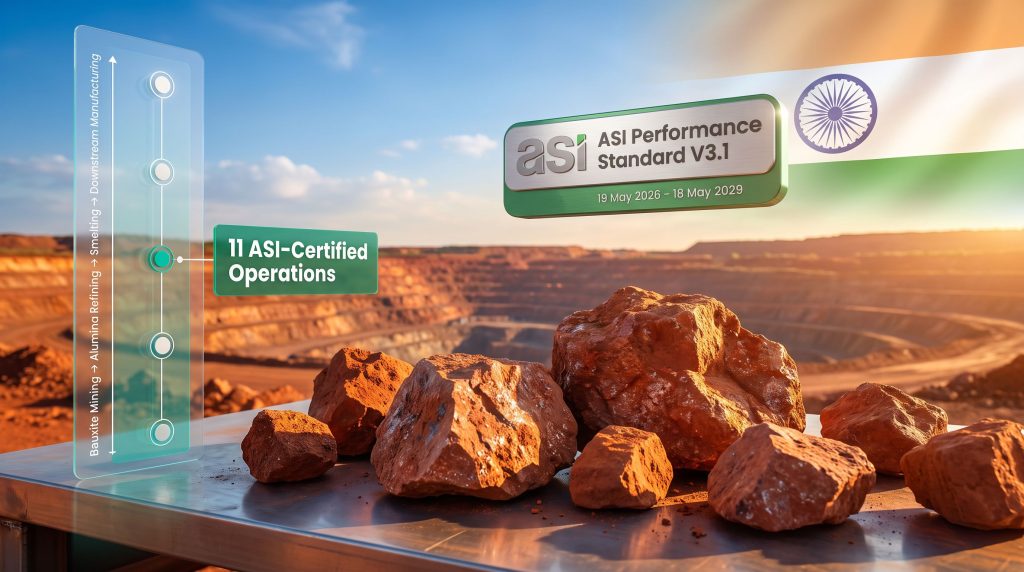
The certification was awarded to Utkal Alumina International Limited, a 100% subsidiary of Hindalco Industries and part of the broader Aditya Birla Group. The certification period runs from 19 May 2026 to 18 May 2029, with the independent audit conducted by CETIZION Verifica under ASI's Witness Assessment framework. Hindalco's Baphlimali bauxite mine consequently becomes the first in India to secure this globally recognised standard.
Nine minor non-conformances were identified during the audit process. These are subject to corrective action plans with verification scheduled for a follow-up audit, consistent with standard ASI certification procedure.
The Mine-to-Refinery Connection: Baphlimali and Utkal Alumina
Baphlimali's operational significance extends beyond its production volume. The mine serves as the primary bauxite feedstock source for Utkal Alumina International Limited's refinery, which produces approximately 2.67 million tonnes of alumina annually. This integration creates a tightly linked upstream system where bauxite quality, consistency, and volume directly influence refinery throughput and alumina output.
The mine-to-refinery model reduces exposure to spot market price volatility for bauxite, a factor that has become increasingly relevant as seaborne bauxite prices respond to supply disruptions and freight cost pressures. Vertical integration at this scale also gives Hindalco greater control over the chemical characteristics of its bauxite feed, which in turn influences alumina recovery rates and refining efficiency.
Why Upstream Certification Carries Downstream Implications
Certification at the mining stage is structurally different from certification at the smelting or downstream fabrication level. When a smelter receives ASI certification, it validates practices at the point where electrical energy is converted into primary metal. When a bauxite mine achieves certification, it validates practices at the origin of the entire production process, before any value transformation has occurred.
This upstream anchoring enables buyers to make verifiable responsible sourcing claims that trace back to the point of extraction, rather than relying on assumptions about what occurred at earlier stages of the supply chain. For global original equipment manufacturers in automotive, aerospace, and packaging sectors, this distinction is becoming commercially relevant as their own supply chain due diligence obligations expand.
Is This a Historic First for India's Mining Sector?
India's First ASI-Certified Bauxite Mine: What the Milestone Represents
The Baphlimali certification marks the first time any bauxite mining operation in India has achieved ASI Performance Standard certification. This is a notable gap given India's position as one of the world's largest holders of bauxite reserves, with Odisha alone accounting for a substantial share of the country's total resource base.
India's bauxite reserves are estimated at approximately 3.4 billion tonnes, placing the country among the top five globally by reserve volume. Yet prior to this certification, no Indian bauxite mine had achieved recognition under the world's leading aluminium-specific responsible mining standard. The contrast between reserve scale and certification participation reflects both the historically domestic orientation of Indian aluminium production and the relatively recent emergence of international ESG procurement requirements as a commercial driver.
How This Positions India Within the Global Responsible Aluminium Landscape
Aluminium-producing nations with established ASI-certified upstream operations, including Australia, Brazil, and Guinea, have benefited from preferential positioning in procurement conversations with European and North American buyers whose own sustainability commitments require verified responsible sourcing. India's absence from that certified group has represented a structural disadvantage in accessing premium-oriented market segments.
The European Union's Corporate Sustainability Due Diligence Directive creates legally binding obligations for companies operating in or sourcing from EU supply chains. For Indian aluminium exporters, this regulatory shift elevates upstream certification from a voluntary differentiator to an increasingly necessary commercial credential. In addition, the top aluminium mining companies globally are accelerating their own certification programmes in response to these same pressures.
Broader Context: As decarbonisation pressures reshape global commodity procurement, the ability to demonstrate third-party verified responsible sourcing at the mine level is transitioning from a reputational advantage to a commercial prerequisite for export-oriented aluminium producers.
How Does Baphlimali Fit Into Hindalco's Broader ASI Certification Strategy?
Mapping Hindalco's 11-Operation ASI-Certified Portfolio
The Baphlimali certification brings Hindalco's total number of ASI-certified operations to 11, spanning the full aluminium value chain from bauxite extraction through to downstream product manufacturing. The complete certified portfolio is as follows:
| Certified Operation | Activity Type |
|---|---|
| Baphlimali (Utkal Alumina) | Bauxite mining and processing |
| Mouda | Downstream manufacturing |
| Hirakud FRP | Downstream manufacturing |
| Taloja | Downstream manufacturing |
| Kuppam | Downstream manufacturing |
| Alupuram | Smelting and downstream |
| Belur | Downstream manufacturing |
| Renukoot | Smelting |
| Belagavi | Downstream manufacturing |
| Hirakud | Smelting |
| Aditya | Smelting and alumina |
The trajectory of Hindalco's certification programme reveals a deliberate strategic pattern. Earlier certifications were concentrated at the smelting and downstream manufacturing stages, where ESG visibility is highest and customer pressure most direct. The addition of an upstream mining operation signals a commitment to extending the certification framework toward the beginning of the production chain.
The Integrated Value Chain Thesis: From Mine to Metal
An integrated aluminium producer that can demonstrate ASI certification across mining, refining, smelting, and downstream manufacturing occupies a structurally distinct market position. The ability to offer customers a traceable, independently audited provenance narrative from bauxite extraction through to finished product is increasingly rare and increasingly valued.
For Hindalco, the Hindalco Baphlimali mine ASI certification closes a critical gap in that narrative. Previously, the company's certified portfolio could validate responsible practices from the smelter forward, but could not extend that assurance to the point where bauxite leaves the ground. With the mine now certified, the chain of custody can begin at the earliest possible stage of production.
Hindalco's Safety Culture Recognition at Baphlimali
Occupational health and safety performance is a formal assessment domain within the ASI Performance Standard, and Baphlimali's operations have received recognition specifically for their safety culture programme. This is operationally significant because large-scale open-cut bauxite mining presents inherent safety challenges including equipment interaction risks, slope stability management, and dust exposure.
Achieving recognised safety performance within the ASI assessment context requires systematic management frameworks, not merely low incident rates in a given year. The discipline required to sustain safety management systems at audit-ready standard across a large workforce also tends to correlate with broader operational consistency, which has implications for production reliability and cost control.
What Does ASI Certification Mean for Aluminium Supply Chain Transparency?
Traceability as a Commercial Imperative in Modern Aluminium Procurement
Global manufacturers in sectors including automotive, aerospace, packaging, and construction have increasingly moved from supplier self-assessment questionnaires toward requiring externally verified certification as a condition of procurement. This shift reflects both regulatory pressure and the reputational risk of supply chain controversies that surface during product lifecycle scrutiny.
A comparison of the leading responsible mining and responsible sourcing frameworks applicable to the aluminium sector illustrates ASI's specific positioning:
| Framework | Scope | Auditing Model | Industry Recognition |
|---|---|---|---|
| ASI Performance Standard | Full aluminium value chain | Third-party audit with witness assessment | Global aluminium industry standard |
| IRMA (Initiative for Responsible Mining Assurance) | Mining operations only | Independent third-party | Broad metals sector |
| Towards Sustainable Mining (TSM) | Mining operations | Third-party with industry oversight | Primarily Canada, expanding globally |
ASI's differentiation lies in its chain-of-custody architecture, which enables certified materials to be tracked from production through to fabrication, providing a connected assurance system rather than isolated point-in-time snapshots. Furthermore, the ASI witness assessment at Baphlimali provides additional transparency into how this rigorous process was applied on the ground.
How Minor Non-Conformances Are Managed Under ASI's Framework
A common misconception about certification processes is that the identification of non-conformances represents a failure or weakness in the audited operation. Within ASI's framework, the opposite interpretation is more accurate. The identification of nine minor non-conformances at Baphlimali is evidence that the audit process was genuinely rigorous, not that the operation is poorly managed.
Minor non-conformances indicate areas where practice did not fully meet the standard's requirements at the time of assessment, but where the gap does not represent a fundamental failure. The corrective action process that follows creates a documented improvement pathway with external verification, which is structurally more rigorous than self-reported continuous improvement claims.
The ASI CEO has stated publicly that the growing participation of Hindalco operations across different value chain stages in ASI certification demonstrates a meaningful commitment to recognised ESG practice. Such efforts play an important role in strengthening transparency, traceability, and stakeholder confidence throughout the aluminium supply chain.
The next major ASX story will hit our subscribers first
What Are the Broader Market Implications of India's First ASI-Certified Bauxite Mine?
India's Bauxite Sector: Scale, Reserves, and Certification Gap
Odisha is the epicentre of India's bauxite resources, with the state holding a dominant share of the country's economically recoverable reserves. The Baphlimali deposit itself is notable not only for its scale but for the quality characteristics of its bauxite, which features relatively favourable alumina-to-silica ratios suited to the Bayer process refining method used at Utkal Alumina's facility.
In bauxite refining, the reactive silica content of the ore is a critical quality parameter. High reactive silica consumes caustic soda during the Bayer process, increasing reagent costs and reducing overall recovery efficiency. Bauxite deposits with lower reactive silica content are therefore more economically attractive from a refinery operating cost perspective.
Demand-Side Drivers Accelerating ESG Certification in Bauxite
Several converging forces are accelerating the commercial value of upstream certification in the bauxite sector:
- The European Green Deal and associated battery materials regulations are creating upstream ESG requirements that extend beyond the immediate manufacturer to encompass raw material suppliers.
- Aluminium's critical role in the energy transition, spanning electric vehicle bodies and battery housings, solar panel frames, and grid infrastructure, means that supply chains serving these applications face elevated scrutiny from both regulators and end-use customers.
- Institutional investors applying ESG screening criteria to commodity sector exposures are increasingly differentiating between producers that can demonstrate third-party verified responsible sourcing and those relying on voluntary disclosure frameworks.
- The OECD's due diligence guidance for responsible mineral supply chains, while originally focused on conflict minerals, is influencing procurement standards across a broader range of industrial metals including aluminium.
Scenario Analysis: The Path to Full-Chain Certification in Indian Aluminium
Scenario Projection: If India's major integrated aluminium producers were to extend ASI certification progressively across their upstream mining operations, the country's aluminium sector could credibly compete for responsible-sourcing premiums in EU and North American markets currently dominated by certified producers from Australia, Guinea, and Brazil. The Baphlimali certification represents the first verifiable structural step toward that competitive position. Whether it catalyses broader certification activity across the Indian bauxite sector will depend on how buyer requirements evolve and whether the commercial case for certification investment strengthens over the medium term.
Frequently Asked Questions: Hindalco Baphlimali Mine ASI Certification
What is the ASI Performance Standard V3.1?
A globally recognised third-party certification framework that evaluates environmental, social, and governance performance across the full aluminium value chain, from bauxite mining through to downstream manufacturing.
Which entity holds the ASI certification for the Baphlimali mine?
Utkal Alumina International Limited, a 100% subsidiary of Hindalco Industries and part of the Aditya Birla Group, holds the certification for the Baphlimali bauxite mining operation located in Rayagada district, Odisha.
What is the annual production capacity of the Baphlimali bauxite mine?
The mine operates at an annual production capacity of 8.5 million tonnes of bauxite.
Who conducted the certification audit?
The independent third-party audit was conducted by CETIZION Verifica, with ASI Secretariat members observing the process under the organisation's Witness Assessment quality-assurance framework.
How long is the certification valid?
The certification period for Utkal Alumina International Limited runs from 19 May 2026 to 18 May 2029, a three-year term consistent with ASI's standard certification cycle.
Were any issues identified during the audit?
Nine minor non-conformances were identified. These are subject to corrective action plans with follow-up verification, which is a standard and expected component of ASI's certification integrity process rather than an indication of fundamental deficiency.
How many ASI-certified operations does Hindalco now have?
With Baphlimali's certification, Hindalco's portfolio of ASI-certified operations has grown to 11, spanning mining, alumina refining, smelting, and downstream manufacturing activities across multiple Indian states.
Key Takeaways: What This Milestone Signals for India's Aluminium Sector
The Hindalco Baphlimali mine ASI certification carries significance at multiple levels simultaneously:
- It establishes India's first independently audited, internationally certified bauxite mining operation, closing a long-standing gap between the country's reserve scale and its responsible sourcing credentials.
- It extends Hindalco's certified value chain to the extraction stage, enabling a mine-to-metal provenance narrative that few integrated aluminium producers globally can match in its completeness.
- It positions the Baphlimali-Utkal Alumina integrated system as a credible participant in responsible sourcing procurement conversations with European and North American buyers whose due diligence requirements are expanding under new regulatory frameworks.
- It demonstrates that the ASI certification process, including the identification and management of minor non-conformances, functions as a genuine quality-assurance mechanism rather than a rubber stamp for compliant producers.
The long-term significance of this milestone will ultimately be determined by performance consistency during the certification period and whether Hindalco's upstream certification initiative influences broader practices across India's bauxite sector. Moreover, recent aluminium sector developments globally suggest that the structural pressure on supply chains to demonstrate verified responsible sourcing from the mine level will only intensify as energy transition demand grows and regulatory frameworks tighten across major consuming markets.
Readers seeking further context on global bauxite supply dynamics may find value in reviewing data on bauxite production leaders and the largest bauxite mines worldwide, which together illustrate where India's certified operations now sit within the global competitive landscape.
This article contains forward-looking analysis and scenario projections. Such content is provided for informational and educational purposes only and should not be construed as investment advice. Market conditions, regulatory environments, and corporate strategies are subject to change.
Want to Know Which ASX Mineral Discoveries Could Deliver Significant Returns?
Discovery Alert's proprietary Discovery IQ model scans ASX announcements in real time, instantly identifying high-potential mineral discoveries across more than 30 commodities — turning complex data into actionable investment insights for both traders and long-term investors. Explore how historic discoveries have generated exceptional market returns on Discovery Alert's dedicated discoveries page, and begin your 14-day free trial today to position yourself ahead of the broader market.