August 13, 2026
The Global Mining Equipment Divide Is Widening Faster Than Most Operators Realise
Across the history of industrial commodity extraction, the equipment that moves rock has always reflected the political economy of the moment. In the post-war era, American and Japanese heavy machinery manufacturers built dominance through export-oriented industrial policy, technical superiority, and globally integrated supply chains. That order is now fragmenting. The Russia-Belarus heavy equipment corridor, and specifically BelAZ dump trucks to Russian mines, offers one of the clearest case studies of how geopolitical realignment reshapes capital goods trade in ways that outlast the headlines that trigger them.
At the centre of this shift is a manufacturer most Western investors and equipment analysts have historically underestimated: BelAZ, headquartered in Zhodino, Belarus. As a global producer of ultra-class haul trucks, BelAZ occupies a peculiar and strategically critical niche, one where its few true competitors have voluntarily exited its most important market, leaving demand entirely to be absorbed by the Belarusian OEM.
When big ASX news breaks, our subscribers know first
Understanding the Ultra-Class Haul Truck Market and Why It Matters
The term ultra-class in mining refers to haul trucks with payload capacities exceeding 200 tonnes, though the category is sometimes extended to include vehicles above 90 tonnes depending on regional convention. These are not ordinary machines. Building a functional, reliable 220-tonne haul truck requires mastery of electric drive systems, tyre engineering operating at the absolute limits of rubber technology, and structural steel fabrication capable of enduring millions of load cycles in permafrost, high-altitude, and chemically aggressive environments.
Very few manufacturers on earth can build these machines at scale. The competitive set has historically included:
| Manufacturer | Country of Origin | Maximum Payload Class | Market Position Post-2022 |
|---|---|---|---|
| BelAZ | Belarus | 450 tonnes (BelAZ 75710) | Active in Russia and CIS |
| Caterpillar | USA | 400 tonnes (797F) | Exited Russia post-2022 |
| Komatsu | Japan | 363 tonnes (960E) | Exited Russia post-2022 |
| Liebherr | Germany/Switzerland | 400 tonnes (T 284) | Not significantly active in Russia |
| XCMG / LGMG | China | Up to 220 tonnes | Growing presence, limited ultra-class penetration |
The exit of Caterpillar and Komatsu from the Russian market following 2022 geopolitical developments did not reduce Russian mining operators' demand for heavy haul capacity. It simply redirected it. BelAZ, already deeply embedded in Russian procurement cycles, was the primary beneficiary of this structural shift. Understanding the broader geopolitical mining landscape helps contextualise just how significant these market realignments have become.
Why Russian Open-Pit Mining Cannot Simply Switch Suppliers
A critical but underappreciated dimension of the BelAZ-Russia relationship is the depth of installed base lock-in that exists across Russian mining regions. This is a concept familiar to equipment finance professionals but less understood by commodity investors.
When a mine deploys a particular truck platform, it simultaneously commits to:
- A specific tyre specification (ultra-class tyres are not interchangeable across manufacturers)
- An electric drive system architecture that determines which control systems and spare parts are stocked
- Operator training programs built around a particular cab layout and instrumentation suite
- Haul road geometry and maintenance infrastructure calibrated to the truck's turning radius and axle load
Replacing one fleet entirely with another manufacturer's product is not simply a purchasing decision. It is an operational transformation requiring years of transition planning and substantial capital expenditure beyond the truck purchase price itself. BelAZ's decades of deployment across Russian mines have created an infrastructure of compatibility that no competitor can displace quickly, regardless of price or technical specification.
Mapping the Delivery Footprint: Where BelAZ Dump Trucks Are Going in Russia
Recent delivery activity reveals the geographic breadth of BelAZ's Russian operations. Shipments span multiple federal districts, with deployment concentrated across coal and gold extraction sectors. Furthermore, these deliveries reflect broader global mining disruptions that are reshaping how operators source and maintain their heavy equipment fleets.
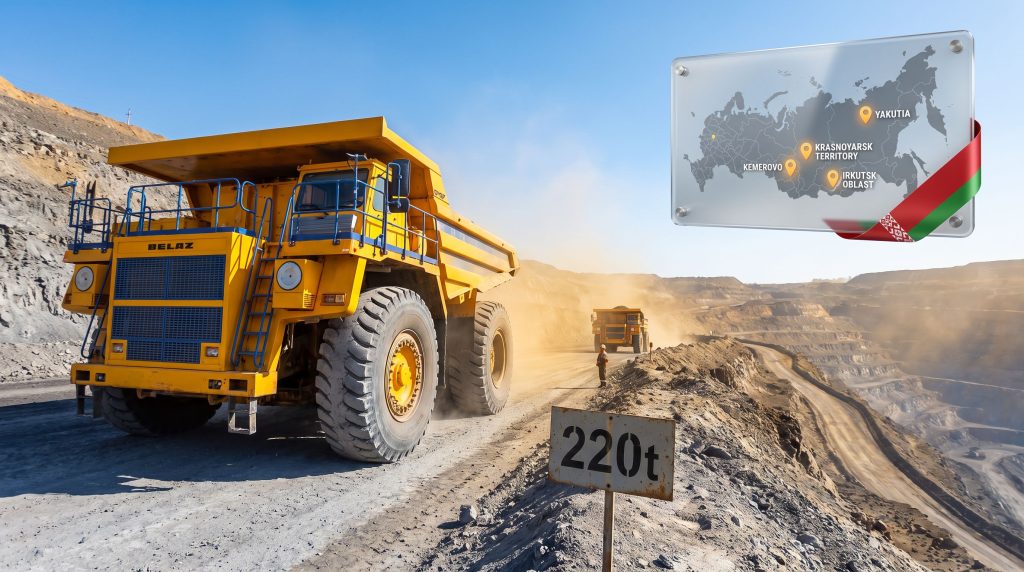
Kemerovo Region (Kuzbass): The Volume Engine
The Kuzbass basin in Kemerovo Oblast remains the single most important destination for BelAZ dump trucks within Russia. This region hosts some of the country's most productive open-pit coal operations, and the scale of truck procurement here dwarfs other regions in volume terms.
- Approximately 400 dump trucks are targeted for delivery to Kemerovo-based operations within a single annual procurement cycle
- Kuzbassrazrezugol, one of Russia's largest coal producers, has received 10 ultra-class 220-tonne trucks alongside specialised water suppression vehicles
- Mechel PAO has procured 15 BelAZ dump trucks for coal operations in the southern Kemerovo region
The 220-tonne class dominates Kuzbass procurement because of its direct impact on cost-per-tonne metrics. In bulk stripping operations, payload efficiency is the primary lever available to mine planners trying to reduce unit operating costs. A 220-tonne truck moving the same volume of overburden as three 90-tonne trucks requires fewer haul cycles, less fuel per tonne moved, and a smaller operator headcount per unit of production.
Yakutia (Sakha Republic): Coal and Gold Converge
Yakutia's mining sector spans two distinct commodity streams, and BelAZ is active across both:
- Coal company Kolmar received 22 trucks over a 12-month period for operations in the Sakha Republic
- 16 new 136-tonne trucks were commissioned at the Gross gold mine, one of Russia's major hard-rock gold deposits
The Gross mine deployment is particularly significant from a technical standpoint. Hard-rock gold mining places different demands on haul trucks than coal operations. Rock density, fragmentation characteristics, and the need for precision loading in bench-and-blast cycles all influence truck specification. The 136-tonne class appears to have emerged as the preferred configuration for Russian hard-rock gold operations, balancing payload capacity with the manoeuvrability required in tighter bench geometries typical of gold-bearing geological formations.
Krasnoyarsk Territory: Polyus's Flagship Assets
Polyus, Russia's largest gold producer by output, has received 11 BelAZ trucks for operations at two of its highest-producing assets: the Olimpiada and Blagodatnoye deposits in Krasnoyarsk Territory. These operations represent some of the highest-grade open-pit gold production in the world, making fleet reliability a critical factor. Equipment downtime at assets of this productivity profile carries outsized revenue consequences.
Irkutsk Oblast: The Bodaybo Gold Corridor
The Bodaybo District in Irkutsk Oblast has historically been one of Russia's most significant gold-producing corridors, with alluvial and hard-rock deposits worked continuously for well over a century. Recent deliveries of 11 BelAZ trucks to operations in this district reflect ongoing capital investment in a region that continues to attract new project development despite its remoteness and harsh seasonal conditions.
Multi-Region Batch Deliveries: Diversified Coal Operations
Beyond the primary demand centres, 16 trucks spanning 130-tonne and 220-tonne configurations have been distributed across coal operations in Khakassia, Zabaikalsky Krai, and Khabarovsk Krai, illustrating the geographic breadth of BelAZ's Russian distribution network.
The Eurasian Economic Union Advantage: A Structural Trade Enabler
A less-discussed dimension of the BelAZ-Russia supply relationship is the role played by the Eurasian Economic Union (EAEU) framework. Belarus and Russia both operate within this customs and trade bloc, which eliminates conventional import tariffs, customs delays, and documentary friction that would otherwise complicate cross-border capital equipment movement.
For a 220-tonne dump truck, which may require specialised heavy-lift transport, route pre-clearance, and oversize load permits across multiple jurisdictions, the elimination of border complexity has material logistical value. This advantage is structural and ongoing, providing BelAZ with a supply chain efficiency that no non-EAEU competitor can replicate without significant additional cost and lead time.
Additional factors reinforcing operational continuity include:
- Rouble-denominated transaction structures that eliminate currency conversion costs and hedging complexity
- Pre-established service depots and spare parts warehouses across major Russian mining regions built over decades of deployment
- Operator training programs already integrated into Russian mine workforce development systems
- Technical documentation and manuals in Russian, eliminating translation overhead and interpretation risk
Chinese OEMs: A Longer-Term Variable, Not an Immediate Threat
The natural question raised by any analysis of the BelAZ-Russia dynamic is whether Chinese heavy equipment manufacturers might eventually challenge BelAZ's dominant position. The answer requires separating near-term reality from longer-term possibility.
Chinese OEMs including XCMG and LGMG have made genuine progress in expanding their global mining equipment footprint, particularly in African and Southeast Asian markets where price sensitivity is high and technical after-sales infrastructure requirements are lower. However, several barriers limit their near-term penetration into Russia's ultra-class segment:
- Chinese manufacturers have not yet demonstrated mass production capability for trucks exceeding 220-tonne payload at BelAZ's volume and reliability levels
- The electric drive systems used in the largest ultra-class trucks require proprietary engineering expertise that takes years to develop and validate in operational environments
- Russian mining operators, particularly state-adjacent majors like Polyus and Kuzbassrazrezugol, have well-established procurement relationships with BelAZ that carry institutional inertia
- Parts availability and service network depth for Chinese OEMs remain limited across Russia's remote mining regions
Chinese manufacturers represent a medium-to-long-term competitive variable worth monitoring, but the technical and logistical barriers to displacing BelAZ in Russia's ultra-class segment are substantial and unlikely to be resolved within a short-horizon planning window.
The next major ASX story will hit our subscribers first
The Localisation Paradox: Russia's Domestic Ambitions vs. Technical Reality
Russia has periodically articulated strategic ambitions for greater domestic production of heavy mining equipment, including ultra-class haul trucks. On the surface, this would appear to represent a threat to BelAZ's market position. In practice, the technical complexity involved creates a significant buffer.
Ultra-class haul trucks are not mechanically sophisticated in a conventional sense. They are electrically sophisticated. The drive systems in 220-tonne class vehicles are essentially mobile power plants, using diesel engines to generate electricity that drives individual wheel motors. The engineering challenge lies not in the diesel engine or the steel structure, but in the traction control systems, thermal management of high-current drive components, and the software governing load distribution across axles under dynamic haul road conditions.
Russia currently lacks the established industrial base to produce these drive systems at the required specification and reliability level. Consequently, meaningful domestic substitution in the ultra-class segment remains a medium-to-long-term ambition rather than a near-term operational reality, which preserves BelAZ's commercial position for the foreseeable future.
What This Means for Global Mining Equipment Market Structure
The BelAZ-Russia supply relationship is one node in a broader structural fragmentation reshaping the global mining landscape. Three distinct supply ecosystems are now consolidating:
- Western-aligned markets serviced by Caterpillar, Komatsu, Liebherr, Sandvik, and Epiroc, covering North America, Australia, Western Europe, and parts of Latin America and Africa
- The Russia-Belarus corridor, where BelAZ functions as the primary ultra-class supplier with deepening market concentration
- China-influenced markets, where XCMG, LGMG, and Sany are progressively expanding presence across Africa, Southeast Asia, and emerging economy mining sectors
For mining companies operating across these ecosystems, or considering equipment sourcing from manufacturers embedded in politically exposed supply chains, several risk dimensions warrant careful evaluation:
- Parts supply continuity risk if geopolitical conditions affecting the Belarus-Russia corridor deteriorate further
- Residual value exposure for fleets tied to sanctioned or restricted supply ecosystems, which can impair asset values on balance sheets and complicate equipment financing
- Regulatory compliance complexity for operators in third-party jurisdictions who may be sourcing components or services that indirectly intersect with restricted trade flows
- Concentration risk for BelAZ itself, given its heavy dependence on a single national market whose investment cycle, domestic policy preferences, and geopolitical trajectory all remain uncertain over a multi-year horizon
Frequently Asked Questions: BelAZ Dump Trucks in Russian Mining Operations
What makes BelAZ's 75710 model notable in the global context?
The BelAZ 75710, with a rated payload capacity of 450 tonnes, holds the distinction of being the world's largest haul truck by payload capacity. While this model is not deployed across standard mine operations due to its infrastructure requirements, it demonstrates the upper limit of BelAZ's engineering capability and reinforces the manufacturer's credibility in the ultra-class segment globally.
How does Kemerovo's coal sector compare in scale to other Russian mining regions?
Kemerovo Oblast, commonly referred to as the Kuzbass, is Russia's primary coal-producing region and one of the most productive coal basins globally by output volume. Its open-pit operations require continuous fleet renewal and expansion at a scale that positions it as BelAZ's single most important regional customer base within Russia.
Are BelAZ trucks used in Russian gold mining fundamentally different from those used in coal operations?
The core platform architecture is similar, but configuration differences are meaningful. Gold mining operations typically favour the 136-tonne class due to bench geometry constraints and the need for precision in loading fragmented hard rock. Coal operations, by contrast, favour the 220-tonne ultra-class for high-volume overburden stripping where payload efficiency per cycle drives cost competitiveness.
What happens to Russian mines' equipment fleets if BelAZ access is disrupted?
This is the central strategic vulnerability for Russian mining operators. With Western OEMs absent and Chinese alternatives not yet capable of filling the ultra-class gap at scale, any meaningful disruption to BelAZ supply would create an equipment availability crisis across multiple commodity sectors simultaneously. There is no short-term substitute at equivalent technical specification and volume.
Key Takeaways for Industry Observers and Equipment Market Analysts
- BelAZ dump trucks to Russian mines represent one of the most structurally entrenched bilateral equipment supply relationships in global mining, reinforced by installed base lock-in, EAEU trade frameworks, and the absence of credible alternatives
- Kemerovo's Kuzbass coal basin is the volume anchor of this relationship, with approximately 400 units targeted in a single annual delivery cycle across major operators including Kuzbassrazrezugol and Mechel PAO
- Russia's gold sector, particularly Polyus's Olimpiada and Blagodatnoye assets, the Gross mine in Yakutia, and Bodaybo District operations, is an expanding and higher-margin demand segment favouring 136-tonne class configurations
- The 220-tonne ultra-class truck dominates coal sector procurement due to its payload efficiency advantage in bulk stripping applications
- Chinese OEM competition in the ultra-class segment remains a longer-term variable constrained by drive system engineering gaps and service network limitations
- Furthermore, the impact of these dynamics on mining company performance is increasingly difficult to separate from the broader equipment sourcing decisions operators are being forced to make
- Global mining equipment supply chains are fragmenting into three distinct geopolitical ecosystems, with material implications for fleet residual values, parts availability, and regulatory compliance for operators across multiple jurisdictions
This article is intended for informational and analytical purposes only. It does not constitute financial or investment advice. Forward-looking assessments regarding market dynamics, competitive positioning, and geopolitical scenarios involve inherent uncertainty and should not be relied upon as predictions of future outcomes.
Want to Know Which ASX Mining Companies Are Making Game-Changing Discoveries Right Now?
While geopolitical fault lines reshape global mining equipment supply chains, the real wealth-building opportunities often emerge from the discovery end of the value chain — and Discovery Alert's proprietary Discovery IQ model scans every ASX announcement in real time, instantly alerting subscribers to significant mineral discoveries before the broader market catches on. Explore historic discoveries and the extraordinary returns they generated, then begin your 14-day free trial to position yourself ahead of the next major find.