August 13, 2026
The Electricity Economics That Decide the Fate of Industrial Aluminium
Few industrial cost structures are as brutally exposed to energy pricing as primary aluminium smelting. Unlike manufacturing sectors where raw materials, labour, or logistics dominate the cost base, aluminium production lives or dies by the price of electricity. A smelter that loses access to competitively priced power does not simply become less profitable, it becomes unviable almost overnight. This fundamental vulnerability has shaped aluminium industry geography for over a century, concentrating production near hydroelectric rivers, low-cost coal grids, and subsidised energy markets.
Australia's position in this global picture has always been precarious. Its smelters were built in an era of cheap coal-fired electricity, and as that era ends, each facility faces a structural reckoning. The resolution now reached for the Tomago smelter power deal through 2038 is therefore far more than a contract renewal. It is a test case for whether a high-cost, high-wage economy can retain primary metal production through an energy transition, and what combination of public and private commitment that requires.
When big ASX news breaks, our subscribers know first
Tomago's Industrial Scale and Why It Cannot Simply Be Replaced
Established in 1983, Tomago Aluminium has operated continuously for over four decades from its Hunter Valley, New South Wales site. Its annual production capacity of up to 590,000 tonnes of aluminium represents close to 40% of Australia's total domestic aluminium output, making it not merely a large facility but a structurally significant one for national supply chains.
Rio Tinto holds a 51.55% majority stake in the operation, with the remainder distributed among other industrial partners. The smelter directly employs approximately 1,000 workers on-site, is supported by around 200 full-time-equivalent contractors, and the broader economic ripple effect extends to an estimated 5,000 indirect jobs across the Hunter Valley supply chain.
What makes permanent closure so consequential is that primary aluminium smelting infrastructure is not interchangeable. Unlike many manufacturing facilities that can be retooled, relocated, or rebuilt relatively quickly, smelting assets represent decades of accumulated capital, specialised infrastructure, and workforce expertise. Among the top aluminium mining companies, no new primary aluminium smelter has been constructed in Australia in decades, and given current capital costs and energy market uncertainties, none is likely to be built if an existing one closes permanently.
The Hunter Valley is already navigating the managed decline of its coal sector. Losing Tomago would compound that structural pressure precisely when the region needs industrial diversification, not contraction.
Understanding the Electricity Intensity That Makes or Breaks a Smelter
To appreciate why the power deal matters so much, it helps to understand just how electricity-dependent the aluminium smelting process actually is. The Hall-Heroult electrolysis process, the method used by virtually every primary aluminium smelter in the world, passes enormous electrical currents through molten alumina dissolved in a cryolite bath to separate aluminium metal from oxygen. The process is continuous, cannot be easily paused, and consumes approximately 14 to 16 megawatt-hours (MWh) of electricity per tonne of aluminium produced.
At Tomago's scale, this translates to electricity consumption that rivals that of a small city. Power costs typically represent the single largest operating expense for a smelter of this type, often accounting for 30% to 40% of total production costs depending on market conditions. When global aluminium prices are suppressed, as they periodically are, that electricity cost burden becomes existential.
This is why smelters that lose access to competitively priced electricity rarely survive. Historical examples from Europe and North America illustrate the pattern clearly: once a smelter becomes electricity-uncompetitive, it tends toward permanent shutdown rather than temporary suspension, because restarting a cold smelter requires substantial capital expenditure and years of operational preparation.
| Production Parameter | Detail |
|---|---|
| Electricity consumption per tonne | Approximately 14 to 16 MWh |
| Annual production capacity | Up to 590,000 tonnes |
| Electricity cost share of production | Typically 30% to 40% of operating costs |
| Existing AGL contract expiry | 31 December 2028 |
| New PPA duration | 2029 through 2038 (10 years) |
| Renewable electricity target | 100% from 2033 |
The Structure of the New Power Purchase Agreement
The Tomago smelter power deal through 2038 is built around a 10-year Power Purchase Agreement (PPA) that activates immediately following the expiry of the existing electricity supply contract with AGL at the end of December 2028. The new arrangement runs continuously through to 2038, providing a full decade of supply certainty that eliminates the planning vacuum that had surrounded the facility's medium-term future.
The most significant structural feature of the PPA is its renewable energy transition timeline. From 2033, electricity supplied to Tomago under the agreement will be sourced entirely from renewable generation. This five-year bridge period between 2028 and 2033 is important: it allows time for new renewable generation capacity to be built, contracted, and commissioned before Tomago depends on it operationally.
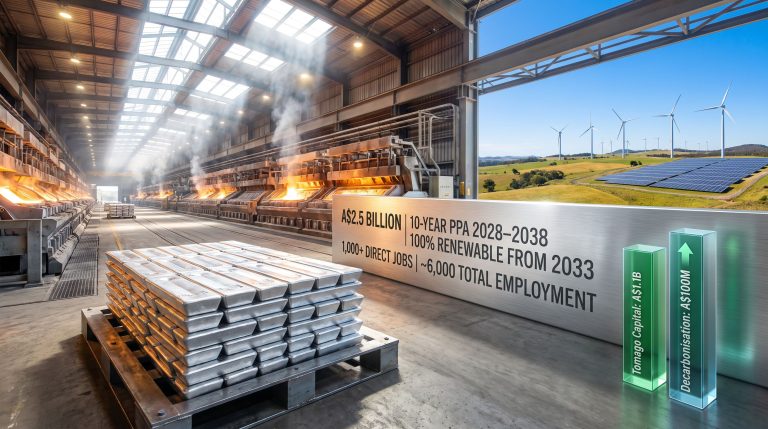
The Australian Federal Government has committed AUD 2.5 billion to underpin the arrangement. Reuters reported that this funding package is structured to support the development of approximately 3 gigawatts (GW) of new electricity generation capacity, a combination that is expected to include renewable energy projects alongside firming capacity such as grid-scale storage or dispatchable generation to maintain reliability.
Separately, the New South Wales Government is also a party to the agreement, reflecting the cross-jurisdictional significance of the facility and the shared interest in its continuation. Tomago Aluminium's official statement confirms that this arrangement represents a landmark commitment to the smelter's future.
On the private investment side, Tomago Aluminium has committed AUD 1.1 billion in real terms between now and 2038. Of that total, AUD 100 million is specifically allocated to decarbonisation initiatives, signalling that the smelter's owners view the energy transition not merely as a compliance requirement but as a genuine operational upgrade pathway.
Demand-Response: The Underappreciated Grid Service That Smelters Provide
One dimension of the Tomago deal that deserves more attention than it typically receives is the smelter's role as a large-scale demand-response asset within the NSW electricity system.
Demand-response refers to the ability of large industrial electricity consumers to voluntarily reduce their consumption during periods when the grid is under stress, typically during extreme weather events or when large generation sources trip offline unexpectedly. Because aluminium smelters operate at such enormous scale and with some degree of operational flexibility in their potline current management, they function as a form of industrial load management that can substitute for physical generation capacity in short-duration emergencies.
Under the new agreement, Tomago will continue providing these services to the NSW grid. This is particularly valuable as Australia integrates increasing proportions of variable renewable energy — wind and solar — whose output fluctuates with weather conditions rather than following demand curves. As grid operators require more tools to manage the mismatch between supply and demand in real time, facilities like Tomago that can flex their consumption become structurally important beyond their role as simple electricity customers.
In an era of high renewable penetration, large industrial loads that can curtail consumption on short notice are effectively acting as distributed grid stability tools. The value of this service is still not fully captured in standard electricity market frameworks.
The Decarbonisation Maths: 7.1 Million Tonnes Per Year
Rio Tinto's estimate that the transition to 100% renewable electricity from 2033 will reduce Tomago's combined Scope 1 and Scope 2 operating carbon emissions by 7.1 million tonnes per year is a figure worth placing in context.
To understand its scale, consider that Australia's total national greenhouse gas emissions are approximately 480 million tonnes of CO2-equivalent per year as of recent reporting periods. A 7.1 million tonne annual reduction from a single industrial facility represents a meaningful contribution to national decarbonisation, equivalent to removing well over one million average passenger vehicles from Australian roads.
The distinction between Scope 1 and Scope 2 emissions is relevant here. Scope 1 emissions arise directly from the smelting process itself, primarily from the carbon anodes consumed during electrolysis and from process gases released in the potlines. Scope 2 emissions arise from the electricity the smelter purchases. Switching to renewable electricity directly eliminates the Scope 2 component, which at a grid-dependent smelter of Tomago's scale is substantial.
Scope 1 reduction is a harder, longer-term challenge that requires technology changes at the pot level, such as inert anode technology, which remains under development by Rio Tinto and others globally. The 2033 renewable electricity target addresses the Scope 2 dimension while the Scope 1 challenge continues to be worked on at the research and development level.
The next major ASX story will hit our subscribers first
Green Aluminium and the Carbon Border Adjustment Mechanism
The commercial significance of Tomago's decarbonisation pathway extends beyond the domestic policy environment. Globally, demand for low-carbon or green aluminium is growing rapidly, driven primarily by downstream manufacturers in the automotive, packaging, and construction sectors who face their own net-zero commitments and supply chain emissions reporting requirements. Furthermore, green steel pricing dynamics offer a useful parallel for understanding how low-carbon credentials are beginning to command genuine market premiums.
The European Union's Carbon Border Adjustment Mechanism (CBAM) creates a particularly concrete financial incentive. CBAM imposes a carbon cost on imports of energy-intensive goods, including aluminium, based on the embedded emissions of their production. As the mechanism phases in fully, Australian aluminium produced with fossil fuel-sourced electricity will face a growing price disadvantage relative to lower-carbon competitors when selling into European markets.
Tomago's transition to 100% renewable electricity from 2033 positions its output to carry a significantly lower CBAM liability, potentially opening or protecting market access to European buyers who would otherwise preference lower-emissions alternatives from Iceland, Norway, or Canada, where hydroelectric-powered smelting already produces aluminium with relatively low Scope 2 emissions.
This is not simply an environmental story. It is a market positioning and revenue protection strategy with tangible financial implications for the smelter's long-term commercial viability. In addition, the broader context of US aluminium tariffs further underscores why securing low-carbon credentials and reliable supply arrangements has become an urgent strategic priority.
The Boyne Comparison: A National Industrial Strategy Taking Shape
The Tomago agreement did not emerge in isolation. In March 2026, a broadly similar arrangement was finalised between Rio Tinto and both the Australian Federal Government and the Queensland Government to secure the long-term future of the Boyne aluminium smelter in Gladstone, Queensland. Rio Tinto's repowering of Gladstone followed a comparable framework, demonstrating the consistency of this emerging national approach.
| Metric | Tomago Aluminium | Boyne Smelter |
|---|---|---|
| Location | Hunter Valley, NSW | Gladstone, Queensland |
| Agreement finalised | August 2026 | March 2026 |
| Power secured through | 2038 | Transitioning |
| Renewable electricity target | 100% from 2033 | Transitioning |
| Majority owner | Rio Tinto (51.55%) | Rio Tinto |
| Government parties involved | Federal + NSW | Federal + Queensland |
Within a six-month window, Rio Tinto has secured power certainty for both of Australia's largest aluminium smelters through coordinated engagement with Federal and state governments. The pattern suggests a deliberate national approach to preserving sovereign primary aluminium manufacturing capacity through the energy transition, rather than allowing market forces alone to determine whether these facilities survive.
Whether this model is financially sustainable over the long term, and whether it can be replicated for other energy-intensive industries facing similar electricity contract cliffs, remains an open and important question. Rio Tinto's official announcement provides further detail on the commitments underpinning this landmark arrangement.
The Three-Way Industrial Policy Balancing Act
The Tomago deal crystallises a tension that Australia, and many other industrialised economies, will need to navigate for the next two to three decades. Three competing imperatives must be balanced simultaneously:
-
Energy affordability for industrial users competing in global commodity markets where rivals often benefit from subsidised hydroelectric or gas-fired power at costs Australian grid-supplied electricity cannot match without structural support.
-
Decarbonisation commitments that require energy-intensive industries to transition away from fossil fuel-sourced electricity within timeframes set by national and international climate obligations.
-
Industrial retention to preserve domestic manufacturing capability, regional employment, supply chain resilience, and the economic activity that large-scale primary production anchors in specific communities.
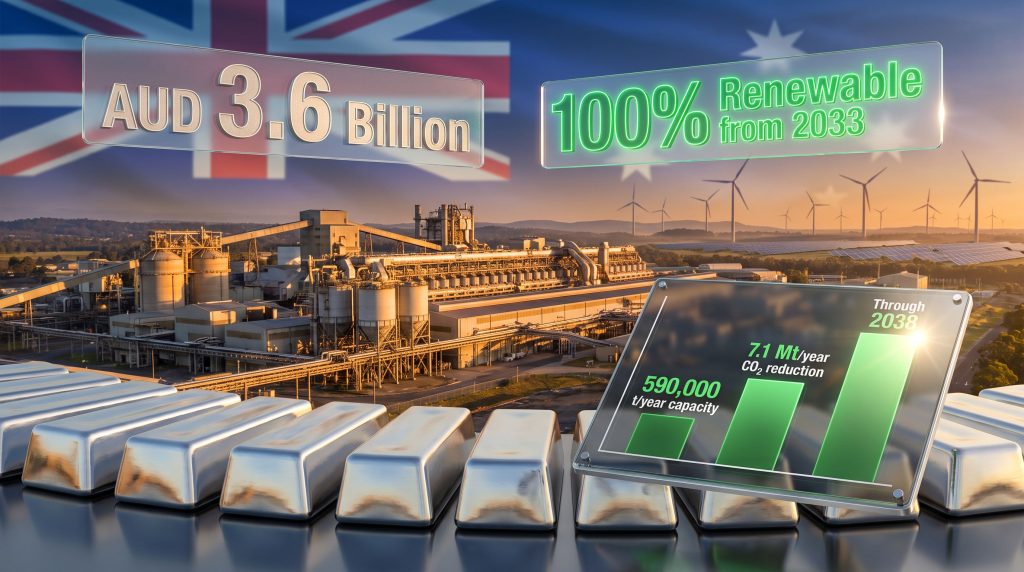
The combined AUD 3.6 billion in public and private investment now committed to Tomago through 2038 reflects how expensive it is to satisfy all three imperatives simultaneously. It also sets a precedent: if the Tomago model works, it becomes a template that steel, cement, chemicals, and other energy-intensive sectors will point to when seeking their own long-term electricity solutions. Consequently, joint venture models such as the Alcoa IGNIS EQT partnership suggest that coordinated investment structures are becoming increasingly central to how the industry navigates these pressures.
The real policy test is not whether this deal saves Tomago through 2038. It is whether the new renewable generation capacity built to serve this PPA can deliver electricity at prices that make the smelter internationally competitive without ongoing public support after 2038.
FAQ: Tomago Smelter Power Deal Through 2038
When does the new power agreement begin?
The new PPA commences after the existing AGL electricity contract expires on 31 December 2028, running continuously through to 2038.
What is the total public and private financial commitment?
The Australian Federal Government has committed AUD 2.5 billion, while Tomago Aluminium has pledged AUD 1.1 billion in real terms, bringing the combined public-private commitment to approximately AUD 3.6 billion through 2038.
When does Tomago switch to fully renewable electricity?
Under the terms of the new arrangement, Tomago's electricity supply transitions to 100% renewable sources from 2033, roughly five years into the 10-year PPA.
How much will the renewable transition reduce Tomago's carbon emissions?
Rio Tinto estimates the shift to renewable electricity will reduce Tomago's combined Scope 1 and Scope 2 operating emissions by 7.1 million tonnes per year.
How many jobs does Tomago support?
The smelter directly employs approximately 1,000 workers, with around 200 full-time-equivalent contractors on-site and an estimated 5,000 indirect jobs supported across the broader regional economy.
What role does Tomago play in Australia's aluminium production?
With a capacity of up to 590,000 tonnes per year, Tomago represents close to 40% of Australia's total annual primary aluminium output, making it the country's single largest aluminium smelting facility.
Disclaimer: This article contains forward-looking statements and projections, including estimates of emissions reductions, renewable energy timelines, and investment figures. These are based on announced commitments and publicly reported information as of August 2026 and are subject to change. Nothing in this article constitutes financial or investment advice.
Want to Know Which ASX Stocks Are Riding the Green Metals Wave?
As Australia commits billions to securing low-carbon aluminium production, the ripple effects across ASX-listed minerals and resources companies could be significant — and Discovery Alert's proprietary Discovery IQ model scans ASX announcements in real time, delivering instant alerts on significant mineral discoveries so subscribers can identify actionable opportunities before the broader market reacts. Explore historic discoveries and their remarkable returns on Discovery Alert's dedicated discoveries page, then begin your 14-day free trial to position yourself ahead of the next major find.