August 13, 2026
When Industrial Demand Meets a Broken Supply Chain: Meghalaya's Coal Compliance Crisis
Across industrial economies, the integrity of raw material supply chains is rarely questioned until something breaks. In energy-intensive sectors like metallurgical coke production, the assumption that coal arrives legally and traceably from approved sources has long been treated as administrative background noise rather than a live operational risk. Meghalaya is now demonstrating, in sharp detail, what happens when that assumption goes unexamined for too long.
The coal source of coke oven plants in Meghalaya has become the focal point of one of India's most aggressive court-supervised industrial compliance reviews, touching not just coke manufacturers but ferro-alloy processors and cement producers as well. What began as an environmental enforcement question more than a decade ago has evolved into a full-spectrum audit of how coal-dependent industries procure, document, and verify their most critical input material. These coal supply challenges are increasingly echoed in industrial jurisdictions far beyond India's borders.
When big ASX news breaks, our subscribers know first
Understanding Why Coal Sourcing Is an Existential Compliance Issue for Coke Producers
Metallurgical coke is not a commodity that can be produced from just any grade of coal. Coke oven plants subject carefully selected coking-grade coal to temperatures exceeding 1,000 degrees Celsius inside sealed, oxygen-limited chambers over periods of 14 to 20 hours. The process drives off volatile compounds and leaves behind a dense, high-carbon material with a specific porosity and compressive strength that blast furnaces require to reduce iron ore into molten iron.
Critically, coking coal differs from thermal coal used in power generation in both its chemical composition and its market positioning. Suitable coking coal must have low sulfur content, controlled ash levels, and specific caking properties that allow it to fuse and resolidify correctly during the carbonisation process. This means the sourcing decision for a coke oven plant is not merely a logistics question but a quality and legality question simultaneously.
In Meghalaya, this sourcing question carries extraordinary legal weight. The state sits atop coal reserves concentrated primarily in the Jaintia Hills and Khasi Hills regions, where extraction historically relied on what is known as rat-hole mining. This technique involves digging narrow horizontal tunnels into hillsides to reach thin, steeply inclined coal seams. While economically accessible for small operators, the method caused severe ecological damage including uncontrolled acid mine drainage that contaminated the Kopili and Lukha rivers, widespread deforestation, and repeated worker fatalities in unventilated tunnels.
The National Green Tribunal banned rat-hole coal mining in Meghalaya in 2014. More than a decade later, any domestic coal circulating within the state faces an immediate legal question: where did it actually come from? For coke oven operators, that question is no longer theoretical.
The Katakey Committee: Judicial Oversight as an Enforcement Substitute
The Meghalaya High Court's response to persistent enforcement gaps was the establishment of the Coal Audit Committee, headed by retired Justice B.P. Katakey. This court-appointed panel operates as a standing oversight mechanism with authority to conduct inspections, order field enquiries, issue compliance directives, and report findings directly to the High Court.
The use of court-appointed monitoring committees in Indian environmental enforcement is not unprecedented, but the Katakey Committee's expanding mandate across multiple industrial sectors makes it notably comprehensive. Its authority now reaches coke oven plants, ferro-alloy facilities, and cement manufacturers, effectively making it the primary compliance gatekeeper for all coal-consuming industries in the state. Understanding the broader mining regulatory framework helps contextualise why such oversight mechanisms become necessary.
A pivotal regulatory tool within this framework is the 2024 Standard Operating Procedure for coal importation, which was introduced specifically to address traceability gaps for coal entering Meghalaya from other Indian states. The SOP establishes documentation requirements, origin verification standards, and chain-of-custody protocols for imported coal destined for industrial use. Its existence acknowledges what enforcement agencies had long understood: without structured documentation requirements, verifying the legality of coal at the point of industrial consumption is practically impossible.
What the June 2026 Inspections Actually Found
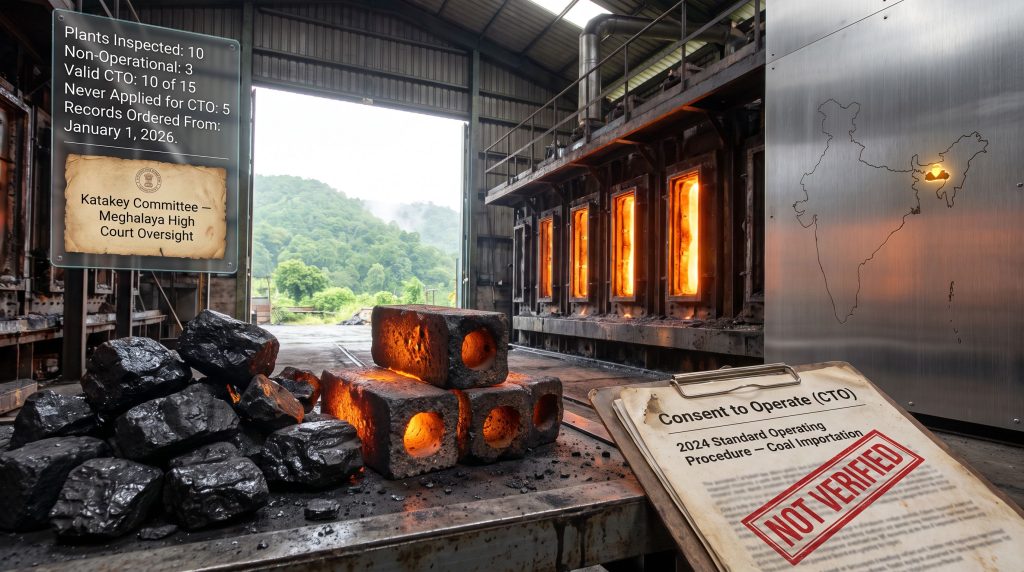
On June 1, 2026, the South West Khasi Hills district administration conducted physical inspections of coke oven plants in the district. The findings, as reported to the High Court by the Katakey Committee, revealed multiple layers of non-compliance.
| Compliance Metric | Finding |
|---|---|
| Coke oven plants identified on inspection | 10 |
| Plants non-operational (no valid CTO) | 3 |
| Plants issued Consent to Establish (CTE) per MSPCB records | 15 |
| Plants with valid Consent to Operate (CTO) | 10 |
| Plants that never applied for CTO | 5 |
| 2024 SOP compliance verified by district admin | Not verified |
| Production records ordered from | January 1, 2026 (month-wise) |
The gap between the 15 plants on record with the Meghalaya State Pollution Control Board and the 10 identified during field inspections raises its own questions about whether the regulatory registry accurately reflects ground conditions. Five plants on official records had never sought an operating permit, suggesting either they were constructed but never activated, or they operated without authorisation.
Coal procurement across the inspected plants fell into three distinct sourcing patterns:
- Entirely imported coal from other Indian states, theoretically subject to the 2024 SOP but not verified for compliance by district authorities.
- Domestically sourced coal from within Meghalaya, where the legal origin of any such coal is deeply questionable given the NGT mining ban.
- Mixed sourcing drawing on both domestic and interstate supply, compounding traceability challenges across two distinct regulatory frameworks.
"The absence of verification is the structural failure at the heart of this crisis. It is not simply that illegal coal may have entered these facilities. It is that no system was operational to confirm legality in either direction, leaving the entire procurement chain legally exposed."
The Forensic Audit Dimension: Month-by-Month Production Records
One of the more technically sophisticated aspects of the Katakey Committee's response is its demand for granular, month-by-month coal consumption and coke production records dating back to January 1, 2026. This approach reflects a forensic accounting methodology applied to industrial materials.
The logic is straightforward but powerful. A coke oven plant's input-to-output ratio is governed by relatively stable conversion chemistry. Approximately 1.3 to 1.4 tonnes of coking coal are typically required to produce one tonne of metallurgical coke, though this varies with coal quality and oven efficiency. By cross-referencing monthly coal procurement volumes against coke output volumes, auditors can identify statistical anomalies that suggest either unrecorded coal inputs — which may point to illegally sourced material — or inflated production records designed to justify above-board coal purchases.
This kind of material-balance auditing is well-established in mining sector compliance globally but remains relatively novel in Indian state-level industrial oversight. Furthermore, its application here represents a meaningful escalation in audit sophistication, and effective mining risk management principles would suggest that operators should have anticipated this level of scrutiny.
Compliance Obligations: A Step-by-Step Framework for Coke Oven Operators
For any facility producing metallurgical coke in Meghalaya, the current regulatory environment demands adherence to a multi-stage compliance architecture:
- Consent to Establish (CTE): Secure approval from the Meghalaya State Pollution Control Board before any construction activity commences.
- Consent to Operate (CTO): Obtain a separate operating authorisation before production begins. This is not automatic upon receiving a CTE and requires independent application and approval.
- Coal procurement documentation: Maintain complete records distinguishing between domestically sourced and interstate-imported coal for every procurement transaction.
- 2024 SOP compliance for imported coal: For all coal entering from other states, meet the full documentation, verification, and traceability requirements established under the 2024 Standard Operating Procedure.
- Legal origin verification for domestic coal: Provide affirmative evidence that any Meghalaya-sourced coal originates from a legally sanctioned extraction source — a requirement that is extremely difficult to satisfy given the near-total absence of legal mining operations following the NGT ban.
- Monthly production records: Maintain reconcilable month-wise records of coal consumed and coke produced, available for committee inspection at any time from January 1, 2026 onward.
- Cooperation with inspections: Participate fully in district task force field visits and Katakey Committee audits, including physical verification of plant existence and operational status.
- Response to demand notices: Address financial penalties issued by the committee within prescribed timeframes and cooperate with recovery proceedings where initiated.
Those unfamiliar with these processes can benefit from reviewing mining permitting basics to understand the foundational regulatory obligations that apply at each stage.
Cross-Sector Reach: Beyond Coke Ovens
The audit's expansion into ferro-alloy plants and cement manufacturers signals that the Katakey Committee has repositioned itself from a sector-specific watchdog into a state-wide coal supply chain regulator. Ferro-alloy production uses coal both as a fuel source and as a chemical reducing agent in the smelting of manganese, chromium, and silicon alloys, making coal provenance equally critical in those facilities.
The issuance of show-cause notices to Star Cement Meghalaya Ltd and Star Cement Ltd regarding coal sourcing at their East Jaintia Hills cement plant is particularly significant. Cement manufacturing is one of the largest industrial coal consumers in India, and bringing cement producers within the committee's enforcement perimeter signals that no coal-dependent industrial sector in Meghalaya operates outside this compliance framework.
"Demand notices against multiple coke oven plants have reached amounts running into lakhs of rupees, with recovery proceedings and closure actions initiated in select cases, according to the Katakey Committee's reports to the High Court."
Why Waste Management Compounds the Problem
In addition to sourcing concerns, the mining waste management implications of unregulated coal operations add further layers of environmental liability for operators already struggling with procurement compliance. Unverified coal inputs frequently come with undisclosed ash and sulfur content, creating downstream effluent and solid waste disposal challenges that regulators are increasingly scrutinising alongside sourcing violations.
The next major ASX story will hit our subscribers first
The Deeper Problem: A Coal Traceability Infrastructure That Does Not Exist
What this enforcement saga ultimately exposes is not a failure of individual operators to follow rules — though that failure is real and documented. The deeper problem is the absence of any functioning coal traceability infrastructure linking the point of extraction to the point of industrial consumption in Meghalaya.
In established mining jurisdictions, this chain of custody is maintained through a combination of mine dispatch records, transport manifests, weigh-bridge logs, and third-party assay certificates that together create an auditable paper trail from pit to plant. In Meghalaya, where the dominant historical extraction method has been banned, where small-scale informal operators have long dominated the supply landscape, and where state enforcement capacity has been repeatedly questioned by the judiciary, that infrastructure simply does not exist in any reliable form.
The 2024 SOP was designed to partially fill this gap for interstate coal movements. However, as the June 2026 inspections confirmed, even that framework was not being verified at the district administration level — the very point where compliance should be actively monitored.
Until Meghalaya develops a robust, real-time coal traceability system that functions from extraction point through transport to industrial gate, the coal source of coke oven plants in Meghalaya will remain a recurring compliance vulnerability rather than a resolved regulatory matter. The Katakey Committee's escalating enforcement posture suggests the judiciary has reached the same conclusion.
Frequently Asked Questions
What triggered the current scrutiny of coal sourcing in Meghalaya's coke oven plants?
Inspections conducted on June 1, 2026 in South West Khasi Hills found that district authorities had not verified whether coal used by coke oven plants came from legal sources, prompting the Katakey Committee to order a comprehensive state-wide field enquiry.
Why is domestic coal sourcing in Meghalaya legally problematic?
The National Green Tribunal banned rat-hole coal mining, the dominant extraction method in the state, in 2014. This effectively eliminated the pool of legally sanctioned domestic coal supply, making origin verification for any Meghalaya-sourced coal an extremely high bar to meet.
What is the difference between a Consent to Establish and a Consent to Operate?
A Consent to Establish authorises construction of an industrial facility. A Consent to Operate is a separate permit required before production can legally begin. Five of the 15 coke oven plants on MSPCB records had never applied for a CTO.
What penalties do non-compliant plants face?
Penalties include demand notices for amounts running into lakhs of rupees, recovery proceedings, closure orders, and the potential for FIR recommendations in cases of criminal violations.
Is the coal sourcing audit limited to coke oven plants?
No. The audit has been extended to ferro-alloy plants and cement manufacturers. Star Cement Meghalaya Ltd and Star Cement Ltd have both received show-cause notices regarding coal sourcing at their East Jaintia Hills facility.
Want to Stay Ahead of Major Mineral Discoveries Before the Broader Market Reacts?
As supply chain scrutiny reshapes coal-dependent industries globally, the ability to identify high-potential resource opportunities early has never been more critical — Discovery Alert's proprietary Discovery IQ model delivers real-time ASX mineral discovery alerts, turning complex geological data into actionable investment insights, so subscribers can act decisively the moment a significant discovery is announced. Explore historic discoveries and their market returns, then begin your 14-day free trial to secure a market-leading edge.