August 12, 2026
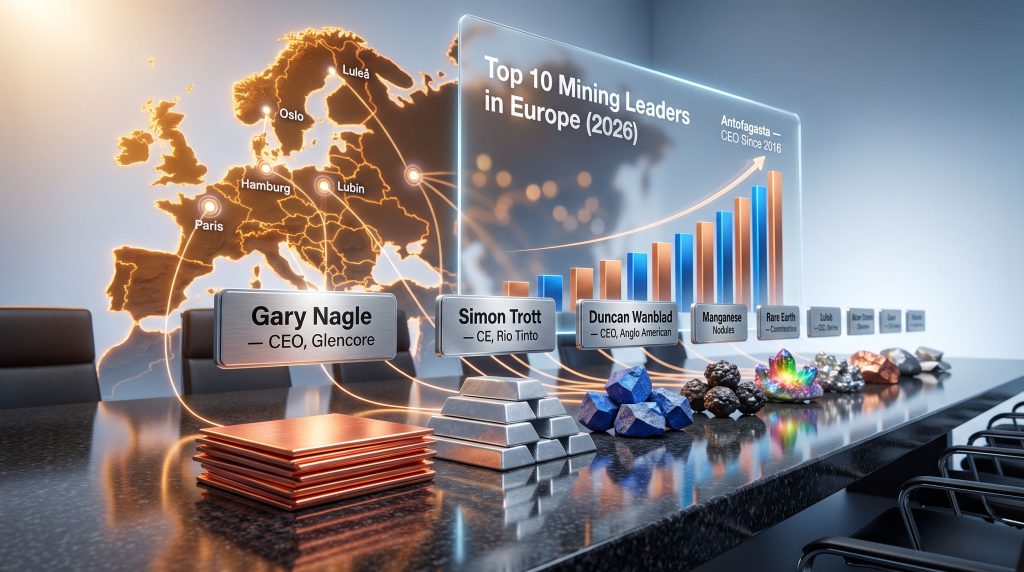
The New Architecture of Mining Power: Europe's Most Influential Industry Leaders in 2026
The global mining industry is undergoing one of its most significant structural recalibrations in decades. Across the world's major commodity markets, the transition toward electrification, green infrastructure, and digitally intensive economies has fundamentally altered which metals matter, which geographies matter, and crucially, which executives matter. Europe sits at the centre of this recalibration, simultaneously one of the world's most sophisticated industrial consumers and one of its most constrained primary producers.
Understanding who leads European mining in 2026 requires more than cataloguing corporate hierarchies. It demands an appreciation of the forces reshaping executive relevance itself: geopolitical fragility in the critical minerals supply chain, the technical complexity of decarbonising heavy industry, and the growing expectation that mining leadership must generate social licence as effectively as it generates tonnes.
This analysis profiles the top 10 mining leaders in Europe, examining not only their career trajectories but the strategic contexts that define the weight of their roles.
When big ASX news breaks, our subscribers know first
How Europe's Critical Mineral Dependency Is Reshaping Executive Priorities
Europe's relationship with its own mineral endowment is structurally uneven. The continent holds meaningful reserves of industrial and construction minerals, including potash, kaolin, fluorspar, and magnesite, and maintains active production in copper, lead, zinc, chromium, and silver across a limited number of member states. Yet for metallic ores broadly, and for the specific minerals underpinning the energy transition in particular, European industry relies heavily on imports.
The convergence of four demand vectors is intensifying that dependency:
- Electrification driving copper and nickel consumption in wiring, motors, and charging infrastructure
- Renewable energy deployment accelerating demand for rare earths, lithium, and manganese
- Digital infrastructure expansion requiring specialised metals for semiconductors and data centre construction
- Defence procurement growth elevating demand for a range of base and specialty metals across EU member states
This context elevates the strategic profile of mining executives far beyond conventional operational roles. A CEO managing a copper smelter in Hamburg or an iron ore mine in northern Sweden is now, in a very real sense, managing a node in a supply chain with geopolitical consequences.
The Four Pillars Defining Modern European Mining Leadership
Europe's top mining executives are no longer evaluated solely on production output. Leadership effectiveness is increasingly measured across four interconnected dimensions: decarbonisation progress, supply-chain resilience, regulatory navigation, and community licence to operate.
1. Decarbonisation and Green Processing
Investment in lower-carbon smelting technologies, hydrogen-based reduction processes, and renewable mining solutions has moved from voluntary ESG commitment to competitive necessity. European producers face carbon pricing mechanisms and regulatory requirements that their counterparts in Australia, Canada, and Chile largely do not.
2. Permitting and Regulatory Complexity
Multi-jurisdictional environmental approvals across EU member states remain one of the most persistent operational constraints facing European mining. Permitting timelines in many EU jurisdictions can extend to a decade or longer, creating structural disadvantages relative to international peers. The EU Critical Raw Materials Act is intended to address this, though its implementation across member states remains uneven.
3. Automation and Digital Transformation
Smart mining technologies, remote operation centres, AI-driven predictive maintenance, and autonomous haulage systems are progressively being integrated across European operations. These investments improve both safety performance and operational efficiency, two metrics increasingly scrutinised by institutional investors and regulators alike.
4. Circular Economy Integration
Multi-metal recycling, secondary materials processing, and resource recovery have become defining features of European mining strategy. The economics of urban mining, recovering copper, precious metals, and battery materials from industrial waste streams, are increasingly competitive with primary extraction in high-cost European markets.
Top 10 Mining Leaders in Europe (2026)
10. Dr Toralf Haag | Chief Executive Officer, Aurubis
Founded: 1866 | HQ: Hamburg, Germany
Dr Toralf Haag has served as CEO of Aurubis since September 2024, bringing to the role a career spanning industrial management, corporate finance, and large-scale organisational transformation. He studied business at the University of Augsburg and completed a doctorate at the University of Kiel.
His career trajectory is instructive: early management roles within ThyssenKrupp, followed by CEO responsibility for the Stamping and Frame Division of the Budd Company in the United States, and then a return to the German metals industry as CFO of Norddeutsche Affinerie from 2002 to 2005, the predecessor entity that subsequently evolved into Aurubis.
Aurubis occupies a strategically important position as one of Europe's largest copper producers and a critical node in the continent's copper recycling expansion and refining infrastructure. Its multi-metal recovery operations, processing complex secondary materials including electronic scrap and industrial residues, represent precisely the kind of circular economy capability that European industrial policy increasingly prioritises. Under Haag's leadership, the focus on energy-efficient smelting processes and expanded recycling throughput aligns with EU decarbonisation targets for energy-intensive industries.
9. Eivind Kallevik | President and CEO, Norsk Hydro
Founded: 1905 | HQ: Oslo, Norway
Eivind Kallevik became Norsk Hydro's President and CEO in May 2024, succeeding Hilde Merete Aasheim. He is the company's 13th chief executive since its founding, a lineage that underscores the institutional depth he inherits.
Kallevik's professional biography is almost entirely written within Hydro. Joining the company in 1998, he progressed through finance and corporate management roles before serving as Executive Vice President and CFO from 2013 to 2019, then leading the Aluminium Metal division until his elevation to the top role. He holds a Bachelor of Business Administration from the Norwegian Business School and a master's degree from the University of San Francisco.
Norsk Hydro operates across the complete aluminium value chain, from bauxite mining and alumina refining to rolled products and recycled aluminium, making it one of the few vertically integrated aluminium producers globally. Kallevik's leadership arrives at a moment of rising European demand for low-carbon aluminium across automotive lightweighting programmes, sustainable construction, and packaging applications. The company's investment in recycled and low-carbon primary aluminium positions it competitively in a market where embodied carbon credentials are increasingly priced by industrial buyers.
8. Christel Bories | Chairwoman and Interim CEO, Eramet
Founded: 1880 | HQ: Paris, France
Christel Bories has served as Eramet's Chairwoman since her first tenure at the group and, since February 2026, has additionally taken on the role of Interim CEO while the board conducts a search for a permanent appointment. Her dual executive and governance role reflects both the board's confidence in continuity leadership and the complexity of managing a strategic transition at one of France's most globally significant mining companies.
A graduate of HEC Paris, Bories brings senior industrial executive experience from organisations including Ipsen to her leadership of Eramet. Her prior strategic direction at the group focused on strengthening its mining and metallurgical portfolio around metals with direct relevance to the energy transition.
Eramet's commodity mix, spanning manganese, nickel, and mineral sands, places it at the intersection of two critical supply chains: battery manufacturing, where both nickel and manganese are key cathode components, and specialty steel production, where manganese alloys are essential inputs. The company's Weda Bay nickel operation in Indonesia and its Moanda manganese mine in Gabon represent significant assets for European downstream industries seeking to diversify supply away from single-source dependencies.
7. Remigiusz Paszkiewicz | President and CEO, KGHM Polska Miedź
Founded: 1961 | HQ: Lubin, Poland
Remigiusz Paszkiewicz leads KGHM Polska Miedź, an enterprise that occupies a structurally unique position within European copper production. Before joining KGHM, his career spanned leadership roles at Grupa Przemysłowa Baltic, Slovenske Železnice, ANWIL, and PKP Polskie Linie Kolejowe. At PKP, he was involved in substantial infrastructure investment programmes and was recognised by the European Commission as Europe's best infrastructure manager in 2014.
KGHM is among the very few European mining companies operating a fully integrated domestic copper production chain, from ore extraction through smelting to refined metal, giving it a structurally distinct position within the EU's critical minerals supply base.
KGHM operates one of the world's largest copper and silver mining complexes, with the Legnica-Glogow Copper Belt in Poland forming the operational core. The company's international footprint extends to North America through its Sierra Gorda copper mine in Chile and operations in Canada. Leadership at KGHM requires balancing Poland's industrial copper heritage with the EU's green transition mandates and evolving ESG expectations from international capital markets.
6. Mikael Staffas | President and CEO, Boliden
Founded: 1924 | HQ: Stockholm, Sweden
Mikael Staffas has led Boliden since June 2018, having joined the company in 2011 as CFO before transitioning to Director of the Mines business area in 2015. His pre-Boliden career included a CFO role at Södra Skogsägarna and a partnership position at McKinsey and Company. He holds an engineering degree from the Royal Institute of Technology (KTH) and an MBA from INSEAD, a combination that reflects the cross-functional profile increasingly common among European mining chief executives.
Boliden operates an integrated business model encompassing both mines and smelters across Scandinavia and Europe, producing copper, zinc, lead, gold, and silver. This integration between primary extraction and downstream processing confers both margin stability and supply chain visibility that pure miners lack.
Under Staffas, Boliden has expanded its smelting capacity and consistently ranked among European mining's leading performers on ESG metrics. Scandinavian regulatory frameworks, while demanding, have arguably helped shape Boliden's operational culture in ways that now constitute competitive advantages as ESG scrutiny intensifies globally.
5. Johan Menckel | President and CEO, LKAB
Founded: 1890 | HQ: Luleå, Sweden
Johan Menckel assumed the presidency of LKAB in the first half of 2026, succeeding Jan Moström at what many observers regard as one of the most consequential junctures in the company's 136-year history. He joined LKAB having served as Vice President and Investment Manager at Latour AB and, prior to that, as CEO of industrial group Gränges. He holds a Master of Science in Engineering from KTH Royal Institute of Technology.
LKAB is a Swedish state-owned enterprise and one of Europe's foremost iron ore producers, supplying high-grade pellets and sinter feed to steel mills across the continent. Its operational mandate extends beyond commercial performance to encompass national industrial strategy, a distinction that shapes leadership priorities in ways not applicable to purely commercial counterparts.
The company's most strategically significant initiative involves the advancement of green steelmaking technology, a process that substitutes green hydrogen for coking coal in the iron ore reduction step, which could eliminate the largest single source of CO2 emissions in European heavy industry. Menckel inherits both the ambition and the execution challenge of this programme at a critical phase of its development.
4. Iván Arriagada | Chief Executive Officer, Antofagasta plc
Founded: 1888 | HQ: London, UK
Iván Arriagada has led Antofagasta since 2016, making him one of the longest-serving CEOs among European-listed major mining producers, a tenure that itself represents a form of institutional knowledge difficult to replicate through executive recruitment.
His career biography spans the full spectrum of the copper industry's financial and operational architecture. Before Antofagasta, he served as CFO of Codelco, the Chilean state copper company and the world's largest copper producer by volume. At BHP Billiton, he held the presidency of Pampa Norte and the CFO role for the base metals division. Earlier, he spent nearly two decades at Royal Dutch Shell in finance and commercial roles across multiple geographies.
Antofagasta plc is London-listed and controls significant copper assets in Chile through subsidiaries including Los Pelambres, Centinela, and Antucoya. Copper's centrality to every major electrification programme globally positions Arriagada's stewardship of these assets as directly relevant to European industrial supply chain security, despite the operational base being in South America.
3. Duncan Wanblad | Chief Executive Officer, Anglo American
Founded: 1917 | HQ: London, UK
Duncan Wanblad brings more than three decades of international mining experience to the chief executive role at Anglo American, a company whose commodity breadth is rivalled by very few organisations globally. He began his career as a junior engineer at Johannesburg Consolidated Investment Company in 1990, progressing through technical, project, operational, and strategic roles across Anglo American Platinum and the broader group over the following three decades.
Appointed Group CEO in April 2022, Wanblad previously served as Group Director of Strategy and Business Development and as CEO of Anglo American's base metals business. His engineering background, relatively uncommon among the peer group of top 10 mining leaders in Europe, gives him a technical literacy that complements the strategic portfolio management demands of his current role.
Anglo American's commodity portfolio is deliberately diversified across platinum group metals, copper, iron ore, crop nutrients through its Woodsmith polyhalite project, and diamonds via De Beers. This breadth positions the company simultaneously in industrial, agricultural, luxury, and energy-transition supply chains. Wanblad's tenure has involved significant portfolio rationalisation, reflecting a strategic preference for high-quality, long-life assets over volume-driven growth.
2. Simon Trott | Chief Executive, Rio Tinto
Founded: 1873 | HQ: London, UK and Melbourne, Australia
Simon Trott became Chief Executive of Rio Tinto in August 2025, bringing over 25 years of experience spanning operating, commercial, and business development functions across one of the world's largest mining organisations. He joined Rio Tinto's Executive Committee in 2018 and held leadership responsibility across a diverse range of commodities and regional operations before ascending to the top role.
His most recent operational leadership position was as CEO of Rio Tinto Iron Ore, the company's largest and most profitable business unit by earnings contribution. In that capacity, he led efforts to improve financial discipline, operational performance, and safety outcomes across the Pilbara iron ore system in Western Australia, one of the most complex and logistically intensive mining operations anywhere in the world.
Rio Tinto's European listing and substantial European shareholder base make Trott's strategic decisions highly relevant to European institutional investors. Furthermore, his tenure begins at a moment when the company is accelerating its exposure to copper through the Oyu Tolgoi expansion in Mongolia, to lithium through the Jadar project in Serbia, and to other energy-transition materials, while simultaneously managing the capital return profile of its iron ore franchise.
1. Gary Nagle | Chief Executive Officer, Glencore
Founded: 1974 | HQ: Baar, Switzerland
Gary Nagle represents a particular archetype of mining leadership: the career insider elevated through decades of commodity-facing operational roles rather than imported from adjacent industries or the financial sector. He joined Glencore in 2000 as part of its coal development team and subsequently held senior leadership positions across Australia, Colombia, South Africa, and Switzerland before becoming CEO in July 2021, succeeding the long-serving Ivan Glasenberg.
Glencore's dual identity as both a significant fossil fuel producer and a critical minerals supplier places Gary Nagle's strategic decisions among the most consequential in global resources. His oversight of the company's commodity marketing operations gives Glencore an influence on global metal pricing that extends substantially beyond its own mine production volumes.
Glencore is Europe's largest mining and commodities trading company by revenue, with operations and marketing activities spanning copper, cobalt, zinc, nickel, ferroalloys, coal, and oil. The cobalt dimension is particularly significant: Glencore's Katanga and Mutanda operations in the Democratic Republic of Congo make it the world's largest cobalt producer, and cobalt is an essential component in lithium-ion battery cathodes used across the EV and consumer electronics industries.
Nagle's leadership of Glencore involves navigating a genuine strategic tension. The company remains one of the world's most significant thermal coal producers, a position that generates substantial cash flow but also attracts persistent ESG scrutiny from institutional investors, particularly European pension funds and asset managers with net-zero commitments. Consequently, how Nagle manages the pace of coal wind-down relative to critical minerals investment will define Glencore's long-term strategic positioning as much as any individual operational decision.
How Do These Leaders Compare? Cross-Executive Analysis
Leadership Tenure, Background, and Commodity Focus
| Executive | Company | CEO Since | Primary Commodity | Career Background |
|---|---|---|---|---|
| Gary Nagle | Glencore | 2021 | Copper, cobalt, coal | Commodities trading and operations |
| Simon Trott | Rio Tinto | 2025 | Iron ore, copper, lithium | Operations and commercial |
| Duncan Wanblad | Anglo American | 2022 | PGMs, copper, crop nutrients | Engineering and strategy |
| Iván Arriagada | Antofagasta | 2016 | Copper | Finance and energy |
| Johan Menckel | LKAB | 2026 | Iron ore | Investment and industrial management |
| Mikael Staffas | Boliden | 2018 | Copper, zinc, gold | Finance and consulting |
| Remigiusz Paszkiewicz | KGHM | Active | Copper, silver | Infrastructure and logistics |
| Christel Bories | Eramet | Interim 2026 | Manganese, nickel | Industrial management |
| Eivind Kallevik | Norsk Hydro | 2024 | Aluminium | Finance and operations |
| Dr Toralf Haag | Aurubis | 2024 | Copper refining and recycling | Finance and industrial management |
What Career Paths Produce Europe's Mining Leaders?
A striking pattern emerges when examining the career backgrounds of Europe's top mining executives: a majority entered their current roles via finance or CFO pathways rather than through technical engineering disciplines. Arriagada, Kallevik, Staffas, and Haag all held senior finance roles before assuming CEO responsibilities. This reflects a broader trend across European industrial leadership, where capital allocation capability and balance sheet management have become as strategically valued as operational expertise.
Notable counterweights exist. Duncan Wanblad's engineering foundation and operational progression through Anglo American Platinum reflects the continued importance of technical credibility, particularly in companies managing complex, multi-commodity portfolios. Remigiusz Paszkiewicz's infrastructure and logistics background at PKP represents a different model again, one where large-scale organisational transformation capability is the primary qualification.
The implication for talent pipelines is significant: European mining companies appear to be selecting for executives capable of communicating investment cases to sophisticated capital markets, managing multi-stakeholder regulatory environments, and allocating capital across long-duration assets. According to Euromines, the European mining industry continues to advocate for stronger frameworks that support executive-level engagement on permitting and supply chain resilience. Pure technical specialists, while essential at operational levels, are increasingly rarely found in the chief executive chair.
The next major ASX story will hit our subscribers first
Strategic Challenges Defining European Mining Leadership in 2026
The Permitting Bottleneck
Permitting timelines across EU member states vary dramatically, with some jurisdictions requiring seven to twelve years from exploration to production approval. This creates structural disadvantages for European producers competing for capital against Australian, Canadian, and Chilean peers operating under faster regulatory regimes. The European raw materials strategy establishes a framework intended to streamline approvals for designated strategic minerals, though translating framework into practice requires implementation at member state level, a process that remains uneven.
Scandinavian jurisdictions, particularly Sweden and Finland, are frequently cited as relatively more efficient permitting environments within Europe, which partly explains why Boliden and LKAB are able to develop and operate mines in ways that would face considerably longer timelines elsewhere on the continent.
Decarbonisation as Competitive Strategy
For European mining and metals companies, decarbonisation has shifted from compliance obligation to genuine competitive differentiator. Three examples illustrate the range of approaches:
- LKAB's hydrogen-based iron ore processing programme represents the most ambitious primary production decarbonisation effort in European mining, targeting elimination of coking coal from the steelmaking process entirely
- Norsk Hydro's low-carbon aluminium product lines command premium pricing in automotive and packaging supply chains where Scope 3 emissions are increasingly measured and disclosed by downstream buyers
- Aurubis's multi-metal recycling operations reduce both the carbon intensity of copper production and the volume of primary ore required, creating a business model that improves environmental performance while generating commercial returns from complex secondary material streams
The Geopolitical Dimension of European Mining Leadership
European industry's dependence on Chinese processing capacity for rare earths, lithium, and cobalt has elevated mining executives to a new category of strategic importance in policy conversations. While the top 10 mining leaders in Europe profiled here lead commercially driven enterprises rather than policy instruments, the alignment between their operational strategies and Europe's supply diversification objectives is increasingly direct.
Glencore's cobalt production in the DRC, KGHM's integrated domestic copper capacity, Eramet's manganese and nickel assets, and LKAB's green steel technology all represent forms of supply chain infrastructure that European industrial strategy increasingly depends upon. However, the executives managing these assets are, in effect, making decisions with consequences that extend well beyond quarterly earnings. For a broader perspective on how these organisations rank globally, the world's biggest mining companies list provides useful context for understanding the scale at which these European leaders operate.
Disclaimer: This article is intended for informational purposes only and does not constitute financial or investment advice. All leadership appointments, company details, and strategic information reflect publicly available sources as of the publication date. Readers should conduct independent due diligence before making any investment or business decisions based on information contained herein.
Want to Identify the Next Major ASX Mineral Discovery Before the Market Does?
Discovery Alert's proprietary Discovery IQ model delivers real-time alerts on significant ASX mineral discoveries, translating complex mineral data into actionable insights for both short-term traders and long-term investors — explore the historic returns major discoveries have generated and begin your 14-day free trial today to position yourself ahead of the market.