August 12, 2026
The Hidden Cost of Execution Failure in Modern Mining
Every year, mining operations around the world invest heavily in geological surveys, feasibility studies, and long-range production planning. Yet a persistent and costly paradox remains: the gap between what a mine plans to produce and what it actually produces. Research across the sector consistently points to unplanned equipment downtime, crew availability gaps, and infrastructure failures as the primary culprits behind this shortfall. Individually, these disruptions appear manageable. Cumulatively, across dozens of shifts and hundreds of operational decisions, they compound into significant revenue loss.
The deeper problem is structural. Most mine management systems are built around static pre-shift planning models that assume a stable operational environment. Underground and open-pit conditions are anything but stable. A single ventilation fan failure, a truck breakdown, or an unexpected ground condition can render an entire shift plan obsolete within minutes.
Without the adaptive intelligence to respond in real time, supervisors are left making high-stakes decisions under pressure, often relying on institutional knowledge rather than live data. Furthermore, data-driven mining operations are increasingly recognised as essential to bridging this planning-to-execution gap across the sector.
This is the specific problem that Hivekit OPS.AI mine operations technology has been engineered to solve.
When big ASX news breaks, our subscribers know first
What Is Hivekit OPS.AI and How Does It Work?
An Orchestration System, Not Just a Scheduling Tool
Hivekit, a U.S.-based mining technology company, has developed OPS.AI as a mine operations orchestration platform. The distinction matters. Where conventional mine planning software produces a static schedule before a shift begins, OPS.AI functions as what its developers describe as an operational brain, continuously coordinating execution across the full mining value chain in real time.
The platform connects strategic production goals with moment-to-moment operational reality. It ingests data from a wide range of sources, constructs a live three-dimensional digital twin of the mine environment, and uses this unified operational picture to generate, validate, and continuously update shift plans based on actual conditions rather than assumptions.
The data inputs that feed OPS.AI span every critical layer of mine operations:
| Data Input Category | Examples of Sources Integrated |
|---|---|
| Geospatial and Layout | 3D mine maps, stope geometry, level configurations |
| Equipment and Assets | Truck telemetry, loader performance metrics, maintenance logs |
| Personnel | Shift rosters, operator certifications, real-time availability |
| Infrastructure Systems | Ventilation monitoring, dewatering systems, power supply |
| Production Planning | Strategic mine plans, shift targets, cycle assignments |
A critical design feature of the platform is its vendor-agnostic integration architecture. Rather than requiring mining operations to decommission existing systems and replace them wholesale, OPS.AI connects with incumbent technology ecosystems including fleet management platforms, environmental monitoring infrastructure, and maintenance management systems. This interoperability substantially reduces the implementation barrier for operations that have already made technology investments across disparate systems.
The 21% Compliance Improvement: What It Actually Means
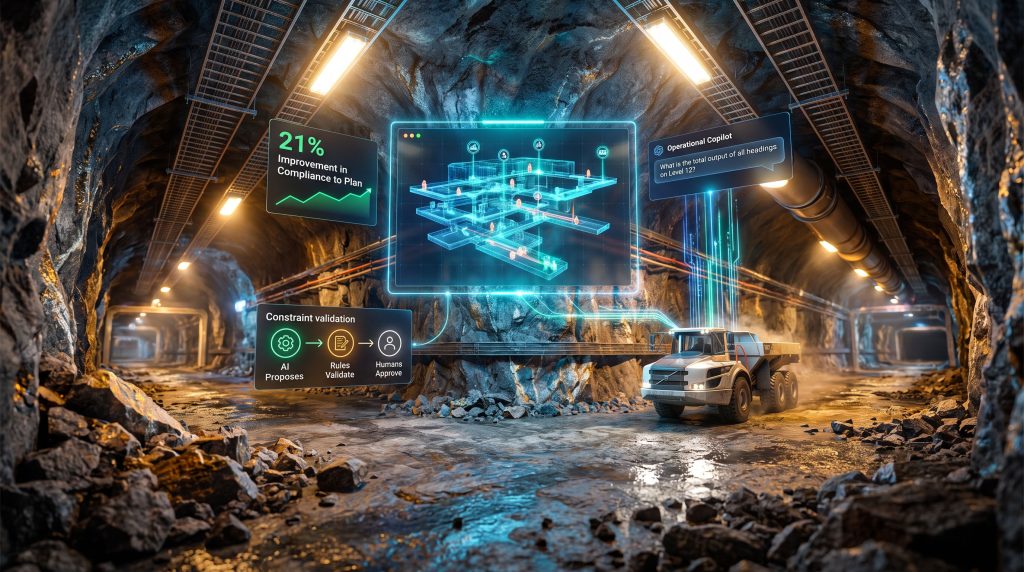
When Hivekit validated OPS.AI against historical mine operations data, the results showed a 21% improvement in compliance to plan, alongside measurable gains in the utilisation of existing resources. Understanding what this figure represents requires some context.
Compliance to plan is a core performance metric in mining operations, measuring the degree to which actual production activity matches what was scheduled at the start of a shift. Low compliance rates are not simply a scheduling problem. They reflect the cascading consequences of unresolved operational variability: equipment idling while awaiting reassignment, crews standing down because of ventilation restrictions, and haul cycles disrupted by breakdowns that were not anticipated in the plan.
In addition, advances in 3D geological modelling have made it possible to construct far more accurate operational environments, further supporting the kind of real-time digital twin that platforms like OPS.AI depend upon.
A 21% improvement in compliance to plan, achieved through better coordination of existing assets rather than capital investment in new equipment, suggests that operational intelligence may be a more immediately accessible productivity lever than infrastructure expansion for many mining operations.
Critically, the efficiency gains observed during testing did not require additional capital expenditure on new equipment. The improvements came entirely from superior coordination of assets already present on site. For mining operations under commodity price pressure, this distinction is strategically significant.
How OPS.AI Adapts to Real-World Disruption
From Static Plans to Dynamic Operational Intelligence
The core operational loop within OPS.AI works as follows:
- Plan generation: OPS.AI translates production targets into optimised shift plans, assigning tasks, haul cycles, crew targets, and equipment allocations based on live resource availability rather than assumed availability.
- Continuous reconciliation: As the shift progresses, OPS.AI tracks actual versus planned performance, identifying divergences as they emerge rather than after the fact.
- Dynamic replanning: When conditions change — whether through equipment breakdown, personnel unavailability, ventilation failure, or shifting ground conditions — OPS.AI automatically recalibrates the shift plan to account for the new operational reality.
- Supervisor integration: Human supervisors retain full authority throughout this cycle. Any override or adjustment made by a supervisor is fed back into OPS.AI, which replans dynamically around those human decisions.
This continuous feedback loop addresses one of the most persistent inefficiencies in mine supervision: the 30-to-60 minute lag between a disruption occurring and a revised operational plan being communicated to the workforce. In high-cost underground environments, that lag has real financial consequences at every shift.
Bottleneck Detection and Constraint-Aware Planning
Beyond dynamic replanning, OPS.AI continuously analyses the operational data stream to identify correlations, constraints, and production bottlenecks as they develop. This bottleneck detection capability is not limited to equipment availability. The system accounts for:
- Mandatory safety requirements and break schedules
- Ventilation restrictions that limit which headings can be active simultaneously
- Equipment certification and capability limitations per operator
- Site-specific operating protocols unique to each mine
- Maintenance windows, both planned and unplanned
This constraint-aware planning model is what separates OPS.AI from simpler scheduling tools that optimise for production targets without adequately modelling the operational boundaries within which those targets must be achieved. Moreover, the role of AI in mining operations more broadly continues to expand, reinforcing why constraint-based architectures like this one are gaining traction.
The Deterministic Constraint Layer: Why This Architecture Matters
Addressing the Core Barrier to AI Adoption in Mining
One of the most significant obstacles to AI adoption in safety-critical industries is the unpredictability of AI-generated outputs. Large language models and machine learning systems can produce recommendations that are locally optimal but violate important operational or safety rules. In a mining environment, the consequences of acting on an invalid AI recommendation can be severe.
Hivekit has addressed this directly through what it calls a deterministic constraint layer: a rule-based validation checkpoint that sits between every AI-generated recommendation and any operational action.
The process works in three stages:
- AI proposes a plan, action, or resource allocation based on its analysis of current operational conditions.
- Deterministic rules validate the proposal against a predefined set of operational rules, safety requirements, equipment limitations, and site-specific constraints.
- Authorised humans approve the validated recommendation before it is executed.
Any proposal that fails validation is automatically rejected before it reaches a human user. This three-tier governance model means that the speed and pattern-recognition capability of AI is always bounded by non-negotiable operational rules, and that human supervisors are never presented with an operationally invalid plan.
This architecture directly answers the question that mining regulators and safety managers have consistently raised about AI systems: how do you ensure the machine cannot propose something dangerous? The answer embedded in OPS.AI is that validated safety rules have structural veto power over AI-generated outputs, regardless of how optimal those outputs appear from a production perspective.
The Operational Copilot: Conversational Intelligence for Mine Managers
Natural Language Queries Against Live Operational Data
OPS.AI includes an integrated Operational Copilot designed for use by mine managers, supervisors, and dispatchers. Unlike general-purpose AI assistants that generate responses from broad language model training, the Copilot is specifically built around the operational data structure of the Hivekit platform.
When a user poses a question such as how many tonnes have been lost due to a ventilation system breakdown, or what the total output of all headings on a specific level has been, the Copilot does not simply generate a language model response. It translates the natural language question into a structured query against the underlying operational database, retrieves the relevant data, and presents the results through answers, tables, and visualisations tailored to the operational context.
This distinction matters technically. A language model responding directly to an operational question is drawing on training data and probabilistic reasoning. The Copilot is retrieving factual, real-time operational data and interpreting it. The accuracy floor is consequently significantly higher for questions that involve current operational status.
From Query to Action: Directive Execution Within Permissions
The Copilot is not limited to answering questions. Authorised users can issue operational directives in plain language, such as assigning a replacement driver to a specific truck or removing a stope from the current production plan. OPS.AI translates these directives into actions within the underlying operational system, subject to the same permission validation and deterministic constraint layers applied across the full platform.
This creates a unified governance architecture for both human-initiated and AI-suggested operational changes, ensuring consistency regardless of how an action originates.
The next major ASX story will hit our subscribers first
Use Cases Where Hivekit OPS.AI Mine Operations Creates the Most Value
The practical applications of Hivekit OPS.AI mine operations technology extend across multiple operational contexts:
- Underground hard rock mining: Dynamic replanning around ventilation constraints, blast timing windows, and sequential stope access, where the interdependencies between working areas are highly complex and supervision is particularly demanding.
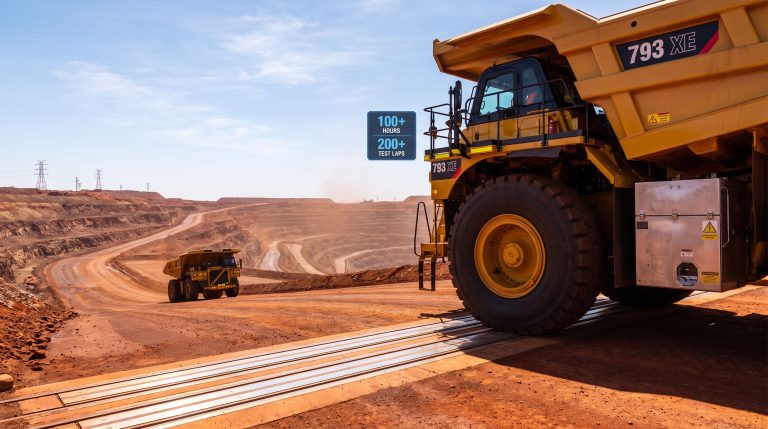
- Open-pit haul optimisation: Real-time matching of loader and truck assets to optimise cycle times and minimise idle equipment across large pit geometries.
- Shift transition management: Automated generation of handover intelligence that ensures incoming supervisors receive an accurate and current operational picture rather than relying solely on outgoing supervisor briefings.
- Maintenance integration: Incorporating both planned maintenance windows and unplanned breakdowns into production scheduling in real time, without requiring manual recalculation by supervisors.
Furthermore, predictive maintenance in mining has become an increasingly integral component of operational planning, and OPS.AI's ability to incorporate maintenance data in real time aligns closely with this emerging standard.
Hypothetical Scenario: Ventilation Failure Response
Consider an underground gold mine where a primary ventilation fan on a lower level fails mid-shift. Under conventional operations, the supervisor must manually assess which headings become non-compliant, determine which crews need redeployment, calculate revised tonnage expectations, and communicate updated tasks across the operation. This process typically takes between 30 and 60 minutes and depends heavily on individual experience.
With OPS.AI monitoring integrated ventilation infrastructure, the system detects the status change immediately, identifies all affected headings and personnel, proposes a constraint-validated revised shift plan that reallocates crews to compliant working areas, and presents the recommendation to the supervisor for approval — all within minutes. The deterministic constraint layer has already verified that the revised plan complies with all ventilation, safety, and equipment rules before it reaches the supervisor's screen.
Why Operational Intelligence May Outperform Capital Expenditure as a Productivity Lever
The mining industry has historically pursued productivity improvements through capital-intensive pathways: acquiring larger haul trucks, expanding processing infrastructure, and increasing workforce headcount. These approaches have delivered results but carry substantial lead times and financial risk, particularly in volatile commodity markets.
The early validation results from OPS.AI suggest a structurally different pathway. By extracting superior performance from assets already deployed on site — through better coordination, real-time decision support, and constraint-aware planning — AI-driven operational management may offer a faster and lower-risk route to productivity improvement for mature mining operations.
This is particularly relevant as global mining operations face simultaneous pressure on operating costs, tightening environmental and safety compliance requirements, and increasing competition for skilled supervisory talent. Platforms that reduce the cognitive burden on supervisors while improving the quality and speed of operational decisions address multiple challenges simultaneously.
The convergence of real-time digital twins, constraint-aware AI planning, and natural language operational interfaces represents a meaningful architectural shift in mine management thinking. Notably, broader mining automation trends suggest that this shift toward proactive, data-driven orchestration is accelerating across the sector as a whole.
Whether Hivekit OPS.AI mine operations technology fulfils that promise at scale remains subject to real-world deployment experience. However, the architectural foundations and early validation data establish a credible basis for the claim. As industry analysts have noted, platforms of this kind represent a significant step forward in how mines translate planning intent into operational execution.
Disclaimer: Information regarding early testing results and performance improvements reflects validation conducted against historical mine operations data as reported by Hivekit. Real-world results may vary depending on site-specific conditions, integration complexity, and operational context. This article does not constitute financial or investment advice.
Want to Know Which ASX Mining Companies Are Turning Operational Advances Into Major Discoveries?
Discovery Alert's proprietary Discovery IQ model scans ASX announcements in real time, delivering instant alerts on significant mineral discoveries — the same kind of transformative moments that have historically driven extraordinary returns, as showcased on Discovery Alert's dedicated discoveries page. Begin your 14-day free trial at Discovery Alert and position yourself ahead of the broader market before the next major discovery is priced in.