August 12, 2026
The Hidden Bottleneck Inside America's Critical Minerals Ambition
The global race for US mining education funding for critical minerals is often framed as a contest of capital: who can deploy the most money, fastest, into the ground. Yet the deeper constraint rarely enters the conversation. A mine is not a financial instrument. It is a physical, technical, and human system. Before a single tonne of lithium carbonate or rare earth concentrate reaches a processing facility, dozens of specialists must first assess the geology, navigate environmental and permitting frameworks, design the extraction methodology, and supervise construction and commissioning.
That chain of expertise does not emerge from a funding announcement. It is built over years, through universities, apprenticeships, and on-site experience. And in the United States, that chain has been quietly breaking for nearly a decade.
When big ASX news breaks, our subscribers know first
Why Capital Investment Alone Cannot Unlock Domestic Production
There is a structural paradox at the heart of US critical minerals policy that receives far less attention than headline investment figures. Billions of dollars committed to mine development cannot translate into operating mines without a corresponding pipeline of trained engineers, geologists, metallurgists, and skilled tradespeople. The mine permitting process alone demands geotechnical engineers and environmental specialists capable of navigating complex regulatory requirements.
The engineering and design phase requires experienced mine planners, ventilation engineers, and ground control specialists. Operations demand certified mine supervisors, blast technicians, and processing plant operators. Each of these roles represents years of specialised education and hands-on formation.
They cannot be imported at scale without creating foreign dependency in the very sectors the US is attempting to reshore. Furthermore, they cannot be conjured overnight in response to a funding package, regardless of its size.
The Society for Mining, Metallurgy and Exploration (SME), which has tracked workforce pipeline data in partnership with the Society of Mining Professors, has consistently highlighted this structural vulnerability. SME's technical briefings make their position clear: the education and workforce components of any critical minerals initiative carry equal strategic weight to the mine financing itself, because trained professionals are the mechanism through which capital commitments become operational outcomes.
A 60% Enrollment Collapse: Understanding the Depth of the Crisis
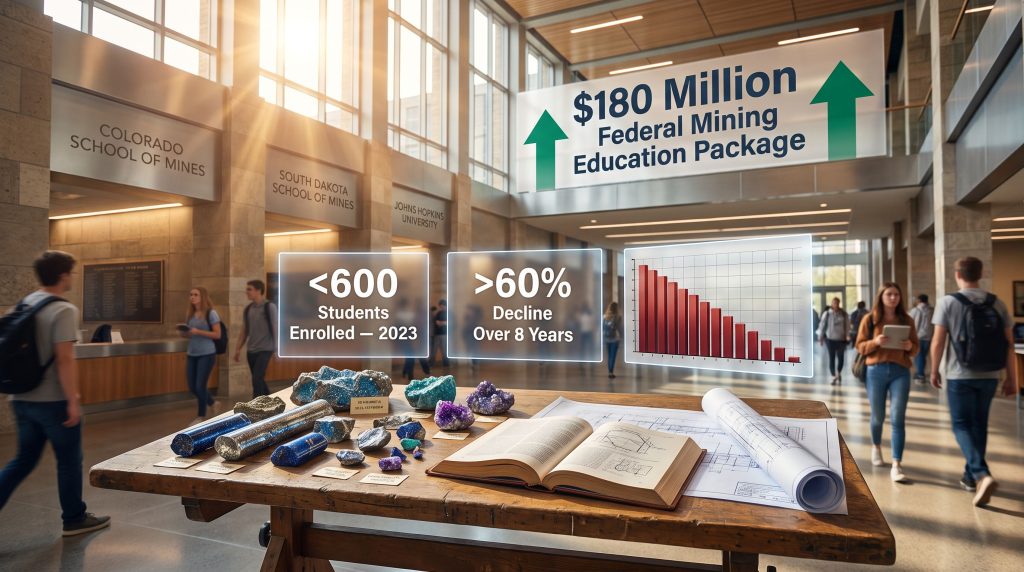
The numbers are stark. US mining engineering enrollment has contracted from approximately 1,500 students around eight years ago to fewer than 600 in 2023. That represents a decline exceeding 60% across accredited programs at a time when critical minerals demand is accelerating due to the energy transition, defence manufacturing requirements, and supply chain reshoring priorities.
| Metric | Data Point |
|---|---|
| Peak US mining engineering enrollment (approx.) | ~1,500 students |
| Enrollment figure (2023) | Fewer than 600 students |
| Enrollment decline (approx.) | >60% over ~8 years |
| ABET-accredited mining schools in the US | 14 institutions |
| Federal education and workforce funding package | >$180 million |
The consequences of this decline compound across time. Fewer students entering programs today means fewer junior engineers available five years from now, fewer mid-career specialists a decade from now, and a thinner senior leadership bench when large-scale domestic projects reach peak operational complexity. Mine development timelines of 10 to 20 years mean that professionals needed to operate the next generation of strategic mines must already be entering their educational pathways now.
What makes this dynamic particularly acute is that the enrollment decline has coincided with an accelerating retirement wave among experienced mining professionals. Seasoned engineers and geologists who accumulated their expertise during the commodity boom cycles of the 1980s and 1990s are exiting the workforce. Institutional knowledge accumulated over careers is not easily documented or transferred. The combination of declining entry-level pipeline and accelerating senior-level attrition creates a compressive workforce squeeze that capital investment cannot directly address.
The US faces a structural talent deficit in mining at precisely the moment when domestic mineral production has become a national security and economic sovereignty priority. Without sustained workforce development, billions in project financing risks sitting idle for want of qualified operators.
Breaking Down the $180 Million Federal Education Package
The DOE PROSPECT Initiative: A $100 Million Workforce Pipeline Program
The US Department of Energy's PROSPECT program represents the largest single federal commitment to mining-specific workforce development in recent history. Allocating $100 million toward expanding educational pathways and training capacity, its stated near-term ambition is to double the number of US graduates in mining and critical minerals-related degree programs within two years.
This goal, while aspirational, is grounded in the reality that the existing 14 ABET-accredited mining engineering institutions collectively have the physical and faculty capacity to expand enrollment if adequate resources are directed toward curriculum development, laboratory infrastructure, faculty recruitment, and student scholarship support. The PROSPECT program is positioned as a funding mechanism to unlock that latent capacity.
The program sits within the DOE's Critical Minerals and Materials Program framework, reinforcing that workforce development is not a peripheral concern but an explicit pillar of the department's strategic approach to mineral security.
The $80 Million Defence-Linked University Investment
A separate $80 million commitment is directed at three specific institutions:
- Colorado School of Mines – one of the most established mining engineering programs in North America, with deep research linkages to industry
- South Dakota School of Mines – a regional anchor for mining talent serving the northern plains resource corridor
- Johns Hopkins University – contributing research capacity in materials science and supply chain analytics
The defence framing of this investment is deliberate and represents a meaningful rhetorical shift. By channelling funds through a defence-linked structure, the federal government is effectively classifying talent development as a national security function, not merely an economic or educational priority. This framing has implications for program continuity and budget protection across political cycles.
The announcement was made at a Presidential roundtable convened at the State Department, attended by Secretary of State Marco Rubio, Secretary of the Interior Doug Burgum, and Secretary of Commerce Howard Lutnick, alongside university and industry leaders. Department heads from all 14 ABET-accredited mining schools were invited to participate, signalling the breadth of institutional engagement sought.
Where Education Fits Within the $3 Billion Package
The $180 million education and workforce commitment forms part of a larger approximately $3 billion domestic critical minerals investment announced at the same roundtable.
| Component | Approximate Allocation | Share of Total |
|---|---|---|
| Mining and mineral processing project investments | ~$2.82 billion | ~94% |
| Education and workforce (total) | >$180 million | ~6% |
| DOE PROSPECT program | $100 million | ~3.3% |
| Defence-linked university hubs | $80 million | ~2.7% |
The 6% weighting of workforce investment relative to total capital deployment reflects an ongoing tension in critical minerals policy: infrastructure and project financing attract political capital more readily than educational investment, even when the latter is the binding constraint on the former's success.
The Critical Mineral Mining Education Act of 2026: A Legislative Backstop
Why Executive Announcements Alone Are Insufficient
One of the most persistent vulnerabilities in federal education funding is its susceptibility to political cycle disruption. Programs initiated through executive action can be modified, defunded, or redirected by subsequent administrations. Congressional codification creates a more durable mechanism, legally requiring appropriations over defined multi-year periods.
The Critical Mineral Mining Education Act of 2026 addresses this structural weakness. If enacted, the legislation would establish a fellowship program enabling US students to pursue mining disciplines at international institutions, broadening the talent formation pathway beyond domestic university capacity. This legislative approach complements the critical minerals executive order framework already in place.
| Program | Administering Body | Funding Level | Duration | Primary Goal |
|---|---|---|---|---|
| PROSPECT Initiative | US Dept. of Energy | $100 million | Near-term | Double mining graduates in 2 years |
| University Technology Hubs | Defence-linked | $80 million | Near-term | Workforce and research infrastructure |
| Critical Mineral Mining Education Act (proposed) | Congress | $10M per year | FY2026 to FY2035 | International fellowships and domestic pipeline |
The proposed legislation's ten-year authorisation window, totalling up to $100 million, complements the executive investment package by providing a sustained funding mechanism across a timeframe more aligned with genuine workforce pipeline development.
What Universities Are Saying: Enrollment Realities and Institutional Capacity
Kray Luxbacher, head of the University of Arizona School of Mining Engineering and Mineral Resources, has articulated a perspective shared across the sector: every mining school department head is actively working to grow enrollment to meet industry demand, and that the federal funding represents a genuine opportunity to change the trajectory of the profession.
The central challenge, as Luxbacher frames it, is reaching students who have had no prior exposure to modern mining careers, showing them what the profession actually looks like today, and equipping programs with the resources needed to compete for their attention against better-funded disciplines.
This points to a less-discussed dimension of the enrollment crisis: the perception problem. Mining as a career is frequently associated with images of hard-rock extraction from previous decades, rather than the data-intensive, technologically sophisticated, and globally significant profession it has become. The modern mining evolution encompasses autonomous haulage systems, real-time geological modelling, drone-based surveying, and hydrometallurgical processing. Reframing the profession's identity for younger generations is consequently as important as expanding scholarship funding.
The next major ASX story will hit our subscribers first
The Industry's Role: Beyond Government Dependency
The SME has been explicit that federal funding is a necessary but not sufficient condition for solving the workforce deficit. The organisation has called on Congress and the administration to ensure that education investment is sustained as a long-term structural commitment rather than treated as a project-style disbursement with a single funding cycle.
SME's leadership has emphasised that a durable domestic supply of critical minerals depends not only on capital for mines and processing facilities, but on a continuous, well-trained pipeline of engineers, geologists, technicians, and tradespeople capable of designing, permitting, building, and operating those assets safely over decades.
The private sector also carries responsibility. Mining companies recruiting graduates are effectively the demand-side signal that justifies educational investment. Formalised industry partnerships with universities — including scholarship programs, internship pipelines, graduate placement commitments, and co-funded research chairs — create institutional incentives that federal dollars alone cannot replicate.
The Shift in Policy Framing: From Climate to Security
How the Rhetoric of Critical Minerals Has Evolved
Earlier federal approaches to critical minerals investment, including programs embedded within the Inflation Reduction Act and the Bipartisan Infrastructure Law, typically situated mineral security within clean energy and climate frameworks. Workforce development was a supporting element within broader energy transition objectives.
The current approach represents a meaningful reframing. US mining education funding for critical minerals is now positioned explicitly as an economic sovereignty and national security function. The decision to route $80 million through defence-linked institutional structures is not merely administrative; it reflects a deliberate classification of mineral expertise as strategic capacity equivalent to defence technology development. This aligns closely with the broader critical minerals strategy being developed across allied nations.
This shift has practical implications:
- Defence-framed programs tend to receive greater protection during budget negotiations
- National security justifications create broader bipartisan support coalitions
- Institutional hubs at research universities generate classified and dual-use research pipelines
- The framing aligns domestic minerals workforce development with allied nation coordination frameworks
Whether this reframing produces more durable investment than its predecessors remains to be seen. What is clear is that treating the mining workforce as a strategic national asset, rather than a sector-specific labour market concern, fundamentally changes the political economy of federal education investment.
FAQ: US Mining Education Funding for Critical Minerals
What is the PROSPECT program?
The PROSPECT program is a US Department of Energy initiative allocating $100 million to expand educational opportunities and workforce development capacity for domestic critical minerals production, processing, recovery, and recycling. Its near-term target is to double the number of US graduates in relevant degree programs within two years.
Which universities are receiving the $80 million defence-linked funding?
Colorado School of Mines, South Dakota School of Mines, and Johns Hopkins University have been designated as recipients for workforce development and technology hub establishment.
How severe is the US mining engineering enrollment decline?
Enrollment fell from approximately 1,500 students around eight years ago to fewer than 600 in 2023, representing a decline exceeding 60% across ABET-accredited programs.
Is the Critical Mineral Mining Education Act already law?
No. As of the time of reporting, it remains a congressional proposal. If enacted, it would authorise $10 million per year from FY2026 through FY2035 for international fellowships and domestic pipeline development.
Why does workforce development matter as much as mine financing?
Trained engineers, geologists, permitting specialists, and skilled tradespeople are the binding constraint on converting financial investment into operational mines. Without them, capital commitments cannot produce mineral output, making human capital a foundational layer of any credible strategy for US mining education funding for critical minerals.
How many ABET-accredited mining schools exist in the US?
There are 14 institutions accredited by the Accreditation Board for Engineering and Technology offering mining engineering programs across the United States.
Disclaimer: This article contains references to proposed legislation and federal program objectives. Program outcomes, legislative enactment, and enrollment projections involve inherent uncertainty. Readers should not treat forward-looking statements or policy proposals as confirmed outcomes. This article is for informational purposes only and does not constitute financial or investment advice.
Want to Identify the Next Major Mineral Discovery Before the Broader Market Does?
While the US builds its critical minerals workforce pipeline, significant ASX mineral discoveries are being announced right now — and Discovery Alert's proprietary Discovery IQ model instantly translates complex geological and commodity data into actionable investment insights for both short-term traders and long-term investors. Explore historic discoveries and their exceptional market returns, then begin your 14-day free trial at Discovery Alert to position yourself ahead of the market.