August 12, 2026
Why Bulk Mineral Logistics Records Reveal More Than Port Efficiency
In the global race to build resilient critical mineral supply chains, the infrastructure connecting mine gates to refinery gates has quietly become one of the most strategically contested spaces in industrial economics. Rail-port integration, specifically the ability to coordinate vessel discharge, yard management, and inland evacuation without creating bottlenecks, separates commodity-exporting nations that can scale from those that remain structurally constrained by their own logistics ceilings.
Against this backdrop, the Visakhapatnam Port bauxite rake handling record set in July 2026 carries considerably more analytical weight than a simple throughput statistic. It signals a measurable shift in how effectively India is moving one of its most critical aluminium raw materials from port to processing facility. Furthermore, the pace at which successive records are being broken suggests this is a structural transformation rather than a temporary operational spike.
When big ASX news breaks, our subscribers know first
Breaking Down What the 71-Rake Benchmark Actually Means
The Compressed Record-Breaking Cycle
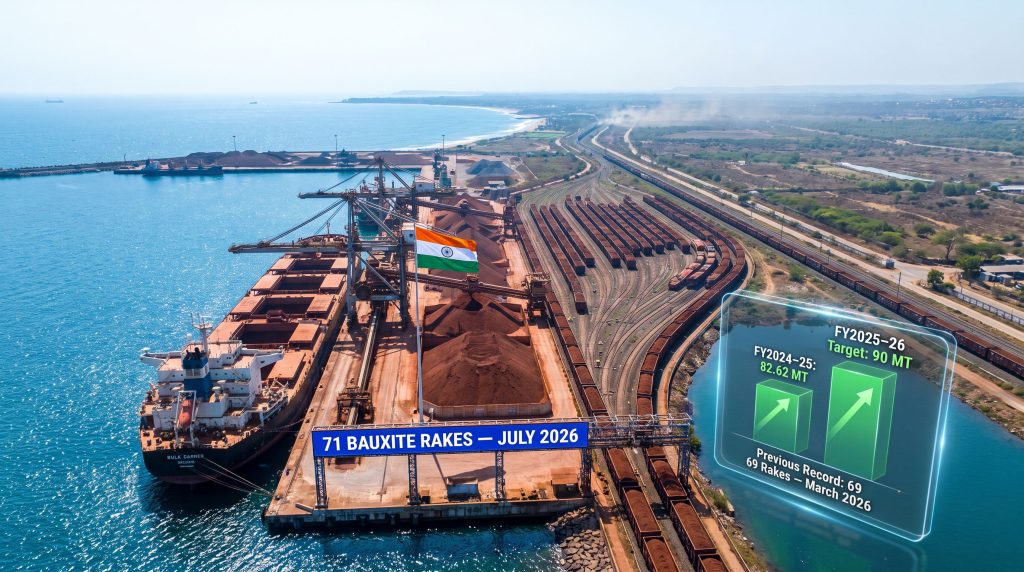
Visakhapatnam Port Authority handled 71 bauxite rakes across the calendar month of July 2026, eclipsing the previous monthly benchmark of 69 rakes set just four months earlier in March 2026. On the surface, a two-rake improvement may appear incremental. In practice, the significance lies not in the margin but in the velocity of improvement.
Two peak benchmarks achieved within the same fiscal year, separated by only one quarter, points to something more durable than a favourable alignment of operational variables. Consequently, it suggests that the port has systematically elevated its throughput floor, meaning the conditions previously required to achieve peak performance are now approaching baseline operating conditions.
A Historical Timeline of Visakhapatnam's Bauxite and Rail Milestones
| Date | Milestone | Volume / Figure |
|---|---|---|
| July 2023 | Monthly bauxite handling record | 259,242 tonnes |
| March 2025 | Largest-ever bauxite vessel berthed in India (MV Captain Leonidas) | 199,500 tonnes |
| January 2026 | Highest-ever monthly bauxite loading volume | Record high (undisclosed) |
| 24 January 2026 | Single-day rail performance record | 58 rakes in one day |
| March 2026 | Previous monthly rake-handling record | 69 rakes |
| July 2026 | New monthly rake-handling record | 71 rakes |
The single-day figure of 58 rakes on January 24, 2026 deserves particular attention. In operational terms, it functions as a capacity ceiling indicator, revealing the upper boundary achievable under near-optimal conditions. The narrowing gap between single-day peak performance and sustained monthly averages is itself a proxy for how consistently the port is approaching its operational maximum.
A port's monthly rake-handling figure is not a single-variable metric. It is a composite reflection of vessel scheduling discipline, yard occupancy management, rail coordination, and the cargo evacuation speed across every stage of the bulk mineral handling chain.
How Rail-Port Integration Drives Bauxite Supply Chain Performance
The Five-Stage Bauxite Rake Cycle
Understanding why a monthly rake record matters requires a working knowledge of how bauxite actually moves through a port system. The process involves five interconnected stages, each of which can independently constrain the overall monthly throughput figure:
- Vessel arrival and berth allocation – scheduling incoming bulk carriers against available berths without creating congestion or idle vessel time
- Cargo discharge to yard storage zones – mechanised unloading of bauxite into designated stockpile areas, where grade segregation and inventory management begin
- Rake placement scheduling – coordinating with the railway to position empty rakes at loading points based on yard occupancy levels and inland demand signals from refineries
- Loading and sealing of rakes – physically loading bauxite into each wagon, sealing, and preparing for inland dispatch
- Evacuation and yard clearance – moving loaded rakes inland to free yard capacity for subsequent vessel arrivals
A blockage at any single stage suppresses the monthly total regardless of how efficiently the remaining stages operate. A 71-rake monthly outcome, therefore, reflects simultaneous optimisation across all five stages, which is a non-trivial coordination achievement at scale.
Yard Utilisation as the Critical Constraint
Among the five stages, yard utilisation is widely regarded within bulk port operations as the binding constraint. When yard storage fills faster than rakes can evacuate cargo inland, incoming vessels face berth delays and the entire system backs up. Conversely, efficient rake turnover keeps yard occupancy at manageable levels, enabling continuous vessel berthing and uninterrupted cargo flow.
This is why rake turnaround speed, not simply rake volume, is the metric that alumina refineries and logistics planners watch most closely. Faster turnaround reduces the average inventory sitting in the port yard, cuts working capital requirements for commodity buyers, and shortens the planning horizon uncertainty that refineries must build into their raw material procurement models. A well-executed mine-to-port logistics strategy can make the difference between operational excellence and chronic supply bottlenecks.
The Waltair Division's Role in the Mineral Corridor
Visakhapatnam Port's rail interface operates through the Waltair Division of East Coast Railway, which functions as the logistical backbone of the entire regional mineral corridor. The scale of this relationship is evident in the division's freight data:
| Freight Category | FY2023-24 Volume |
|---|---|
| Bauxite loading | 5.52 million tonnes |
| Alumina loading | 3.77 million tonnes |
| Total freight handled | 75.64 million tonnes |
The composition of this freight profile reveals a deliberate structural alignment between rail capacity and the aluminium raw material supply chain. Bauxite and alumina together represent a meaningful share of the Waltair Division's traffic. This means that operational improvements at the port level have upstream and downstream reverberations across the entire rail network serving the region.
Rake availability is rarely discussed publicly but is widely understood within Indian bulk logistics circles to be the true binding constraint on mineral port throughput. A 71-rake monthly record signals as much about railway scheduling discipline and rake allocation agreements as it does about port-side infrastructure.
Visakhapatnam Port's Position Within India's Bulk Cargo Hierarchy
Annual Throughput Trajectory
| Fiscal Year | Cargo Throughput | Status |
|---|---|---|
| FY2024-25 | 82.62 million tonnes | Record annual throughput |
| FY2025-26 | 90 million tonnes | Active growth target |
VPA's ambition to reach 90 million tonnes in FY2025-26 across all commodity categories frames the bauxite rake records within a broader strategic growth agenda. According to India Shipping News, bauxite is one component of a diversified cargo mix that includes iron ore, steam coal, fertilisers, and steel products — a portfolio that distributes operational risk and helps sustain throughput stability through commodity cycle volatility.
Terminal-Level Evidence of Structural Shift
The broader pattern of rail-linked mineral cargo growth at Visakhapatnam is further corroborated at the terminal level. Vedanta's Vizag General Cargo Berth handled 1,606 rail rakes during FY2025-26, the highest rake-handling volume recorded at that terminal in a decade. The same terminal also processed its largest-ever bauxite vessel, carrying 200,453 tonnes, during the fiscal year.
These figures, taken alongside VPA's port-wide Visakhapatnam Port bauxite rake handling record of 71 rakes in July 2026, paint a consistent picture. Visakhapatnam is not experiencing isolated performance improvements at individual berths. It is undergoing a broad-based uplift in its ability to handle, store, and evacuate bulk mineral cargo through rail connections.
The Large-Vessel Berthing Advantage
The March 2025 arrival of MV Captain Leonidas, carrying 199,500 tonnes of bauxite, marked the largest-ever bauxite vessel call in Indian port history at that time. This milestone matters economically as well as operationally. Larger vessels carry lower freight costs per tonne, which compresses the landed cost of bauxite at the refinery gate. When combined with faster inland evacuation through improved rake handling, the cumulative logistics cost reduction for alumina producers can be substantial across an annual procurement cycle.
The Broader Implications for India's Bauxite and Alumina Supply Chain
India's Bauxite Geology and the Logistics Gap
India holds significant bauxite reserves, concentrated primarily across Odisha and Andhra Pradesh — two states whose geological formations have long been identified as among the most bauxite-rich in Asia. The geographic alignment between these ore bodies and the Visakhapatnam port-rail corridor is not coincidental. The region's lateritic bauxite deposits, formed through intense tropical weathering of aluminium-bearing parent rocks, sit within economically accessible distance of the eastern coast rail network.
Historically, the constraint on monetising these reserves has not been geological availability but logistics infrastructure. The inability to move large volumes reliably from mining areas to port, and from port to refinery, created an artificial ceiling on how much of India's bauxite endowment could be efficiently utilised domestically. Improvements in rake-handling performance at Visakhapatnam directly erode this structural inefficiency. Indeed, shifts in global bauxite production dynamics make these domestic infrastructure gains increasingly consequential for India's competitive positioning.
Supply Chain Resilience and Refinery Input Security
For alumina refineries that depend on port-delivered bauxite, consistent and predictable rake-handling throughput is not merely a cost variable. It is a production planning input. When rake availability is uncertain or throughput is volatile, refineries must carry larger raw material buffers, which ties up working capital and increases inventory carrying costs.
A sustained monthly average of 70 or more bauxite rakes at Visakhapatnam would represent a structurally higher baseline than any previously recorded period. Annualised, this would materially reduce the frequency and severity of supply disruptions to downstream alumina production, with compounding benefits for refinery operational efficiency and cost predictability. The evolving bauxite and alumina market outlook makes this domestic logistics progress all the more strategically relevant.
If Visakhapatnam Port maintains a monthly average above 70 bauxite rakes across a full fiscal year, the annualised rake-handling volume would establish a new structural benchmark for Indian mineral port logistics, with direct implications for alumina refinery input cost stability and India's broader aluminium sector competitiveness. This is a scenario projection based on current trajectory, not a confirmed outcome.
India's Aluminium Sector and the Upstream Infrastructure Imperative
India's aluminium production capacity has expanded meaningfully over the past decade, driven by domestic demand growth across construction, packaging, automotive, and power transmission sectors. This downstream expansion creates an upstream infrastructure imperative: the port and rail systems moving bauxite to refineries must scale in proportion to smelter capacity growth, or the logistics chain becomes the binding constraint on production.
Visakhapatnam's Visakhapatnam Port bauxite rake handling records are, in this sense, a leading indicator of whether India's upstream mineral logistics infrastructure is keeping pace with its downstream industrial ambitions. When the port sets successive monthly records within a compressed timeframe, it demonstrates that at least one critical node in the supply chain is expanding its effective throughput capacity. Furthermore, the performance of major aluminium mining companies is increasingly sensitive to exactly these kinds of logistics gains.
Frequently Asked Questions: Visakhapatnam Port Bauxite Rake Handling
What is a bauxite rake and why does it matter for port logistics?
In Indian Railways terminology, a rake refers to a complete train formation, comprising a locomotive and a full set of wagons, used for bulk commodity transport. The number of rakes handled per month at a port is a direct measure of how efficiently the port can evacuate cargo inland after vessel discharge. Higher rake throughput enables faster yard clearance, which in turn allows the port to berth incoming vessels more quickly without congestion delays.
Why does eastern-coast port performance matter disproportionately for India's mineral supply chains?
India's primary bauxite and alumina producing regions in Odisha and Andhra Pradesh are geographically oriented toward the eastern coastline. Western-coast ports serve different hinterland mineral corridors. For the aluminium raw material supply chain specifically, eastern-coast ports such as Visakhapatnam carry outsized strategic importance because they sit closest to both the ore sources and many of the country's alumina refining facilities.
What infrastructure improvements are likely driving VPA's improved rake-handling performance?
While specific infrastructure investments have not been itemised in public disclosures, the consistent pattern of record-setting across different metrics — including daily rake peaks, monthly totals, and vessel size — points to a combination of factors. These include yard expansion, improved rake staging capacity, mechanisation upgrades, and tighter operational coordination between port management and the Waltair Division of East Coast Railway. These improvements are structural rather than circumstantial. Visakhapatnam Port's handling facilities outline some of the infrastructure capabilities underpinning this growth trajectory.
How does rake-handling efficiency affect aluminium production costs?
The cost of bauxite delivered to an alumina refinery includes not only the raw commodity price but also freight, port handling, and inland transport costs. Faster rake turnaround reduces port dwell time, which lowers per-tonne handling charges. It also reduces inventory buffer requirements at refineries, cutting working capital costs. Across a large-scale alumina operation processing millions of tonnes annually, these logistics efficiencies compound into material cost advantages. Understanding bulk commodity market dynamics provides useful context for appreciating how logistics performance translates into competitive positioning.
The next major ASX story will hit our subscribers first
Key Takeaways
- Record benchmark: VPA handled 71 bauxite rakes in July 2026, surpassing the previous monthly record of 69 rakes set just four months earlier
- Compressed improvement cycle: Two successive peak benchmarks within one fiscal year point to structural rather than cyclical operational improvement
- Single-day ceiling: The record of 58 rakes in a single day on January 24, 2026, establishes the upper boundary of peak operational capacity under near-optimal conditions
- Rail-port integration: The achievement reflects coordinated optimisation between VPA's yard operations and the Waltair Division of East Coast Railway, which handled 5.52 million tonnes of bauxite loading in FY2023-24 alone
- Annual throughput context: VPA's FY2025-26 target of 90 million tonnes across all commodities frames bauxite rake records within a broader, deliberate growth strategy
- Refinery implications: Sustained rake-handling improvements reduce input supply uncertainty for alumina refineries and compress the logistics cost component embedded in domestic aluminium production
- Broader significance: Visakhapatnam's bauxite logistics trajectory is increasingly a measurable proxy for whether India's upstream mineral infrastructure is scaling proportionally with its downstream aluminium industrial ambitions
This article contains scenario projections and forward-looking observations based on publicly reported operational data. Readers should not interpret throughput trajectories or supply chain efficiency assessments as confirmed forecasts or investment recommendations.
Want to Stay Ahead of Major Mineral Discoveries as They Happen?
While India's bauxite logistics infrastructure scales to meet surging aluminium demand, Discovery Alert's proprietary Discovery IQ model scans ASX announcements in real time, instantly identifying significant mineral discoveries — including bauxite and aluminium-sector opportunities — before the broader market reacts. Explore how historic discoveries have generated substantial returns and begin your 14-day free trial today to position yourself at the forefront of the next major find.