August 12, 2026
When the Market Fails Heavy Industry: Understanding the Tomago Aluminium Bailout
Few economic tensions expose the complexity of an energy transition more sharply than what happens to industries that cannot simply switch fuels, relocate operations, or absorb higher input costs. Aluminium smelting sits at the extreme end of this spectrum. It is not a process that can be made intermittent, scaled down during peak pricing periods, or powered by diesel generators as a stopgap. It demands enormous, continuous, and competitively priced electricity to remain economically viable. When a country restructures its electricity system, smelters either find affordable long-term power or they close.
That is the structural reality underpinning the Tomago Aluminium bailout, a rescue package now being jointly delivered by the federal Albanese government and the New South Wales Minns government to preserve Australia's largest aluminium smelter beyond the expiry of its existing power contract.
When big ASX news breaks, our subscribers know first
Why Aluminium Smelting Is Uniquely Vulnerable to Energy Market Disruption
Aluminium production is one of the most electricity-intensive industrial processes on earth. The Hall-Heroult process, the dominant commercial method for converting alumina into primary aluminium, works by passing enormous electrical currents through molten aluminium oxide dissolved in cryolite at roughly 960 degrees Celsius. This electrochemical reduction is continuous and cannot be paused without risking the solidification of the entire pot line, which would result in catastrophic and costly damage.
Electricity typically accounts for 30 to 40 percent of total aluminium production costs, making power pricing the single most consequential variable in smelter economics. For context:
- A smelter producing 250,000 tonnes of aluminium per year may consume approximately 14 to 15 terawatt-hours of electricity annually.
- Global benchmark studies consistently place energy as the dominant cost driver separating profitable smelters from loss-making ones.
- Smelters in jurisdictions with access to cheap hydroelectric or long-term contracted power have historically dominated global production cost rankings.
Australia's energy transition away from coal-fired baseload generation has disrupted the long-term contract market that smelters depend on. The shift toward renewable generation, while essential for decarbonisation, has introduced pricing volatility and contract uncertainty that grid-dependent heavy manufacturers cannot absorb without external support. These wider aluminium market pressures have compounded an already difficult operating environment for smelters across the country.
What Is Tomago Aluminium and Why Does It Matter?
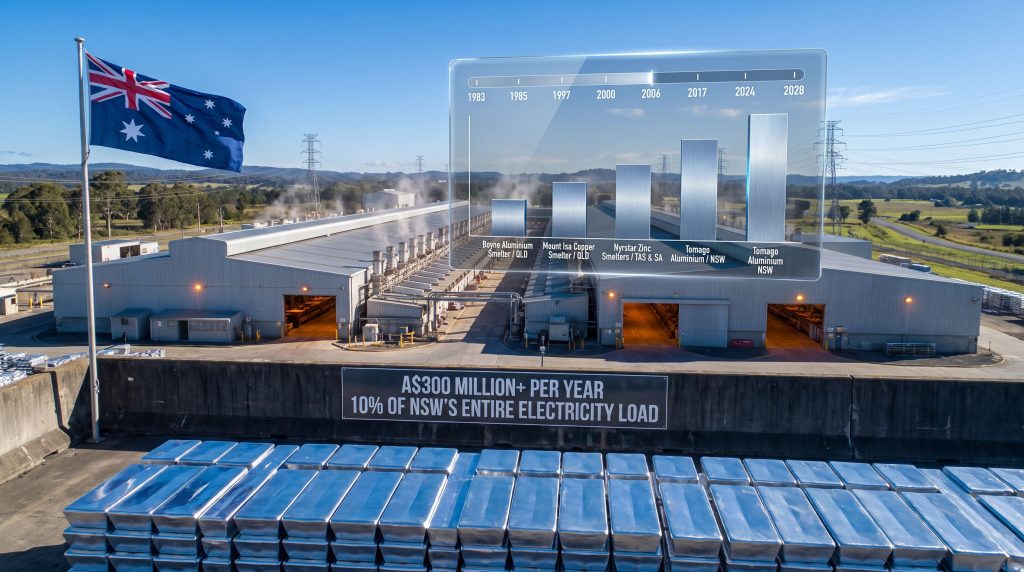
Tomago Aluminium operates in the Hunter Region of New South Wales and has run continuously, 24 hours a day, every day, since 1983. It is majority-owned by global mining giant Rio Tinto and is classified as the single largest electricity consumer in New South Wales, accounting for roughly 10 percent of the entire state's electricity load.
The scale of that energy consumption cannot be overstated. When a single industrial facility draws one-tenth of a state grid's output, its operational status directly affects wholesale electricity market dynamics, grid stability planning, and the financial modelling of energy retailers and generators across the region.
| Key Fact | Detail |
|---|---|
| Location | Hunter Region, New South Wales |
| Majority Owner | Rio Tinto |
| Continuous Operation Since | 1983 |
| Direct Workforce | Approximately 1,000 employees |
| NSW Grid Share | ~10% of total state electricity consumption |
| Current Power Contract Expiry | 2028 |
| Anticipated Closure Risk | Post-2028 without intervention |
The facility directly employs approximately 1,000 workers, with further employment flowing through contractors and regional supply chain businesses. In the context of the Hunter Valley, a region already navigating significant structural economic adjustment as coal industry activity winds down, the loss of an employer of this scale would compound pressures that communities and local governments are already managing.
The Mechanics of the Crisis: Why the Market Could Not Solve This
Late in 2025, Rio Tinto formally communicated that Tomago Aluminium faced a genuine risk of closure once its existing energy supply arrangements expired in 2028. The core problem was not operational performance or market demand for aluminium. It was the projected cost of replacement electricity contracts at commercial market rates, which would render the facility economically unviable.
This is a structurally important distinction. The smelter was not failing because of poor management, falling aluminium prices, or outdated technology. It was failing because the Australian electricity market, in transition between legacy coal-fired supply and emerging renewable infrastructure, could not offer long-term fixed-price contracts at rates consistent with competitive aluminium production.
Smelters operating in Australia face a fundamental pricing gap: the old baseload contracts that made them competitive are expiring, while the new renewable energy market has not yet matured to the point where it can replicate equivalent long-term pricing certainty at comparable rates.
This structural gap is what makes government intervention the instrument of last resort. Without it, the commercial logic points to closure. Furthermore, leading aluminium producers globally are watching Australia's response closely, as it may set a precedent for how other energy-transition economies handle similar situations.
The Structure of the Rescue Package
While the full details of the Tomago Aluminium bailout were subject to formal announcement by Prime Minister Anthony Albanese and NSW Premier Chris Minns, the package is understood to be built around several interlocking components:
- Long-term fixed-price electricity supply channelled through Snowy Hydro, the Commonwealth-owned electricity generator and retailer, providing Tomago with power at rates insulated from volatile spot market pricing.
- Concessional financing arrangements designed to reduce the ongoing capital cost burden associated with the facility's continued operation.
- Commitments from Rio Tinto covering maintenance investment and decarbonisation pathways as conditions attached to receiving public financial support.
- Annual taxpayer exposure reported at potentially in excess of A$300 million per year, sustained across an approximately decade-long support horizon, representing a potential total public commitment exceeding A$3 billion.
The Snowy Hydro Mechanism
The decision to route electricity supply through Snowy Hydro is more than logistical. As a Commonwealth-owned entity, Snowy Hydro gives the federal government a direct commercial lever to offer below-market power pricing without requiring open competitive procurement. The arrangement can be structured as a commercial supply contract rather than a direct cash subsidy, though the economic effect on public finances is substantively equivalent. This distinction matters for how the package is classified in budget accounting and how it is politically framed.
How Negotiations Unfolded: A Federal-State Funding Dispute
The path to the Tomago Aluminium bailout was not straightforward. Following Prime Minister Albanese's visit to the smelter site in December 2025, where he signalled confidence that a deal could be reached quickly, negotiations stalled on a fundamental question: who pays, and how much?
| Period | Key Development |
|---|---|
| Late 2025 | Rio Tinto formally warns of post-2028 closure risk due to energy costs |
| December 2025 | Prime Minister visits Tomago; signals deal is close |
| Early 2026 | Federal government proposes 50:50 funding split modelled on Boyne Smelter deal |
| April 2026 | NSW Premier pushes back; negotiations stall; NSW commits undisclosed budget allocation |
| August 2026 | Joint announcement by PM and NSW Premier expected imminently |
The federal government sought a funding model mirroring its earlier arrangement with the Queensland government for the Boyne Aluminium Smelter near Gladstone, which also involved Rio Tinto and was structured as an equal cost-sharing deal between Canberra and the host state. The broader context around Gladstone aluminium operations illustrates how Rio Tinto has been navigating energy contract challenges across multiple Australian sites simultaneously.
NSW Premier Chris Minns resisted this framework, arguing that the rescue initiative was principally a federal undertaking and that any state contribution must be demonstrably in the interests of NSW taxpayers. The impasse was eventually resolved after NSW quarantined an undisclosed budget allocation specifically designated to support the deal, allowing negotiations to advance to announcement stage.
The federal-state funding dispute over Tomago reflects a broader unresolved tension in Australian industrial policy: when legacy heavy industries require government support to survive an energy transition, the question of which tier of government bears the burden has no obvious constitutional or fiscal answer.
The next major ASX story will hit our subscribers first
Australia's Pattern of Heavy Industry Rescue Packages
The Tomago Aluminium bailout does not exist in isolation. It is the latest in a series of government interventions targeting energy-intensive industrial facilities that have found themselves stranded by the structural repricing of Australian electricity.
| Facility | Location | Operator | Intervention Type |
|---|---|---|---|
| Boyne Aluminium Smelter | Gladstone, QLD | Rio Tinto | Federal-State energy deal (50:50 split) |
| Mount Isa Copper Smelter | Queensland | Glencore | Government support package (2025) |
| Nyrstar Zinc Smelters | Tasmania and South Australia | Nyrstar | Feasibility funding (2026) |
| Tomago Aluminium | Hunter Region, NSW | Rio Tinto | Federal-NSW energy rescue package |
This pattern signals that the affordability gap for grid-dependent heavy manufacturers is not a facility-specific problem but a systemic market failure arising from the speed and structure of Australia's energy transition. Government intervention has become the default policy mechanism for bridging the gap between legacy industrial energy economics and the emerging renewable pricing environment.
The cumulative fiscal exposure across these interventions is significant and growing, raising questions about the long-term sustainability of this approach as an industrial policy framework. In addition, broader aluminium sector restructuring across the Asia-Pacific region is reshaping competitive dynamics in ways that may further complicate Australia's domestic industrial calculus.
The Strategic Case: Why Aluminium Is Not Just Another Industrial Commodity
Critics of the Tomago Aluminium bailout often frame it as a straightforward transfer of public wealth to a profitable multinational corporation. That framing, while politically resonant, overlooks several dimensions of aluminium's strategic role in contemporary industrial supply chains.
Aluminium is a core input material for many of the technologies central to decarbonisation:
- Solar photovoltaic panel frames and mounting systems rely heavily on aluminium extrusions.
- Wind turbine nacelle housings and tower components use significant volumes of aluminium alloys.
- Electric vehicle battery enclosures and structural components depend on lightweight aluminium to offset battery weight and extend range.
- Grid infrastructure expansion, including transmission towers and cable systems, consumes large quantities of aluminium conductor material.
Australia is a major global producer of bauxite, the raw ore from which alumina is refined, and alumina itself. Without domestic smelting capacity to convert alumina into primary aluminium, Australia exports a lower-value intermediate product and cedes the value-added manufacturing stage to overseas jurisdictions, many of which operate under significantly lower environmental and labour standards. From a sovereign industrial capability perspective, this represents a meaningful diminution of domestic manufacturing depth. Rio Tinto's broader industrial decarbonisation strategy suggests the company is simultaneously pursuing cleaner production pathways, which could ultimately strengthen the long-term case for retaining Tomago as a lower-emissions asset.
The Arguments Against: Fiscal Risk and Market Distortion
The case for the Tomago Aluminium bailout is not without serious counterarguments, and a balanced assessment requires engaging with them directly.
Fiscal exposure: At a reported cost of more than A$300 million per year over a decade, the total public commitment could exceed A$3 billion. This is a substantial allocation of taxpayer resources to support the operating economics of a facility majority-owned by one of the world's largest and most profitable mining corporations.
Market distortion: Standard economic analysis holds that sustained government subsidisation of commercially unviable operations misallocates capital. If Tomago cannot operate profitably at market electricity rates, the argument runs that resources and labour would generate greater economic value if redeployed into industries that can.
Transition alignment: Some energy policy analysts contend that underwriting long-term electricity supply to carbon-intensive industrial processes at below-market rates creates perverse incentives that slow, rather than accelerate, the broader decarbonisation transition. The counter to this is the strategic aluminium supply chain argument outlined above.
Ownership asymmetry: The political tension inherent in directing public funds toward a facility owned by Rio Tinto, a corporation with substantial global revenues, is unlikely to dissipate regardless of the strategic rationale advanced by government.
What Happens Next: Milestones and Unresolved Questions
The formal joint announcement from Prime Minister Albanese and NSW Premier Minns is expected to resolve several outstanding uncertainties:
- The precise federal-state funding split and the total annual cost to taxpayers.
- The duration of the support arrangement and the conditions attached to Rio Tinto's continued operation of the facility.
- The mechanisms through which Snowy Hydro will supply electricity to Tomago and at what contracted rate.
- The decarbonisation and investment commitments required of Rio Tinto as a condition of receiving public support.
- Parliamentary oversight and performance reporting arrangements to ensure taxpayer exposure remains bounded and accountable.
Beyond the announcement itself, the medium-term viability of the deal will depend heavily on the trajectory of renewable energy costs in Australia. If wholesale electricity prices decline materially as new renewable capacity comes online, the commercial case for Tomago's continued operation may strengthen organically over the support period. If costs remain elevated, the subsidy dependency could extend beyond the initial decade-long commitment.
For the approximately 1,000 workers at the facility and the broader Hunter Region community, the announcement represents the resolution of a prolonged period of uncertainty that union representatives described as deeply distressing. Workers reported waking each day uncertain whether a closure announcement had been made, with the Electrical Trades Union characterising the negotiation period as one of the most stressful episodes in the site's recent history.
The Deeper Policy Question the Tomago Bailout Forces
Beneath the specifics of funding splits, Snowy Hydro supply contracts, and Rio Tinto commitments lies a more fundamental question that the Tomago Aluminium bailout forces Australian industrial policy to confront directly.
Is the government constructing a genuine bridge to a commercially self-sustaining clean industrial future, or is it underwriting the indefinite operation of legacy assets that the market has already determined are structurally uncompetitive at current and projected energy prices?
The answer is not yet clear. It will depend on the pace at which renewable energy achieves the scale and contract certainty required to replicate legacy baseload pricing, the strategic weight assigned to domestic aluminium manufacturing capability, and the political economy of preserving employment in regions like the Hunter Valley that are simultaneously absorbing the economic consequences of coal industry contraction.
What is clear is that the Tomago Aluminium bailout is not an isolated policy decision. It is one node in an emerging and increasingly costly framework of government intervention designed to hold Australia's heavy industrial base together during an energy transition whose timing, cost, and distributional consequences were never fully priced into the original policy design.
This article is intended for informational purposes only and does not constitute financial or investment advice. Figures relating to the cost of the rescue package are based on reporting at time of publication and have not been officially confirmed by the federal or New South Wales governments. Readers should consult official government announcements and independent financial advisers for verified details.
Want to Capitalise on the ASX Stocks Shaping Australia's Resource Sector?
Discovery Alert's proprietary Discovery IQ model delivers real-time alerts on significant ASX mineral discoveries — including in the commodities central to Australia's industrial future, such as aluminium, bauxite, and copper — instantly empowering subscribers to identify actionable opportunities ahead of the broader market. Explore Discovery Alert's discoveries page to understand how historic mineral discoveries have generated substantial returns, and begin your 14-day free trial today to position yourself ahead of the next major find.