August 12, 2026
When Refineries Become Battlegrounds: Understanding Libya's Energy Infrastructure Crisis
Across conflict zones worldwide, a strategic shift has been underway for more than a decade. Armed factions have increasingly moved away from purely military targets toward something far more consequential: the energy infrastructure that sustains civilian populations. Pipelines, power grids, fuel depots, and refineries have become instruments of coercion, capable of inflicting economic pain and humanitarian suffering without a single conventional military engagement. Nowhere is this pattern more visible, or more dangerous, than in Libya, where the Libya drone attacks on Zawiya refinery in August 2026 exposed the catastrophic vulnerability sitting at the heart of the country's fuel supply chain.
When big ASX news breaks, our subscribers know first
Why Zawiya Sits at the Centre of Western Libya's Energy Ecosystem
To understand the severity of what occurred on the night of August 11, 2026, it is necessary to first understand what the Zawiya refinery actually does, and why its disruption reverberates far beyond the facility's perimeter fence.
Located roughly 40 to 47 kilometres west of Tripoli, the Zawiya refinery is operated by the Brega Oil Company, a subsidiary of Libya's National Oil Corporation (NOC). With a rated processing capacity of 120,000 barrels per day, it functions as the single most important fuel processing hub for the entire western Libyan region. The facility does not merely refine crude oil; it stores and distributes a portfolio of critical petroleum derivatives including:
- Gasoline, for transport and civilian use
- Diesel, for heavy industry and generator fuel
- Kerosene, for both heating and aviation purposes
- Liquefied petroleum gas (LPG), for cooking and domestic energy
What makes Zawiya strategically distinct is its dual role. The refinery does not just supply fuel to petrol stations; it supplies the inputs that keep western Libya's electricity generation infrastructure operational. A sustained attack on Zawiya is therefore simultaneously an attack on the fuel supply and on the power grid, creating a compounding humanitarian crisis that extends from the refinery gates to every household connected to the western Libyan grid.
Libya holds the largest proven oil reserves on the African continent, yet this extraordinary natural endowment has delivered remarkably little stability since the 2011 collapse of the Qaddafi government. The country currently operates under a fractured dual-government arrangement: the UN-recognised Government of National Unity (GNU) based in Tripoli under Prime Minister Abdulhamid Dbeibah, and a rival eastern administration aligned with military commander Khalifa Haftar. This political fragmentation means that critical national infrastructure like Zawiya operates without the protection of a unified national security apparatus, leaving it exposed to factional pressure from multiple directions. Furthermore, the broader geopolitical risk landscape across the region continues to intensify these structural weaknesses.
The August 2026 Strikes: A Coordinated Multi-Day Campaign
The Libya drone attacks on Zawiya refinery were not a single opportunistic strike. They formed part of a deliberate, multi-day operational campaign targeting multiple nodes within the same energy complex and its surrounding facilities.
In the days preceding the major incident, drones had already struck:
- A naphtha reservoir within the broader complex
- A water desalination plant serving the facility
- An oil blending and filling plant in the vicinity
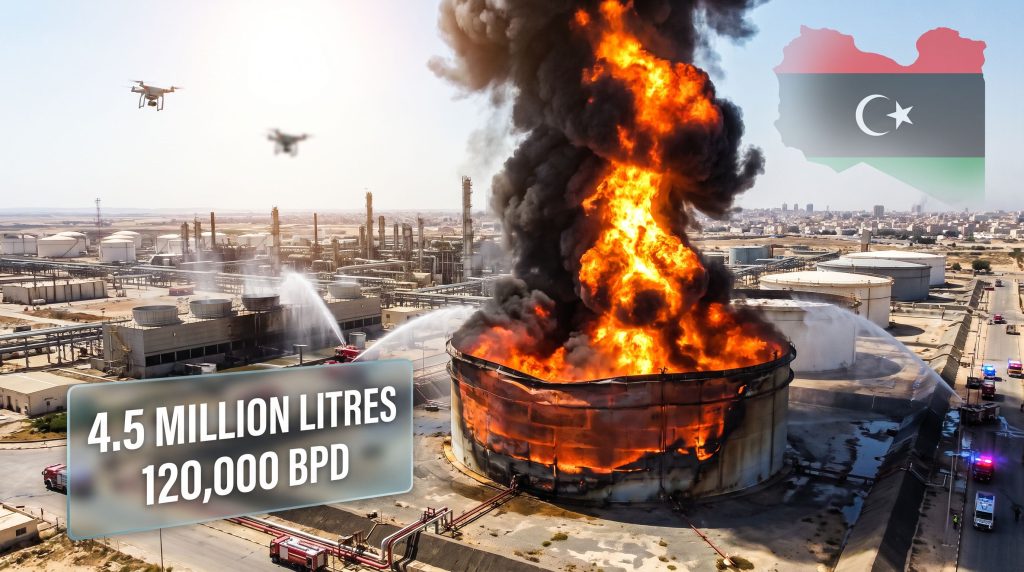
Then, on the night of August 11, 2026, a drone made direct contact with a large gasoline storage tank at the Zawiya refinery. The tank, which held approximately 4.5 million litres of gasoline, ignited and subsequently collapsed. A second drone landed near an adjacent tank but failed to detonate. A third targeted the broader complex without causing structural damage. The National Oil Corporation declared a state of emergency that same night.
Containment Timeline
| Event | Date / Time |
|---|---|
| Drone strike on gasoline storage tank | Monday night, August 11, 2026 |
| State of emergency declared by NOC | Monday night, August 11, 2026 |
| Firefighting and adjacent tank cooling operations initiated | Overnight, August 11 into 12 |
| All fires confirmed contained | Tuesday evening, August 12, 2026 |
Firefighting crews faced a particularly difficult suppression challenge. Gasoline presents unique hazards compared to crude oil: its lower flash point and higher volatility cause it to ignite more readily and behave unpredictably under foam-based suppression. The physical collapse of the tank further altered fire dynamics, disrupting the geometry that standard petroleum fire containment strategies rely upon.
Crews prioritised cooling neighbouring tanks to prevent thermal cascading, a critical tactical choice given the density of petroleum storage in the surrounding area. Footage captured by drone cameras above the blaze showed the extraordinary scale of the fire and the precarious conditions firefighters were working under.
Hamdi Al-Bishti, head of the Brega Oil Company, confirmed that the gasoline content of the tank made full containment exceptionally difficult, and that firefighters came extremely close to a far larger catastrophe.
No serious casualties or confirmed fatalities were reported from the strikes.
The Force Majeure Dimension: What a Declaration Would Actually Mean
Perhaps the most consequential element of the NOC's response was not the state of emergency declaration, but its explicit warning that continued attacks could compel a formal force majeure declaration covering refinery operations.
In oil sector contract law, force majeure provides an operator the legal mechanism to suspend supply obligations and halt operations on the basis that circumstances beyond its control have made performance impossible or unsafe. For Libya's NOC, invoking force majeure is not a theoretical contingency. The corporation has a documented history of force majeure declarations during periods of armed conflict, blockades, and infrastructure destruction, stretching back over more than a decade of post-Qaddafi instability.
A force majeure declaration at Zawiya would carry cascading consequences:
- Immediate suspension of refined fuel production at a facility processing 120,000 barrels per day
- Rapid depletion of fuel stocks at petrol stations across the Tripoli region
- Electricity generation failures at power plants dependent on Zawiya's diesel and LPG output
- Humanitarian pressure on civilian populations already experiencing significant economic hardship
It is worth noting that a Zawiya force majeure would not directly halt Libya's crude oil export operations, which average between 1.1 and 1.4 million barrels per day during stable periods and flow primarily through separate upstream and export infrastructure. However, prolonged internal instability of this nature historically creates conditions that eventually threaten upstream production as well, with potential knock-on effects for Mediterranean crude benchmarks and broader oil price movements in global markets.
Attribution Gaps and the Political Landscape of Suspicion
As of August 12, 2026, no armed group had claimed responsibility for the Libya drone attacks on Zawiya refinery. This silence is not simply an absence of information; it is itself a strategic posture. Unclaimed attacks allow the perpetrating party to apply sustained pressure while avoiding the formal accountability that a claim of responsibility would trigger, including international condemnation, potential sanctions, or military retaliation.
Libya's fractured political landscape generates a wide field of potential actors with both motive and the demonstrated technical capability to conduct drone strikes:
- Haftar-aligned Libyan National Army (LNA): The eastern military force has a documented history of targeting western Libyan infrastructure as a lever of political and military pressure against the Tripoli-based government
- Internal western factions: Power struggles within the GNU's own sphere of influence have previously resulted in attacks on shared infrastructure as rival militias compete for economic and territorial control
- Independent armed groups: Non-state actors operating in Libya's ungoverned spaces maintain their own drone inventories, sourced through networks that remain partially opaque to international observers
The GNU's response was swift and unambiguous. Prime Minister Dbeibah described the attacks as a direct threat to citizens, workers, and the country's vital national infrastructure, characterising them as an assault on Libya's economic sovereignty. The government pledged to pursue those responsible, framing the strikes as a deliberate act of escalation rather than a tactical military operation.
The Significance of Targeting Fuel Storage Rather Than Export Infrastructure
One analytically important detail about the August 2026 strikes is what was targeted. The attacking force chose fuel storage and processing infrastructure, not pipeline networks, export terminals, or upstream production facilities. This targeting logic points toward a primary objective of destabilising civilian life and economic function in western Libya, rather than disrupting crude oil flows to international markets.
Attacking a gasoline storage tank deprives ordinary Libyans of transport fuel and indirectly undermines electricity supply, creating visible, immediate suffering at the civilian level. This is the signature of an actor seeking to erode public confidence in the GNU's capacity to govern and protect essential services. Consequently, the geopolitical oil risks associated with Libya's fractured governance model remain as acute as ever, compounding what analysts have long identified as a deeply unstable operating environment for geopolitical oil risks across North Africa.
Libya's Structural Vulnerability: Why This Will Keep Happening
The August 2026 attacks are not an anomaly. They are the latest expression of structural vulnerabilities that have been present in Libya's energy sector since 2011 and show no signs of resolution.
Libya's oil infrastructure faces a uniquely compounded risk profile:
| Risk Factor | Description |
|---|---|
| Geographic concentration | Key processing and storage facilities clustered along the northwestern coastal corridor |
| Dual-government fragmentation | No unified national security command capable of coordinating infrastructure protection |
| Ageing infrastructure | Facilities with limited hardening against aerial threats, many originally designed in an era before drone warfare |
| External drone supply | Both rival governments have received drone technology from foreign backers, raising attribution complexity |
| Limited international enforcement | UN-brokered ceasefires have repeatedly collapsed; no effective peacekeeping mechanism exists for infrastructure protection |
The multi-day, multi-target nature of the August 2026 campaign further underscores a concerning evolution in tactical sophistication. Striking a naphtha reservoir, a water desalination plant, a blending facility, and then a major gasoline tank in sequential operations suggests advance reconnaissance, coordinated logistics, and an intent to systematically degrade the facility's operational capacity rather than simply deliver a symbolic strike.
This pattern mirrors developments seen in other conflict zones where drone warfare has matured. The 2019 Aramco strikes in Saudi Arabia demonstrated that drone attacks on petroleum infrastructure could achieve outsized economic and psychological effects relative to the cost and complexity of the operation. Houthi drone and missile campaigns targeting Red Sea shipping have similarly demonstrated the force-multiplication potential of low-cost aerial platforms against high-value, fixed infrastructure. In addition, the OPEC market influence over global supply decisions means that any sustained disruption to Libyan output can quickly ripple through international pricing mechanisms.
The next major ASX story will hit our subscribers first
Downstream Consequences: Fuel, Power, and People
The human stakes attached to the Libya drone attacks on Zawiya refinery extend well beyond the economic metrics of barrels per day and storage volumes. Western Libya's civilian population depends on this single facility for the fuel that powers generators, vehicles, and the power stations that deliver electricity to homes, hospitals, and businesses.
Any prolonged disruption to Zawiya's output would likely produce a predictable sequence of downstream failures:
- Petrol station fuel shortages across the Tripoli metropolitan region
- Increased reliance on black market fuel at significantly higher prices
- Reduced runtime at diesel-dependent power generation facilities
- Extended electricity outages in areas already accustomed to unreliable grid supply
- Cascading economic pressure on households and small businesses operating on narrow margins
For a population that has lived through more than a decade of conflict-driven economic deterioration, the addition of sustained fuel shortages would represent a qualitative worsening of already difficult conditions. Furthermore, the effect of sanctions on oil trade in other conflict-affected regions offers a sobering parallel for how prolonged infrastructure disruption compounds civilian hardship.
FAQ: Libya Drone Attacks on Zawiya Refinery
What is the Zawiya refinery and why does it matter?
The Zawiya refinery is Libya's largest currently operating oil refinery, with a processing capacity of 120,000 barrels per day. Located approximately 40 to 47 kilometres west of Tripoli, it is the primary source of refined petroleum products for western Libya's fuel supply and power generation infrastructure.
How much gasoline was lost in the August 2026 attack?
The targeted storage tank held approximately 4.5 million litres of gasoline. It caught fire and collapsed after being struck by a drone on the night of August 11, 2026. Video footage of the inferno shared widely online illustrated the enormous scale of the blaze and the challenges faced by responding crews.
Were there casualties?
No serious injuries or confirmed fatalities were reported from the August 2026 drone strikes on the Zawiya complex.
Who operates Zawiya?
The facility is operated by the Brega Oil Company, a subsidiary of Libya's National Oil Corporation (NOC).
What does force majeure mean in this context?
A force majeure declaration by the NOC would formally suspend the refinery's operations and contractual obligations on the grounds that the attacks represent circumstances beyond the operator's control, effectively halting refined fuel production without financial penalty to the corporation.
What other targets were struck?
Prior to the major gasoline tank strike, drones targeted a naphtha reservoir, a water desalination plant, and an oil blending and filling plant associated with the broader Zawiya complex.
Who is responsible?
No group had claimed responsibility as of August 12, 2026. Libya's dual-government structure and the presence of multiple armed factions make definitive attribution difficult without further intelligence disclosure.
The Trajectory Ahead: Escalation, Negotiation, or Stalemate?
Three plausible scenarios emerge from the August 2026 strikes, each carrying distinct implications for Libya's energy sector and its civilian population.
Scenario One: Escalating Infrastructure Warfare. If the attacking faction perceives the strikes as operationally successful and politically effective, further attacks on Zawiya and other western Libyan energy facilities become probable. This path leads toward a force majeure declaration, sustained fuel shortages, and potentially a broader collapse of western Libya's power infrastructure.
Scenario Two: Deterrence Through International Pressure. Strong international condemnation, combined with credible diplomatic pressure on the external backers of Libyan factions, could raise the political cost of continued strikes sufficiently to deter further attacks. However, given the track record of UN engagement with Libya since 2011, this scenario requires a level of international coordination that has proven difficult to sustain.
Scenario Three: Prolonged Stalemate. The most historically consistent pattern in Libya's post-2011 experience is neither escalation nor resolution, but chronic low-intensity conflict in which infrastructure attacks occur periodically, damage is absorbed, repairs are made, and the underlying political contest remains unresolved. This scenario preserves a fragile status quo but at the ongoing cost of infrastructure degradation and civilian suffering.
Disclaimer: The scenario projections above represent analytical frameworks based on historical patterns in Libya's conflict dynamics and are not predictions of future events. Readers should treat forward-looking assessments in geopolitically complex environments with appropriate caution.
The Libya drone attacks on Zawiya refinery represent more than a local security incident. They are a case study in the weaponisation of civilian energy infrastructure, the strategic logic of asymmetric warfare in fragmented political environments, and the cascading human consequences that follow when the facilities sustaining everyday life become battlegrounds. Until Libya's underlying political fracture is addressed, the refinery, its workers, and the millions who depend on its output will remain in the crosshairs.
Want to Stay Ahead of Resource Sector Developments Shaped by Geopolitical Risk?
Discovery Alert's proprietary Discovery IQ model delivers real-time alerts on significant ASX mineral discoveries, helping investors identify actionable opportunities the moment they emerge — even as global energy disruptions reshape commodity markets. Explore how historic mineral discoveries have generated substantial returns and begin your 14-day free trial today to secure a genuine market-leading advantage.