August 12, 2026
The Hidden Cost of the Execution Gap in Modern Mining
Every major mine on earth operates with two parallel realities. The first is the production plan: a carefully constructed document built on equipment availability assumptions, crew rosters, ventilation schedules, and geological forecasts. The second is what actually happens during a shift. The distance between those two realities is where billions of dollars in potential output quietly disappear each year.
This is not a technology gap in the conventional sense. Modern mine sites are, by many measures, extraordinarily well-instrumented. Vehicle telemetry, environmental sensors, maintenance management systems, and workforce tracking platforms generate enormous volumes of operational data every hour. The problem is not data scarcity.
The problem is that almost none of that data feeds back into shift-level decision-making fast enough to matter. By the time a supervisor becomes aware that a critical piece of equipment has degraded, that a ventilation event has restricted access to a working area, or that three crew members are unavailable, the production plan built around different assumptions has already started to fail.
This is the operational execution gap, and it is the specific problem that Hivekit OPS.AI mine planning software is designed to close.
When big ASX news breaks, our subscribers know first
Why Static Plans Cannot Survive Contact with a Live Mine
The Compounding Effect of Shift-Level Disruption
Underground and open-pit mining environments are among the most dynamically complex operational settings in any industry. A single equipment failure does not simply delay one task. It cascades: a stalled loader holds up blasting cycles, which pushes back ore movement, which starves the processing plant of feed, which affects throughput metrics that determine daily revenue. Each disruption compounds across interconnected workflows in ways that a static production schedule cannot anticipate or accommodate.
Traditional mine planning tools were built for a different purpose. Platforms designed for long-range scheduling, resource modelling, and life-of-mine optimisation are extraordinarily powerful within their intended scope. They translate geological data, resource estimates, and economic parameters into production strategies that span months or years. However, what they were never designed to do is respond to a ventilation failure at 2am or reassign haul truck drivers when two scheduled operators call in sick thirty minutes before a shift starts.
The gap between weekly production targets and moment-to-moment operational decisions has historically been filled by human supervisors working from experience, intuition, and incomplete information. That model works, up to a point. However, as mine sites grow more complex, as labour markets tighten, and as commodity price cycles compress the margin for operational inefficiency, the cognitive load placed on shift supervisors has reached a level where unaided human judgement alone is no longer sufficient.
What Hivekit OPS.AI Actually Does: Platform Architecture Explained
From Swarm Intelligence to Mine Fleet Coordination
Hivekit Inc. was founded in 2023, but the intellectual groundwork for its platform stretches back further. The company's origins lie in five years of research into workforce self-organisation principles modelled on collective insect behaviour, specifically the emergent coordination that large groups of social insects achieve without centralised control. That biological insight became the conceptual foundation for a system designed to coordinate the movements of people, equipment, and materials across a mine site in real time.
The U.S.-headquartered company now operates with team members distributed across the United States, Germany, and the United Kingdom, reflecting both the global nature of the mining industry it serves and the multinational research talent required to build at this technical level.
The Digital Twin as the Operational Foundation
Before OPS.AI existed, Hivekit built what it calls the Hivekit platform: a shared, real-time three-dimensional operational model that connects personnel, vehicles, equipment, and infrastructure systems within a single unified view. This digital twin is the data foundation on which OPS.AI sits. Furthermore, 3D geological modelling plays an important role in enriching the contextual accuracy of this operational picture.
The architecture is deliberately vendor-agnostic. Rather than requiring mines to replace existing hardware or software investments, the platform integrates with existing systems through APIs and pre-built data connectors. Operational data sources that feed the twin can include:
- Vehicle location data and fuel status
- Environmental sensor readings including ventilation and atmospheric monitoring
- Maintenance records and equipment health data
- Inventory and stockpile information
- Employee availability and location tracking
- Site-specific infrastructure systems
This breadth of data ingestion is what makes adaptive shift planning possible. A system that only sees equipment telemetry cannot account for a workforce availability change. A system that only tracks personnel cannot respond to a ventilation restriction. OPS.AI requires the full operational picture, and the digital twin provides it.
OPS.AI: The AI Layer That Translates Plans into Executable Actions
OPS.AI sits on top of the digital twin as an active decision-support layer. Its core function is to continuously reconcile what the production plan expected to happen with what is actually happening across the operation, then determine what should happen next.
In practice, the system ingests geospatial mine layouts, real-time equipment telemetry, crew assignments, and regulatory constraints to generate adaptive shift plans. As conditions change during a shift, those plans are revised automatically. Equipment breakdowns, unavailable workers, ventilation failures, changing ground conditions, and supervisor-initiated adjustments are all processed and incorporated without requiring manual replanning from scratch.
According to Hivekit CEO Wolfram Hempel, the core premise of OPS.AI is that mine plans are built around assumptions about equipment, people, infrastructure and conditions, but the reality underground or in the pit changes constantly. The system is designed to continuously reconcile planned intentions with operational reality and help determine what the operation should do next. (Metal Tech News, August 2026)
The Deterministic Constraint Layer: AI with Hard Boundaries
One of the most technically significant aspects of OPS.AI is what Hivekit calls the deterministic constraint layer. This is a separate rule-based validation engine that evaluates every AI-generated action before it is presented to a user or executed in the system.
The constraint categories covered include:
- Mandatory employee rest periods and break requirements
- Ventilation zone access restrictions
- Equipment operating limits and maintenance thresholds
- Site-specific safety protocols
- Applicable regulatory compliance requirements
Any proposed action that violates a constraint is automatically rejected before it reaches an operator. This architecture addresses one of the most frequently cited concerns about AI in safety-critical industrial environments: the risk that an AI system might generate a recommendation that is operationally optimal in isolation but violates a safety or regulatory boundary.
Why this matters technically: Most AI systems in industrial settings are designed with guardrails at the user interface level. The Hivekit approach embeds constraint validation at the action generation level, meaning non-compliant recommendations are eliminated before they can even be presented. This is architecturally distinct from systems that simply flag or warn after generating a potentially unsafe action.
The OPS.AI Copilot: Natural Language Access to Operational Intelligence
Beyond shift orchestration, OPS.AI includes a Copilot interface that allows mine managers, supervisors, and dispatchers to query the operational environment using natural language. Consequently, this AI-powered mining copilot capability represents a significant step forward in how operational intelligence is accessed and acted upon at the shift level.
The critical technical distinction here is that the Copilot does not answer from general AI knowledge. It searches the mine's actual operational dataset, interprets the results, and presents findings through written summaries, structured tables, or visual outputs.
Practical query examples include:
- How much production was lost during a ventilation failure on a specific date
- Cumulative output across multiple working areas over a shift
- Equipment utilisation rates by crew or by shift period
Authorised users can also issue operational commands through the same interface, such as reassigning a driver to a different vehicle or removing a restricted work area from the active production plan. All commands are subject to the same permission structures and constraint checks applied across the broader platform.
OPS.AI vs. Conventional Mine Planning Tools: A Direct Comparison
Understanding where OPS.AI fits in the mine technology landscape requires a clear distinction between different categories of software. The table below maps the key capability differences:
| Capability Dimension | Hivekit OPS.AI | Traditional Planning Platforms |
|---|---|---|
| Primary Function | Real-time operational execution and adaptive orchestration | Long-range scheduling, resource modelling, strategic optimisation |
| Planning Horizon | Shift-level and intra-shift (minutes to hours) | Weekly, monthly, annual, life-of-mine |
| Adaptability | Dynamic, continuous revision as conditions change | Static or periodic, requires manual replanning |
| Data Integration | Live telemetry, sensor feeds, workforce systems via API | Survey data, geological models, drill and blast records |
| AI Component | Embedded AI with deterministic constraint validation | Optimisation algorithms with limited real-time AI |
| Human Control | Final authority retained by mine personnel at all times | Planner-driven with manual override |
| Deployment Scope | Underground, open-pit, processing, logistics | Primarily design and scheduling phases |
| Vendor Agnostic | Yes, integrates with existing hardware and software | Varies, often tied to proprietary data formats |
OPS.AI is not a replacement for geological modelling tools or long-range scheduling platforms. It functions as the operational execution layer, converting approved production plans into real-time, adaptive work instructions. Mines using existing planning software can theoretically integrate OPS.AI to manage shift-level execution of those same plans.
What the 21% Plan Adherence Improvement Actually Means
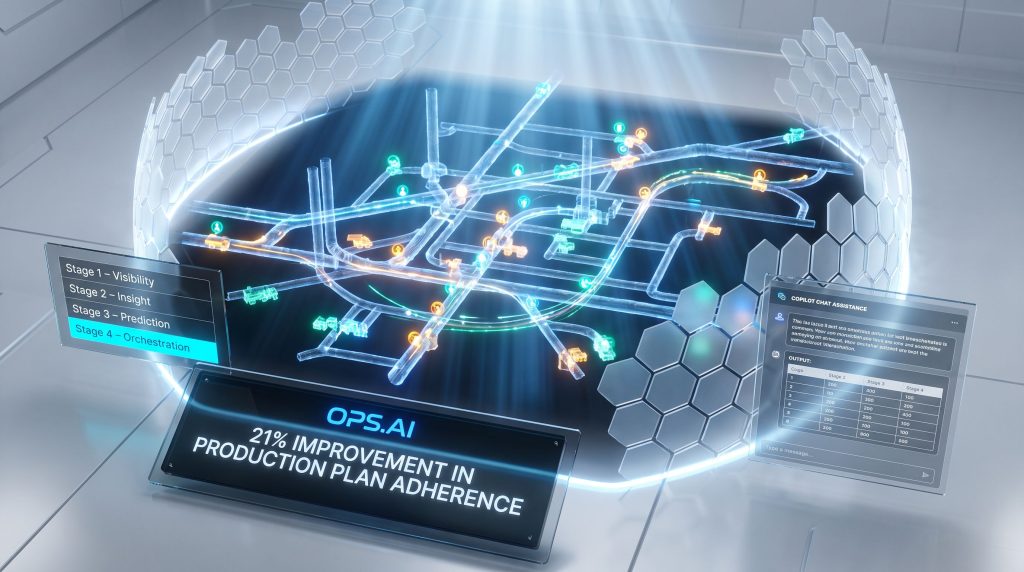
In early testing conducted against historical mine operations data, Hivekit reported a 21% improvement in production plan adherence. Understanding why this figure is meaningful requires some context about what plan adherence measures and what it costs when it fails.
Plan adherence is the percentage of planned shift tasks that are completed as scheduled, in the sequence planned, with the resources allocated. It is a direct proxy for operational efficiency because any deviation from plan represents:
- Lost tonnes or metres that cannot be recovered within the shift
- Increased cost per unit of output due to underutilised capital equipment
- Downstream disruptions to processing plant feed rates and throughput
- Compounding schedule slippage that affects the following shift's starting conditions
In high-throughput bulk commodity operations, even small improvements in plan adherence translate to material changes in quarterly output. For operations running tight processing plant feed requirements, the effect is amplified further because plant throughput and recovery rates are sensitive to feed consistency.
Important caveat: The 21% figure is derived from testing against historical operational data, not from live deployment across multiple active mine sites. Independent third-party validation across diverse commodity types and mine configurations would be required before this figure could be treated as a broadly generalisable performance benchmark.
The Four Stages of Mine Digitalisation: Where OPS.AI Fits
Mining's digital transformation has generally progressed through recognisable maturity stages. Understanding where operational AI sits within that progression clarifies both the value proposition and the adoption challenges ahead.
| Stage | Capability | Technology Examples |
|---|---|---|
| Stage 1: Visibility | Knowing what is happening | IoT sensors, SCADA systems, fleet management |
| Stage 2: Insight | Understanding why it happened | Analytics dashboards, reporting tools |
| Stage 3: Prediction | Anticipating what will happen | Predictive maintenance AI, ore body modelling |
| Stage 4: Orchestration | Automatically coordinating what should happen next | Hivekit OPS.AI |
Most large mining operations have invested heavily in Stages 1 and 2. Predictive maintenance in mining represents the leading edge of Stage 3 adoption. Stage 4, operational orchestration, remains the least developed and arguably the highest-value capability layer in the mine technology stack.
The reason Stage 4 has been slow to develop is not a lack of data or computational capacity. It is the complexity of operating within the safety, regulatory, and human authority constraints that govern mining environments. The deterministic constraint layer in OPS.AI is Hivekit's specific answer to that challenge.
The next major ASX story will hit our subscribers first
Key Use Cases Across Mine Types and Operational Environments
Underground Mining
Underground operations face some of the most complex coordination challenges in any extractive industry. Ventilation-constrained work scheduling, blast timing coordination across multiple headings, and equipment positioning within confined three-dimensional spaces all create interdependencies that compound rapidly when any single variable changes. OPS.AI's ability to maintain a live three-dimensional operational view and reassign tasks in real time is particularly well-suited to these environments.
Open-Pit and Surface Operations
In surface mining, dynamic haul route optimisation based on live equipment availability and fuel status can significantly reduce cycle times and fuel consumption. Blast cycle coordination across multiple benches, combined with automatic task reassignment when equipment is unavailable, addresses one of the persistent efficiency challenges in large open-pit operations.
Mineral Processing and Logistics
Processing plant performance is highly sensitive to the consistency and quality of upstream feed. Hivekit's processing solutions demonstrate how the platform extends beyond the pit or portal to align extraction rates and stockpile management with live plant requirements. In addition, shift handover quality is improved through automated transfer of full operational context between crews.
Frequently Asked Questions: Hivekit OPS.AI Mine Planning Software
What is Hivekit OPS.AI?
Hivekit OPS.AI mine planning software is an AI-powered operational execution platform that continuously adapts shift plans in response to real-time changes in equipment availability, workforce conditions, environmental factors, and site constraints. It operates on top of Hivekit's digital twin platform, which provides a live three-dimensional view of mine operations.
Is OPS.AI a mine planning or mine management system?
OPS.AI functions primarily as an operational execution and orchestration system rather than a traditional mine planning tool. It bridges the gap between approved production plans and shift-level execution, dynamically adjusting work assignments as conditions change rather than performing geological modelling or long-range scheduling. Furthermore, it complements data-driven mining operations by converting raw operational data into actionable, real-time decisions.
How does the deterministic constraint layer work?
Every action proposed by OPS.AI is evaluated against a fixed set of operational rules covering safety requirements, ventilation limits, equipment thresholds, and regulatory obligations before being presented to users. Actions that violate any constraint are automatically blocked.
What performance improvements has OPS.AI demonstrated?
Early testing against historical operational data showed a 21% improvement in production plan adherence, with additional gains in equipment and resource utilisation. These results are based on historical data analysis; live operational validation across diverse mine types is ongoing.
Does OPS.AI replace existing mine software systems?
No. OPS.AI integrates with existing mine technology stacks through APIs and pre-built connectors, functioning as a complementary execution layer rather than a replacement for geological modelling, resource estimation, or long-range scheduling platforms.
What Broad Adoption of Operational AI Would Require
For platforms like Hivekit OPS.AI mine planning software to achieve broad adoption across the global mining industry, several conditions would need to be met. Consequently, understanding these prerequisites helps contextualise where the technology currently sits in its commercial maturity curve.
- Independent performance validation across multiple commodity types, mine configurations, and geological environments, conducted by parties independent of the technology developer.
- Integration certification with major existing mine software ecosystems to reduce implementation risk for mines with established technology stacks.
- Regulatory acceptance of AI-assisted operational decision-making frameworks in key mining jurisdictions, particularly for underground environments where safety authority oversight is most stringent.
- Demonstrated performance in live operations, rather than historical data testing, across a statistically meaningful sample of mine sites and shift types.
The biomimicry-inspired architecture that underpins Hivekit's approach represents a genuinely novel conceptual framework for operational coordination. However, broader adoption will also depend on how well the platform integrates with the wider wave of mining automation trends already reshaping how modern mines are managed and staffed. Whether that framework scales to the full complexity of active mine environments, across varying commodity types, geological conditions, and regulatory contexts, remains the central question that live deployment will need to answer.
Readers seeking further context on AI applications in mining operations and emerging mine digitalisation trends can explore related industry coverage at Metal Tech News, which tracks developments across automation, AI, and operational systems in the mining technology sector.
This article contains forward-looking statements and references to early-stage performance data. Historical test results are not necessarily indicative of future operational outcomes. Readers should conduct independent assessment before drawing conclusions about the commercial performance or investment implications of any technology discussed herein.
Want to Stay Ahead of the Next Major Mining Discovery?
While operational AI is reshaping how mines extract value from existing resources, the greatest returns in the sector have historically come from being positioned early in significant new mineral discoveries — Discovery Alert's proprietary Discovery IQ model delivers real-time ASX alerts the moment a major discovery is announced, turning complex geological data into actionable insights for investors at every level. Explore how historic discoveries have generated extraordinary returns and begin your 14-day free trial to ensure you never miss the next transformative find.