
August 11, 2026
When a Single Supply Decision by a Foreign Nation Reshapes a Country's Defense Strategy
The global critical minerals landscape has rarely offered a cleaner lesson in strategic vulnerability than the one delivered in 2021, when China ceased exporting military-grade antimony trisulfide to the United States. That single policy decision exposed a structural weakness that had been quietly building for decades: the U.S. defense manufacturing base had become almost entirely dependent on foreign suppliers for a compound it needed to produce ammunition across more than 300 weapons systems. The army-backed antimony pilot plant in Idaho is the most concrete institutional response that has emerged from that moment of strategic clarity.
Understanding why this facility matters requires more than tracking a single mining project. It demands a broader look at how mineral supply chains intersect with military readiness, how processing technology gaps can be just as strategically dangerous as resource shortfalls, and why Idaho has quietly become one of the most consequential places in America's critical minerals future.
When big ASX news breaks, our subscribers know first
Antimony's Hidden Role in American Military Power
More Than a Periodic Table Curiosity
Antimony is a brittle, silvery-white metalloid that sits at an unusual intersection of physical properties. Its ability to harden lead alloys, its role in flame-retardant chemistry, and its specific combustion behaviour as antimony trisulfide (Sb₂S₃) make it technically irreplaceable across a surprising range of applications. In civilian industry, it appears in solar glass manufacturing, semiconductor production, and fire-retardant textiles. As an antimony critical mineral, its uses in defense contexts become considerably more concentrated and considerably more sensitive.
The compound antimony trisulfide is the active ingredient in primer formulations used across more than 300 types of U.S. military ammunition. A primer is the initiating charge that ignites a propellant cartridge, and its chemical stability, sensitivity profile, and combustion consistency must meet extraordinarily precise standards. Antimony trisulfide's physical characteristics, particularly its predictable ignition threshold and storage stability across wide temperature ranges, have made it the compound of choice for military primer engineers over many decades.
Beyond ammunition, antimony appears in:
- Coatings applied to night-vision optics and image-intensifier tubes
- Flame-resistant textile treatments used in soldier gear and vehicle interiors
- Advanced battery systems, including certain military-grade power storage applications
- Infrared decoy flares and pyrotechnic signalling devices
The difficulty of substituting antimony trisulfide in primer applications is not simply one of chemistry. Military-specification primers must pass exhaustive ballistic testing, long-term storage assessment, and environmental performance evaluation before any reformulation can be approved for service. That certification process takes years and substantial investment, creating an effective lock-in effect that makes the supply chain for existing antimony-based primers highly inelastic in the short to medium term.
The Import Dependency Problem in Numbers
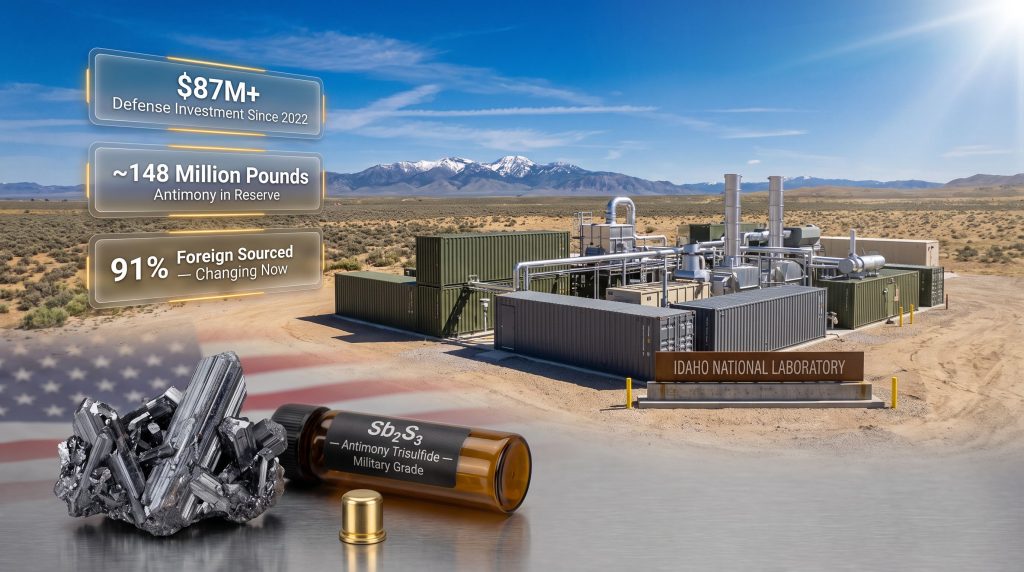
According to U.S. Geological Survey data, American manufacturers source approximately 91% of their antimony needs from foreign suppliers, placing it among the most import-reliant critical minerals in the entire defense supply chain.
That figure alone would register as a strategic concern. Furthermore, the concentration of foreign supply makes it considerably more acute. China, Russia, and Tajikistan collectively account for more than 85% of global antimony production, according to the USGS annual commodity report. The U.S. Geological Survey estimated apparent American antimony consumption at approximately 45,000 metric tons in 2025, a figure that underscores the scale of the dependency.
The 2021 inflection point crystallised the risk into an operational problem rather than a theoretical one. When Chinese authorities halted military-grade antimony trisulfide exports to the United States, the Army found itself without a primary supplier for a compound embedded in the production lines of virtually every American ammunition manufacturer. Consequently, the strategic calculation was immediate: domestic sourcing was no longer a desirable policy outcome. It had become an operational necessity, as highlighted by growing antimony shortage risks across the defense sector.
Inside the Army-Backed Antimony Pilot Plant in Idaho
Facility Design, Location, and Operating Parameters
The pilot plant at the centre of this initiative is a modular, containerised processing facility situated at Idaho National Laboratory in Idaho Falls. Its design reflects a deliberate engineering philosophy: rather than constructing a fixed, purpose-built facility with a single application, the modular architecture allows processing configurations to be tested, adjusted, and potentially redeployed for other minerals that Pentagon planners have flagged as critical supply chain vulnerabilities.
In its current configuration, the army-backed antimony pilot plant in Idaho is engineered to convert antimony-bearing ore samples from central Idaho into military-specification antimony trisulfide. Key operational parameters include:
- Continuous operation running 24 hours per day
- Processing throughput of approximately one ton of material per day
- Output tested against exacting military specifications set by Picatinny Arsenal
- Integration with INL's materials science laboratories for real-time compositional analysis
The choice of Idaho National Laboratory as the host site reflects more than geographic convenience. INL has long operated at the intersection of materials science, advanced processing research, and national security applications. Its expanding mandate now includes critical minerals processing R&D, making it a natural institutional partner for a project that is as much about generating processing knowledge as it is about producing material.
Funding Structure and Institutional Partnerships
The financial and institutional architecture behind the pilot plant involves several distinct layers:
| Partner | Role |
|---|---|
| Perpetua Resources Corp. | Ore supply, commercial operator, project developer |
| Idaho National Laboratory | Host facility, materials science expertise, processing R&D |
| U.S. Army (Picatinny Arsenal) | Defense end-user, military specification authority, funding |
| Defense Ordnance Technology Consortium | Program framework and funding mechanism |
Total funding committed under the Ordnance Technology Initiative Agreement stands at $27 million, with the most recent tranche of $4.7 million awarded by the Army in June 2026. Cumulative Army and Department of Defense investment in the broader Stibnite-to-defense antimony pipeline has surpassed $87 million since 2022, reflecting sustained institutional commitment well beyond pilot-stage experimentation.
Separately, a strategic antimony loan from the Export-Import Bank of the United States, totalling $2.9 billion, was approved in May 2026 to support full mine construction at the Stibnite Gold Project, covering the project's estimated direct construction costs alongside Perpetua's existing cash position.
Army officials have characterised the Idaho facility as a meaningful step toward reducing American dependence on foreign antimony sources while simultaneously building the domestic industrial capacity needed to support long-term military readiness. Idaho National Laboratory's leadership has framed the data and operational experience generated at the facility as foundational to demonstrating how national laboratories, private industry, and government can collaborate effectively on supply chain challenges.
The Stibnite Gold Project: America's Only Identified Domestic Antimony Reserve
What Makes This Deposit Strategically Irreplaceable
The Stibnite Gold Project, operated by Perpetua Resources Corp. in central Idaho, holds a distinction that no other domestic project can currently claim: it is the only known identified domestic antimony reserve in the United States. While gold functions as the primary economic engine of the project, antimony co-production is what elevates Stibnite from a conventional mining development into a national security asset.
The ore body at Stibnite contains antimony in the form of stibnite mineral (Sb₂S₃), the same compound name shared with the military-specification product the pilot plant is designed to produce. This geological alignment between the ore mineralogy and the desired output compound is significant from a processing standpoint, as it reduces the chemical transformation steps required compared to ore bodies where antimony appears in more complex mineralogical associations.
Reserve Scale and Production Projections
| Metric | Figure |
|---|---|
| Total estimated antimony in reserves | ~148 million pounds |
| Projected antimony recovery (first 4 years) | ~69.1 million pounds |
| Average annual antimony output (early production) | ~17.3 million pounds per year |
| Share of estimated 2025 U.S. consumption covered | ~17% of ~45,000 metric tonnes |
| Total antimony recovery (15-year mine life) | ~106.5 million pounds |
| Projected first production date | 2029 |
During its first four years of operation, Stibnite's antimony output is projected to satisfy roughly one-sixth of total U.S. annual antimony demand, a meaningful displacement of import reliance that nonetheless underscores the need for parallel domestic processing infrastructure and potential complementary sources.
Construction at Stibnite commenced in October 2025, with current activities focused on road upgrades, worker accommodation, power infrastructure, and other critical-path works. The 2029 production target depends on maintaining this construction trajectory alongside financing stability and continued permitting continuity.
The Lesser-Known Mineralogy Advantage
One detail that rarely surfaces in mainstream coverage of the Stibnite project is the significance of the ore's specific mineralogical character. The predominance of stibnite mineral in the ore body, rather than more oxidised or complex antimony-bearing phases such as valentinite or cervantite, materially affects processing economics. Stibnite mineral responds well to conventional flotation concentration methods, producing high-grade antimony concentrates without requiring exotic reagent chemistries or elevated-pressure hydrometallurgical circuits. This processing compatibility is partly why the pilot plant at INL can operate at meaningful throughput rates while maintaining tight compositional specifications on its output product.
How the Ground-to-Round Supply Chain Functions
From Ore Body to Ordnance Component
The concept of a vertically integrated domestic supply chain for a defense-critical mineral is more complex in practice than in policy documents. The step-by-step flow for the Stibnite-to-primer pathway looks like this:
- Ore extraction at the Stibnite Gold Project in central Idaho
- Concentrate production through flotation processing on-site or nearby
- Pilot-scale refining at Idaho National Laboratory, converting concentrate to antimony trisulfide
- Military specification testing against Picatinny Arsenal standards for primer-grade material
- Processing data generation to inform commercial-scale facility design and cost modelling
- Workforce training at INL, building a specialist talent base for domestic antimony processing
- Supply to U.S. defense manufacturers producing primers, initiators, and ordnance components
The pilot plant's most important output may not be the antimony trisulfide it physically produces. The operating data, process optimisation parameters, energy consumption benchmarks, and workforce competency developed through continuous 24-hour operation are the intellectual capital that will de-risk the commercial-scale transition. Scaling mineral processing from one ton per day to commercial throughput requires empirical process data that cannot be reliably modelled from laboratory-scale experiments alone.
Why Antimony Trisulfide Cannot Simply Be Reformulated Away
A recurring question in defense supply chain discussions is whether primer chemists could engineer around the antimony trisulfide dependency. The role of antimony in defense applications means the short answer, based on the technical constraints of military specification compliance, is: not quickly, and not cheaply. Alternative energetic compounds face several structural barriers:
- Ballistic performance equivalence must be demonstrated across the full temperature range of operational environments
- Storage stability requirements extend to decades-long shelf life in conditions ranging from Arctic cold to tropical humidity
- Compatibility testing with existing propellant formulations must be conducted for each of the affected ammunition types
- Sensitivity calibration must ensure reliable ignition without unacceptable risk of accidental initiation
Each of these testing phases requires time, specialised facilities, and substantial expenditure. For a reformulation affecting more than 300 ammunition types simultaneously, the timeline for complete substitution would extend well into the 2030s even under an accelerated programme, making near-term domestic antimony supply the only realistic path to restoring ammunition production security.
Geopolitical Context and the Broader Critical Minerals Decoupling Strategy
Why Idaho's Pilot Plant Is Part of a Larger Architecture
The army-backed antimony pilot plant in Idaho does not exist in isolation. It is one node in a rapidly expanding network of domestic critical mineral processing initiatives that reflect a structural reassessment of how the United States manages supply chain risk for defense-relevant materials. Rare earth separation facilities in West Virginia and Texas, lithium processing developments across the American Southwest, and cobalt refining initiatives in the Midwest are all expressions of the same strategic logic: that processing capability, not just resource ownership, is the decisive variable in supply chain security.
Antimony's case is particularly instructive because it illustrates how a material can be strategically critical even when it lacks the name recognition of lithium or cobalt. Its market is smaller, its production more concentrated, and its substitutability in high-specification applications extremely limited. Those characteristics combine to create what supply chain analysts describe as a single-point-of-failure risk, where disruption to one supply node cascades immediately into operational problems for downstream users with no viable alternative source. Indeed, critical minerals demand across all sectors continues to surge, making domestic processing capacity ever more vital.
Idaho's Emerging Role as a Critical Minerals Hub
Idaho's natural resource base, anchored by the Stibnite ore body, combined with Idaho National Laboratory's expanding processing R&D capabilities, positions the state as a meaningful centre of gravity in America's domestic critical minerals strategy. The INL's modular facility architecture is explicitly designed for adaptation beyond antimony, with the potential to test processing approaches for other Pentagon-priority minerals as they are identified.
Idaho Governor Brad Little has highlighted the state's ambition to leverage its natural resources alongside institutional innovation capacity to establish durable leadership in critical minerals supply chains. Furthermore, Pentagon officials have been explicit that economic security and national security are not separate domains. Reducing dependence on geopolitical rivals for commercial-grade mineral supply is treated as an extension of the same strategic doctrine that governs military-grade material procurement. U.S. Representative Mike Simpson has described the Stibnite-related infrastructure developments as a significant milestone in the multiyear effort to rebuild American critical mineral supply chains.
The next major ASX story will hit our subscribers first
Risks, Timelines, and What the Pilot Still Needs to Prove
The Critical Unproven Step
Despite the momentum represented by the pilot plant's opening, several material risks remain between the current demonstration phase and a fully functional domestic antimony supply chain.
- The scale gap is significant. Processing one ton per day at the INL pilot facility is orders of magnitude below the commercial throughput Stibnite will require. The transition to full-scale output depends on process data that the pilot is only beginning to generate.
- Timeline execution risk is real. A 2029 first production date requires consistent construction progress, stable financing conditions, and continued permitting integrity across a complex regulatory environment.
- Military specification compliance must be demonstrated at scale. Pilot-scale results showing that Stibnite ore can be converted to specification-compliant antimony trisulfide are necessary but not sufficient. Commercial-scale consistency across variable ore grades requires extended operational evidence.
- Stibnite alone cannot close the import gap. At approximately 17% of estimated U.S. annual consumption during peak early production years, Stibnite represents a meaningful but partial displacement of import dependence. Complementary domestic sources or demand-side substitution research remain necessary components of a complete supply security strategy.
Disclaimer: Projections regarding production timelines, output volumes, and financial parameters are based on publicly available company disclosures and USGS data. Actual outcomes may differ materially from forecasts due to operational, regulatory, geological, or market variables. This article does not constitute investment advice.
Frequently Asked Questions
What does the army-backed antimony pilot plant in Idaho produce?
The facility converts antimony-bearing ore samples from the Stibnite Gold Project into military-grade antimony trisulfide, the specific compound used in primer formulations across more than 300 types of U.S. military ammunition.
Where is the pilot plant located?
The modular processing facility operates at Idaho National Laboratory in Idaho Falls, Idaho.
How much has the U.S. Army invested in this initiative?
The Army and broader Department of Defense have committed more than $87 million to the Stibnite-to-defense antimony pipeline since 2022, with $27 million allocated specifically under the Ordnance Technology Initiative Agreement.
Why did the Army pursue a domestic antimony processing solution?
China's 2021 halt on military-grade antimony trisulfide exports to the United States eliminated the primary foreign supply source for a compound critical to American ammunition production. With foreign suppliers controlling over 85% of global output, developing domestic alternatives became an operational priority.
When will Stibnite begin producing antimony commercially?
Perpetua Resources is targeting 2029 as the first year of commercial production, with early construction activities underway since October 2025.
How much of U.S. antimony demand could Stibnite supply?
During its first four years of operation, Stibnite is projected to produce approximately 17.3 million pounds of antimony per year, equivalent to roughly 17% of estimated 2025 U.S. annual consumption of 45,000 metric tonnes.
Want to Know Which ASX Companies Are Securing Critical Mineral Discoveries Right Now?
Discovery Alert's proprietary Discovery IQ model delivers real-time alerts on significant ASX mineral discoveries — including critical minerals like antimony that are reshaping defence supply chains globally — instantly empowering subscribers to identify actionable opportunities ahead of the broader market. Explore Discovery Alert's discoveries page to understand why historic mineral discoveries generate substantial returns, and begin your 14-day free trial today to position yourself ahead of the market.