August 11, 2026
The Infrastructure Trap Hiding Inside Africa's Most Valuable Oil Relationship
Cross-border energy pipelines are among the most revealing documents a region can produce. They expose which countries trust each other enough to share critical infrastructure, which governments have the institutional capacity to honour long-horizon commitments, and which bilateral relationships have matured past the press-release stage. By those standards, the Libya Egypt oil pipeline agreement currently under negotiation is one of the most consequential infrastructure stories unfolding anywhere on the African continent in 2026.
This is not a new proposal dressed up in fresh language. The Tobruk-to-Alexandria corridor has been formally discussed, agreed upon in principle, shelved, and resurrected across nearly three decades. What makes the current iteration different is not simply a new memorandum or a change in government. The external pressures driving both Cairo and Tripoli toward genuine commitment have never been more structurally acute, and the commercial logic underpinning the project has never been better supported by production data.
When big ASX news breaks, our subscribers know first
Why 2026 Is Different From Every Previous Attempt
Understanding why the Libya Egypt oil pipeline agreement is advancing now requires looking at what changed, not just what was agreed. The January 2026 Memorandum of Understanding on oil, gas, and mining cooperation formalised the revival of the pipeline concept. However, the MoU itself was a response to conditions that had been building for months, not a spontaneous diplomatic gesture.
Egypt's energy market endured significant strain following disruptions at the Strait of Hormuz, the narrow waterway through which a substantial share of global seaborne crude flows. For a country that relies on maritime supply routes to feed its Mediterranean coast refineries, that disruption was not an abstract risk event. It was a live demonstration of structural vulnerability, and the oil price shock that accompanied it accelerated Cairo's policy thinking considerably.
The prospect of a land-based, regionally sourced crude supply corridor running from Libyan territory directly into Egyptian refining infrastructure suddenly shifted from a long-term planning aspiration to an immediate policy priority. Furthermore, geopolitical tensions across the broader region reinforced how exposed Egypt's existing supply arrangements had become.
Simultaneously, Libya's domestic production trajectory gave Tripoli a compelling reason to pursue alternative export infrastructure. Libya's National Oil Corporation has confirmed that the country's output has reached levels not recorded since 2013, with the government targeting production of 1.5 million barrels per day. Achieving that target without diversified export pathways creates a bottleneck problem.
Coastal export terminals remain periodically vulnerable to political and security disruption, meaning a pipeline routing directly into a neighbouring country's refining system offers something Libya's existing infrastructure cannot: stable, politically insulated throughput.
High-level diplomatic engagement between Egyptian Prime Minister Mostafa Madbouly and Abdul Hamid Dbeibeh, Prime Minister of Libya's Government of National Unity, elevated the energy cooperation agenda beyond technical working groups and into the domain of political commitment. Their discussions covered natural gas interconnection, petroleum refining collaboration, and electricity grid linkage, situating the oil pipeline within a broader bilateral energy architecture rather than treating it as a standalone infrastructure project.
The Project in Numbers: What Is Actually Being Built
The current iteration of the Libya Egypt oil pipeline agreement involves specifications that have expanded considerably from the original 1997 conception. The following table captures the evolution of the project across its various planning phases:
| Planning Phase | Approximate Length | Key Features | Outcome |
|---|---|---|---|
| 1997 Agreement | ~620 km | 150,000 bpd capacity target | Stalled |
| 2002 Renewal | ~620 km | Reiterated original parameters | Dormant |
| 2026 MoU Framework | ~800 km | Expanded scope, ~$1 billion cost | Under negotiation |
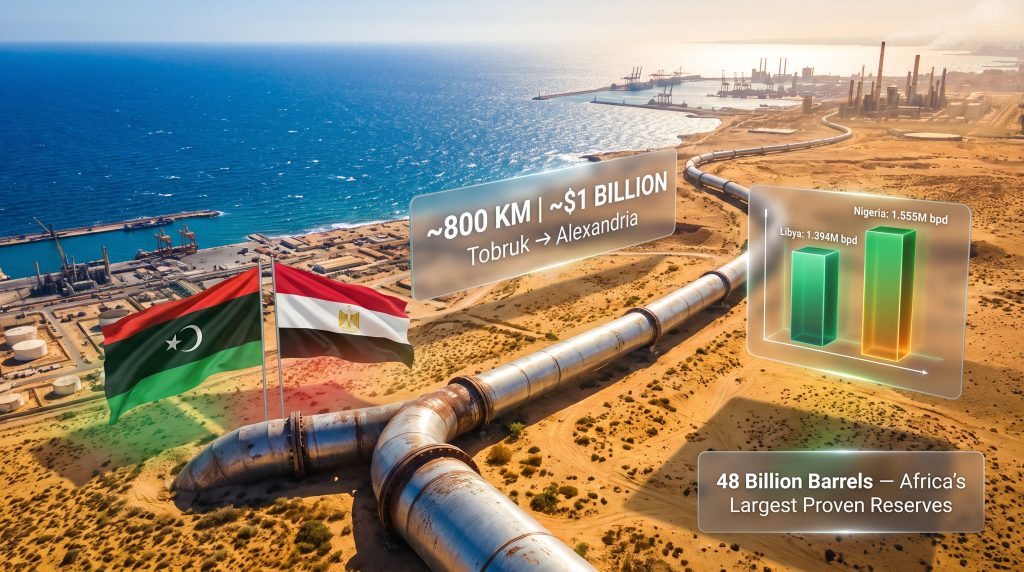
The route runs along the North African Mediterranean coast from Tobruk in eastern Libya to Alexandria in northwestern Egypt. At an estimated cost of approximately $1 billion USD, the project falls within the more capital-efficient range of large-scale cross-border African energy infrastructure. For context, the East African Crude Oil Pipeline connecting Uganda to Tanzania carries an estimated price tag of around $5 billion, while the proposed Nigeria-Morocco Gas Pipeline has been costed at closer to $25 billion.
The relative affordability of the Libya-Egypt pipeline reflects both the shorter distance and the geographic advantages of a coastal alignment. The route avoids the most technically demanding desert interior terrain, though an 800-kilometre corridor across North African coastal geography still requires substantial geotechnical assessment, particularly in zones susceptible to seismic activity or subsurface instability.
As of mid-2026, three critical variables remain under active bilateral deliberation:
- Financing structure: Neither government has confirmed which financing mechanisms will be employed, meaning project execution timelines remain dependent on this resolution
- Pipeline throughput capacity: Calibrating the volume the pipeline will carry requires matching Libya's export ceiling against Egypt's refinery intake capacity, a technical coordination challenge that has direct commercial implications
- Construction and execution model: The selection of engineering contractors and the project delivery framework have not been finalised
Libya's Production Surge and the Reserve Advantage Underwriting This Deal
Does Libya Have the Reserves to Justify This Investment?
The commercial rationale for the Libya Egypt oil pipeline agreement is anchored in a fundamental asymmetry between the two countries' hydrocarbon positions. Libya sits atop Africa's largest proven oil reserves, estimated at 48 billion barrels. That reserve base dwarfs Nigeria's approximately 37 billion barrels and Algeria's roughly 12 billion barrels, yet Libya's export infrastructure has historically underperformed relative to its geological endowment.
According to OPEC's most recent monthly report, Libya produced approximately 1.394 million barrels per day in June 2026, placing it as Africa's second-largest oil producer, marginally behind Nigeria's output of approximately 1.555 million bpd. The gap between Libya's reserve position and its production ranking reflects years of political instability, infrastructure vulnerability, and underinvestment in export capacity. Monitoring crude oil price trends also suggests that sustained pricing above breakeven levels makes the investment case considerably stronger.
"The structural mismatch between Libya's reserve base and its export infrastructure is precisely the dynamic that makes the pipeline commercially attractive. A country with 48 billion barrels of proven reserves and aspirations of 1.5 million bpd in output needs more ways to move oil, not just more wells to produce it."
Why Crude Quality Matters
One aspect of Libya's hydrocarbon profile that receives less attention than its reserve size is the quality of its crude. Libyan crude, predominantly sourced from the Sirte Basin, is classified as light and sweet, meaning it carries low sulphur content and high API gravity. This grade is particularly well-suited to Mediterranean refinery configurations, which are typically optimised for lighter crude inputs.
Egypt's refining infrastructure on the Mediterranean coast is therefore not just geographically convenient as a destination for Libyan crude — it may be technically well-matched for processing it efficiently, potentially reducing per-barrel refining costs compared to heavier, sourer alternative feedstocks.
Egypt's Position: Downstream Capacity Meeting Upstream Constraint
Egypt's oil production profile presents a structural contrast to Libya's. The country produces approximately 540,000 barrels per day, drawing from three primary zones: the Gulf of Suez, the Western Desert, and the Nile Delta. That output makes Egypt North Africa's third-largest oil producer, behind Libya and Algeria.
While Egypt has been quietly adding to its reserve base through ongoing domestic exploration activity, its refining throughput capacity continues to outpace what domestic production can supply. This creates a persistent feedstock gap that Egyptian refineries currently address through imports.
The Libya-Egypt oil pipeline agreement, if completed, would fill a portion of that gap with regionally sourced crude delivered via land-based infrastructure, reducing Egypt's dependence on maritime supply routes and their associated geopolitical exposure. In addition, the oil price impacts of continued global market volatility make a domestically routed supply chain considerably more attractive to Egyptian planners.
The broader energy cooperation framework being discussed between Cairo and Tripoli also encompasses natural gas connectivity and electricity grid interconnection. This multi-sector approach suggests that both governments view the oil pipeline not as an isolated transaction but as one component of a deeper bilateral energy integration strategy.
That framing matters for project durability. Single-asset bilateral agreements are easier to abandon when political conditions shift. Multi-sector energy relationships, however, create interdependencies that are harder to unwind.
Benchmarking the Libya-Egypt Pipeline Against African Energy Infrastructure
Placing the Libya Egypt oil pipeline agreement within the landscape of African cross-border energy projects reveals both its relative efficiency and the competitive context in which it will need to attract financing.
| Project | Countries | Estimated Cost | Distance | Current Status |
|---|---|---|---|---|
| Tobruk-Alexandria Oil Pipeline | Libya-Egypt | ~$1 billion | ~800 km | Under negotiation (2026) |
| East African Crude Oil Pipeline | Uganda-Tanzania | ~$5 billion | ~1,443 km | Under construction |
| Trans-Saharan Gas Pipeline | Nigeria-Algeria-Europe | ~$13 billion | ~4,128 km | Long-term planning |
| Nigeria-Morocco Gas Pipeline | Nigeria-Morocco | ~$25 billion | ~5,660 km | Feasibility stage |
The Libya-Egypt project's cost-per-kilometre ratio positions it as a relatively accessible financing challenge compared to the mega-corridor projects dominating African energy infrastructure headlines. However, affordability relative to larger projects does not eliminate the fundamental challenge facing cross-border energy infrastructure in politically complex environments: lenders require revenue certainty, and revenue certainty requires governance stability. Consequently, African project finance expertise will be essential in structuring a workable deal.
The next major ASX story will hit our subscribers first
The Governance Question That Could Derail Everything
What Are the Key Political Risks?
Libya's dual-governance structure represents the most significant non-financial risk attached to the Libya-Egypt oil pipeline agreement. The country continues to operate with competing authorities, with the internationally recognised Government of National Unity based in Tripoli and separate power centres operating in the east of the country. The pipeline's origin point in Tobruk places the project's upstream endpoint within the political orbit of eastern Libyan factions, whose relationship with Tripoli has been complex and periodically adversarial.
For international lenders and development finance institutions evaluating potential participation in the project's financing, this governance dynamic requires careful risk modelling. Standard cross-border infrastructure financing typically involves:
- Robust off-take agreements that guarantee minimum throughput volumes over a defined contract period
- Revenue-sharing frameworks that distribute pipeline income equitably between parties in a way that sustains political support across governments
- Political risk insurance mechanisms that protect lender capital against force majeure events linked to governance disruption
- Multilateral development bank participation, which can provide both capital and a form of diplomatic protection that reduces the likelihood of project interference
None of these protections have been publicly confirmed as part of the current negotiation framework, which is consistent with the project still being in its pre-commitment phase. The sequence of events that would need to occur before construction could begin involves resolving all three of the unconfirmed variables — financing, capacity, and execution model — in a governance environment that has historically complicated large-scale infrastructure delivery.
What a Completed Pipeline Would Actually Deliver
Setting aside the execution risks, the strategic value of a fully operational Libya-Egypt pipeline is substantial enough to explain why both governments continue returning to the concept despite decades of false starts.
Benefits for Egypt
For Egypt, the pipeline would deliver a regionally sourced, land-based crude supply that is structurally insulated from maritime chokepoint risk. Given the Strait of Hormuz disruption experience of 2026, that insurance value alone carries significant policy weight in Cairo's energy planning. At throughput volumes consistent with the original design parameters of 150,000 bpd or potentially higher, the pipeline would supply a meaningful share of Egyptian Mediterranean refinery feedstock needs from a single infrastructure asset.
Benefits for Libya
For Libya, the pipeline would provide what its existing export infrastructure lacks: a politically diversified, stable export channel that does not depend on the continued operational integrity of coastal terminals. As Libya pushes toward its 1.5 million bpd production target, export infrastructure capacity becomes a binding constraint on how much of that ambition can be monetised.
Benefits for the Broader Region
For the broader North African energy landscape, a functioning Libya-Egypt pipeline would reinforce Alexandria's strategic position as a Mediterranean energy hub. The city's refining infrastructure, fed by Libyan crude, could increasingly serve as a processing node for crude destined for European markets, positioning North Africa more firmly within European energy supply chain discussions at a time when European buyers are actively seeking to diversify away from Russian crude.
Disclaimer: This article is intended for informational purposes only and does not constitute financial or investment advice. Forecasts, scenario projections, and statements about potential project outcomes involve inherent uncertainty. Readers should conduct independent research before making any investment decisions related to the topics discussed.
Want To Stay Ahead of the Next Major Resource Discovery?
Discovery Alert's proprietary Discovery IQ model scans ASX announcements in real time, transforming complex mineral and energy data into actionable investment insights — explore historic discoveries and their exceptional returns, then begin your 14-day free trial at Discovery Alert to secure your market-leading edge before the broader market catches on.