
August 11, 2026
When Equipment Alone Is No Longer Enough: The New Calculus of Mineral Processing Performance
Every processing plant manager understands the uncomfortable arithmetic of unplanned downtime. A single slurry pump failure in a SAG mill discharge circuit can halt thousands of tonnes per hour of throughput, and if replacement components are sitting in a centralised warehouse weeks away, that arithmetic becomes financially devastating. Across the global minerals industry, this reality has quietly shifted the procurement conversation from capital expenditure optimisation toward something more operationally nuanced: the total cost of ownership, measured not just in equipment price but in response speed, service proximity, and lifecycle technical support.
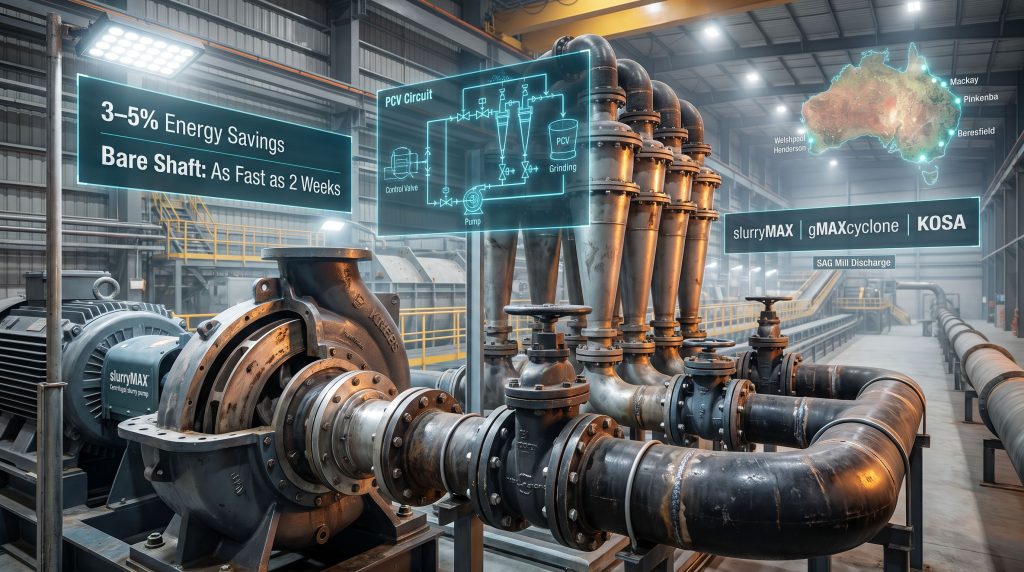
This shift has made the FLS pumps cyclones and valves speed strategy one of the more consequential service developments in Asia-Pacific mineral processing. It represents a structured answer to a question that plant operators across copper, gold, lithium, nickel, and iron ore circuits have been asking with increasing urgency: what happens after the equipment is commissioned?
When big ASX news breaks, our subscribers know first
The PCV Ecosystem and Why It Carries Disproportionate Downtime Risk
How Pumps, Cyclones and Valves Function as an Interdependent System
Pumps, cyclones and valves (PCV) are not independent components. They form a tightly coupled hydraulic and mechanical system within a mineral processing circuit, and performance degradation in any single element creates cascading consequences across the others.
In a closed grinding circuit, a centrifugal slurry pump delivers feed material to a bank of hydrocyclones under precisely controlled pressure. The cyclones separate coarse particles for return to the mill from fine particles that advance to downstream processes. Valves regulate flow distribution, control pressure, and isolate equipment during maintenance. The performance ceiling of the entire classification step is directly governed by how consistently the upstream pump delivers feed within the cyclone's design pressure range.
Operational Insight: In mineral processing, the performance ceiling of a hydrocyclone is largely determined by the consistency of the upstream pump, making integrated PCV management a system-level discipline rather than a component-level one.
The practical consequence of this interdependency is that PCV equipment accounts for a disproportionate share of processing plant downtime risk. Slurry pumps operate in some of the most mechanically demanding conditions in industrial processing, handling abrasive, high-density slurries continuously across extended shift cycles. Wear is inevitable, but the rate of wear and the speed of response when components degrade are variables that service strategy can directly influence.
PCV equipment appears across every major stage of a processing plant's operational flow:
- Comminution circuits: SAG mill and ball mill discharge, where slurry density and particle size distribution are at their most variable
- Classification circuits: cyclone feed, where pressure stability determines separation sharpness
- Leach and flotation circuits: reagent handling and recirculation, requiring chemical compatibility in pump materials
- Tailings management: long-distance slurry transport under lower pressure but extreme wear conditions
- Water recovery: return water circuits where efficiency directly affects operational water costs
What the FLS Speed Strategy Actually Involves
Four Pillars Defining a Lifecycle Service Framework
The FLS pumps cyclones and valves speed strategy is built on a lifecycle service architecture rather than a transactional supply model. Its logic centres on four interconnected operational pillars:
- Proximity – Positioning service infrastructure and spare parts inventory closer to operating mine sites to reduce physical delivery distances
- Responsiveness – Compressing lead times for wear components, spare parts, and rebuild services through regionally distributed stock and specialist teams
- Technical depth – Deploying personnel with genuine mineral processing expertise capable of conducting diagnostic audits, not just delivering components
- Digitalisation – Integrating real-time monitoring, 3D scanning capability, and process analytics into ongoing lifecycle support
What separates this approach from a conventional OEM service model is the deliberate integration of process optimisation into the service relationship. Rather than treating equipment supply and operational performance improvement as separate commercial engagements, the speed strategy positions technical support, parts availability, and digital monitoring as a unified offering delivered throughout the equipment lifecycle. Furthermore, data-driven mining operations are increasingly central to how progressive operators measure and manage PCV performance across their sites.
Speed Strategy vs. Conventional OEM Service: A Direct Comparison
| Service Dimension | Traditional OEM Model | FLS Speed Strategy |
|---|---|---|
| Parts availability | Centralised warehouse distribution | Regionally distributed, site-proximate inventory |
| Bare shaft pump delivery | 6-12+ weeks typical lead time | As fast as 2 weeks via KREBS Express Pump Program |
| Complete pump assembly | 8-16 weeks | Within 4 weeks (slurryMAX range) |
| Diagnostic capability | Reactive, on-request engagement | Proactive audits plus digital monitoring integration |
| Process optimisation | Separate commercial engagement | Embedded within lifecycle service offering |
| Installation support | Specification-based drawings | Pre-upgrade 3D scanning and dimensional overlay |
Customer feedback was a direct input into the design of this framework. Structured surveys of existing customers revealed that while FLS's product portfolio was rated highly on technical performance, the responsiveness of service delivery represented an area where improvement would generate the greatest operational value for clients. That feedback loop, from operator pain point to strategic service investment, illustrates an important industry dynamic: in mature equipment categories where technical differentiation between leading OEMs is relatively narrow, service speed and proximity frequently determine which supplier retains long-term relationships.
Pump Efficiency Engineering: The Physics Behind the 3-5% Energy Saving
Best Efficiency Point Operation and Why Deviation Is Costly
Every centrifugal slurry pump has a Best Efficiency Point (BEP), the specific combination of flow rate and head at which the pump converts shaft power to fluid energy with maximum hydraulic efficiency. Operating significantly to the left or right of BEP introduces a series of compounding losses:
- Left of BEP (below design flow): Increased internal recirculation, elevated radial forces on the shaft and bearings, accelerated wear-part degradation, and higher specific energy consumption per tonne of material moved
- Right of BEP (above design flow): Cavitation risk increases, suction conditions deteriorate, and NPSH (Net Positive Suction Head) margins erode, introducing the risk of mechanical damage
- Both cases: The pump curve flattens at efficiency extremes, meaning small changes in operating point produce disproportionately large efficiency losses
In a large processing facility handling several thousand tonnes per hour, operating even a single primary slurry pump 10-15% left of BEP across a full year can translate into hundreds of megawatt-hours of wasted electrical energy. Multiply that across a bank of cyclone feed pumps, tailings pumps, and recirculation pumps, and the aggregate energy cost of off-BEP operation becomes a material line item in operating expenditure. According to Australian Mining's coverage of FLS pump efficiency developments, these efficiency gains are increasingly central to how operators evaluate lifecycle pump value.
How the KREBS slurryMAX Targets Recirculation Losses
The KREBS slurryMAX pump addresses one of the primary mechanisms of BEP deviation loss: internal recirculation at the suction inlet. Through a suction wear ring adjustment mechanism, the pump geometry can be modified to reduce the gap through which slurry recirculates back toward the suction eye, a design feature that directly targets the efficiency losses associated with running below the design flow point.
The quantified outcome of this design is an energy saving of 3-5% compared with conventional slurry pump configurations operating under equivalent duty conditions. While this figure may appear modest, its operational significance scales rapidly:
Key Metric: A 3-5% reduction in pump energy consumption across a large mineral processing facility can translate to substantial annual operating cost reductions, particularly in energy-intensive circuits such as SAG mill discharge and cyclone feed systems.
Beyond the recirculation reduction mechanism, the slurryMAX range is engineered with matched materials across the impeller, liner, and casing to extend wear life in abrasive slurry applications. The selection of appropriate materials for specific duties, whether natural rubber for fine, low-temperature slurries or high-chrome white iron for coarse, abrasive applications, is a less-discussed but operationally critical dimension of pump lifecycle management.
Variable-Speed Drives and BEP Management Across Variable Duty Cycles
Processing plants rarely operate at a single constant throughput. Ore variability, shift changes, maintenance windows, and circuit reconfigurations all cause flow demand to fluctuate. Variable-speed drives (VSDs) allow pump speed to be adjusted to match changing flow requirements while maintaining operation closer to the pump's BEP across a wider duty range.
The practical sizing principle for VSD applications is to specify the pump's maximum rated flow slightly to the right of BEP, ensuring that as speed is reduced to match lower-flow operating conditions, the operating point tracks through the high-efficiency region of the pump curve rather than falling sharply away from it. This is a subtlety that is frequently overlooked during initial pump selection and only becomes apparent during operational energy audits.
The capital cost of VSD installation must be weighed against long-term energy and wear savings, but for applications where flow demand varies regularly across shift cycles or ore types, the economics typically favour VSD specification over fixed-speed alternatives within a few years of commissioning.
Hydrocyclone Classification: Why Feed Pressure Stability Is Non-Negotiable
The Fluid Dynamics Governing Cyclone Separation Performance
A hydrocyclone separates particles by centrifugal force generated by the tangential velocity of the incoming feed slurry. The intensity of that centrifugal field, and therefore the sharpness and efficiency of the particle size cut, is directly proportional to feed pressure. This relationship has a critical practical implication: pressure fluctuations at the cyclone inlet do not simply cause minor variations in separation performance. They fundamentally alter the cut size, the sharpness of the separation curve, and the proportion of fine material misclassified to the underflow.
In a hard rock grinding circuit, misclassified fines returning to the mill represent wasted grinding energy. Misclassified coarse particles reporting to the overflow represent material that bypasses adequate liberation, potentially degrading downstream flotation or leach recovery. Both failure modes have direct financial consequences.
Common Cyclone Performance Failure Modes
| Cyclone Performance Variable | Optimal Condition | Common Failure Mode |
|---|---|---|
| Feed pressure | Stable within design specification | Pressure spikes from pump surging or cavitation |
| Feed density | Consistent within design limits | Density variation from upstream ore variability |
| Underflow/overflow sizing | Correctly matched to duty | Incorrect apex or vortex finder selection |
| Feed line condition | Clear and unobstructed | Partial blockage from coarse debris accumulation |
| Pump-cyclone hydraulic matching | Pump curve intersects duty point near BEP | Pump oversized or undersized for cyclone pressure requirement |
Partial blockage of cyclone feed lines by coarse debris is a significantly underappreciated cause of cyclone underperformance in hard rock circuits. Unlike a pump failure, which produces an obvious operational event, gradual debris accumulation in feed manifolds manifests as slow, difficult-to-attribute degradation in classification efficiency that often goes undiagnosed until a scheduled inspection or a product quality alert triggers investigation.
gMAXcyclone Geometry and Classification Precision
The gMAXcyclone from FLS addresses classification performance through geometric design principles that improve separation sharpness compared with conventional cylindrical-conical cyclone bodies. The specific geometry modifies the velocity distribution within the cyclone body, reducing the short-circuit flow path through which coarse particles can bypass the separation zone and report directly to overflow.
In high-throughput hard rock circuits where even a 1-2% improvement in classification efficiency can meaningfully affect downstream recovery rates, the gMAXcyclone's design represents a measurable operational advantage when deployed alongside correctly matched pump and valve infrastructure.
Digitalisation: From Equipment Monitoring to Integrated Processing Solutions
3D Scanning and Installation Risk Reduction in Brownfield Plants
One of the less-publicised but practically significant capabilities within the FLS speed strategy is the use of 3D scanning technology to digitally map existing equipment installations before upgrade work begins. In brownfield Australian processing plants, a recurring challenge is the gap between original as-built documentation and the actual current state of installed infrastructure. Piping reroutes, equipment modifications, and decades of maintenance interventions frequently mean that engineering drawings are unreliable guides for planning new equipment installation.
Pre-upgrade 3D scanning generates precise dimensional models of existing equipment and surrounding infrastructure. Engineers use these models to identify potential interference points, confirm available clearances, and create accurate installation overlays before any physical work commences. In addition, 3D modelling tools are becoming a standard part of the modernisation toolkit across mineral processing and exploration alike. The result is a reduction in unexpected plant modifications during shutdown windows, which directly compresses the duration and cost of maintenance outages.
KREBS One Stream Analyser (KOSA) and Real-Time Particle Size Control
The KREBS One Stream Analyser (KOSA) provides continuous, real-time particle size distribution measurements within grinding and classification circuits. This capability addresses a long-standing operational limitation in mineral processing: the delay between when grind conditions change and when operators can detect and respond to that change through conventional laboratory sampling.
Traditional particle size measurement relies on periodic manual sampling followed by laboratory analysis, a process that can take 30 minutes to several hours to return actionable data. In that interval, the circuit may have been processing ore at a suboptimal grind size, either over-grinding and consuming excess energy or under-grinding and producing coarse particles that reduce downstream recovery. KOSA closes that feedback loop by providing continuous measurement data that enables faster, evidence-based control decisions.
The connection between tight particle size control and downstream metallurgical recovery is operationally significant beyond the grinding circuit itself. Flotation performance, for example, is highly sensitive to particle size distribution. Coarse particles have insufficient surface area liberation for effective bubble attachment, while ultrafine particles are difficult to float due to mass and surface chemistry interactions. Maintaining a tighter grind size distribution through KOSA-enabled circuit control therefore has a direct bearing on concentrate grade and recovery.
TIPCO Acquisition and the Move Toward Integrated Process Control
FLS's 2024 acquisition of TIPCO Tudeshki Industrial Process Control GmbH expanded the company's capability from equipment-level monitoring into integrated process analytics. This transition is conceptually significant: rather than monitoring individual pump performance or a single cyclone bank in isolation, the integrated platform enables simultaneous analysis of pump operating points, cyclone feed pressure behaviour, valve positions, and particle size distribution within a unified operational view.
For a plant metallurgist or processing superintendent, this convergence means that root-cause analysis of a classification efficiency problem, previously a time-consuming manual investigation involving data from multiple disconnected systems, can be accelerated by cross-referencing pump, cyclone, and particle size data within a single analytical framework. Consequently, AI-powered mining efficiency tools are increasingly complementing these integrated monitoring platforms across the industry.
Strategic Observation: The convergence of real-time particle size analytics, pump performance monitoring, and cyclone feed pressure control into a single operational framework represents a structural shift in how PCV suppliers position their value proposition, moving from equipment vendor to process performance partner.
The next major ASX story will hit our subscribers first
Building Regional Service Capability Across Australia and Asia-Pacific
The Service Network Expansion Logic
FLS has expanded its Australian service network with the addition of a larger facility in Mackay, Queensland, complementing existing operations in Pinkenba (QLD), Welshpool (WA), Henderson (WA), and Beresfield (NSW). The geographic distribution of these locations reflects the concentration of mineral processing activity across Queensland, Western Australia, and New South Wales, providing service coverage across the country's three most active mining states.
The strategic logic of proximity-based service infrastructure is straightforward but frequently underestimated in its financial impact. Geographic proximity of service centres directly correlates with response time, and response time directly determines the duration of unplanned downtime events. A service centre capable of dispatching a rebuilt pump or a specialist technician within hours rather than days can convert a multi-day production outage into a single-shift event.
The Universal PCV Demand Across All Commodity Sectors
A defining characteristic of PCV demand is its commodity independence. Every processing plant that handles ore requires pumps, cyclones, and valves, regardless of whether the target mineral is copper, gold, lithium, nickel, iron ore, or any other commodity. This universality means that demand for lifecycle PCV services is distributed across the entire mining industry rather than concentrated in any single commodity cycle.
Asia-Pacific represents one of the most significant serviceable markets for PCV lifecycle support globally, with processing infrastructure across Australia, Southeast Asia, and the Pacific concentrated in geographically remote locations where supply chain proximity has an outsized operational impact. Near-term demand drivers across the region include:
- Critical minerals processing expansion, including lithium hydroxide conversion and nickel sulphate circuits
- Copper project development across Queensland, South Australia, and Southeast Asia
- Gold circuit upgrades at aging operations seeking efficiency improvements without full circuit replacement
- Tailings reprocessing initiatives driven by both resource recovery economics and environmental management requirements
A Step-by-Step PCV Circuit Audit Framework
How to Assess and Prioritise PCV Performance Systematically
For plant operators seeking to implement a structured approach to PCV health management, the following audit sequence provides a practical framework:
- Establish baseline performance data – Collect current pump curves, cyclone pressure readings, valve position logs, and particle size distribution data under representative operating conditions
- Map operating points against design specifications – Identify where pumps are running relative to their BEP and where cyclones are operating outside their design pressure range
- Inspect wear components physically – Assess liner condition, impeller wear progression, apex and vortex finder condition, and valve seat integrity against manufacturer wear limits
- Review digital monitoring trends – Analyse time-series data for power draw, bearing temperature, vibration, and particle size distribution to identify gradual performance degradation
- Prioritise corrective actions – Rank interventions by production impact, ensuring the highest-risk items are scheduled into the next planned maintenance window rather than deferred to an unplanned event
- Validate post-intervention performance – Confirm that operating points have returned to design specification and that energy consumption has responded accordingly before closing the audit cycle
Key Metrics for Ongoing Slurry Pump Health Monitoring
Operators managing slurry pump assets should track the following parameters as part of a structured monitoring programme:
- Power draw vs. pump curve: deviations indicate wear progression or operating point drift away from BEP
- Flow rate and developed head: verified against the original pump curve to detect efficiency degradation over time
- Bearing temperature trends: a leading indicator of mechanical stress, misalignment, or lubrication failure before catastrophic bearing damage occurs
- Wear-part inspection intervals: scheduled against duty severity (slurry density, particle size, and throughput rate) rather than fixed calendar time
- Suction and discharge pressure: cross-referenced with flow meter data to confirm hydraulic performance and detect cavitation risk
The Broader Strategic Picture: Lifecycle Partnerships and Energy Efficiency as Competitive Imperatives
Why the Shift to Lifecycle Partnerships Creates Durable Competitive Advantages
The structural shift underway in mineral processing procurement reflects a deeper change in how mining companies evaluate total operational risk. When equipment selection was primarily governed by upfront capital cost and technical specification, OEMs competed primarily on product performance and price. As the industry has matured and processing plants have aged, operators have increasingly recognised that the quality of after-market support is a more consequential variable for sustained processing performance than marginal differences in equipment specification.
This shift creates a different competitive dynamic for OEMs. Long-term lifecycle service agreements generate more stable revenue streams than capital equipment sales, while also creating deeper operational integration with client plants that makes switching to an alternative supplier progressively more complex. For mine operators, these agreements reduce the operational risk associated with unplanned downtime and transfer a portion of performance responsibility to the service partner, an arrangement that aligns incentives around sustained plant performance rather than equipment replacement cycles.
Energy Efficiency as Both a Commercial and ESG Imperative
The 3-5% energy saving achievable through BEP-optimised slurry pump operation is not merely an operational cost reduction. In the context of mining companies' Scope 1 and Scope 2 emissions reporting obligations, incremental efficiency gains in high-energy processing circuits represent a measurable contribution to emissions reduction targets.
Grinding and pumping circuits typically account for the majority of electrical energy consumption at a processing plant. Optimising pump operating points, reducing recirculation losses, and maintaining classification efficiency through tight cyclone pressure control all contribute to a lower energy intensity per tonne of ore processed. Furthermore, mining electrification and decarbonisation initiatives are increasingly shaping how operators integrate PCV efficiency improvements into their broader sustainability programmes. For operations with carbon reduction commitments, PCV optimisation offers a practical, near-term lever for emissions reduction that does not require major capital investment or circuit redesign. Renewable mining solutions are, however, becoming an equally important complementary strategy as operators pursue deeper emissions reductions across their energy mix.
Disclaimer: This article contains forward-looking statements and performance estimates based on engineering principles and publicly available information. Actual energy savings, lead times, and operational outcomes will vary depending on site-specific conditions, equipment configuration, duty cycle, and ore characteristics. This article does not constitute financial or investment advice.
Further Exploration:
Readers seeking additional technical context on slurry pump selection, hydrocyclone performance optimisation, and mineral processing circuit design may find value in exploring related industry resources published by Australian Mining at australianmining.com.au, which covers the latest developments in mining services, OEM technology, and processing innovation across the Asia-Pacific region.
Want to Know Which ASX Mining Companies Are Advancing Mineral Processing Innovation?
Discovery Alert's proprietary Discovery IQ model scans ASX announcements in real time, instantly identifying significant mineral discoveries across copper, gold, lithium, nickel, and iron ore — the same commodities driving demand for next-generation processing infrastructure. Explore how historic discoveries have delivered exceptional market returns, then begin your 14-day free trial to position yourself ahead of the broader market.