August 11, 2026
The Engineering Gamble Reshaping U.S. LNG Export Infrastructure
Offshore energy development has historically followed a familiar script: drill, produce, pipe to shore, process on land. For decades, the architecture of American LNG exports reinforced this pattern, with every liquefaction facility anchored to coastal real estate, fixed concrete foundations, and a web of onshore regulatory approvals. The emergence of floating LNG technology challenged that assumption globally, but the United States was notably absent from the offshore LNG conversation, until now.
The Delfin LNG Deepwater Port Project is rewriting that script entirely. Positioned in federal waters of the Gulf of Mexico, it represents not just another LNG development, but a structural departure from everything that has defined U.S. gas export infrastructure for the past two decades. Understanding what makes this project technically distinct, commercially meaningful, and strategically consequential requires moving beyond the headline figures and into the engineering logic, regulatory architecture, and market forces converging to make it viable.
When big ASX news breaks, our subscribers know first
Why Offshore LNG Export Infrastructure Represents a Structural Shift
The Limitations of Conventional Onshore Terminal Models
Onshore LNG terminals operate within a relatively well-understood development framework, but that framework carries significant constraints. Coastal land acquisition in sensitive jurisdictions introduces environmental review timelines that routinely extend across multiple years. Fixed liquefaction trains require large parcels of real estate, impose permanent visual and industrial footprints on coastal communities, and demand dedicated pipeline corridors linking the facility to upstream supply basins.
Beyond logistics, the capital commitment profile for onshore terminals is front-loaded and largely irreversible. Once a liquefaction train is constructed on a fixed coastal site, its throughput capacity is locked in place. Operators cannot easily scale up or reposition assets in response to shifting market conditions or evolving buyer demand patterns.
How Deepwater Port Licensing Creates a New Regulatory Pathway
The Deepwater Ports Act provides a regulatory mechanism that sits entirely outside the conventional Federal Energy Regulatory Commission (FERC) framework that governs onshore LNG terminals. Under this structure, the U.S. Maritime Administration (MARAD) holds primary licensing authority over offshore port operations in federal waters, while the Department of Energy (DOE) separately authorises export volumes.
This dual-agency model creates a fundamentally different development environment. Jurisdictional authority rests with federal agencies operating outside state coastal zone management processes, which removes one of the most friction-intensive layers of the traditional onshore approval sequence. For developers seeking to move capital efficiently through the regulatory pipeline, this distinction is operationally significant.
The Strategic Case for Floating LNG Technology in Federal Waters
Floating LNG vessels function as self-contained liquefaction platforms, combining gas processing, liquefaction, storage, and offloading capability within a single marine structure. Deploying these vessels in federal deepwater zones allows developers to bypass coastal land constraints entirely while retaining access to established subsea and pipeline infrastructure.
The modular nature of FLNG deployment also introduces a scalability dynamic absent from onshore models. Rather than committing to a fixed multi-train terminal at the outset, developers can sequence vessel additions in response to commercial offtake agreements, financing conditions, and market demand signals. Furthermore, this approach directly addresses many of the energy export challenges that conventional onshore projects face.
Understanding the Delfin Deepwater Port: Location and Physical Parameters
Where Is the Delfin LNG Project Located?
The Delfin LNG Deepwater Port sits in federal Gulf of Mexico waters, positioned approximately 37.4 to 40.8 nautical miles offshore Cameron Parish, Louisiana, within the West Cameron area. Its classification as a brownfield deepwater port is technically precise and commercially meaningful: the project is designed around pre-existing offshore infrastructure rather than requiring a complete new-build installation.
Cameron Parish occupies a strategically advantageous position within the U.S. energy corridor. The surrounding region already hosts substantial gas transmission infrastructure connecting the Haynesville Shale, Permian Basin, and broader Gulf Coast supply aggregation points to export terminals along the Louisiana coastline.
Brownfield vs. Greenfield Offshore Development: Key Differences Explained
The brownfield classification directly affects the project's capital intensity, timeline compression, and regulatory complexity relative to a comparable greenfield offshore terminal.
| Attribute | Brownfield (Delfin) | Greenfield Offshore Terminal |
|---|---|---|
| Infrastructure Reuse | High, utilises existing UTOS pipeline system | Low, requires full new build |
| Development Timeline | Compressed | Extended |
| Capital Expenditure | Reduced baseline | Higher baseline |
| Regulatory Complexity | Moderate, leverages prior approvals | High, full new permitting |
| Environmental Footprint | Smaller incremental impact | Larger initial impact |
The UTOS (Universal Tracking and Operations System) pipeline is central to this advantage. Delfin Midstream acquired this existing offshore pipeline system specifically to serve as the feedgas conduit linking onshore supply to the FLNG vessels, converting a stranded asset into a cornerstone of the project's cost structure.
How Does Floating LNG Technology Work in a Deepwater Port Context?
The Technical Architecture of an FLNG Vessel
An FLNG vessel integrates several processing stages within a marine hull that must tolerate continuous wave motion, thermal cycling, and the mechanical stresses of open-water operations. The core processing chain moves through inlet gas treatment, acid gas removal, nitrogen rejection, refrigerant compression, and multi-stage heat exchange to achieve liquefaction at approximately -162 degrees Celsius. The resulting LNG is stored in cryogenic cargo tanks integral to the vessel structure before transfer to LNG carrier ships through bow-loading or side-by-side transfer systems.
The engineering challenge in offshore liquefaction is maintaining thermal efficiency and safety margins in a dynamic marine environment that land-based plants never have to accommodate. Motion compensation systems, sloshing mitigation in cargo tanks, and redundant shutdown architecture all add layers of complexity that distinguish FLNG engineering from equivalent onshore liquefaction design.
Liquefaction Capacity Design: From Single Unit to Multi-Vessel Deployment
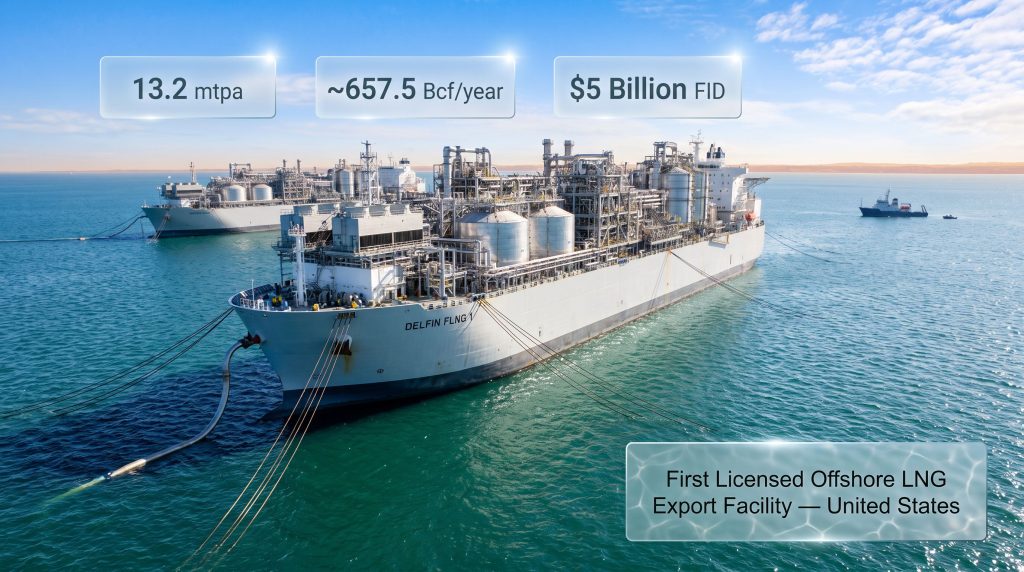
The full Delfin development envisions up to three FLNG vessels operating concurrently in the designated deepwater port area, delivering a combined liquefaction capacity of approximately 13.2 million tonnes per annum (mtpa). The inaugural vessel, Delfin FLNG 1, is independently rated at 4.4 mtpa, establishing the foundational production unit from which subsequent phases would be added.
This sequenced vessel addition strategy allows capital deployment to track commercial progress. Each additional vessel represents an incremental capacity commitment rather than a binary decision to build or abandon a large fixed facility.
The Role of the UTOS Pipeline System in Feedgas Supply
The acquired UTOS pipeline infrastructure provides the subsea gas transmission link between onshore supply aggregation points and the FLNG vessels stationed at the deepwater port. Without this pre-existing asset, the project would require substantial new subsea pipeline construction, significantly extending both the timeline and the capital requirement for initial production.
What Is the Regulatory Framework Governing the Delfin Deepwater Port Licence?
MARAD's Role in Deepwater Port Authorisation
MARAD's licensing authority under the Deepwater Ports Act covers site approval, safety standards, operational parameters, and environmental compliance for offshore port facilities in U.S. federal waters. The Delfin MARAD licence was publicly announced in March 2025, formally executed by Delfin in June 2025, and became fully effective that same month.
DOE Export Authorisation: Volume Thresholds and Compliance Parameters
The U.S. Department of Energy has authorised long-term LNG exports from the Delfin LNG Deepwater Port Project equivalent to approximately 657.5 billion cubic feet per year (Bcf/year), representing a throughput rate of roughly 1.8 Bcf per day. At this authorised volume, Delfin ranks among the larger-scale U.S. export authorisations on record, reflecting the combined capacity of all three planned FLNG vessels.
Timeline of Key Regulatory and Development Milestones
| Milestone | Date |
|---|---|
| MARAD Licence Publicly Announced | March 2025 |
| Executed Licence Submission by Delfin | June 2025 |
| Licence Fully Effective | June 2025 |
| Final Investment Decision (FID) | 2026 |
| Geophysical Survey Commencement | Late August 2026 |
| Geotechnical Investigation Phase | Late September 2026 |
| First Production Target | 2030-2031 |
What Do Geophysical and Geotechnical Surveys Reveal About Offshore LNG Site Readiness?
Why Seabed and Subsurface Data Collection Is a Critical Pre-Engineering Step
Before any mooring system can be designed, before subsea infrastructure can be engineered, and before foundation loads can be calculated, developers require precise knowledge of what lies beneath the water surface. Geophysical and geotechnical survey programmes generate the primary datasets that underpin all subsequent offshore engineering decisions.
Skipping or compressing this phase introduces substantial risk into foundation design, increasing the probability of costly redesigns or unforeseen installation challenges during construction. For a project of Delfin's scale and first-of-kind status in U.S. waters, the survey programme carries particular weight.
The Technical Scope of the Survey Programme Awarded to TDI-Brooks
TDI-Brooks has been designated as prime contractor for the offshore survey programme, with geophysical data acquisition scheduled to begin in late August 2026 aboard the R/V Brooks McCall. Geotechnical investigations, managed in coordination with subcontractor Tolunay-Wong Engineers (TWE), are expected to commence in late September 2026.
The geophysical survey methods being deployed include:
- Sub-bottom profiling to assess sediment layering, thickness, and depth to competent material
- Side-scan sonar for seabed hazard mapping, identifying features such as boulders, debris, or anomalous surface conditions
- Multibeam bathymetry for high-resolution, three-dimensional seafloor topography mapping
- Shallow gas detection to identify subsurface pockets of free gas that represent both geohazard and engineering risks
How Geotechnical Data Informs Foundation and Mooring System Design
The geotechnical phase, managed by TWE, will involve physical sampling of seabed sediments through coring and in-situ testing. These samples reveal soil shear strength, consolidation characteristics, and bearing capacity, all of which directly inform the design of anchor systems, mooring chain configurations, and any subsea structure foundations.
For FLNG applications specifically, mooring system design must accommodate the dynamic loading generated by the vessel's motion response across the range of storm conditions anticipated for the Gulf of Mexico. The interaction between seabed soil properties and mooring anchor behaviour is a critical engineering dependency that cannot be accurately modelled without site-specific geotechnical data.
The next major ASX story will hit our subscribers first
How Does the $5 Billion Final Investment Decision Change the Project's Trajectory?
What a Final Investment Decision Means in Offshore Energy Development
An FID in offshore energy project development marks the point at which a project sponsor formally commits capital, authorises construction contracts, and activates the financing structures arranged during the pre-FID phase. Before FID, most expenditure covers development costs: engineering studies, environmental assessments, regulatory fees, and survey programmes. After FID, the capital deployment curve accelerates sharply toward procurement, fabrication, and installation.
Delfin Midstream's reported $5 billion FID for the first FLNG vessel signals that the project has crossed this critical threshold, transitioning from regulatory and engineering preparation into active construction planning. With first production targeted in the 2030-2031 window, the timeline from FID to initial LNG cargo spans approximately four to five years, consistent with the fabrication and commissioning schedules observed on comparable FLNG projects in other jurisdictions.
Risk Factors That Could Affect the FID-to-First-Production Timeline
Several variables can compress or extend the timeline between FID and first production:
- Fabrication yard availability for FLNG hull and topsides construction, which remains a globally constrained resource
- Offtake contract terms and whether long-term sales agreements with creditworthy counterparties remain in place throughout construction
- Weather and marine operations during offshore installation, particularly given Gulf of Mexico hurricane season timing
- Equipment supply chains for cryogenic heat exchangers, compressor trains, and marine systems, which carry long lead times
- Regulatory compliance through construction and commissioning phases under the MARAD licence conditions
How Does the Delfin Project Compare to Other U.S. LNG Export Facilities?
| Factor | Delfin (Offshore FLNG) | Conventional Onshore LNG Terminal |
|---|---|---|
| Location | Federal deepwater waters, Gulf of Mexico | Coastal onshore sites |
| Technology | Floating LNG vessels | Fixed liquefaction trains |
| Infrastructure Dependency | Existing pipeline (UTOS) | New pipeline and terminal build |
| Scalability Model | Modular, vessel-by-vessel addition | Train-by-train expansion |
| Regulatory Authority | MARAD under Deepwater Ports Act | FERC and DOE |
| First-of-Kind Status | Yes, first U.S. offshore LNG export facility | No, established model |
The first-of-kind designation carries genuine engineering and commercial significance. Delfin will operate without a directly comparable U.S. precedent to reference for operational benchmarking, commissioning protocols, or regulatory interpretation. This introduces execution risk that established onshore operators do not face, but it also positions the project as the reference case for any future offshore LNG development in American federal waters.
What Are the Broader Market Implications of U.S. Offshore LNG Export Capacity?
Global LNG Demand Dynamics and Where U.S. Supply Fits
Global LNG demand has demonstrated consistent structural growth, driven by coal-to-gas switching across Asian industrial markets, European energy diversification following supply disruptions, and expanding gas-fired power generation across South and Southeast Asia. The International Energy Agency has projected continued demand growth through the early 2030s, with supply additions needed to balance markets as legacy contracts expire.
At full three-vessel capacity, Delfin would contribute approximately 13.2 mtpa of new U.S. LNG supply to Atlantic Basin markets at precisely the period when analysts anticipate tightening in global LNG availability. For a broader energy market overview of current conditions shaping these dynamics, the interplay between supply constraints and demand growth is becoming increasingly consequential. The LNG supply outlook through 2025 and beyond further reinforces why projects like Delfin are attracting serious long-term capital commitments.
The Geopolitical Dimension: Energy Security and Long-Term Supply Contracts
European and Asian buyers are actively restructuring their LNG procurement portfolios to reduce dependence on single-source or pipeline-constrained supply. However, European gas prices remain sensitive to supply shifts, making new U.S. project approvals particularly significant for buyers seeking price stability. U.S. natural gas prices also influence the competitive positioning of American LNG exports relative to other global suppliers.
U.S. projects, including offshore facilities like Delfin, offer supply sourced from a politically stable jurisdiction with transparent regulatory frameworks and robust upstream production depth. The offshore format introduces an additional flexibility dimension, suggesting that Delfin's success could unlock a broader category of offshore LNG development that has not previously existed within the U.S. regulatory architecture.
Environmental and ESG Considerations for Offshore FLNG Operations
The offshore siting of FLNG vessels introduces a distinct environmental profile relative to onshore terminals. Reduced terrestrial footprint and the absence of onshore industrial land clearing represent incremental ESG advantages, though offshore operations carry their own environmental sensitivities including marine ecosystem interaction, vessel emissions in federal waters, and produced water management.
ESG-focused investors and offtake counterparties are increasingly scrutinising methane emission intensity across the LNG supply chain. FLNG operators face the same pressure as onshore developers to demonstrate low-leakage gas handling and transparent emissions reporting throughout the production and transfer sequence.
Frequently Asked Questions: Delfin LNG Deepwater Port Project
What is the Delfin LNG Deepwater Port Project?
The Delfin LNG Deepwater Port Project is a planned offshore LNG export facility located in federal Gulf of Mexico waters approximately 37.4 to 40.8 nautical miles offshore Cameron Parish, Louisiana. It is the first U.S. facility of its kind, utilising floating LNG technology within a brownfield deepwater port designation.
Who has authorised the Delfin LNG export facility?
MARAD issued the deepwater port licence effective June 2025, while the DOE has separately authorised long-term LNG export volumes of approximately 657.5 Bcf/year, covering the combined output of the planned three-vessel development.
How many FLNG vessels will the Delfin project use?
The full development plan encompasses up to three FLNG vessels operating concurrently at the deepwater port site.
When is first LNG production expected from Delfin FLNG 1?
First production from the initial FLNG vessel is targeted for the 2030-2031 timeframe, subject to construction, commissioning, and regulatory milestones.
What surveys are currently underway for the Delfin project?
TDI-Brooks, as prime contractor, commenced geophysical survey operations in late August 2026 using the R/V Brooks McCall, with geotechnical investigations managed by subcontractor Tolunay-Wong Engineers expected to begin in late September 2026.
Key Takeaways: Delfin LNG Deepwater Port Project at a Glance
| Metric | Detail |
|---|---|
| Project Location | Approximately 37.4-40.8 nautical miles offshore Cameron Parish, Louisiana |
| Port Classification | Brownfield Deepwater Port |
| Regulatory Authorisation | MARAD Licence effective June 2025, plus DOE Export Authorisation |
| DOE-Authorised Export Volume | Approximately 657.5 Bcf/year (roughly 1.8 Bcf/day) |
| Number of Planned FLNG Vessels | Up to 3 |
| Total Liquefaction Capacity | Approximately 13.2 mtpa |
| First Vessel Capacity (FLNG 1) | Approximately 4.4 mtpa |
| Final Investment Decision | Approximately $5 billion (reported 2026) |
| Target First Production | 2030-2031 |
| Survey Prime Contractor | TDI-Brooks (with TWE as geotechnical subcontractor) |
| Survey Vessel | R/V Brooks McCall |
| U.S. Distinction | First licensed offshore LNG export facility in the United States |
This article contains forward-looking statements regarding project timelines, production targets, investment figures, and market projections. All such statements are subject to material risks and uncertainties. Readers should conduct independent research and consult qualified financial and technical advisors before making investment or commercial decisions based on information presented here.
Want to Capitalise on the Next Major Energy or Mineral Discovery Before the Broader Market?
While the Delfin LNG project illustrates how transformative infrastructure developments can reshape entire commodity markets, Discovery Alert's proprietary Discovery IQ model delivers real-time ASX mineral discovery alerts, turning complex geological announcements into actionable investment insights the moment they hit the exchange — explore Discovery Alert's discoveries page to see the historic returns major discoveries have generated, and begin your 14-day free trial to position yourself ahead of the market.