August 11, 2026
Africa's Downstream Paradox: The Continent That Refines Almost Nothing It Produces
For decades, a structural absurdity has defined Africa's relationship with its own hydrocarbons. The continent sits atop enormous crude oil reserves, yet consistently exports raw crude while importing the refined products its populations actually need. Petrol, diesel, aviation fuel, liquefied petroleum gas: all of these flow back into African markets at a premium, processed elsewhere, often in Europe or Asia, then shipped back across oceans to consumers who could theoretically have produced them domestically.
This paradox is not the result of geological misfortune. It is the product of chronic underinvestment in downstream processing infrastructure, compounded by financing constraints, political risk perceptions, and the historical absence of private-sector actors with both the capital and the conviction to build at continental scale.
The Dangote Kenya refinery in Lamu represents the most ambitious attempt yet to disrupt this pattern in East Africa, a region where the downstream capacity gap is arguably more severe than anywhere else on the continent.
When big ASX news breaks, our subscribers know first
East Africa's Fuel Supply Problem: Understanding the Structural Gap
The Import Dependency That Defines the Region
East Africa's energy economics are shaped by a fundamental imbalance. Unlike West Africa, which has had at least some domestic refining capacity for decades, the East African bloc has operated with near-zero processing infrastructure for refined petroleum products. Kenya, Uganda, Tanzania, and South Sudan collectively import the overwhelming majority of their refined fuel requirements, making their economies perpetually exposed to global oil trading disruptions, shipping cost volatility, and supply chain disruptions.
Kenya's situation is particularly instructive. The country lost its only crude refining capability when the Mombasa refinery was decommissioned, leaving a structural vacuum that has never been filled. Every litre of petrol sold at Nairobi's forecourts today has travelled from a refinery elsewhere in the world, adding cost and vulnerability to Kenya's energy supply chain at every step.
The foreign exchange implications of this dependency are significant. Fuel import bills represent recurring and substantial drains on the current account balances of multiple East African economies, creating chronic pressure on currency reserves and limiting fiscal headroom for governments that are simultaneously managing infrastructure debt and social spending obligations.
Kenya's Upstream Ambitions and the Turkana Basin Equation
Beneath the import dependency narrative lies a less-discussed upstream dimension. Kenya has been developing crude oil resources in the Turkana basin in the country's northwest, a commercially promising but logistically challenging development. The critical insight here is that a functioning domestic refinery at Lamu would transform the strategic logic of Turkana basin development entirely.
Without domestic refining capacity, any Turkana crude production must be exported as raw crude, capturing only the upstream margin while the value-added refining margin accrues elsewhere. A Lamu refinery changes this calculus by creating an in-country downstream anchor that could process domestically produced crude, capturing a far greater share of the energy value chain within Kenya's economy. This end-to-end vertical integration possibility is rarely discussed in mainstream coverage of the project but represents one of its most consequential long-term dimensions.
Furthermore, these energy export challenges align closely with the broader energy export challenges faced by resource-rich nations seeking to retain downstream value domestically.
Why the Lamu Location Is More Strategic Than It Appears
Deep-Water Access and the LAPSSET Corridor Multiplier
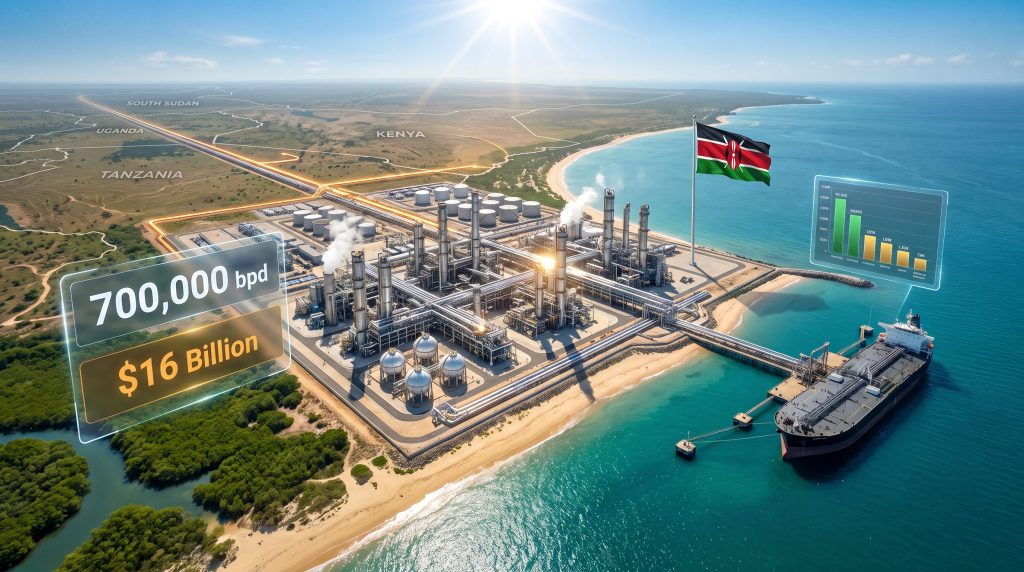
The selection of Lamu as the refinery site was not arbitrary. The port's deep-water infrastructure can accommodate very large crude carriers, the class of tanker that moves crude oil most economically at scale. This logistical capability is a prerequisite for a processing facility of 700,000 barrels per day (bpd) ambition.
What elevates Lamu beyond a simple port location is its position at the origin point of the Lamu Port-South Sudan-Ethiopia Transport (LAPSSET) corridor. This multi-billion-dollar infrastructure network is designed to connect Kenya's coastline with landlocked markets in South Sudan and Ethiopia through a combination of road, rail, and pipeline links. A refinery positioned at LAPSSET's coastal anchor gains automatic distribution reach into some of East Africa's most fuel-hungry inland markets without requiring secondary transshipment infrastructure.
The hub-and-spoke distribution logic this creates is commercially powerful. From a single processing hub at Lamu, refined products could flow westward into Uganda, northward into South Sudan and potentially Ethiopia, southward into Tanzania, and inland across Kenya simultaneously. This geographic reach is what makes the 700,000 bpd capacity commercially viable in a way that would be impossible for a landlocked or less strategically positioned site.
Project Metrics at a Glance
| Metric | Detail |
|---|---|
| Proposed Location | Lamu County, Kenya's Coast |
| Processing Capacity | 700,000 barrels per day |
| Estimated Capital Cost | $16 billion (revised from ~$17 billion) |
| Target Groundbreaking | October 2026 |
| Estimated Build Duration | Under 4 years |
| Primary Markets Served | Kenya, Uganda, Tanzania, South Sudan |
| Projected Job Creation | ~60,000 direct and indirect jobs |
| Financing Structure | 30% equity / 70% debt |
The Lagos Blueprint: How One Mega-Project Teaches the Next
Cost Engineering and Institutional Learning
One of the least-discussed but most analytically significant aspects of the Dangote Kenya refinery in Lamu is the direct knowledge transfer from the Lagos refinery construction. The $1 billion reduction in the cost estimate, from approximately $17 billion to $16 billion, is not simply a function of market conditions. It reflects the application of hard-won procurement intelligence, contractor management frameworks, and engineering sequencing lessons that can only be acquired by actually building a refinery of comparable scale.
In large-scale infrastructure construction, first-of-kind projects always carry a significant knowledge premium. Costs are higher, timelines are longer, and unexpected complications multiply because the developer is navigating uncharted execution territory. The Dangote group is not building Lamu as a first-of-kind project. It is building it as a second iteration of a model already tested at Lagos, which is a materially different risk proposition.
The faster execution schedule that partially accounts for the lower cost estimate reflects this same institutional learning. When procurement channels are established, supplier relationships are proven, and engineering design methodologies are already developed from the Lagos build, the timeline compression potential on the next project is real and quantifiable.
The Lagos Benchmark and Continental Context
According to OilPrice.com, the Dangote Lagos refinery currently processes approximately 650,000 bpd, with stated expansion targets aiming to reach 1.4 million bpd within three years. If the Lamu facility is completed at its planned 700,000 bpd capacity, it would become the second-largest refinery on the African continent, sitting just behind an expanded Lagos operation that itself would be the largest.
| Refinery | Location | Capacity (bpd) | Status |
|---|---|---|---|
| Dangote Lagos (expanded, targeted) | Nigeria | 1,400,000 | Expanding |
| Dangote Lamu (proposed) | Kenya | 700,000 | Pre-construction |
| Dangote Lagos (current) | Nigeria | 650,000 | Operational |
| Combined existing East African refineries | Various | Under 100,000 | Operational |
This positioning reveals the scale of Dangote's emerging pan-African downstream strategy. Two facilities, one anchoring West Africa and one anchoring East Africa, would together give a single private-sector operator more continental refining influence than any other entity currently in existence. There is no precedent for this degree of private downstream concentration in sub-Saharan Africa.
Financing a $16 Billion Bet: Structure, Sources, and the Critical Debt Question
The 70/30 Capital Structure and Its Implications
The proposed financing structure for the Lamu project follows an infrastructure-standard 70% debt and 30% equity split. At the reported $16 billion total cost, this translates to approximately $4.8 billion in equity and $11.2 billion in debt. The equity component may draw from Dangote Group's internally generated cash flows from Lagos refinery operations, potential bond issuance, and a reported consideration of an initial public offering as an additional capital-raising mechanism.
The debt component is where the real financing complexity resides. An $11.2 billion debt syndication requirement for a single African infrastructure project is exceptional by any standard. Assembling a lender consortium of this scale will almost certainly require participation from multiple categories of institution simultaneously, reflecting broader trends in African project financing:
- International development finance institutions with Africa mandates
- Commercial banks with emerging market lending appetite
- Export credit agencies tied to the project's equipment procurement origins
- Potentially, sovereign wealth fund participation if structured appropriately
| Financing Component | Estimated Amount | Likely Source Category |
|---|---|---|
| Equity (30%) | ~$4.8 billion | Dangote Group / IPO / Bonds |
| Debt (70%) | ~$11.2 billion | DFIs / Commercial Banks / ECAs |
| Government Co-investment | Minority (amount unconfirmed) | Kenya National Infrastructure Fund |
Key Risk: The debt syndication process represents the single greatest threat to the October 2026 groundbreaking timeline. Binding commitments from a consortium of this size and complexity are rarely secured quickly, and any slippage in lender engagement will directly delay construction mobilisation regardless of how advanced preparatory technical work becomes.
Preparatory Work Already in Motion
Soil studies, geotechnical assessments, and early-stage engineering and design work have already commenced at the Lamu site. The Kenyan government has established a dedicated project committee and allocated seed funding through its national infrastructure framework. These are meaningful signals of institutional engagement, though they should be understood as preliminary steps rather than construction readiness indicators.
However, it is also worth noting that the broader energy transition demand is reshaping how development finance institutions evaluate fossil fuel infrastructure commitments, adding another layer of complexity to the debt syndication process.
The Environmental Tightrope: UNESCO Heritage, Coastal Ecology, and the 2018 Legal Warning
Lamu's Ecological Sensitivity Is Not a Minor Footnote
The Lamu coastal environment is one of East Africa's most ecologically complex and internationally recognised natural and cultural landscapes. Mangrove forest systems, coral reef networks, seagrass beds, and critical marine fisheries all exist in proximity to the proposed refinery footprint. Lamu Old Town holds UNESCO World Heritage Site status, placing the broader area under international heritage protection scrutiny that goes well beyond standard environmental impact assessment processes.
Greenpeace Africa has publicly called for comprehensive, independent environmental and social impact assessments before any construction approval is granted. The distinction between an internal ESIA commissioned by the project developer and a genuinely independent assessment is not procedural pedantry: it goes to the heart of whether the project's approvals will withstand legal challenge.
The 2018 Court Ruling: A Legal Precedent That Cannot Be Ignored
Perhaps the most underappreciated risk factor for the Lamu refinery timeline is the legal precedent established by a 2018 Kenyan court ruling. That ruling found material deficiencies in the community consultation process associated with LAPSSET corridor development in the Lamu region. The implications are specific and consequential.
Community consultation failures in Kenya are not merely reputational risks. They are grounds for successful litigation that can halt construction activities entirely. Any October 2026 groundbreaking will need to demonstrate that the consultation shortcomings identified in 2018 have been remedied through a more rigorous, documented, and inclusive stakeholder engagement process. This is a non-negotiable prerequisite from a legal risk management perspective.
| Risk Category | Specific Concern | Potential Impact |
|---|---|---|
| Marine Ecosystems | Mangrove destruction, coral damage | Fisheries collapse, biodiversity loss |
| Heritage Preservation | Proximity to UNESCO Lamu Old Town | International body intervention |
| Community Displacement | Land acquisition for refinery and logistics | Social conflict, litigation |
| Pollution Exposure | Operational spills, emissions, wastewater | Long-term coastal degradation |
| ESIA Adequacy | Independent assessment status unconfirmed | Regulatory approval delays |
The next major ASX story will hit our subscribers first
Economic Transformation Potential: Jobs, Foreign Exchange, and Regional Pricing Power
Employment and Local Economic Development
The Kenyan government's estimate of approximately 60,000 direct and indirect jobs from the Lamu refinery project is significant in the context of Lamu County's current economic profile. The region's economy is predominantly anchored in fishing and tourism, with limited industrial employment. A construction-phase workforce mobilisation of this scale would represent an immediate and substantial economic stimulus for one of Kenya's less economically developed coastal areas.
The longer-term operational employment base is arguably more valuable. A permanent skilled industrial workforce in refinery operations, maintenance engineering, logistics, and ancillary services would create an employment structure with considerably higher wage floors than the sectors currently dominant in the Lamu economy.
Foreign Exchange Savings and Fuel Price Stability
The macroeconomic case for domestic refining capacity goes beyond employment. When a country processes crude oil domestically rather than importing finished refined products, it eliminates a structural foreign exchange drain at the national level. East African economies that currently spend hard currency on refined fuel imports would, under a functioning Lamu refinery scenario, redirect a portion of that expenditure to domestically generated economic activity.
Local refining also typically provides a buffer against the price volatility that characterises internationally traded refined petroleum markets. Freight costs, refinery outage events in exporting countries, and currency movements all feed directly into import-dependent fuel pricing. Moreover, global supply chain disruptions of recent years have demonstrated precisely how exposed import-dependent nations can be to external shocks. A regional refinery insulates downstream markets from some of these transmission mechanisms, producing more stable domestic pump prices over time.
Macro Insight: A fully operational 700,000 bpd Lamu refinery would represent a structural rebalancing of East Africa's energy economics, moving the region from a price-taking import position to a supply-setting refining hub with the capacity to influence fuel availability and pricing terms across multiple landlocked neighbouring markets simultaneously.
The Road to October 2026: What Must Happen Before Ground Is Broken
Pre-Construction Milestones in Sequence
The October 2026 groundbreaking target is achievable in principle, but it is contingent on the successful completion of several distinct workstreams that are running in parallel. Missing any one of them could shift the timeline regardless of progress in the others.
- Geotechnical completion – Finalise soil studies and site engineering reports to inform foundation design specifications
- Independent ESIA – Secure credible, independent environmental and social impact assessment approval
- Community consultation – Conduct documented, inclusive, and legally defensible stakeholder engagement with affected Lamu communities, directly addressing the 2018 court ruling's findings
- Debt syndication – Secure binding commitments from lenders for the approximately $11.2 billion debt component
- Regulatory permits – Obtain all Kenyan government construction and environmental licences
- EPC contracts – Finalise engineering, procurement, and construction contractor agreements
- Groundbreaking – October 2026 (targeted)
The sequencing matters as much as the individual steps. Debt syndication cannot be fully completed without a credible ESIA in place, because lenders will require environmental approvals as a condition of financing commitment. ESIA approval in turn depends on community consultation outcomes. The dependencies between these workstreams mean that the critical path runs through community engagement and environmental assessment, not through engineering readiness.
Frequently Asked Questions: Dangote Kenya Refinery in Lamu
What is the planned processing capacity of the Dangote Lamu refinery?
The Dangote Kenya refinery in Lamu is designed to process 700,000 barrels of crude oil per day. Upon completion, this would make it East Africa's largest refinery and the second-largest on the African continent, behind only the expanded Dangote Lagos facility.
Why has the cost estimate fallen from $17 billion to $16 billion?
The $1 billion reduction has been attributed to three primary factors: lessons applied from the construction of the Lagos refinery, a faster projected execution schedule, and more favourable financing conditions compared to earlier project planning assumptions.
When is the groundbreaking scheduled?
October 2026 has been publicly identified as the target groundbreaking date. Construction is expected to take less than four years from that point, which would place potential completion in the 2030 to 2031 timeframe.
Which markets will the refinery serve?
The refinery is designed to supply refined petroleum products to Kenya, Uganda, Tanzania, and South Sudan as primary markets, with the LAPSSET corridor infrastructure providing potential distribution reach into Rwanda, Burundi, and the Democratic Republic of Congo.
What are the most significant risks to the October 2026 timeline?
The most consequential risks are: finalising the approximately $11.2 billion debt syndication, securing credible independent environmental approvals, and addressing the community consultation requirements established by the 2018 Kenyan court ruling on prior LAPSSET development failures.
How will the project be financed?
The project is structured on a 30% equity and 70% debt basis. Equity sources under consideration include Dangote Group's own capital, potential bond issuance, and a reported initial public offering pathway. The Kenyan government is expected to take a minority co-investment position through its national infrastructure fund. The debt component will require a consortium of international lenders to participate.
Want to Track the Next Major Resource Discovery Before the Market Does?
Discovery Alert's proprietary Discovery IQ model delivers real-time alerts on significant ASX mineral discoveries — instantly translating complex resource data into actionable investment insights for traders and long-term investors alike. Explore historic examples of exceptional discovery returns and begin your 14-day free trial today to position yourself ahead of the broader market.