August 10, 2026
The Landlocked Energy Paradox: Why Uganda Is Betting on Tanzania's Coast
Across sub-Saharan Africa, a structural contradiction defines the petroleum economies of many resource-rich nations: they sit atop vast hydrocarbon reserves yet remain dependent on imported refined fuels at enormous cost. This is not a failure of geology. It is a failure of downstream infrastructure, compounded by decades of upstream-heavy investment strategies that prioritised extraction over value-added processing. Uganda's situation crystallises this paradox more sharply than almost any other country on the continent.
Uganda is simultaneously preparing to become a crude oil exporter while spending approximately $2 billion per year importing gasoline, diesel, and kerosene. That figure represents a substantial fiscal drain on a landlocked economy that has no coastline of its own, no refinery capable of meeting domestic demand at scale, and no independent access to global shipping lanes. The Uganda Tanga energy hub in Tanzania is the strategic response to that multi-layered vulnerability, and understanding it requires looking well beyond the headline of a signed agreement.
When big ASX news breaks, our subscribers know first
The Cost of Being Landlocked in a Petroleum-Dependent Economy
Landlocked nations face a compounding set of cost disadvantages in petroleum logistics that coastal states rarely encounter. Transit fees accumulate at each border crossing. Corridor dependency creates political exposure whenever bilateral relationships deteriorate. Price volatility is amplified because supply disruptions cannot be rapidly rerouted through alternative ports.
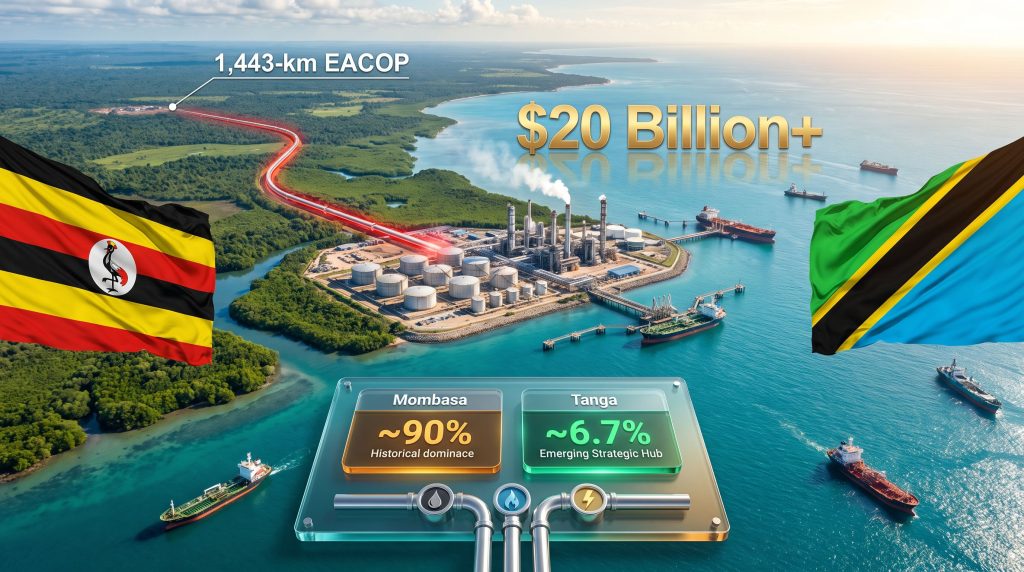
For Uganda, these disadvantages have historically been concentrated through a single chokepoint. More than 90% of the country's fuel imports have transited through Kenya's Mombasa port and the Kenya Pipeline Company network. This level of corridor concentration represents a systemic vulnerability that extends beyond commercial inconvenience into genuine national energy security risk.
The consequences of that dependency became concrete in 2023, when a commercial dispute between Uganda and Kenya temporarily disrupted the primary fuel import route. The episode exposed Uganda's near-total reliance on infrastructure it does not own, cannot control, and cannot reroute around in the short term. That experience gave strategic urgency to what had previously been a theoretical conversation about supply chain diversification.
Key Insight: Corridor concentration risk — the danger of routing critical commodity flows through a single geopolitical chokepoint you do not control — is one of the most underappreciated structural vulnerabilities in African energy logistics. Uganda's 2023 supply disruption was a live demonstration of what that risk looks like in practice.
What the Uganda Tanga Energy Hub Actually Proposes
From Export Terminal to Integrated Energy Complex
Tanga, located on Tanzania's Indian Ocean coast, is already embedded in Uganda's petroleum future as the terminus of the East African Crude Oil Pipeline (EACOP), a 1,443-kilometre heated pipeline running from Hoima in western Uganda to the Tanzanian coastline. The Chongoleani oil terminal at Tanga is where Uganda's crude will reach global markets once the pipeline becomes fully operational.
The Tanga hub proposal goes considerably further than crude export logistics. It envisions transforming the existing terminal into a fully integrated downstream energy complex, with four core infrastructure pillars:
| Infrastructure Component | Strategic Function |
|---|---|
| Petroleum refining capacity | Convert crude into usable domestic fuel products |
| Storage and logistics facilities | Buffer supply disruptions and reduce import dependency costs |
| Petrochemical processing | Capture higher-margin value from raw hydrocarbon streams |
| Cross-border distribution networks | Enable regional fuel supply to neighbouring landlocked states |
The MoU: What Was Agreed and What Remains to Be Done
On August 6, 2026, in Dar es Salaam, a tripartite memorandum of understanding was signed by three parties:
- Tanzania Petroleum Development Corporation (TPDC)
- Uganda National Oil Company (UNOC)
- Vitol Bahrain E.C.
The signing took place in the presence of President Samia Suluhu Hassan of Tanzania and President Yoweri Museveni of Uganda, a detail that carries political weight beyond the commercial terms of the document itself. Heads-of-state attendance at an MoU signing signals bilateral commitment at the highest level of government, even when the agreement itself remains non-binding.
And non-binding it is. Before the Tanga hub moves from aspiration to concrete infrastructure, the parties must complete feasibility studies, progress through Front-End Engineering Design (FEED) processes, establish financing frameworks, and navigate regulatory approvals across two sovereign jurisdictions. Officials have indicated the fully implemented hub could attract more than US$20 billion in cumulative investment. That figure should be understood as an aspirational ceiling rather than a committed capital sum. It reflects the total potential scale of a fully realised multi-decade infrastructure complex, not a near-term financing commitment.
EACOP's Role and the Gap It Cannot Fill
The Pipeline That Solves Half the Problem
EACOP is the foundational logistics artery that makes the Tanga hub concept coherent. Without it, there would be no strategic rationale for anchoring Uganda's downstream energy infrastructure at Tanzania's coast. With it, Tanga becomes the natural terminus for an integrated energy corridor spanning over 1,400 kilometres.
However, EACOP solves only half of Uganda's petroleum challenge. The pipeline addresses crude export logistics comprehensively. It does nothing to resolve the country's reliance on importing refined products at commercial premiums through a corridor it does not control. Uganda's planned Kabaale refinery is not expected to be operational before crude production itself commences, leaving a structural gap between production start and domestic refining capacity.
The Bidirectional Corridor Concept
The more sophisticated aspect of the Tanga hub strategy is the proposed bidirectional refined-products pipeline between Uganda and Tanzania, currently at feasibility study stage with completion expected by October 2026. The economic logic is straightforward but transformative in implication.
Rather than exporting crude at commodity prices and then re-importing refined products at a significant premium through Kenya, a bidirectional system would allow Uganda to access Tanga-refined fuels through the same physical corridor used to export its crude. A natural gas pipeline feasibility study is running in parallel, adding another dimension to what could become a genuinely multi-commodity energy corridor. The shifting geopolitical landscape across East Africa further reinforces the strategic case for this kind of diversified corridor development.
Strategic Framing: The Tanga hub effectively proposes converting EACOP from a one-directional crude export artery into the backbone of a two-way energy trade corridor. Crude moves out to global markets. Refined products move back in to serve domestic demand. This single concept, if realised, would fundamentally alter Uganda's energy trade balance.
Vitol's Expanding Role: Strategic Asset or Governance Risk?
A Deepening Footprint Across Uganda's Supply Chain
No analysis of the Uganda Tanga energy hub in Tanzania is complete without examining the accumulating role of Vitol, one of the world's largest independent energy trading companies. Vitol's positions across Uganda's petroleum system now span multiple stages of the supply chain:
- Exclusive petroleum products supplier to Uganda under a $2 billion agreement signed in 2025
- Signatory to the Tanga MoU through Vitol Bahrain E.C., placing it at the centre of future downstream infrastructure development
- 20.15% equity stake acquired in the Kenya Pipeline Company during its March 2026 initial public offering, as reported by CNBC Africa
This accumulation of positions gives a single private entity meaningful influence over supply sourcing, financing, distribution infrastructure, and now potentially refining and storage development. That is a level of vertical integration across a national petroleum system that warrants careful scrutiny.
The Concentration Risk Debate
Reports indicate that a significant portion of Vitol's Ugandan contracts were awarded without competitive tendering processes. For infrastructure of this strategic importance, the absence of open procurement creates risks that extend well beyond commercial pricing concerns.
When a single counterparty controls multiple stages of a nation's energy supply chain simultaneously, the state's negotiating leverage diminishes at each additional stage of integration. Supply disruption risk concentrates. Pricing leverage accumulates on one side of the relationship. The state's ability to credibly threaten switching suppliers weakens as switching costs rise with each new dependency created.
Governance Watch: Uganda's regulatory and parliamentary oversight bodies have yet to subject Vitol's expanding role to sustained public scrutiny. As the Tanga project advances toward feasibility completion and potential financing commitments, that oversight gap represents a material governance risk requiring proactive attention.
Transparent project finance structures for infrastructure of this scale typically require independent feasibility validation, competitive procurement across major contract categories, and multilateral co-financing to distribute risk and enforce governance standards. The $250 million World Bank commitment to Uganda's section of the Uganda-Tanzania high-voltage electricity transmission line provides a contrasting example of how multilateral-backed infrastructure financing applies those discipline mechanisms in practice.
Tanzania as East Africa's Emerging Energy Logistics Hub
A Coastline Serving Multiple Landlocked Partners
Tanzania's strategic geography positions it as the natural Indian Ocean gateway for several landlocked neighbours simultaneously. Its coastline, existing port infrastructure at both Tanga and Dar es Salaam, and improving inland connectivity make it an increasingly attractive alternative to Kenya's Mombasa corridor. Furthermore, broader energy transition trends across the continent are reinforcing the case for more diversified and resilient regional energy infrastructure.
The country is developing energy relationships across multiple fronts at once. Beyond the Uganda partnership, Tanzania is also becoming a primary fuel supply route for Rwanda. In early July 2026, Rwanda formalised a fuel import agreement with Gulf Bulk Petroleum Tanzania Limited. The first shipment of 40,000 tonnes arrived in late July 2026, with monthly deliveries expected from August onward.
Comparing the Mombasa and Tanga Corridors
| Corridor Attribute | Mombasa (Kenya) | Tanga (Tanzania) |
|---|---|---|
| Current Uganda fuel import share | ~90%+ historically | Nascent and emerging |
| Pipeline infrastructure | Kenya Pipeline Company network | EACOP crude; refined products pipeline proposed |
| Political risk exposure | Demonstrated (2023 dispute) | To be established |
| Refining capacity at port | Limited for Uganda's needs | Proposed under Tanga hub |
| Regional multi-country access | Established | Growing (Rwanda, Uganda) |
| Private sector anchor | Multiple operators | Vitol-dominant |
The Electricity Dimension Beyond Petroleum
Energy cooperation between Tanzania and Uganda extends well beyond petroleum. The two countries are progressing a natural gas pipeline feasibility study alongside the refined-products pipeline work. More significantly, Uganda has secured $250 million from the World Bank to finance the Ugandan section of a high-voltage electricity transmission line connecting the two countries.
The long-term ambition for this transmission infrastructure is to enable electricity trading flows between East Africa and Southern Africa, positioning the Uganda-Tanzania corridor as a multi-commodity energy bridge rather than simply an oil logistics route. This aligns with the broader African Union energy integration agenda and the emerging Eastern Africa Power Pool framework. In this context, renewable energy solutions are also playing an increasingly relevant role in shaping how regional energy systems are designed and financed. These initiatives seek to create the kind of interconnected regional electricity markets that have proven transformative in other parts of the world.
The next major ASX story will hit our subscribers first
Scenario Analysis: Three Pathways for the Tanga Hub
Scenario 1: Full Integration (Optimistic Case)
For the Tanga hub to reach its full potential, several conditions must align: EACOP completes on schedule, Tanga refining capacity is commissioned within a credible timeline, the bidirectional pipeline receives financing approval, and governance concerns around Vitol's role are addressed through transparent procurement reforms.
Under this scenario, Uganda achieves a meaningful reduction in refined fuel import costs, Tanzania captures downstream value-added revenue that transforms Tanga into a genuine multi-country Indian Ocean energy platform, and the pathway toward the $20 billion+ investment target becomes credible within a 10-to-15-year horizon.
Scenario 2: Partial Build-Out (Base Case)
A more probable near-term outcome involves storage and logistics infrastructure advancing while refining capacity faces delays driven by financing complexity. The bidirectional pipeline may remain at feasibility stage beyond 2028. Under this scenario, Uganda achieves partial corridor diversification but retains meaningful import dependency through Kenya. Tanga functions as a supplementary rather than primary supply route, and governance risk persists if procurement transparency is not addressed proactively.
Scenario 3: Stalled Development (Downside Case)
The downside scenario involves EACOP construction delays cascading into the broader hub timeline, financing for Tanga proving insufficient to attract committed capital, and Vitol's concentration triggering regulatory or political backlash. Under these conditions, Uganda remains structurally dependent on the Mombasa corridor, and the MoU does not progress beyond preliminary agreements.
Historical precedent across the continent offers sobering reference points: multiple African energy infrastructure memoranda of understanding have stalled at feasibility stage due precisely to this combination of financing gaps and governance disputes. Consequently, the availability of critical raw materials and the infrastructure required to process them will remain tightly linked to how well these governance challenges are resolved.
Analytical Note: The non-binding nature of the current MoU means the Tanga hub remains a strategic intention rather than a committed project. The transition from intention to execution will depend on the speed of feasibility completion, the depth of financial commitments from all parties, and the political durability of the Uganda-Tanzania bilateral relationship across administrations.
Frequently Asked Questions: Uganda Tanga Energy Hub in Tanzania
What is the Uganda Tanga energy hub in Tanzania?
The Uganda Tanga energy hub is a proposed multi-function energy complex at Tanzania's Tanga port, designed to add petroleum refining, bulk storage, logistics, and petrochemical processing capacity to the existing Chongoleani crude oil export terminal, which serves as the Indian Ocean terminus of EACOP.
Why is Uganda developing energy infrastructure in Tanzania rather than domestically?
Uganda's landlocked geography means it has no Indian Ocean coast of its own. Domestic refining capacity at the planned Kabaale facility is not expected to come online before crude production begins. Co-locating downstream infrastructure at EACOP's terminus in Tanga allows Uganda to address both its export logistics and import dependency through a single integrated corridor.
Who are the key parties to the Tanga agreement?
The tripartite MoU signed on August 6, 2026 involves the Tanzania Petroleum Development Corporation, the Uganda National Oil Company, and Vitol Bahrain E.C. The agreement was witnessed by the presidents of both Tanzania and Uganda.
How much could the Tanga hub attract in investment?
Officials have cited a figure exceeding US$20 billion in potential cumulative investment. This figure is aspirational at the current stage and depends on successful completion of feasibility studies, financing frameworks, and regulatory approvals before capital commitments materialise.
How does the Tanga hub affect Uganda's dependence on Kenya?
Successful development of the Tanga corridor would give Uganda an alternative Indian Ocean fuel supply route, progressively reducing the historically over-90% dependence on Kenya's Mombasa port and the Kenya Pipeline Company network that was demonstrated to be vulnerable during the 2023 commercial dispute. In addition, shifts in global LNG supply dynamics are also creating new strategic considerations for landlocked nations seeking to diversify their energy import channels.
Key Takeaways: Five Structural Shifts the Tanga Hub Represents
The strategic significance of the Uganda Tanga energy hub extends across five intersecting dimensions:
- Corridor diversification: Reducing Uganda's single-corridor fuel import vulnerability by establishing a viable alternative Indian Ocean supply route independent of Kenyan infrastructure
- Downstream value capture: Moving Uganda's economic participation in petroleum beyond crude export toward refining, processing, and petrochemical revenue generation
- Regional hub formation: Positioning Tanzania as East Africa's primary Indian Ocean energy logistics anchor for multiple landlocked partner countries simultaneously
- Private sector concentration: The Vitol question represents an unresolved governance challenge that requires proactive regulatory attention before the project advances to committed capital stages
- Multi-commodity integration: The convergence of petroleum logistics, natural gas infrastructure, and high-voltage electricity transmission along a single Uganda-Tanzania corridor creates the architecture for a genuinely integrated regional energy system
The Tanga hub's ultimate significance will not be determined by the MoU itself. It will be determined by the institutional capacity, financing discipline, and governance transparency that Uganda and Tanzania bring to its execution across the next decade. The strategic logic is compelling. The infrastructure gap it addresses is real. Whether the execution matches the ambition is a question that feasibility studies, procurement decisions, and financing frameworks will answer in the years ahead.
Want to Track the Commodities Powering Africa's Next Energy Infrastructure Boom?
Discovery Alert's proprietary Discovery IQ model delivers real-time ASX alerts on significant mineral discoveries — including the critical commodities underpinning major energy corridors like the Uganda-Tanzania hub — turning complex geological data into actionable investment insights for traders and long-term investors alike. Explore Discovery Alert's discoveries page to understand the historic returns that major mineral finds can generate, and begin your 14-day free trial today to position yourself ahead of the broader market.