August 10, 2026
When Industrial Ambition Meets Marine Ecology: Decoding India's Coastal Mining Dilemma
Few regulatory decisions in the extractive sector carry as many layered implications as a mining clearance proposed adjacent to a marine protected area. The intersection of domestic mineral security priorities, internationally recognised biodiversity obligations, and multi-agency approval architectures creates a governance environment that is anything but straightforward. India's experience with the Gulf of Kachchh bauxite mining project environmental clearance encapsulates all of these tensions in a single, revealing case study.
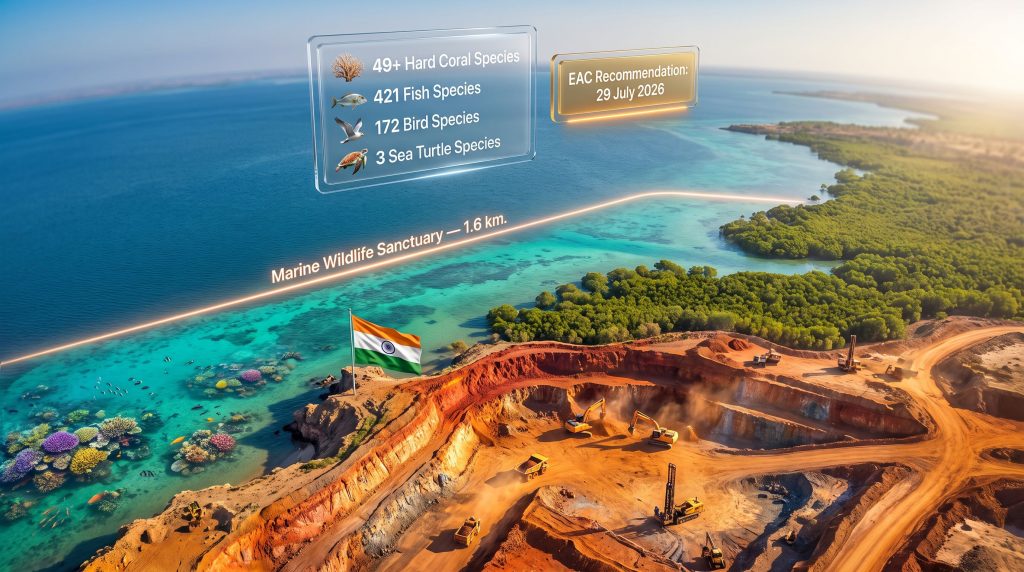
The proposed Mevasa Block bauxite and marl mining project in Gujarat's Devbhumi Dwarka district sits at precisely this crossroads. Its Expert Appraisal Committee recommendation, issued on 29 July 2026, is not a green light for mining. It is the beginning of a more complex regulatory journey that will test the durability of India's environmental governance architecture against the backdrop of intensifying upstream aluminium supply pressures.
When big ASX news breaks, our subscribers know first
The Mevasa Block: Location, Scale, and Proximity Risk
Understanding the significance of this case begins with geography. The Mevasa Block occupies approximately 5 hectares along the southern shoreline of the Gulf of Kachchh, within Devbhumi Dwarka district in Gujarat. While 5 hectares represents a modest footprint by industrial mining standards, location amplifies its significance beyond what scale alone would suggest.
The proposed lease boundary sits roughly 1.6 kilometres from the Marine Wildlife Sanctuary and approximately 6 kilometres from the Marine National Park. These are not interchangeable designations. Under Indian wildlife law, the Marine Wildlife Sanctuary and the Marine National Park carry distinct legal statuses, with the National Park offering the most stringent protection. Activities within or near these zones trigger heightened thresholds under the Wildlife Protection Act, 1972, and the Environment Protection Act, 1986.
The dual-designation framework creates overlapping protective jurisdictions, meaning that regulatory compliance is not assessed against a single standard but against multiple intersecting legal instruments simultaneously. This layered complexity is a defining feature of environmental governance near marine protected areas in India, and it distinguishes coastal mining approvals from those in inland or non-sensitive terrain.
What Are the Two Minerals Being Targeted, and Why Do They Matter?
The Mevasa Block targets two minerals with distinct industrial applications. Understanding bauxite production importance to the broader aluminium supply chain is essential context here:
- Bauxite is the primary raw material for alumina refining and, ultimately, aluminium metal production. India holds significant bauxite reserves, yet domestic mining capacity has historically lagged behind the country's refining and smelting ambitions.
- Marl is a calcium carbonate-rich sedimentary rock used extensively in cement manufacturing. Its co-extraction alongside bauxite improves project economics by diversifying revenue streams from a single mining operation.
Together, these two materials position the Mevasa Block as a dual-commodity project with relevance to both the aluminium and construction materials supply chains.
Understanding the EAC Clearance Recommendation and Its Limits
A critical point that is frequently misunderstood, even within industry circles, is the legal distinction between an EAC recommendation and a formally issued Environmental Clearance order. The Expert Appraisal Committee, operating under India's Ministry of Environment, Forest and Climate Change (MoEFCC), functions as an advisory body. Its recommendation that clearance be granted to L and S Company is a necessary but not sufficient condition for mining to proceed.
The gap between an EAC conditional recommendation and a fully executed, legally binding environmental clearance order represents a material regulatory risk window, during which public objections, NGT petitions, or additional departmental reviews could alter project outcomes.
The staged clearance pathway from recommendation to operational mining involves multiple sequential steps:
- MoEFCC issues the formal Environmental Clearance order based on the EAC recommendation.
- L and S Company prepares and submits a Wildlife Conservation Plan to the Gujarat Forest Department.
- The Gujarat Forest Department conducts its own review and grants approval for the conservation plan.
- Consent-to-establish is obtained under the Water (Prevention and Control of Pollution) Act and the Air (Prevention and Control of Pollution) Act.
- The mining lease is formally activated under the Mines and Minerals (Development and Regulation) Act, 1957.
Each of these steps represents a discrete regulatory gate, and failure at any stage can delay or redirect the project. The Wildlife Conservation Plan condition is particularly significant because it introduces a second competent authority, the Gujarat Forest Department, whose independent judgment must be satisfied before operations can lawfully begin.
Known Conditional Requirements Attached to the EAC Recommendation
| Condition Category | Requirement Detail |
|---|---|
| Wildlife Plan Approval | Must be obtained from the Gujarat Forest Department |
| Human-Animal Conflict Mitigation | Operational protocols to minimise wildlife disturbance |
| Buffer Zone Compliance | Maintenance of adequate distance from sanctuary boundaries |
| EIA Verification | Confirmation that the mining lease falls outside the protected area perimeter |
The Ecological Significance of the Gulf of Kachchh Marine Ecosystem
Established in 1980, the Gulf of Kachchh Marine Wildlife Sanctuary holds the distinction of being India's first marine wildlife sanctuary. This historical precedent alone signals the ecological and symbolic weight that surrounds any development decision in its vicinity.
The biodiversity inventory documented by the Gujarat Forest and Environment Department reveals an ecosystem of exceptional richness:
| Ecological Category | Recorded Count |
|---|---|
| Hard Coral Species | 49+ |
| Fish Species | 421 |
| Bird Species | 172 |
| Sea Turtle Species | 3 |
Beyond raw species counts, the sanctuary's ecological architecture is built on interconnected habitat systems. Its coral reefs function as structural environments that support juvenile fish populations. Its mangrove belts serve as nursery grounds for commercially important species, providing the feeding and breeding conditions that sustain both artisanal and industrial fisheries across the broader Gulf of Kachchh region.
This functional interdependence means that localised disruption, even from a project positioned outside the sanctuary boundary, can propagate ecological effects well beyond the immediate mining footprint. Sediment runoff, changes to nearshore water turbidity, and noise disturbance during construction phases all represent vectors through which a coastal mining operation can exert stress on adjacent marine habitats. Furthermore, the role of natural capital in mining contexts is increasingly recognised as a material consideration in project assessments of this kind.
What the Environmental Impact Assessment Addresses and What It Leaves Open
The EIA submitted for the Mevasa Block reaches the conclusion that the lease area falls outside the legally protected boundary and that natural topography provides an adequate ecological buffer between the mine site and the sanctuary. It acknowledges that mining activities will produce localised impacts but projects that broader ecosystem function and species life cycles within the sanctuary will not be materially affected.
However, several analytical gaps remain unaddressed within this framing:
- Cumulative impact modelling is absent from the EIA, meaning the assessment evaluates this project in isolation rather than alongside any other extractive or industrial activities in the region.
- Sediment runoff pathway analysis specific to monsoon-season hydrological dynamics has not been publicly detailed, despite the Gulf of Kachchh coastline being subject to significant seasonal water movement.
- Long-term coral stress indicators, including thermal sensitivity and bleaching risk compounded by localised turbidity increases, are not addressed within the scope of the submitted EIA.
- Baseline water quality data collected at the sanctuary boundary, against which operational monitoring would be compared, has not been confirmed as part of the public record.
These gaps do not necessarily invalidate the EIA's conclusions, but they create substantive grounds on which the assessment could be challenged before the National Green Tribunal.
Regulatory Risk Pathways and Legal Challenge Mechanisms
The National Green Tribunal represents the primary judicial forum through which third parties can contest environmental clearances in India. NGOs, local fishing communities, and environmental advocacy groups have standing to approach the NGT on multiple grounds, including procedural non-compliance, inadequacy of the EIA scope, or disproportionate risk to a recognised protected area.
Precedent cases involving mining proposals near marine protected areas in Odisha and along the Andhra Pradesh coastline have demonstrated that EAC recommendations can be subject to significant judicial scrutiny. Outcomes have ranged from additional conditions being imposed to temporary stays on construction activity pending further assessment. For instance, forest clearance decisions for bauxite mining in Odisha's Lanjigarh region illustrate how protracted and contested such processes can become when ecological sensitivity is at stake.
The Coastal Regulation Zone notification adds another regulatory instrument to this landscape. CRZ classifications govern permissible activities near tidal and intertidal zones, and the specific CRZ designation applicable to the Mevasa Block area will determine what additional restrictions, if any, apply independent of the EAC clearance process.
Whether the 1.6 km proximity to the Marine Wildlife Sanctuary boundary satisfies the cumulative requirements of CRZ norms, Wildlife Protection Act buffer expectations, and MoEFCC's own precautionary framework is a question that environmental legal practitioners and conservation advocates are likely to examine closely as the clearance process progresses.
India's Bauxite Supply Chain Pressures and the Role of Coastal Gujarat
To contextualise why a 5-hectare project in Gujarat commands attention at a national policy level, it is necessary to understand the structural pressures reshaping India's bauxite mining landscape in 2026. The leading global bauxite mines demonstrate the scale of international competition that Indian producers are responding to, and consequently why domestic deposit development has intensified.
India's aluminium sector is facing converging demand pressures from three directions simultaneously:
- Infrastructure expansion under multi-year capital investment programmes requiring aluminium in structural, electrical, and transport applications.
- Electric vehicle manufacturing growth, where aluminium's light-weighting properties make it a preferred material across battery housings, chassis components, and powertrain structures.
- Defence and aerospace procurement, where domestically sourced aluminium feedstocks are increasingly prioritised as part of import substitution programmes.
These demand vectors are placing upstream pressure on India's bauxite supply chain at a time when large-scale block development timelines remain extended. The competitive auction environment for premium bauxite blocks, illustrated by the record 175% bidding premium reported in the Karlapat block auction in Odisha, reflects how acute this supply competition has become among India's major aluminium producers.
Gujarat's coastal bauxite deposits, while smaller in scale than the major Odisha and Jharkhand formations, offer logistical advantages related to port proximity and shorter transport routes to coastal alumina refineries. This geographic efficiency partially offsets the lower absolute tonnage of deposits like the Mevasa Block. In addition, the top aluminium mining companies are increasingly targeting such strategically located coastal deposits to reduce logistics costs.
Comparing Regulatory Buffer Standards Across Key Jurisdictions
| Jurisdiction | Minimum Buffer from Marine Protected Area | Regulatory Body |
|---|---|---|
| India (CRZ Notification) | Varies by CRZ classification | MoEFCC |
| Australia (EPBC Act) | Case-by-case, typically 5-10 km for sensitive areas | DCCEEW |
| EU Habitats Directive | Strict precautionary principle applied | European Commission |
| South Africa (NEMA) | 1 km minimum for Category A MPAs | DFFE |
India's variable CRZ classification framework means that proximity thresholds are not fixed but contextually determined, which introduces interpretive flexibility that can work either in favour of or against project proponents depending on site-specific classification outcomes.
The next major ASX story will hit our subscribers first
Best Practice Mitigation Measures for Coastal-Proximate Bauxite Mining
Internationally, the governance of mining operations adjacent to marine protected areas has converged around a recognised set of mitigation standards that extend beyond EIA compliance alone. For coastal bauxite projects, accepted best practice mitigation includes:
- Engineered sediment control systems, including silt curtains and retention basins designed to prevent mineral-laden runoff from reaching marine or intertidal zones during rain events.
- Phased extraction scheduling aligned with the breeding and migratory cycles of species documented within adjacent protected areas, particularly sea turtles and colonial nesting birds.
- Real-time water quality telemetry at sanctuary boundary monitoring stations, providing continuous data on turbidity, pH, and suspended solids during active extraction periods.
- Community-based ecological monitoring involving local fishing communities in observation and reporting, which builds trust with stakeholders who depend directly on sanctuary-adjacent fisheries for their livelihoods.
- Dust suppression infrastructure to prevent airborne mineral particulates from depositing onto nearshore reef surfaces, where they can smother coral polyps and disrupt photosynthesis in symbiotic algae.
The IUCN's guidelines on buffer zones surrounding Category II protected areas, which is the classification applicable to wildlife sanctuaries under comparable international frameworks, emphasise precautionary distance standards and mandatory adaptive management protocols. These go well beyond point-in-time EIA assessments. Furthermore, these standards align closely with broader considerations around critical raw materials transition planning, where responsible sourcing frameworks are increasingly embedded in supply chain due diligence requirements.
Frequently Asked Questions: Gulf of Kachchh Bauxite Mining Project Environmental Clearance
What is the current regulatory status of the Mevasa Block project?
As of 29 July 2026, the Expert Appraisal Committee of the MoEFCC has recommended that environmental clearance be granted to L and S Company for the Mevasa Block bauxite and marl project. This recommendation is conditional and does not constitute the final issued Environmental Clearance order. A separately approved Wildlife Conservation Plan from the Gujarat Forest Department is among the conditions that must be satisfied before mining operations can lawfully commence.
How close is the proposed mine to protected marine areas?
The Mevasa Block is located approximately 1.6 km from the boundary of the Marine Wildlife Sanctuary and roughly 6 km from the Marine National Park along the Gulf of Kachchh's southern coastline.
What minerals will the Mevasa Block extract?
The project targets bauxite, the primary feedstock for aluminium production, alongside marl, a calcium carbonate-rich material used in cement manufacturing. The co-extraction of both materials supports the economic case for developing what is a relatively small-scale deposit.
What makes the Gulf of Kachchh marine ecosystem ecologically unique?
Established in 1980 as India's first marine wildlife sanctuary, the Gulf of Kachchh protected area contains more than 49 hard coral species, 421 fish species, 172 bird species, and 3 sea turtle species. Its coral reef and mangrove systems perform critical ecological functions that support both biodiversity and regional fishery productivity.
Can the EAC recommendation be legally contested?
Yes. The National Green Tribunal provides a formal judicial mechanism through which affected parties, including local communities, environmental organisations, and fisheries stakeholders, can challenge the clearance recommendation on grounds related to EIA adequacy, procedural compliance, or disproportionate ecological risk.
Key Takeaways: Navigating the Gulf of Kachchh Bauxite Mining Project Environmental Clearance
The Mevasa Block case is instructive precisely because it does not resolve cleanly into either a straightforward approval or an outright rejection. It occupies the complex regulatory middle ground where conditional clearances, multi-agency requirements, and judicial review mechanisms intersect with genuine ecological sensitivity.
Several conclusions emerge from a close reading of the regulatory and ecological dimensions:
- The conditional nature of the EAC recommendation, particularly the Wildlife Conservation Plan requirement, signals that oversight bodies are applying substantive scrutiny rather than issuing routine approvals for projects in ecologically sensitive zones.
- The 1.6 km proximity to India's oldest marine wildlife sanctuary will remain a focal point for legal scrutiny, conservation advocacy, and fisheries community concern throughout the remaining approval process.
- The EIA's acknowledged gaps around cumulative impacts, sediment pathway modelling, and long-term coral health indicators represent the most likely grounds on which a judicial challenge could gain traction before the National Green Tribunal.
- From a supply chain perspective, even modestly scaled bauxite deposits like the Mevasa Block contribute to India's broader strategy of expanding domestic mineral sourcing as aluminium demand continues to build through the late 2020s.
- The governance architecture surrounding the Gulf of Kachchh bauxite mining project environmental clearance reflects a broader truth about coastal mining approvals in India: the formal clearance process is not the endpoint but a checkpoint within an extended multi-agency, multi-stakeholder evaluation that continues well after the EAC meeting concludes.
Disclaimer: This article presents regulatory, ecological, and market analysis for informational purposes only. It does not constitute legal, financial, or investment advice. Readers should conduct independent due diligence before making decisions based on regulatory processes, project timelines, or market projections discussed herein. Forecasts and projections referenced in this article are subject to change based on evolving regulatory, environmental, and commercial conditions.
Want to Stay Ahead of the Next Major Mineral Discovery on the ASX?
Discovery Alert's proprietary Discovery IQ model delivers real-time alerts on significant ASX mineral discoveries — including bauxite and other critical commodities — instantly transforming complex geological data into clear, actionable investment insights for traders and long-term investors alike. Explore how historic discoveries have generated extraordinary returns on Discovery Alert's dedicated discoveries page, and begin your 14-day free trial today to position yourself ahead of the broader market.