August 10, 2026
The Invisible Crisis Reshaping Mining's Workforce From the Inside Out
Every major industry eventually confronts a moment when the gap between its internal reality and its external reputation becomes impossible to ignore. For global mining, that moment has arrived simultaneously on two fronts: a demographic cliff driven by the mass retirement of its most experienced professionals, and a deepening image problem that continues to repel the next generation of talent. What makes this convergence particularly dangerous is that the very technologies being deployed to modernise the industry's image may be actively reinforcing the stereotypes it is trying to dismantle.
The questions being asked publicly within practitioner communities about Mark Cutifani, ageism, AI, and the image crisis are not peripheral curiosities. They are diagnostic signals from within the industry itself, reflecting a workforce that senses something is structurally wrong but has not yet seen a coherent response.
When big ASX news breaks, our subscribers know first
Two Pressures, One Structural Failure
Mining is navigating simultaneous pressure from opposite ends of its workforce timeline. On one side, the cohort that built and refined modern open-cut and underground operations across Australia, Canada, South Africa, and Chile is approaching retirement in compressed, overlapping waves. On the other, graduate attraction from engineering, geoscience, and data science disciplines continues to underperform relative to the sector's scale and economic significance.
These two forces are frequently treated as separate problems requiring separate solutions. That framing is flawed. They are structurally linked through perception: how the industry represents itself, who it visibly values, and what career story it tells to the outside world. Furthermore, the mining industry evolution underway makes addressing this perception gap more urgent than ever.
Mark Cutifani's career offers a useful lens for understanding what is at stake. With nearly five decades of operational leadership spanning four continents and approximately 30 commodities, perspectives from executives with that depth of experience function less as personal opinion and more as sector-wide diagnostics. When such voices engage directly with public questions about ageism and AI bias, the topics themselves are elevated from fringe concerns to mainstream workforce risks.
"The questions being asked publicly within professional communities about age discrimination, algorithmic bias, and industry perception reflect a broader anxiety inside the global mining workforce that leadership can no longer afford to treat as background noise."
Understanding the Grey Tsunami: More Than a Headcount Problem
The term grey tsunami has become shorthand for the accelerating retirement of experienced mining professionals, but the phrase undersells the complexity of what is actually being lost. This is not a simple headcount replacement challenge. It is a knowledge transfer problem with no clean historical precedent in the sector.
The knowledge held by senior engineers, geologists, and operational managers falls into categories that resist easy transfer:
- Site-specific geological intuition developed over decades of working a single orebody or geological province
- Safety culture and hazard recognition that is absorbed through lived operational cycles rather than formal training
- Regulatory navigation expertise built through long-cycle permitting processes and relationship capital with government agencies
- Crisis management judgment forged through commodity downturns, operational failures, and restructuring events
- Community trust constructed over years of consistent, localised engagement that cannot be inherited by a successor
| Dimension | Risk Level | Key Concern |
|---|---|---|
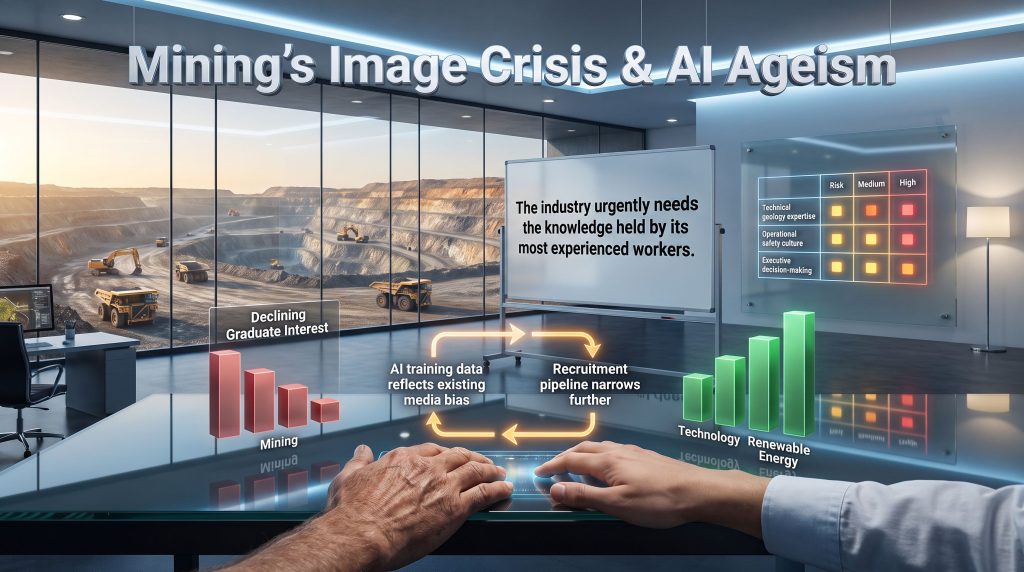
| Technical geology expertise | High | Decades of site-specific knowledge lost at retirement |
| Operational safety culture | Critical | Tacit knowledge not easily codified or transferred |
| Executive decision-making | High | Relationship capital and institutional memory |
| Regulatory navigation | Medium-High | Long-cycle permitting expertise concentrated in senior cohorts |
| Community engagement | Medium | Trust built over decades cannot be inherited |
Digital systems and AI in mineral exploration can capture procedural knowledge in documented form. What they cannot replicate is the judgment that emerges from having navigated a full commodity cycle, managed a workforce through a fatality, or restructured an operation during a price collapse. That category of expertise is fundamentally experiential, and it exits the industry permanently with each retirement.
Engineering and geoscience graduate pipelines entering mining have not kept pace with projected retirement volumes in major producing nations. Competition from technology, renewables, and finance sectors for technically capable graduates has intensified considerably, and mining is consistently losing that competition at the recruitment stage.
Ageism in Mining: A Paradox Operating at the Worst Possible Moment
Ageism in professional environments is often treated as a cultural attitude problem, best addressed through awareness training and policy updates. The reality operating within mining is more structurally embedded than that framing suggests.
Two distinct forms of age-based bias operate simultaneously within the sector:
- Outward ageism: The perception held by young professionals and the broader public that mining is an old-fashioned, physically dangerous, and environmentally harmful industry with limited career progression
- Inward ageism: The systematic undervaluation of experienced workers within the industry itself, particularly as automation and AI-driven operations accelerate and experienced professionals find themselves excluded from digital transformation conversations
The paradox embedded in this dynamic is difficult to overstate. At precisely the moment when mining needs to retain and leverage its most experienced professionals to manage the knowledge transfer crisis, structural and cultural biases within the sector may be accelerating their departure. Performance management frameworks, succession planning models, and digital upskilling programmes frequently disadvantage workers over 55.
This occurs whether through implicit assumptions about technology fluency, compensation structures that fail to reflect the value of long-tenure expertise, or leadership development pathways that effectively close at a certain career stage.
"The sector faces a compounding paradox: it urgently needs the knowledge held by its most experienced workers while simultaneously failing to create environments where those workers feel valued, included, or future-relevant."
How Does Inward Ageism Create a Recruitment Feedback Loop?
There is also a reputational feedback mechanism that the industry has not adequately accounted for. Young professionals observing how senior colleagues are treated form expectations about their own long-term career trajectory. If a graduate watches experienced engineers being marginalised during a digital transformation programme, they draw a rational conclusion about what their own career at age 55 will look like in that organisation.
This dynamic creates a self-reinforcing cycle:
- Poor treatment of older workers generates negative internal sentiment
- That sentiment becomes visible externally through professional networks and peer conversations
- Prospective recruits adjust their career decisions accordingly
- The talent pipeline narrows further, compounding the knowledge gap
In addition, issues around women in mining and female leadership in mining compound these dynamics, as the sector simultaneously struggles to attract and retain diverse talent across multiple dimensions.
How AI Is Amplifying the Image Problem It Was Supposed to Solve
The most counterintuitive dimension of mining's image crisis involves the technology being deployed to modernise the sector's communications. Research into AI-generated imagery has documented a consistent and measurable pattern of age-based bias embedded in text-to-image systems, and the implications for mining's public communications strategy are significant.
Multiple independent studies examining AI image generation outputs have identified the following patterns:
- Older adults are disproportionately depicted as white, middle-class, and emotionally neutral or negative
- AI generators systematically associate older individuals with vulnerability, isolation, and passivity
- Younger demographics are over-represented in professional, aspirational, and technology-forward visual contexts
- Diversity across age, ethnicity, and ability is structurally under-represented in AI training datasets
- Older professionals are rarely depicted in technical leadership, STEM, or innovation contexts
| AI Image Bias Pattern | Documented Outcome | Industry Relevance |
|---|---|---|
| Age-negative emotional framing | Older adults shown as passive or marginalised | Reinforces perception that experienced workers are liabilities |
| Homogeneous demographic representation | Predominantly white, middle-class older adult depictions | Erases diversity within experienced workforce cohorts |
| Youth-technology association | Young professionals linked to innovation and progress | Excludes experienced workers from digital transformation narratives |
| Under-representation of older professionals in STEM | Older adults rarely depicted in technical or leadership roles | Distorts public image of who drives industry expertise |
Mining companies, industry bodies, and recruitment teams increasingly rely on AI-assisted content creation for social media, annual reports, and recruitment campaigns. Consequently, if the underlying tools are systematically biased toward youth-centric, stereotype-reinforcing visual outputs, those communications may be actively undermining efforts to present an inclusive, experienced workforce.
Why Is This Feedback Loop So Difficult to Break?
This is not a theoretical risk. It represents an operational communications failure with measurable consequences for both talent attraction and stakeholder trust. The feedback loop that results is particularly damaging. AI transforming mining operations is genuinely positive, however the same AI tools used in communications risk reproducing deeply embedded stereotypes:
- AI training data reflects existing media bias
- AI-generated images reinforce age and diversity stereotypes
- Mining communications using AI tools reproduce these stereotypes
- Young professionals perceive mining as demographically narrow
- Recruitment pipeline narrows further
- Industry perception worsens, and AI training data absorbs this bias
Without deliberate intervention in both AI tool selection and content governance, mining organisations risk using the very technology intended to modernise their image to entrench the stereotypes they are trying to escape.
The Perception Gap: Where Operational Reality and Public Narrative Diverge
Modern mining operations are increasingly automated, data-intensive, and subject to environmental management standards that would be unrecognisable to the sector of three decades ago. Remote operations centres, autonomous haulage systems, real-time geological modelling, and precision blasting technologies represent a fundamentally different operational profile from the industry's historical image.
Yet public perception continues to lag behind operational reality by a significant and consequential margin. The sector's role in supplying the critical minerals underpinning electric vehicles, renewable energy infrastructure, and defence technology remains poorly understood by the general public and, critically, by prospective recruits.
This perception gap reflects decades of underinvestment in public communication at both company and sector level. Consider how other industries with comparable talent competition approach the problem:
| Sector | Perception Strategy | Talent Attraction Outcome |
|---|---|---|
| Technology | Emphasises innovation culture, flexibility, and global impact | Consistently attracts top STEM graduates |
| Renewable Energy | Leads with climate mission and future-building narrative | Growing appeal among purpose-driven graduates |
| Finance | Promotes intellectual challenge and compensation transparency | Maintains strong graduate pipeline despite reputation challenges |
| Mining | Historically leads with operational scale and commodity output | Declining graduate interest relative to sector size and economic importance |
Mining's digital presence relative to technology, finance, and renewables sectors remains comparatively underdeveloped. The visual and narrative language used in recruitment often emphasises physical scale and extraction volumes rather than the innovation, problem-solving complexity, and global supply chain significance that might resonate with technically capable graduates.
The next major ASX story will hit our subscribers first
What a Strategic Response Actually Requires
Rebuilding mining's workforce narrative and addressing the age bias problem embedded in its communications requires intervention at three distinct levels. Treating any one layer in isolation will produce incomplete results.
Layer 1: Internal Culture Reform
- Implement age-inclusive performance and succession frameworks that explicitly recognise long-tenure expertise as a strategic asset
- Create structured knowledge transfer programmes pairing experienced professionals with early-career entrants across geological, operational, and executive functions
- Audit HR, promotion, and digital upskilling structures for implicit age bias, with particular attention to programmes targeting workers over 55
Layer 2: AI Governance and Communications Integrity
- Establish content governance policies requiring human review of AI-generated imagery for age, gender, and diversity representation before publication
- Prioritise AI tools trained on diverse, inclusive datasets when producing recruitment and stakeholder communications
- Commission original photography and video content that authentically represents the full demographic range of the modern mining workforce
Layer 3: Sector-Wide Perception Investment
- Develop industry-funded campaigns that connect mining's role in critical minerals supply chains to outcomes young professionals actively care about, including clean energy transition, advanced technology, and economic sovereignty
- Engage directly with universities, schools, and online communities using authentic storytelling rather than polished corporate broadcast messaging
- Leverage respected industry voices to participate in substantive public conversations on platforms where prospective recruits are active
The model of senior executives engaging directly with professional communities on platforms like LinkedIn, responding to real questions from practitioners about ageism in mining and AI bias, represents something categorically different from traditional corporate communications. It builds credibility through dialogue rather than broadcast, and it demonstrates that the industry's most experienced leaders are willing to engage with uncomfortable questions publicly.
"The image crisis facing mining is not primarily a marketing problem. It is a governance problem, a culture problem, and an AI literacy problem, and solving it requires leadership willing to engage with uncomfortable questions publicly, consistently, and at scale."
The Cost of Inaction
The talent crisis, ageism problem, AI bias issue, and image deficit are interconnected symptoms of a single underlying failure: sustained underinvestment in how the industry understands, represents, and communicates its own workforce value. Treating these as separate operational problems will produce fragmented responses that fail to address the structural dynamic driving all of them simultaneously.
The mining companies and industry bodies that invest now in age-inclusive cultures, AI governance frameworks, and authentic public communication will be structurally better positioned to attract, retain, and develop the talent required for the next commodity cycle. Those that delay will face compounding workforce costs, accelerating knowledge gaps, and reputational disadvantages that become progressively harder and more expensive to reverse.
The conversation that Mark Cutifani, ageism, AI, and the image crisis represents in public professional forums is not a sidebar to the industry's strategic agenda. It is the agenda, expressed by practitioners who understand what is at stake and are no longer content to have it discussed only in private.
Want to Stay Ahead of the Next Major ASX Mineral Discovery?
While mining grapples with workforce transformation and the push to modernise through technology, the opportunities emerging from significant mineral discoveries remain as compelling as ever — and timing is everything. Discovery Alert's proprietary Discovery IQ model scans ASX announcements in real time, delivering instant, actionable insights across more than 30 commodities so investors can act ahead of the broader market; explore historic discoveries and their returns to see what's possible, then begin your 14-day free trial at Discovery Alert to secure your market-leading edge.