
August 11, 2026
The Hidden Cost of Getting Skilled Migration Wrong in a Resource-Dependent Economy
Few policy levers carry as much economic consequence in a resource-dependent nation as the design of its skilled migration system. When those settings are miscalibrated, the effects rarely appear overnight. Instead, they accumulate quietly across project timelines, contractor cost structures, and exploration program schedules until they become visible as delayed commissioning dates, compressed margins, and forfeited export revenues. Australia is now navigating precisely this kind of slow-burn risk, and the MCA skilled visa changes mining workforce shortage debate has moved from background policy conversation to urgent industry-level alarm.
When big ASX news breaks, our subscribers know first
Why the Workforce Gap Cannot Be Trained Away
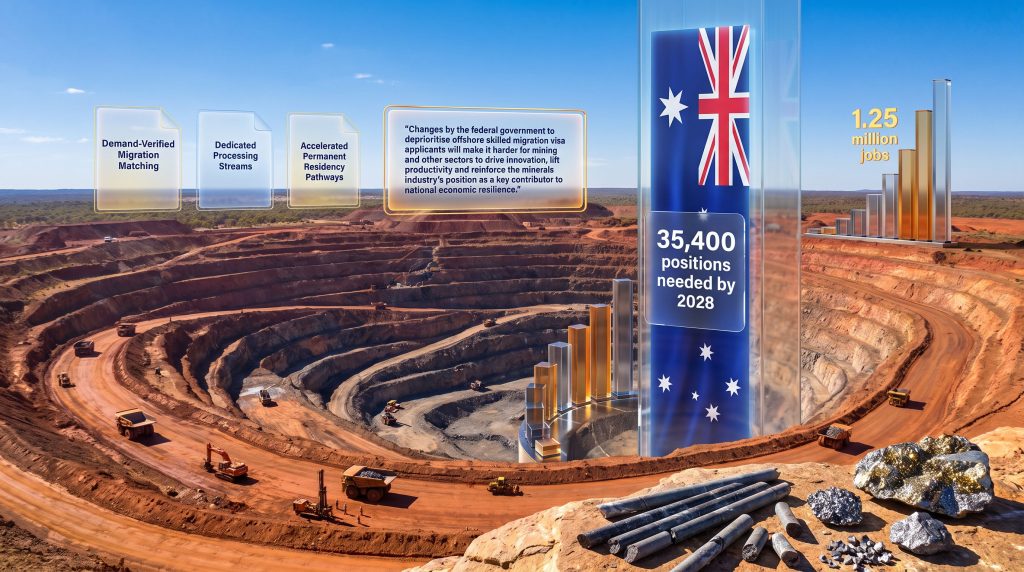
Australia's minerals sector is among the most employment-intensive industries in the national economy, supporting approximately 1.25 million direct and indirect jobs. This figure alone signals the sector's systemic importance, but the more pressing number is forward-looking: industry modelling projects that roughly 35,400 additional positions will need to be filled by 2028. That is not a generalised labour demand figure spread evenly across skill levels. It is concentrated in the upper tiers of technical complexity, in roles that require years of structured formation before a practitioner is ready for independent operational responsibility.
Engineering and geoscience programs at Australian universities typically run for four to five years before graduation. Add a further one to two years of supervised field experience before a graduate becomes fully productive in a demanding mining environment, and the arithmetic becomes sobering. Domestic training institutions simply cannot compress that timeline regardless of how much funding flows into enrolment programs. The structural mismatch between long formation cycles and near-term project activation schedules is not a solvable problem in the short term through domestic policy alone.
Enrolments in mining-critical disciplines such as geotechnical engineering, metallurgy, and geology have not tracked projected industry demand. This is partly a function of student career preference, partly a reflection of the geographic and lifestyle challenges associated with remote operational environments, and partly a consequence of the cyclical reputation that mining carries among younger cohorts considering long-term career investments. The result is an inherent and structural reliance on internationally trained professionals to fill the residual gap, not as a preference but as an operational necessity.
How Does This Affect Junior Exploration Programs?
Furthermore, the workforce crunch does not only affect large-scale operations. Junior explorer funding models are increasingly strained when specialist geoscientists and engineers are unavailable within commercially viable timeframes, pushing exploration program deferral risk into smaller companies that have far less capacity to absorb the delay.
Understanding the July 2025 Policy Shift and Its Operational Impact
In July 2025, the federal government introduced a processing prioritisation framework that placed onshore visa applicants ahead of offshore candidates within the skilled migration queue. The change followed the December 2024 rollout of the Skills in Demand visa, which replaced the earlier Temporary Skill Shortage framework and was designed to create a closer alignment between migration intake and verified labour market needs. The intent behind the broader reform package was defensible: direct migration more precisely toward genuine workforce gaps while protecting opportunities for domestic jobseekers.
However, the practical consequence for the mining sector is that internationally recruited candidates for specialist roles now face extended and uncertain processing timelines relative to their position in the queue before the change. This is not a minor administrative inconvenience. For an industry where time-to-hire for geotechnical engineers or metallurgists directly determines whether a project meets its mobilisation schedule, processing delays measured in additional months translate into measurable operational and financial disruption.
| Recruitment Dimension | Pre-Change Position | Post-Change Outlook |
|---|---|---|
| Offshore candidate processing | Standard queue access | Deprioritised behind onshore applicants |
| Time-to-hire for specialist roles | Already stretched | Projected to extend further |
| Project mobilisation timelines | Under pressure | Elevated delay risk |
| Export revenue continuity | Stable | Exposed to workforce-driven disruption |
The Minerals Council of Australia has formally called for the immediate suspension of the offshore deprioritisation settings, pending structured industry consultation. MCA CEO Tania Constable has made the industry's position clear through public statements, arguing that the policy changes risk undermining productivity, project delivery, and Australia's economic resilience more broadly. The MCA has been equally explicit that this position does not conflict with prioritising Australian workers. Skilled migrants fill residual specialist vacancies that domestic candidates are not available to service within commercially viable timeframes. The two objectives are not in competition; they operate in sequence.
The Occupational Map of Vulnerability
Skilled migrants represent approximately 1.24% of the national minerals workforce by headcount. This figure can mislead. Percentage-wise it appears marginal, but this cohort is not distributed evenly across general operational roles. It is concentrated at the precise points in the workforce structure where technical failure carries the highest operational and safety consequences.
The roles most exposed to the visa processing slowdown include:
- Geotechnical engineers, who assess ground stability and design slope geometries for open-cut and underground operations. Errors in this discipline carry catastrophic consequences.
- Metallurgists, responsible for optimising processing plant performance and improving mineral recovery rates. Even incremental improvements in metallurgical recovery can represent tens of millions of dollars in additional revenue on large-scale operations.
- Mine surveyors, who maintain the spatial data integrity that underpins regulatory compliance, resource delineation, and blasting safety.
- Geologists, foundational to exploration targeting and resource estimation, including the detailed structural and stratigraphic work that supports bankable feasibility studies.
- Mining engineers, who design production schedules, extraction methodologies, and ore flow systems.
- Electricians and diesel fitters, trades where remote operational environments and FIFO lifestyle demands persistently reduce the pool of willing domestic applicants.
- Drillers, required for both exploration programs and production drilling across operating mines.
Many of these occupations carry additional barriers beyond technical qualification. State-based licensing, regulatory registration, and site-specific induction requirements mean that even a fully credentialled international recruit cannot simply begin work on arrival. There is a mandatory lag between visa grant and full operational productivity, which makes processing delays upstream even more consequential downstream.
The Cross-Industry Contagion Effect
One of the less-examined dimensions of this policy debate is its reach beyond the resources sector. The MCA has flagged that the consequences of offshore applicant deprioritisation extend into construction, clean energy and renewables, advanced manufacturing, defence, and cybersecurity. Each of these sectors draws from overlapping technical talent pools and faces versions of the same structural problem: domestic training pipelines that are too slow to respond to accelerating project demand.
For Australia's critical minerals sector specifically, this is a compound risk. The global transition toward electrification and decarbonisation is generating extraordinary demand for lithium, cobalt, nickel, rare earths, and copper. Australia holds significant endowment in many of these commodities and is actively positioned as a preferred supplier to key trading partners including Japan, South Korea, and European Union member states. Workforce constraints that delay project commissioning do not simply affect individual company earnings. They affect Australia's credibility as a reliable, long-term supplier within international offtake and strategic partnership frameworks.
In addition, the intersection of critical minerals and energy security means that workforce-driven delays carry geopolitical implications that extend well beyond domestic economic management. Nations competing for preferred supplier status in global clean energy supply chains will not wait for Australia to resolve its internal migration policy settings.
Sector-wide risk: Extended offshore visa processing timelines create a compounding disadvantage that affects not just individual project schedules but Australia's broader positioning within global critical minerals supply chains, where reliability of supply is as commercially important as price competitiveness.
How Australia Compares to Global Peers
Australia's situation becomes sharper when benchmarked against competing mining jurisdictions. Canada operates a dedicated Global Talent Stream that commits to two-week processing for high-demand technical roles, with resources and mining occupations explicitly included within the program's eligibility framework. Chile, as the world's largest copper producer by volume, maintains bilateral skills recognition agreements with primary source countries to reduce the credential assessment burden that typically adds weeks or months to an international candidate's onboarding timeline. South Africa has introduced critical skills visa categories with targeted processing arrangements for mining engineering and geology disciplines.
Australia's skilled migration framework, even before the July 2025 prioritisation change, was regarded by international recruitment specialists as comparatively slow for technical mining roles when measured against these competitor jurisdictions. Post-change, the risk is that offshore candidates who would previously have accepted Australian positions increasingly redirect their applications toward Canadian or Chilean employers who can offer faster resolution and comparable remuneration. This talent redirection dynamic is difficult to detect in real time but can become structurally significant within a relatively short period.
Furthermore, these broader resource export challenges compound the competitive disadvantage, as delayed project delivery and constrained capacity erode Australia's market share in commodity categories where global demand continues to accelerate.
The next major ASX story will hit our subscribers first
What Structural Reform Actually Looks Like
The MCA's reform agenda does not propose dismantling domestic employment protections. It proposes a more intelligent architecture that serves both objectives simultaneously. The three central pillars of the organisation's recommended reforms are:
-
Demand-verified migration matching that aligns intake volumes with independently modelled, sector-specific workforce data updated on a rolling basis rather than through infrequent legislative revision cycles. The current system's occupation priority lists can become outdated between update cycles, creating mismatches between what the market needs and what the migration framework permits.
-
Dedicated processing streams for mining and resources sector applications covering verified shortage occupations, with binding processing time commitments. Canada's Global Talent Stream model provides a functional template, and the UK's Skilled Worker visa framework offers additional reference points for sector-specific lane design.
-
Accelerated permanent residency pathways for internationally trained professionals in critical STEM disciplines and technical trades. Temporary visa settings create inherent uncertainty for long-term career planning, which reduces Australia's attractiveness to the most experienced and sought-after international candidates who have multiple destination options.
| Reform Pillar | Alignment with Skills in Demand Visa | Gap Being Addressed |
|---|---|---|
| Demand-verified matching | Partial alignment via occupation list | Update frequency and data granularity |
| Processing streamlining | Framework exists | Speed and sector-specific lanes absent |
| Permanent residency pathways | Limited fast-track provisions | Long-term talent retention |
Consequently, the junior mining investment landscape is also directly shaped by how effectively these reforms are implemented, as smaller companies rely disproportionately on specialist migrant professionals to advance early-stage projects toward feasibility and production. The Minerals Council's full policy position on skilled migration reform provides additional technical detail on how these mechanisms would operate in practice.
Scenario Analysis: The Cost of Policy Inertia
Understanding the stakes requires projecting consequences across different time horizons if the current offshore deprioritisation settings remain unchanged.
In the near term (0 to 12 months): Vacancy periods for geotechnical, metallurgical, and specialist engineering roles lengthen across active operations. Operators absorb the gap through premium-cost contractor arrangements that compress project margins. Some exploration programs dependent on specialist geoscience expertise face deferral.
In the medium term (1 to 3 years): Projects in the pre-production phase, particularly in critical minerals where development pipelines are already long, face commissioning delays. Australian employers begin losing competitive ground in global talent acquisition as candidates with multiple destination options accept offers from faster-processing jurisdictions. Downstream effects emerge across critical minerals export commitments and sovereign supply chain partnership agreements.
Over the long term (3 years and beyond): If workforce constraints become a systemic and predictable feature of Australian project execution risk, capital allocators begin pricing this uncertainty into project valuations and feasibility assessments. The consequence is structural underinvestment in exploration and development that compounds across multiple commodity cycles, with downstream effects on royalty revenue, employment, and export earnings.
Frequently Asked Questions
What changed in Australia's skilled visa system in July 2025?
The federal government introduced a processing prioritisation rule placing applicants already residing in Australia ahead of offshore candidates in the skilled migration queue. This directly affects employers recruiting internationally for roles that cannot be filled from the domestic labour market within operationally viable timeframes.
How large is the projected workforce gap in Australian mining?
Industry modelling indicates the sector needs to fill approximately 35,400 new positions by 2028, on top of an existing direct and indirect employment base of around 1.25 million people.
What proportion of the mining workforce are skilled migrants?
Skilled migrants account for approximately 1.24% of the national minerals workforce. While small in percentage terms, this group is concentrated in the most technically demanding and hardest-to-fill roles.
Which sectors beyond mining are affected?
The MCA has identified construction, clean energy and renewables, advanced manufacturing, defence, and cybersecurity as sectors facing comparable exposure to the offshore deprioritisation policy.
Does the MCA support prioritising Australian workers?
Yes. The MCA has explicitly stated that Australian jobseekers represent the sector's primary recruitment focus. Skilled migrants are called upon to fill specialist vacancies that domestic candidates are not available to service within the timeframes that operational continuity requires.
Calibrating Policy for Economic Reality
The fundamental challenge at the centre of the MCA skilled visa changes mining workforce shortage debate is one of design precision rather than philosophical disagreement. No serious industry voice is arguing against prioritising Australian workers. The argument being made is that a blunt processing prioritisation rule, applied uniformly across all skilled migration categories regardless of occupation criticality or domestic supply availability, produces outcomes that harm the very national economic interests it is intended to protect.
A well-constructed skilled migration framework serves both domestic employment objectives and national productivity simultaneously. The mechanism for achieving this is not complicated in principle: occupation-specific processing arrangements informed by verified labour market data, updated frequently enough to remain accurate, and accompanied by pathways that make Australia a compelling long-term destination for the internationally trained professionals whose expertise the sector genuinely cannot replace from domestic supply alone. The urgency of getting this calibration right is not abstract. It is embedded in the project schedules, export commitments, and capital allocation decisions being made across the Australian minerals sector right now.
This article draws on publicly available information from the Minerals Council of Australia and Resources Review. It contains forward-looking analysis and scenario projections that involve assumptions and uncertainties. Readers should not treat this content as financial or investment advice.
Want to Know Which ASX Mineral Discoveries Are Worth Acting On Right Now?
While workforce constraints and visa policy shape the operational landscape for Australia's mining sector, the underlying resource discoveries driving project pipelines remain the critical investment signal — and Discovery Alert's proprietary Discovery IQ model scans every ASX announcement in real time, instantly identifying significant mineral discoveries and translating complex data into actionable opportunities for both short-term traders and long-term investors. Explore historic discovery returns on Discovery Alert's dedicated discoveries page and begin your 14-day free trial to position yourself ahead of the market.