August 11, 2026
The Invisible Infrastructure Reshaping How Mines Think About Data
Across every major mineral-producing region on the planet, a quiet transformation is underway. It has nothing to do with the ore grades being extracted or the equipment sitting on the pit floor. It lives in the sky, thousands of kilometres above the earth's surface, and it is fundamentally altering what a mine can know about itself in real time.
The shift toward satellite connectivity for cloud-based mining operations is not simply a technology upgrade story. It represents a structural rethinking of what connectivity means inside a production environment where the nearest fibre cable may be hundreds of kilometres away and where a data gap of even a few minutes can translate into missed fault signals, delayed decisions, and measurable output losses.
Understanding why this matters requires stepping back from the hardware and examining the underlying problem that satellite architecture is being asked to solve.
When big ASX news breaks, our subscribers know first
The Connectivity Deficit That Traditional Networks Cannot Fix
The geography of mining has always worked against communications infrastructure. Active mine sites are disproportionately located in regions where terrestrial network buildout is economically unviable for carriers and governments alike. Open-cut operations in arid inland basins, underground mines in mountainous terrain, and deep-sea mineral processing platforms all share one characteristic: they sit well outside the commercial footprint of fibre and cellular coverage.
The operational consequences of this coverage gap have grown considerably more serious as digital transformation has accelerated across the sector. What was once a minor inconvenience for back-office communications has become a direct production liability. Consider what a modern mine now depends on continuous connectivity to sustain:
- Autonomous haul truck fleets requiring unbroken telemetry links to cloud-based control systems
- Environmental sensor networks generating continuous compliance data streams
- Predictive maintenance systems that lose their value entirely the moment sensor data stops flowing
- Workforce safety monitoring systems that must remain operational regardless of weather or infrastructure disruptions
- Cloud analytics pipelines feeding centralised intelligence platforms from distributed field assets
Each of these systems was either non-existent or far less data-intensive a decade ago. The digital transformation of mining has not just increased bandwidth demand at remote sites. It has made continuous, reliable connectivity a production-critical requirement rather than a convenience.
What Is Multi-Orbit Satellite Connectivity and Why Does It Matter for Mining?
The most important thing to understand about satellite connectivity for cloud-based mining operations is that no single orbital layer can satisfy all the demands placed on a modern digital mine. The performance characteristics that make one orbit type ideal for safety-critical systems make it poorly suited to interactive cloud applications, and vice versa.
Breaking Down the Three Orbital Layers
Key Insight: Purpose-built hybrid satellite architecture combining GEO, MEO, and LEO layers is increasingly becoming the baseline expectation for enterprise-grade mining connectivity, not a premium option.
| Orbit Type | Altitude Range | Primary Strength | Best Mining Use Case |
|---|---|---|---|
| GEO (Geostationary) | ~35,786 km | Wide coverage, predictable SLAs | Safety-critical OT systems, SCADA |
| MEO (Medium Earth Orbit) | 2,000–20,000 km | Balanced latency + high upload throughput | Cloud data aggregation, backhaul |
| LEO (Low Earth Orbit) | 200–2,000 km | Low latency, interactive performance | Real-time cloud apps, workforce collaboration |
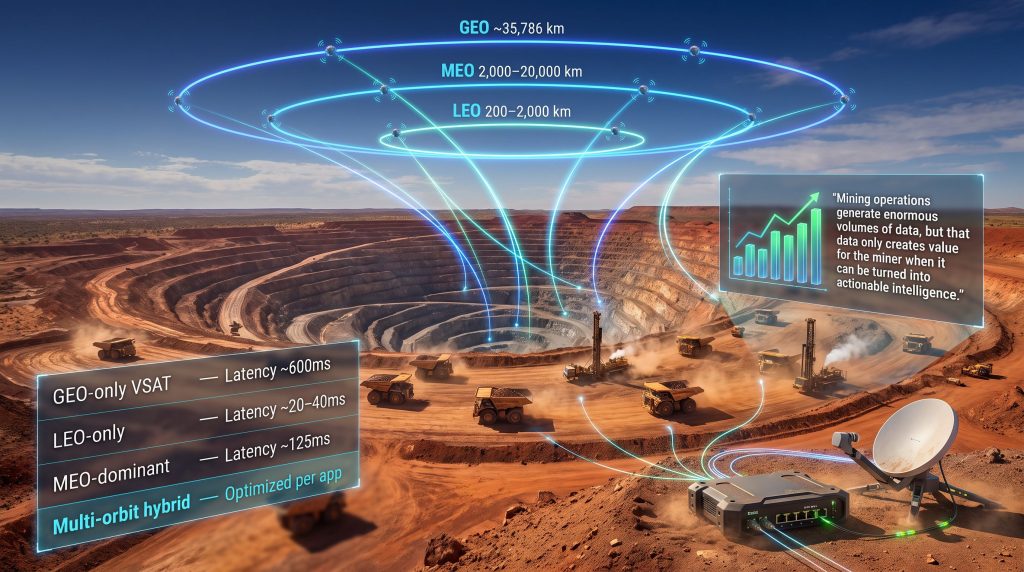
Geostationary satellites have served industrial communications for decades, and their value proposition in mining remains intact for specific applications. The ~600ms round-trip latency is too high for interactive cloud tools, but the consistency of a GEO link and the availability of SLA-backed performance guarantees make it the right layer for operational technology environments where uptime certainty outweighs raw speed. SCADA systems, emergency communications, and safety monitoring platforms all fit this profile.
Low Earth Orbit constellations solve the latency problem by reducing the distance data must travel. Round-trip times in the 20–40ms range bring LEO satellite performance into the same territory as mid-tier fixed broadband, enabling the kind of interactive cloud application performance that autonomous mining systems and remote collaboration tools require. The trade-off is that LEO coverage and performance consistency vary considerably by provider.
Medium Earth Orbit occupies the most strategically interesting position for cloud-based mining workflows. MEO satellites deliver a combination of manageable latency (typically around 125ms) and exceptionally high upload throughput. This is the orbital layer that addresses one of the most under-discussed aspects of mining connectivity: the asymmetric nature of mine site data flows.
The Upload Throughput Problem Most Connectivity Discussions Ignore
Standard enterprise connectivity conversations focus on download speeds because most commercial applications consume more data than they produce. Mining reverses this dynamic entirely. A modern smart mine generates enormous volumes of outbound data: fleet telemetry readings, vibration and temperature sensor logs from processing equipment, environmental monitoring streams, video feeds from autonomous vehicle cameras, and geospatial survey data.
All of this flows away from the mine site and toward centralised cloud platforms. High upload capacity — what the industry terms return path throughput — is therefore the differentiating performance variable for mining applications rather than download speed. Furthermore, enterprise satellite networks purpose-built for mining environments can support the transfer of terabytes of operational data daily, providing the pipeline capacity that data-driven mining operations and AI-driven maintenance platforms require to function at full value.
How Satellite Enables Cloud-Based Mining Operations in Practice
Autonomous Equipment and Real-Time Fleet Management
The deployment of autonomous haul trucks, drills, and loaders at major mine sites has created a connectivity dependency that simply did not exist in conventionally operated environments. These systems require continuous, low-latency data links to cloud-based control and monitoring infrastructure. Any interruption to the telemetry stream is not just an inconvenience — it is a direct threat to safe and productive autonomous operation.
Satellite backhaul, particularly through MEO and LEO layers, ensures that the data links supporting automated mining technology remain intact even when cellular coverage is unavailable or degraded. Equally important, predictive maintenance algorithms that monitor equipment health across thousands of sensor points lose their effectiveness the moment data flow becomes intermittent. Connectivity gaps do not just delay fault detection — they create blind spots that allow developing failures to reach the point of unplanned downtime before they are identified.
Environmental Monitoring and Regulatory Compliance
Mining's regulatory environment has become considerably more demanding around environmental reporting over the past decade. Air quality, water discharge, ground movement, and emissions data must be recorded continuously and reported accurately to regulatory bodies. Satellite connectivity enables these monitoring networks to transmit data in real time to centralised cloud platforms, where both on-site teams and off-site compliance personnel can access live dashboards.
The accuracy and timeliness improvements this delivers translate directly into reduced regulatory risk and stronger ESG performance documentation. For mining companies competing for access to capital in an environment where institutional investors apply increasingly rigorous ESG screening criteria, the quality of environmental data infrastructure is no longer a back-office concern.
Worker Safety Systems
Personnel monitoring, underground gas detection, emergency alert systems, and remote expert support all require reliable uplinks that function continuously in the environments where mining workers are most exposed to risk. Satellite connectivity enables remote technical specialists to support on-site teams via video and voice without physical travel, reducing both cost and the safety risks associated with bringing additional personnel into hazardous environments.
What Is SD-WAN and How Does It Transform Mining Network Architecture?
Satellite connectivity alone does not deliver the full network capability that cloud-based mining operations require. The missing layer is intelligent orchestration, and this is where software-defined wide area networking comes in. In addition, AI-powered mining efficiency platforms depend heavily on this orchestration layer to function at their full potential.
How SD-WAN Unifies Diverse Connection Types
SD-WAN creates a single logical network from multiple physical connections simultaneously: satellite links across GEO, MEO, and LEO layers, LTE and 5G cellular where available, fixed wireless, and fibre where it exists. Rather than treating these as separate backup options, SD-WAN manages them as a unified resource pool, applying traffic prioritisation rules that ensure mission-critical applications always receive bandwidth precedence.
Operational Implication: In a hybrid satellite plus cellular architecture managed by SD-WAN, a temporary cellular outage at a remote site does not interrupt autonomous equipment operations. Satellite links absorb the load automatically, with no manual intervention required and no perceptible disruption to operational systems.
Application-Aware Traffic Management
Not all cloud-based mining applications have the same network requirements, and treating them as equivalent is a significant architectural mistake. SD-WAN applies quality-of-service policies dynamically, distinguishing between:
- Low-latency priority traffic such as autonomous control system commands and safety alerts
- High-throughput priority traffic such as bulk sensor data uploads and fleet telemetry aggregation
- Standard business traffic such as workforce communications, scheduling systems, and administrative applications
This application-aware intelligence prevents low-priority traffic from competing with mission-critical operational systems during periods of constrained bandwidth, which is exactly the scenario that occurs most frequently at remote mine sites.
The Path Toward 5G-Integrated Mining Networks
Private 5G networks are beginning to appear within mine site boundaries, primarily for underground environments and processing plant connectivity. As these deployments expand, SD-WAN will serve as the orchestration layer that connects 5G, satellite, and legacy terrestrial infrastructure into a coherent whole. Software-defined architectures allow the network to adapt in real time as mine footprints change, production areas shift, and operational priorities evolve across the life of a project.
Hybrid vs. Single-Orbit Architecture: A Direct Comparison
| Architecture | Latency | Throughput | Reliability | Best Application |
|---|---|---|---|---|
| GEO-only VSAT | High (~600ms) | Moderate | High (SLA-backed) | OT/SCADA, safety systems |
| LEO-only | Low (~20–40ms) | Variable | Best-effort | Interactive cloud, collaboration |
| MEO-dominant | Medium (~125ms) | High (strong upload) | High | Cloud data aggregation, backhaul |
| Multi-orbit hybrid | Optimised per application | Maximum | Highest | Full digital mine technology stack |
The case for multi-orbit hybrid design rests on one fundamental reality: no single connectivity technology delivers the full spectrum of performance, coverage, and resilience that modern mining operations require across their entire digital technology stack. Ground network scale matters as much as the space segment. Supporting distributed operations across multiple continents requires terrestrial infrastructure of comparable depth, including globally distributed gateways, fibre interconnects, and public and private network handoffs.
SES, for example, operates infrastructure spanning coverage of 99% of the world's populated regions, supported by 120 GEO and MEO satellites, approximately 500,000 miles of fibre, 150 teleports, and 50 points of presence globally. According to Global Mining Review, satellite and wireless technologies are actively revolutionising how remote operations maintain enterprise-grade connectivity. This scale of ground network is what separates enterprise-grade satellite solutions from consumer-grade alternatives when it comes to SLA-backed performance guarantees.
The next major ASX story will hit our subscribers first
What Business Outcomes Can Mining Operators Actually Expect?
The productivity case for satellite connectivity for cloud-based mining operations is not built on bandwidth metrics alone. It is built on the ability to convert raw operational data into decisions that improve output, reduce costs, and protect workers. The business outcomes that well-architected satellite connectivity enables include:
- Reduced unplanned equipment downtime through uninterrupted predictive maintenance data streams
- Improved fleet utilisation rates driven by real-time production optimisation analytics
- Enhanced worker safety outcomes via continuous personnel monitoring and remote expert access
- Faster operational decision cycles through centralised intelligence platforms fed by live field data
- Stronger environmental and regulatory reporting accuracy and timeliness across compliance obligations
- Greater resilience across geographically dispersed asset portfolios with no single point of connectivity failure
Jean-Philippe Gillet, President of the Fixed Data Vertical at SES, has articulated that "mining operations generate enormous volumes of data, but that data only creates tangible value for the operator when reliable connectivity infrastructure can transform it into actionable intelligence." This framing captures precisely why connectivity has moved from a utility decision to a strategic capital allocation question for mining executives.
The Strategic Imperative: Connectivity as a Core Infrastructure Decision
Reframing Satellite from a Fallback to a Foundation
The historical positioning of satellite connectivity in mining was as a backup option, something activated when terrestrial networks were unavailable. That framing is increasingly misaligned with operational reality. As cloud-based architectures have become the backbone of mine management systems, autonomous operations, and environmental compliance frameworks, the connectivity layer supporting them has become as strategically important as the processing plant or the haul road.
However, mining companies that treat satellite connectivity as an IT procurement decision rather than a strategic infrastructure investment are likely underestimating both the dependency their digital systems have on reliable connectivity and the competitive differentiation that superior connectivity infrastructure can deliver over time. Consequently, this shift in thinking is driving broader mining infrastructure transformation across the sector.
Key Evaluation Criteria for Mining Operators
When assessing satellite connectivity solutions for cloud-based operations, mining executives should evaluate providers across these dimensions:
- Orbit architecture — Does the solution offer genuine multi-orbit capability across GEO, MEO, and LEO to serve diverse application requirements simultaneously?
- Upload throughput — Can the network handle the outbound data volumes generated by the mine's sensor, telemetry, and autonomous equipment infrastructure?
- SLA structure — Are performance guarantees aligned with the uptime requirements of operational technology and safety-critical systems?
- SD-WAN integration — Does the solution support intelligent traffic management, application-aware QoS, and hybrid network orchestration?
- Ground network scale — Does the provider's terrestrial infrastructure support seamless handoffs to cloud platforms and private networks at the required geographic scale?
- Global coverage — Can the solution scale across multiple geographically dispersed mine sites under a unified management and monitoring framework?
As digital mining matures, the operators who establish robust, multi-orbit satellite connectivity infrastructure early will carry a structural advantage in their capacity to deploy AI-driven maintenance, real-time environmental management, and fully autonomous operations. For those exploring purpose-built solutions, Speedcast's mining connectivity services offer one example of how enterprise satellite providers are packaging these capabilities for complex operational environments.
Connectivity quality is increasingly the variable that determines which mining companies can translate digital transformation investment into measurable operational performance — and which cannot.
This article contains forward-looking analysis and technology assessments. Readers should conduct independent due diligence before making infrastructure investment decisions based on any information presented here.
Want to Stay Ahead of the Next Major ASX Mineral Discovery?
Discovery Alert's proprietary Discovery IQ model scans ASX announcements in real time, instantly converting complex mineral data into actionable investment insights for both short-term traders and long-term investors — explore historic discoveries and their extraordinary returns, then begin your 14-day free trial at Discovery Alert to position yourself ahead of the broader market.