August 13, 2026
The Hidden Economics of Aluminium: Why Energy Price Is the Difference Between Industry and Extinction
Long before a smelter closes its doors, the economics quietly deteriorate. Unlike most manufacturing sectors where cost pressures build gradually and allow time for strategic adjustment, aluminium smelting operates under a fundamentally different logic. The process is continuous, power-dependent, and structurally irreversible. Once a smelting pot line cools and solidifies, restarting it requires enormous capital expenditure and years of lead time. This technical reality means that closure decisions are rarely reversible in any practical sense, which is precisely why the energy pricing environment surrounding a smelter carries existential weight in a way that few other industries experience.
It is against this industrial backdrop that the Tomago aluminium smelter deal deserves to be understood, not simply as a jobs announcement or a political win, but as a case study in how modern economies must think about sovereign industrial capability when liberalised energy markets and deep decarbonisation transitions collide.
When big ASX news breaks, our subscribers know first
When Market Forces Alone Cannot Preserve Critical Infrastructure
Aluminium smelting is one of the most electricity-intensive industrial processes in existence. Electricity typically accounts for between 30 and 40 percent of total operating costs in primary aluminium production, a figure that makes the sector uniquely vulnerable to power price movements that most industries would absorb without existential consequence.
The process at the core of this vulnerability is electrolysis. Aluminium oxide, refined from bauxite, is dissolved in a molten cryolite bath and subjected to enormous direct electrical current, which separates pure aluminium metal from oxygen. This process, known as the Hall-Heroult process, runs continuously at temperatures exceeding 960 degrees Celsius. It cannot be paused, throttled significantly, or switched off without causing irreversible damage to the pot lining infrastructure. The smelter is, in essence, a machine that must never stop.
This technical constraint creates a structural exposure to electricity price volatility that operates on a completely different scale to conventional manufacturing. A 20 percent rise in electricity costs for a furniture factory is painful. For a primary aluminium smelter, however, the same increase can render the entire operation commercially unviable against international competitors operating in lower-cost energy environments.
The Sovereign Capability Question
The economic logic behind retaining domestic smelting capacity goes well beyond direct employment figures. When a nation exports raw bauxite ore and then imports finished aluminium products, it is effectively transferring the value-added component of the production chain — along with the associated jobs, tax revenue, industrial expertise, and supply chain infrastructure — to another jurisdiction entirely.
Australia sits on some of the world's largest bauxite reserves. The country is a dominant force in global bauxite production, accounting for roughly 30 percent of world mine production according to the United States Geological Survey. Yet without domestic smelting capacity, this resource abundance generates far less economic value per tonne than it otherwise could. Nations including Norway, Canada, and Iceland have recognised this calculus for decades, structuring long-term industrial energy policies specifically designed to retain smelting operations that anchor broader industrial ecosystems.
Norway's aluminium industry, for example, has historically benefited from long-term hydropower contracts that provide stable, low-cost electricity to smelters as part of a deliberate industrial policy framework. The result is that Norway punches far above its weight in global aluminium processing despite having no bauxite reserves of its own. The competitive input is not the ore, but the electricity.
What the Tomago Aluminium Smelter Deal Actually Commits
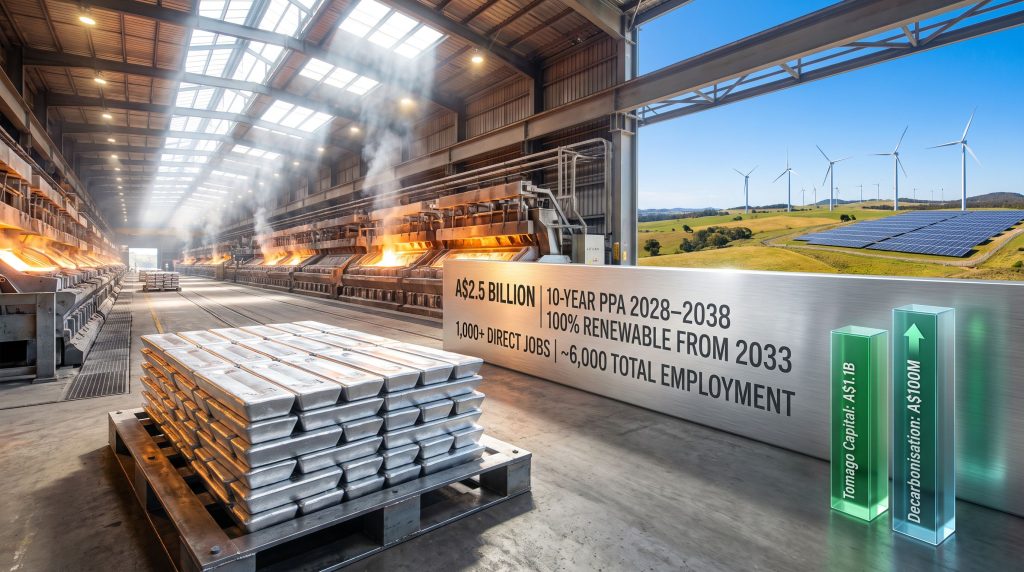
The Tomago aluminium smelter deal is a multi-party agreement involving the Australian federal government, the New South Wales government, and Snowy Hydro, structured around a 10-year power purchase agreement (PPA) that commences following the expiry of Tomago's existing electricity contract in December 2028 and extends through to 2038.
The agreement carries substantial financial weight on all sides. Tomago itself has committed A$1.1 billion in capital investment across the life of the deal, of which A$100 million is specifically earmarked for decarbonisation and emissions reduction works. The total reported package sits at approximately A$2.5 billion, though the complete breakdown of government-side financial contributions within that figure has not been comprehensively disclosed publicly.
A critical milestone embedded in the agreement is the commitment to source 100 percent of electricity from renewable energy from 2033 onwards. This is not a voluntary aspiration. It is a structural feature of the PPA framework, with Snowy Hydro providing the renewable generation underpinning that supply obligation.
| Component | Detail |
|---|---|
| Total reported package value | ~A$2.5 billion |
| Tomago's own capital commitment | A$1.1 billion |
| Decarbonisation investment | A$100 million |
| PPA duration | 10 years (2028 to 2038) |
| Renewable energy milestone | 100% sourcing from 2033 |
| Parties involved | Federal government, NSW government, Snowy Hydro, Tomago Aluminium |
Why December 2028 Was a Crisis Deadline
The urgency driving the Tomago aluminium smelter deal cannot be overstated. Tomago's existing electricity supply arrangements were due to expire in December 2028, and the projected cost of procuring power on unassisted wholesale market terms post-expiry was assessed as incompatible with continued commercially viable operations.
This is not a hypothetical risk. Australia's wholesale electricity market has experienced significant structural repricing as coal-fired baseload generation exits the grid and is replaced by variable renewable energy. The transition period, while ultimately expected to deliver lower long-run electricity costs, creates an interim volatility window that is particularly dangerous for industrial users who cannot shift their consumption patterns or hedge effectively over long time horizons.
The irreversibility problem compounds the urgency considerably. Unlike a retailer that can close stores and reopen them if conditions improve, a smelter that reaches the closure decision point effectively ceases to exist as a going industrial concern. The workforce disperses, the supply chain unravels, the technical expertise migrates, and the infrastructure deteriorates. Reversing that outcome would require building a new smelter — a project of billions of dollars and many years, with no guarantee of commercial viability.
Employment, Regional Economics, and the Supply Chain Multiplier
The employment figures attached to the deal are significant in absolute terms, but their true economic weight lies in how they interact with the Hunter Valley's broader industrial and post-coal transition story.
Tomago directly employs more than 1,000 workers at its facility. Beyond the gate, the smelter supports an estimated 5,000 additional jobs across the Hunter region's supply chain, spanning logistics, maintenance contracting, engineering services, raw material supply, and ancillary manufacturing. Total employment exposure linked to the smelter's continued operation therefore sits at approximately 6,000 roles.
| Employment Metric | Figure |
|---|---|
| Direct Tomago employees | 1,000+ |
| Estimated supply chain jobs | ~5,000 |
| Total regional employment exposure | ~6,000 |
The regional multiplier effect of major industrial employment is well-documented in economic literature. Each direct manufacturing job typically supports multiple additional roles in local services, retail, healthcare, and education. The loss of 6,000 primary and supply chain roles in a regional economy the size of the Hunter Valley would generate a contraction far larger than the headline employment numbers suggest.
This context matters enormously for the Hunter's transition narrative. The region is simultaneously managing the decline of thermal coal employment and attempting to build new economic pillars. Tomago's continued operation provides a stable, high-wage industrial employment base during that transition, rather than requiring the region to rebuild industrial capacity from scratch at a later date.
The Australian Workers' Union has framed the preservation of Tomago as fundamental to Australia's ability to retain domestic processing capability rather than defaulting to a raw material export model that generates substantially less economic value per tonne of bauxite mined.
Green Aluminium: The Premium Market Australia Is Now Positioned to Access
One of the most strategically significant elements of the Tomago aluminium smelter deal is its forward-looking orientation toward what the global aluminium industry is increasingly calling "green aluminium" or low-emissions primary aluminium.
Global manufacturers in automotive, aerospace, packaging, and construction are under mounting pressure from both regulatory frameworks and consumer-facing sustainability commitments to demonstrate the carbon intensity of their supply chains. Aluminium, as a material whose production is inherently electricity-intensive, carries a carbon footprint that varies enormously depending on the energy source powering the smelter. Coal-fired smelting produces roughly 14 to 16 tonnes of CO2-equivalent per tonne of aluminium. Renewably-powered smelting can, furthermore, reduce this figure to below two tonnes — a differential that increasingly commands a price premium in international markets.
Europe's Carbon Border Adjustment Mechanism (CBAM), which applies to aluminium imports among other carbon-intensive goods, is creating a direct financial incentive for trading partners to reduce the emissions intensity of their exported products. Nations whose smelters are powered by renewables will face lower CBAM charges, translating into a meaningful cost advantage in European markets from the mid-2020s onwards. These broader aluminium tariff impacts are reshaping competitive dynamics for producers worldwide.
Australia's Competitive Position in the Green Aluminium Race
The combination of Australia's world-class renewable energy resource base, its existing smelting infrastructure, and the 2033 renewable electricity milestone creates a credible pathway to premium green aluminium exports. This positioning matters because current global supply of certified low-emissions primary aluminium falls well short of projected demand from major industrial consumers.
Key competing jurisdictions include:
- Norway: Already producing largely hydropower-sourced aluminium, but constrained by geography and reservoir capacity from large-scale expansion.
- Canada: Significant hydropower-backed smelting capacity, but facing its own infrastructure investment cycle.
- Iceland: Renewable-powered but geographically limited in scale.
- UAE: Investing heavily in solar-powered smelting but starting from a high-emissions baseline.
Australia's advantage is the scale of its renewable energy potential combined with existing, operational smelting infrastructure. Building a new smelter anywhere in the world is a multi-decade, multi-billion dollar undertaking. Retaining and decarbonising Tomago is structurally faster and more capital-efficient than any greenfield alternative. The decarbonisation economic benefits of this approach extend well beyond the smelter itself, creating positive spillovers across related industries.
What A$100 Million in Decarbonisation Actually Buys
The A$100 million decarbonisation investment component of the Tomago deal warrants specific attention because it signals an intention that goes beyond meeting a contractual renewable energy supply obligation.
Decarbonisation at a primary aluminium smelter involves several technical dimensions:
- Renewable energy integration: Ensuring pot line operations are compatible with the variable supply characteristics of wind and solar, which may require demand flexibility management systems.
- Anode technology: Traditional carbon anodes release CO2 during the electrolysis process itself, independent of the electricity source. Inert anode technology, still in commercial development globally, would eliminate this process emission source entirely.
- Process efficiency improvements: Reducing electricity consumption per tonne of aluminium produced through modernisation of pot line control systems and thermal management.
- Upstream emissions reduction: Addressing supply chain carbon intensity in alumina refining and bauxite mining operations.
The A$100 million investment places Tomago in a position to pursue several of these pathways concurrently, potentially establishing the facility as a technology demonstration site for low-emissions primary aluminium production in the Asia-Pacific region.
Policy Architecture and the Precedent This Deal Sets
The structural design of the agreement is as significant as its headline numbers. Rather than a direct subsidy or a production support payment, the deal is built around a power purchase agreement — a mechanism that creates a long-term bilateral contract between a generator and a consumer at an agreed price structure.
This is a critically important distinction. PPA-based industrial support is commercially sustainable in a way that open-ended subsidy arrangements are not. It creates bankable certainty for investment decisions on both sides, encourages renewable energy generation development by providing a committed large-scale offtaker, and does not require ongoing appropriations from government budgets after the initial framework is established.
The three-party architecture — distributing roles across the federal government, NSW government, and Snowy Hydro — also spreads risk in a way that no single party would accept alone. This co-investment model reflects emerging thinking in industrial policy about how to retain critical processing capacity without creating moral hazard or permanent dependency on public funding. In addition, initiatives such as Gladstone aluminium repowering demonstrate that this approach is gaining traction among aluminium industry leaders across Australia.
What This Means for Other Energy-Intensive Industries
The Tomago aluminium smelter deal is being closely watched by other energy-intensive sectors in Australia, including steel manufacturing, chemical production, and glass manufacturing — all of which face structurally similar electricity pricing challenges as the energy transition unfolds.
The precedent established is not that government will rescue any industry facing energy cost pressure. Rather, it demonstrates that where genuine sovereign capability arguments can be made, where regional employment concentration is significant, and where a credible decarbonisation pathway exists, a PPA-centred structured support framework is a viable policy instrument.
The Australian Workers' Union's framing of this outcome as a watershed moment for domestic processing capability reflects a broader debate about where Australia wants to sit in global industrial value chains. The choice between exporting raw bauxite and producing finished aluminium domestically is ultimately a choice about how much economic value the country captures from its natural resource endowment — and over what time horizon that value is realised.
The next major ASX story will hit our subscribers first
Frequently Asked Questions: Tomago Aluminium Smelter Deal
What is the Tomago aluminium smelter deal?
A structured multi-party agreement between Tomago Aluminium, the Australian federal government, the NSW government, and Snowy Hydro that secures continued smelter operations beyond December 2028 through a 10-year power purchase agreement extending to 2038.
How many jobs does the Tomago smelter support?
The facility directly employs more than 1,000 workers, with an estimated 5,000 additional supply chain jobs across the Hunter Valley, bringing total employment exposure to approximately 6,000 roles.
What is the total value of the Tomago deal?
The overall package has been reported at approximately A$2.5 billion. Tomago itself is committing A$1.1 billion of that total, including A$100 million allocated specifically to decarbonisation investment.
When will Tomago switch to 100% renewable electricity?
Under the power purchase agreement terms, Tomago Aluminium is committed to sourcing 100 percent of its electricity from renewable energy from 2033 onwards.
Why was a structured agreement necessary?
Tomago's existing electricity contract expires in December 2028. Projected wholesale market electricity costs beyond that date were assessed as incompatible with commercially viable continued operations, creating a closure risk that would have removed thousands of jobs and eliminated a significant domestic aluminium processing capability.
What is green aluminium and why does it matter?
Green aluminium is primary aluminium produced using renewable electricity, dramatically reducing the carbon intensity of the metal compared to coal-powered production. As global industries accelerate supply chain decarbonisation under regulatory and market pressure, certified low-emissions aluminium commands growing price premiums, particularly in European markets affected by carbon border adjustment mechanisms.
The material provided in this article is for information purposes only and should not be treated as investment advice. Readers are encouraged to conduct their own research and consult with a qualified financial adviser before making any investment decisions.
Want to Track the Next Major Mineral Discovery Before the Market Does?
Discovery Alert's proprietary Discovery IQ model delivers real-time alerts on significant ASX mineral discoveries across more than 30 commodities — including bauxite and aluminium-related opportunities — turning complex geological data into actionable insights for investors at every level. Explore how historic discoveries have generated substantial returns and begin your 14-day free trial today to position yourself ahead of the broader market.