August 14, 2026
When Operational Discipline Becomes a Competitive Advantage in Mineral Processing
Across the global mining industry, a quiet rebalancing is underway. After years of enthusiasm for digital transformation, automation platforms, and data-driven mining operations, processing operations are rediscovering an uncomfortable truth: technology alone does not fix a poorly run plant. The most consistent gains in throughput, recovery, and cost performance continue to come from the same place they always have — rigorous operational discipline applied every shift, every day.
This tension between technological ambition and operational fundamentals sits at the centre of what makes dedicated mineral processing forums so strategically valuable. It is precisely this dynamic that shapes the agenda of the AusIMM Mill Operators Conference, now approaching its 17th edition and widely regarded as the most technically rigorous gathering of its kind in the Southern Hemisphere.
When big ASX news breaks, our subscribers know first
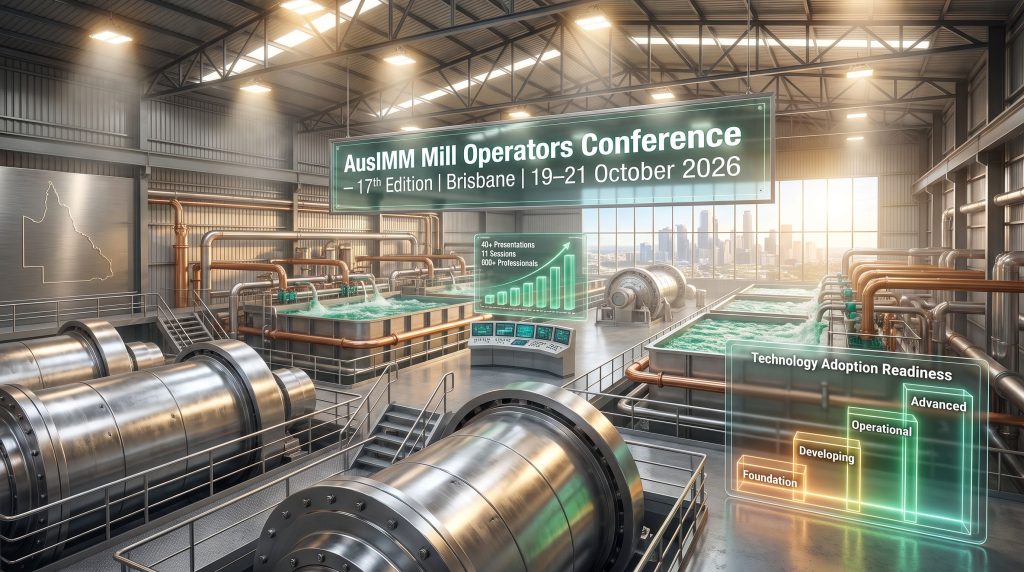
Conference at a Glance: 17th Mill Operators Conference
| Detail | Information |
|---|---|
| Event Name | AusIMM Mill Operators Conference (17th Edition) |
| Dates | 19–21 October 2026 |
| Location | Brisbane Convention and Exhibition Centre |
| Format | Single-session (no concurrent streams) |
| Technical Presentations | 40+ across 11 dedicated sessions |
| Expected Attendance | 600+ professionals |
| First Held | 1978, Mount Isa |
The AusIMM Mill Operators Conference brings together metallurgists, geometallurgists, process engineers, plant managers, researchers, technology suppliers, and executives from Australia and internationally. Its format, scope, and longevity distinguish it from generalist mining conferences that touch on processing as one topic among many.
From Mount Isa to Brisbane: Nearly Five Decades of Minerals Processing Knowledge Exchange
Why 1978 Still Matters
The inaugural Mill Operators Conference took place in Mount Isa in 1978, a period when Australian mining was grappling with the operational complexity of processing increasingly variable ore bodies at scale. The event was conceived as a practitioner-to-practitioner forum rather than an academic symposium, with the explicit goal of transferring hard-won operational knowledge between sites and disciplines.
Reaching the 17th iteration in 2026 is not merely a milestone in event management. It reflects nearly five decades of sustained industry relevance across commodity cycles, technological disruptions, and shifting workforce demographics. Few technical conferences in any sector achieve that kind of longevity without continuous reinvention of their core value proposition.
Over that period, the program scope has broadened substantially. Early editions concentrated heavily on comminution — the breaking and grinding of ore — which remains the most energy-intensive and operationally critical stage of most processing circuits. Contemporary programs now span the full plant lifecycle, from flowsheet design and metallurgical testwork through to tailings management, ESG integration, and digital optimisation.
The Single-Session Format: A Deliberate Design Choice
One structural feature that sets the AusIMM Mill Operators Conference apart from comparable technical events is its commitment to a single-session format. Rather than splitting delegates across concurrent technical streams — a common approach at larger conferences that maximises topic coverage but fragments the audience — MillOps ensures every registered professional hears every presentation. Furthermore, this approach is consistent with the AusIMM's broader technical conference philosophy of fostering shared understanding across the full delegate cohort.
This structural choice reflects a philosophy that shared understanding across the full delegate cohort creates more durable knowledge transfer than allowing individuals to self-select into specialised tracks.
The practical consequence is significant. When a metallurgist and a maintenance engineer both attend the same session on comminution circuit optimisation, they leave with a common reference point for subsequent site-level conversations. Extended question-and-answer periods following keynote addresses deepen that engagement further, allowing presenters and practitioners to stress-test ideas in real time.
Comparing conference formats for technical knowledge transfer:
| Format Type | Knowledge Breadth | Shared Understanding | Peer Engagement Depth |
|---|---|---|---|
| Single-session (MillOps model) | Focused | High across all delegates | Deep, extended Q&A |
| Multi-stream concurrent | Broad | Fragmented by stream | Moderate, time-constrained |
| Workshop-only | Narrow | High within cohort | Very deep, small groups |
| Hybrid (keynote + streams) | Broad | Mixed | Variable |
What Operational Challenges Are Driving the 2026 Conference Agenda?
The Cost Pressure Crisis Reshaping Mineral Processing Economics
Australian processing operations are navigating one of the most sustained periods of input cost inflation in recent memory. Diesel, electricity, labour, reagents, grinding media, and structural steel have all experienced significant price escalation over recent years. For operations running on fixed or declining commodity price assumptions, these cost pressures compress margins in ways that demand a sharper focus on plant-level efficiency.
Conference chair Reg Radford, who serves as principal specialist metallurgy at Gold Fields and brings more than 25 years of metallurgical and operational experience to the role, has been direct about the environment facing the sector. The minerals processing industry is contending with rising input costs across raw materials, diesel, power, labour, and consumables, and the operational response must centre on doing the fundamentals consistently and well.
That response translates into a specific set of priorities: maintaining and improving metallurgical recovery, increasing throughput rates, reducing avoidable operating costs, and sustaining overall plant efficiency. These are not novel objectives, but they become substantially harder to achieve when inflationary pressures erode the financial cushion that allows operations to absorb inefficiency.
The Five Pillars of Processing Plant Performance
The 2026 conference agenda has been built around an operational improvement philosophy that Radford has described as the consistent execution of fundamentals. This translates into five interconnected performance drivers:
- Reliable metallurgical control — maintaining consistent feed characterisation and reagent response across variable ore types
- Sound operating discipline — shift-by-shift adherence to process parameters rather than reactive adjustments
- Strong maintenance practices — proactive scheduling that prevents unplanned downtime from compounding into recovery losses
- High-integrity production data — accurate, validated, and timely information that supports informed decision-making
- Practical improvement projects — structured initiatives with measurable outcomes rather than aspirational technology deployments
Inflationary Pressures vs. Operational Levers
| Cost Pressure Category | Operational Response Strategy |
|---|---|
| Rising energy costs (diesel, power) | Throughput optimisation, energy efficiency audits |
| Labour cost escalation | Automation-assisted decision support, skills retention |
| Consumables inflation | Recovery maximisation, reagent optimisation |
| Raw material input variability | Flowsheet redesign, ore characterisation improvements |
| Maintenance cost growth | Proactive scheduling, component life extension |
How Is AI and Data Automation Reshaping Mill Operations — and What Are the Risks?
The Growing Adoption of Digital Technologies Across Processing Plants
Digital technology adoption in mineral processing has accelerated markedly over the past decade. Distributed control systems, advanced process control platforms, machine vision tools for particle size analysis, and predictive maintenance benefits are now being realised across a growing number of Australian operations. The productivity potential is genuine, particularly in environments where experienced metallurgists are stretched across multiple responsibilities.
However, the gap between technology potential and operational readiness remains one of the sector's most underappreciated challenges. Many operations have invested in sophisticated analytics platforms only to find that the underlying data feeding those systems is too fragmented, inconsistent, or poorly validated to generate reliable insights. The result is not improved performance — it is amplified decision-making error at greater speed.
Why Data Quality Remains the Sector's Most Underestimated Challenge
Critical Warning: Deploying artificial intelligence or advanced analytics on top of fragmented, unvalidated operational data does not improve plant performance. It accelerates the propagation of existing errors through the decision-making chain. Robust data infrastructure is a prerequisite for technology deployment, not an afterthought to be addressed later.
Radford has emphasised that the challenge for the industry is not access to technology — it is improving how operational data is collected, validated, and secured before new tools are applied. The principle is straightforward: unreliable inputs produce unreliable outputs, and in a processing plant operating at scale, unreliable outputs translate directly into recovery losses and cost blowouts.
The data challenge in processing environments is particularly acute for three reasons:
- Collection complexity: Plant instrumentation spans hundreds of measurement points across grinding, flotation, thickening, and dewatering circuits, each with its own calibration requirements and failure modes
- Validation difficulty: Cross-checking sensor data against mass balance calculations and laboratory assay results requires skilled metallurgical interpretation, not just automated flagging
- Security risk: As operational technology systems become more connected, the integrity of production data faces cybersecurity threats that were not part of the processing engineer's traditional risk framework
Technology Adoption Readiness: A Framework for Processing Operations
| Readiness Level | Data Infrastructure Status | Recommended Technology Step |
|---|---|---|
| Foundation Stage | Fragmented, inconsistent data | Data consolidation and validation protocols |
| Developing Stage | Centralised but unvalidated | Quality assurance and integrity audit systems |
| Operational Stage | Clean, validated production data | Analytics dashboards and visualisation tools |
| Advanced Stage | Integrated real-time data streams | AI-assisted optimisation and predictive modelling |
The 2026 conference addresses this progression directly through a dedicated AI and data visualisation panel discussion planned for Day 3. The panel is designed to examine both the genuine value that AI-powered mining efficiency can deliver and the operational risks that arise when deployment outpaces foundational readiness.
What Does the 2026 Technical Program Cover Across Its 11 Sessions?
Session Architecture: From Newly Commissioned Plants to Tailings Management
The 2026 technical program spans the full spectrum of processing plant operations, with session topics selected through a competitive paper review process designed to prioritise practical outcomes over theoretical contribution. Presentations were evaluated on the basis of measurable plant improvements, transferable case study evidence, and demonstrated operational innovation.
Key thematic areas across the 11 sessions include:
- Operating performance updates and benchmarks from recently commissioned processing facilities
- Best-practice frameworks for existing plant optimisation, covering training programmes, workforce capability development, and continuous improvement structures
- Comminution circuit design and performance, including grinding efficiency, media consumption, and circuit configuration
- Flotation performance optimisation, encompassing reagent selection, cell hydrodynamics, and recovery-grade trade-off management
- Concentrator efficiency across the full processing chain from primary crushing to final product
- ESG integration in plant design and operating practice
- Tailings management approaches that address both environmental compliance and operational performance variables
ESG Integration in Mineral Processing: Beyond Compliance
One of the more significant shifts in mineral processing practice over the past decade is the mainstreaming of environmental, social, and governance considerations into plant-level decision-making. Tailings management has moved from a purely engineering and regulatory discipline to a board-level risk management priority, particularly following high-profile failures internationally that reshaped the global conversation about dam design and monitoring standards.
For processing engineers, this evolution carries a practical implication: technical competence now needs to be accompanied by literacy across sustainability frameworks, community engagement principles, and long-term liability management. The 2026 program reflects this expanded expectation, treating ESG not as a compliance overlay but as an integrated design and operational variable. This approach also aligns with mining's broader transformation towards electrification and decarbonisation.
The Competitive Paper Selection Process
The quality of MillOps technical content has historically been underpinned by a rigorous selection process that filters for practitioner-validated contributions. Papers demonstrating quantified improvements in recovery, throughput, or cost performance at operating plants carry greater weight than submissions presenting promising laboratory or simulation results without operational validation. This curatorial philosophy explains why the conference has maintained its reputation as a source of actionable operational intelligence rather than speculative research output.
The next major ASX story will hit our subscribers first
Who Are the Keynote Speakers Shaping the 2026 Conference Narrative?
Brian Puntland: Comminution Expertise and Global Process Engineering Perspective
Brian Puntland brings more than three decades of minerals processing experience to the 2026 keynote program. His career began in Western Australia's gold sector, where he developed deep technical expertise in comminution circuit design and gold processing flowsheet development before expanding his practice internationally.
Puntland is the managing director and principal metallurgist of Orway Mineral Consultants, and a founding director of OrwayIQ, which developed the MillROC optimisation platform. MillROC is used by mining operations globally to optimise grinding circuit performance, making it one of the more widely deployed comminution optimisation tools in the industry. He also serves as a non-executive director of Lycopodium Minerals APAC.
His expansion of Orway's presence into North America through the establishment of the company's Toronto office reflects the international applicability of Australian comminution expertise — a point that carries broader significance for the conference's positioning as a globally relevant forum.
Martin Lynch: Bridging Operational Experience, Renewable Energy, and Academic Research
Martin Lynch represents a less conventional but intellectually compelling keynote profile. A chemical engineering graduate from the University of Queensland, Lynch accumulated operational and analytical experience with Rio Tinto and Iluka Resources before transitioning into renewable energy entrepreneurship, where he established a business focused on solar hot water, solar power, and energy storage systems before divesting it in 2024.
He is currently completing a PhD through the University of Queensland's Sustainable Minerals Institute, with research examining how broad macroeconomic forces shape the trajectory of the mining industry. He is also the author of Mining in World History, a work that situates contemporary resource extraction within long-cycle historical patterns — a perspective that is rarely represented in technical processing conferences.
What the Keynote Lineup Signals About the Conference's Direction
The pairing of Puntland's operational and technical depth with Lynch's macroeconomic and historical perspective is a deliberate statement about the intellectual scope the conference aspires to. Processing engineers who engage only with plant-level variables are increasingly exposed to strategic risks they cannot identify from within the circuit boundary. Understanding commodity cycle dynamics, energy transition pressures, and broader economic forces has consequently become a professional competency, not an optional intellectual interest.
Why Professional Knowledge Exchange Matters for Australia's Downstream Processing Ambitions
The Strategic Link Between Operational Knowledge and Value-Chain Expansion
Australia exports enormous quantities of mineral concentrate and unprocessed ore to offshore processors, capturing a fraction of the value that would accrue from further domestic beneficiation and refining. Strengthening the country's downstream processing capability requires not only capital investment and policy frameworks but a deep pool of operational knowledge that can be applied to new and more complex processing challenges.
Events like the AusIMM Mill Operators Conference play an underappreciated role in this equation. When processing engineers across multiple operations share case studies on reagent optimisation, circuit redesign, or data system implementation, the entire industry moves up the learning curve faster than any single operation could achieve independently. The cost of operational error is effectively distributed across the network of practitioners who attend, absorb, and apply the lessons shared.
Workforce Development and the Generational Knowledge Transfer Challenge
One of the less visible but strategically significant functions of the Mill Operators Conference is its role in bridging the knowledge gap between experienced practitioners approaching retirement and the emerging generation of metallurgists and processing engineers entering the industry. In addition, the conference contributes to the mining automation trends shaping how next-generation engineers are trained and deployed.
Radford has highlighted this dimension explicitly, noting that the value of conferences extends beyond the technical presentations to encompass the development of skills in younger and emerging leaders, the sharing of accumulated operational experience, and the transmission of practical knowledge that prevents the repetition of costly mistakes across sites and generations.
This is not a minor concern. Australia's mining industry faces a well-documented skills shortage across technical disciplines, and the unstructured retirement of experienced metallurgists without formal knowledge capture creates operational vulnerability at individual sites. Peer-to-peer learning environments like MillOps provide one mechanism for moderating that risk.
The Supplier and Vendor Ecosystem: Extending Conference Value
The exhibition and tradeshow component of the Mill Operators Conference 2026 serves a function that differs meaningfully from commercial trade shows. When technology suppliers engage with plant operators and metallurgists in an environment already primed for technical discussion, the conversations that occur around equipment demonstrations or product presentations carry a different quality than those at generalist industry expos.
Procurement decisions in mineral processing are rarely made at conferences, but technology trial decisions frequently are. The informal conversations between a vendor demonstrating a new sensor technology and a metallurgist grappling with a specific measurement challenge can initiate pilot programmes that would otherwise take months of formal procurement process to initiate.
Frequently Asked Questions: AusIMM Mill Operators Conference 2026
What is the AusIMM Mill Operators Conference?
A long-running technical conference hosted by AusIMM, dedicated to mineral processing, mill operations, and concentrator performance. Now in its 17th edition, it has served as a central forum for the Australian and international minerals processing community since its inaugural event in Mount Isa in 1978.
When and where is the 2026 Mill Operators Conference being held?
The 17th Mill Operators Conference is scheduled for 19–21 October 2026 at the Brisbane Convention and Exhibition Centre, Queensland, Australia.
Who should attend the Mill Operators Conference?
The event is designed for metallurgists, geometallurgists, process engineers, plant managers, researchers, technology suppliers, and industry executives with responsibility for or interest in mineral processing performance. International participants are regularly represented across both the delegate and speaker programs.
How many presentations will be delivered at the 2026 conference?
The 2026 program includes more than 40 technical presentations delivered across 11 dedicated sessions over three days, complemented by workshops and an exhibition tradeshow.
What makes the Mill Operators Conference format unique?
Unlike many large technical conferences, MillOps operates on a single-session format, meaning all delegates attend all presentations. Extended discussion periods following keynote addresses and technical papers reinforce shared understanding across the full delegate cohort.
What are the key themes for the 2026 program?
The 2026 program addresses: operating updates from newly commissioned plants, best-practice plant optimisation, unit operation design and performance, ESG integration in processing environments, tailings management, and the practical role of AI, data analytics, and automation in supporting operational excellence.
Key Takeaways: What the 17th Mill Operators Conference Tells Us About the Future of Mineral Processing
- Operational fundamentals — recovery discipline, throughput consistency, data integrity, and maintenance rigour — remain the primary determinants of processing plant performance regardless of the technology layer applied above them
- AI and automation hold genuine promise for mineral processing optimisation, but their value is contingent on the quality and integrity of underlying operational data infrastructure; deployment without that foundation amplifies rather than corrects existing performance problems
- Australia's downstream processing ambitions depend on sustained investment in practitioner knowledge, workforce capability, and cross-sector collaboration that events like MillOps facilitate
- The generational knowledge transfer challenge is one of the industry's most strategically underweighted risks, and structured peer learning environments provide one of the few scalable mechanisms for addressing it
- The single-session conference format, far from being a logistical constraint, is a deliberate knowledge architecture decision that produces measurably different learning outcomes compared to multi-stream alternatives
Readers seeking further information on the AusIMM Mill Operators Conference 2026, including program updates, registration details, and speaker announcements, can explore the official conference page for the latest updates. This article is intended for informational purposes only and does not constitute financial or investment advice. Forward-looking statements regarding industry trends and conference outcomes involve inherent uncertainty.
Want to Identify the Next Major Mineral Discovery Before the Broader Market Does?
Discovery Alert's proprietary Discovery IQ model delivers real-time alerts on significant ASX mineral discoveries, transforming complex geological data into actionable investment insights for both short-term traders and long-term investors — explore the historic returns major discoveries have generated and begin a 14-day free trial to position yourself ahead of the market.