August 14, 2026
The Engineering Shift Redefining Underground Mining Operations
The underground mining environment has always presented a paradox: the most productive zones are often the most dangerous, forcing operators to choose between maximising tonnage and protecting human lives. For decades, that tension was managed through procedural controls, personal protective equipment, and increasingly sophisticated ventilation systems. However, the deeper logic of the problem points toward a different kind of solution entirely, one where the machine itself carries the intelligence to operate without placing a person in harm's way.
This is the foundational premise behind Sandvik onboard automation in mining, a technology architecture that has matured from an experimental concept into a commercially deployed platform spanning loaders, trucks, and drilling equipment across multiple continents. Understanding how this system works, why adoption rates are climbing, and what it means for the future structure of underground mining operations requires stepping back from individual product specifications and examining the broader engineering and operational logic at play.
When big ASX news breaks, our subscribers know first
From Peripheral Hardware to Core Machine Architecture
The Transition That Changed Everything
Early automation attempts in mining followed an additive logic: take an existing machine, bolt on sensors and cameras, and connect it to a remote control unit. The results were predictably limited. Systems were fragile, latency affected responsiveness, and the separation between the machine's native control systems and the automation layer created reliability gaps that operators quickly learned to distrust.
What Sandvik's onboard automation approach represents is a departure from that add-on philosophy. Rather than layering automation hardware over existing machine architecture, the system is built around tight integration with the Vehicle Control and Management (VCM) system, the electronic backbone that governs the machine's core functions. Furthermore, this integration means automation commands interact with the same control pathways used during manual operation, eliminating the translation errors and latency problems that plagued earlier bolt-on configurations.
The shift matters because it changes the reliability profile of the entire system. When automation is architecturally embedded rather than externally attached, the machine behaves predictably across its full operational range, which is a prerequisite for deploying equipment in environments where human oversight is intentionally minimised. In many ways, automation transformed mining by demanding exactly this kind of foundational design rethink.
How Sandvik Onboard Automation Actually Works
The Five-Component Hardware Foundation
At the machine level, Sandvik's onboard automation package comprises five primary hardware elements that function as an integrated system rather than independent modules:
- Wireless communication unit – Maintains real-time data exchange between the machine and surface control infrastructure, enabling remote monitoring, command transmission, and emergency override capability
- Navigation computer – Processes sensor inputs to determine machine position, plan movement paths, and execute autonomous route following within mapped underground environments
- Safety unit – Operates as an independent layer that monitors system integrity and can initiate emergency shutdown or park sequences without relying on the navigation computer or communication link
- Audio/video system – Provides situational awareness for remote operators and generates incident documentation for post-event analysis
- Navigation sensors – Supply continuous environmental data including obstacle detection, tunnel wall proximity, and spatial positioning relative to pre-mapped reference points
The interdependency between these components is deliberate. No single element carries the full operational burden, which means individual component degradation does not necessarily compromise the safety architecture of the overall system.
The Operational Spectrum: From Tele-Remote to Full Fleet Autonomy
Understanding Sandvik's automation offering requires mapping it across a spectrum of operational capability rather than treating it as a single product. The progression from basic remote control to full fleet autonomous operation represents fundamentally different approaches to workforce deployment, infrastructure investment, and risk management.
| Automation Level | System Name | Key Capability | Typical Use Case |
|---|---|---|---|
| Tele-Remote | AutoMine Tele-Remote | Replaces line-of-sight operator control | Single machine in hazardous zones |
| Semi-Automated | AutoMine Lite | Automates one loader at a time | Smaller operations entering automation |
| Coordinated Fleet | AutoMine Multi-Lite | Semi-autonomous coordination across machines | Mid-scale underground producers |
| Full Fleet Automation | AutoMine Core/Fleet | Traffic management, analytics, mass mining | High-tonnage continuous production environments |
The progression from tele-remote to full fleet automation is not simply a technology upgrade. It represents a fundamental restructuring of how underground mining operations are staffed, managed, and risk-profiled.
The Business Case for Underground Mining Automation
What Adoption Data Reveals
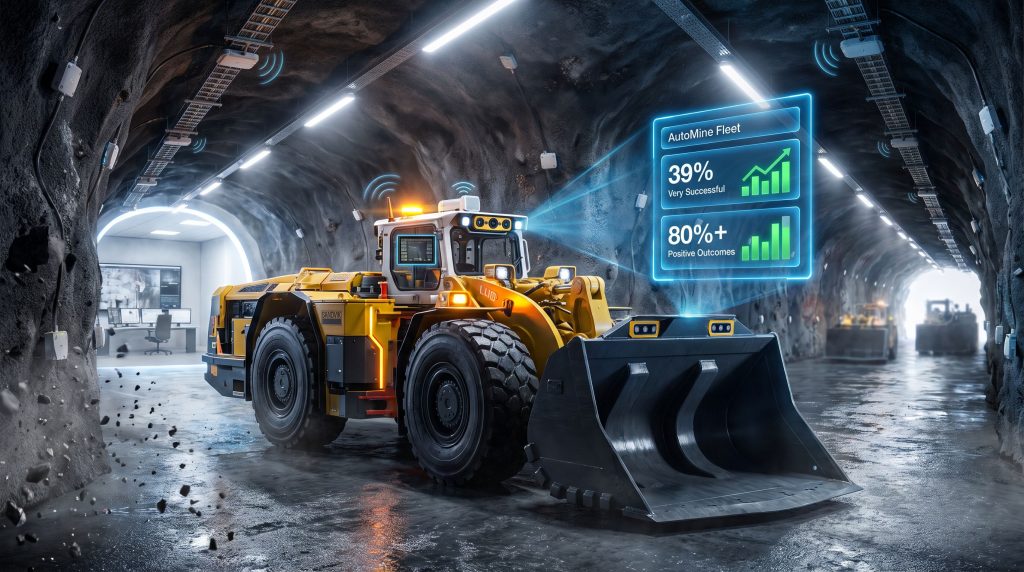
The commercial justification for automation investment has historically been contested terrain, with productivity claims often outpacing demonstrated results. However, industry survey data is shifting that conversation. According to Mining IQ research, 39% of miners who implemented automation rated their projects as very successful, with a further 43% reporting moderate success. Combined, these figures indicate that more than four in five automation adopters recorded outcomes they considered positive.
This data point carries significant weight for risk-adjusted investment analysis. In capital-intensive industries where major technology deployments frequently underdeliver, an 82% positive outcome rate across a diverse adoption base suggests that automation systems have crossed the threshold from experimental to reliably deployable. Consequently, investment committees that previously treated automation as speculative are increasingly incorporating it into base-case capital planning.
Productivity and Cost Efficiency Variables
The economic argument for Sandvik onboard automation in mining operates across several distinct value dimensions that compound when analysed together:
| Cost Variable | Crewed Operation | Automated Operation |
|---|---|---|
| Operator hours per shift | Full crew required at machine level | Reduced to supervisory and monitoring roles |
| Machine utilisation rate | Constrained by shift patterns and change-over periods | Extended through automation cycles with reduced downtime |
| Hazardous zone exposure | High, with corresponding injury risk and compensation liability | Significantly reduced through physical separation |
| Maintenance predictability | Primarily reactive following operational incidents | Sensor-assisted, enabling proactive scheduling |
| Continuous production capacity | Limited by human fatigue thresholds | Operational continuity across extended periods |
The productivity multiplier that matters most in deep underground operations is machine utilisation rate. Conventional shift structures introduce unavoidable gaps as operators travel to and from active mining faces, conduct pre-shift checks, and rotate between crews. Automated systems reduce these gaps substantially, which in high-grade underground mines where ore extraction rates are tightly linked to development schedules translates directly into revenue timing advantages.
Drilling Automation: A Different Technical Challenge
How Sandvik Applies Onboard Intelligence to Drill Platforms
Loader and truck automation attract most of the attention in underground automation discussions, but Sandvik's onboard automation capabilities extend comprehensively to drilling equipment, where the technical implementation differs meaningfully from mobile haulage systems. In addition, the underground mining sensor technology embedded in modern drill platforms is advancing the resolution and accuracy of geological data capture well beyond what manual drilling operations can achieve.
Drill automation focuses on task-sequential execution: automatic positioning of the drill over the designated collar location, autonomous hole collaring without manual alignment, pipe handling during rod additions and removals, and full drill cycle completion from setup through extraction. Each of these functions represents a discrete interaction between the machine and the rock face that previously required skilled operator judgement.
The distinction from loader and truck automation is instructive. Mobile haulage automation is primarily a spatially dynamic problem, requiring continuous navigation through tunnel networks where conditions change as development progresses. Drill automation is more accurately characterised as a precision task execution problem, where the machine must perform a defined sequence of actions with high repeatability at fixed or semi-fixed locations.
This difference shapes the sensor architecture and feedback loop design. Drill platforms rely heavily on force sensing, torque measurement, and vibration analysis to manage interaction with rock, while navigation sensors play a secondary role compared to their importance in autonomous loader operation.
Drilling Data as a Geological Intelligence Asset
One dimension of drill automation that receives insufficient attention is its function as a geological data collection system. Automated drilling platforms generate continuous logs of penetration rate, torque variance, water pressure, and vibration signatures across every metre drilled. When integrated with mine planning software and geological databases, this dataset builds a continuously updated picture of orebody characteristics that manual drilling operations cannot match in resolution or consistency.
This capability positions drill automation not just as an operational efficiency tool but as a geological intelligence asset that informs reserve estimation, blast design, and development planning. For a broader perspective on how these capabilities are shaping the sector, Sandvik's underground automation positioning highlights the strategic direction the company is pursuing across its mining and rock solutions division.
Safety Architecture as a Primary Design Requirement
Redefining Risk in Underground Environments
The safety case for onboard automation in underground mining addresses several distinct hazard categories simultaneously. Physical separation of workers from active mining faces reduces exposure to blast concussion, post-blast atmospheric contamination, and the risk of ground instability events during the most vulnerable phases of rock extraction.
The onboard safety unit operates as an independent protective layer within the automation architecture. Critically, it does not depend on the navigation computer or wireless communication link to execute emergency responses. This design choice reflects the recognition that the most dangerous scenarios, including communication failures, seismic events, and sudden environmental changes, are precisely the conditions under which automated safety responses must be most reliable.
Scenario: An underground loader operating autonomously detects a seismic trigger via onboard sensors. The safety unit initiates an emergency park sequence immediately, the wireless communication unit transmits an alert to the surface control room, and the navigation computer logs positional data for post-event analysis. Every one of these responses occurs without requiring human presence anywhere near the hazard zone.
This illustrates why safety architecture must be treated as a primary design requirement rather than a compliance add-on.
Regulatory Context Across Major Mining Jurisdictions
The regulatory landscape for autonomous mining equipment varies significantly across Australia, Canada, Sweden, and Chile, which represent the highest-density markets for underground automation deployment. Australian jurisdictions have developed specific guidance for autonomous and remotely operated equipment through state-level mining safety regulators, with Western Australia's Department of Mines, Industry Regulation and Safety having published technical guidelines that shape implementation requirements.
Canadian provincial frameworks similarly address autonomous equipment operation, while Scandinavian regulators have developed standards that reflect the significant volume of automation deployment in Nordic underground mines. Understanding how onboard safety units are validated against these jurisdictional requirements is a meaningful due diligence consideration for operators planning automation deployments across multiple geographies.
The next major ASX story will hit our subscribers first
AutoMine System Tiers: Matching Technology to Operational Scale
AutoMine Lite: The Entry Point for Automation Adoption
AutoMine Lite addresses the operational reality that many underground mines cannot justify or fund fleet-wide automation infrastructure from a standing start. By automating a single loader at a time and replacing line-of-sight remote control with semi-autonomous operation, it creates a pathway for operators to build internal capability, validate the technology against site-specific conditions, and establish the business case for broader deployment without committing to the full infrastructure investment upfront.
AutoMine Multi-Lite: Coordinated Operation at Intermediate Scale
The step from single-machine to coordinated multi-machine automation introduces the traffic management dimension that becomes central to operational efficiency at scale. AutoMine Multi-Lite enables coordination across multiple machines without requiring the full fleet management infrastructure of the Core system, making it the appropriate solution for mid-scale producers that have outgrown single-machine automation but are not yet operating at the tonnage volumes where mass-mining infrastructure delivers maximum return.
AutoMine Core and Fleet: Autonomous Operation at Production Scale
At the highest tier, AutoMine Core delivers traffic management, machine coordination, real-time surface monitoring, and integrated data collection across large underground networks. The system is designed for continuous high-tonnage production environments where maximising machine utilisation across an entire fleet translates into material revenue and cost advantages.
The connectivity architecture at this level enables surface-based control rooms to monitor every machine in the automated fleet simultaneously, with operational data feeding into mine management systems, maintenance scheduling platforms, and geological databases in near real time. These are the kinds of data-driven mining operations that are increasingly defining competitive advantage across the global underground mining sector.
Automation as a Foundation for Mine Digitalisation
Onboard Sensors as Continuous Data Generators
Each automated machine in an underground fleet functions simultaneously as a production asset and a data collection node. Navigation computers, safety units, and onboard sensors collectively generate datasets covering machine position, cycle times, equipment health indicators, and environmental conditions across every shift. The cumulative value of this data, when properly structured and integrated with mine management software, extends well beyond operational monitoring.
Predictive maintenance in mining applications built on onboard sensor telemetry are already demonstrating the capacity to identify component wear patterns before they generate failures, reducing unplanned downtime in a class of machinery where maintenance events are particularly costly given the logistics of underground access.
Digital Twins and the Simulation Advantage
An emerging application of automation-generated data is the development of digital twins for underground mining environments. These virtual replicas of physical mine infrastructure allow operators to simulate changes to automation configurations, machine counts, and routing logic before implementing them in the physical environment, a capability that reduces the risk and cost of operational optimisation.
Digital twin modelling also supports the application of machine learning algorithms that use historical cycle data to identify inefficiencies, optimise loading sequences, and predict the downstream effects of changes to mine development plans on automated fleet performance. Furthermore, AI-powered mining efficiency tools are increasingly being layered on top of these datasets to accelerate the pace of operational insight generation. For a detailed technical overview of the AutoMine machine fleet architecture, Sandvik's own documentation provides comprehensive specifications across the full product range.
Understanding the Challenges of Automation Deployment
Infrastructure Prerequisites That Operators Must Prepare For
Successful Sandvik onboard automation in mining deployment depends on infrastructure conditions that are not inherent to underground mining environments and must be deliberately engineered:
- Underground wireless mesh networks with sufficient signal strength and redundancy to maintain reliable communication throughout all active mining areas
- Signal repeater placement calibrated to tunnel geometry, which can be highly irregular in operating mines
- Power redundancy systems for safety-critical onboard components that must maintain function even during primary power disruptions
- Compatible fleet management software that can integrate automation data streams with existing operational systems
- Ground condition compatibility with navigation sensor technology, since highly irregular tunnel geometries or significant water ingress can affect sensor performance
These prerequisites mean that automation deployment planning must begin significantly upstream of equipment commissioning, with infrastructure investment treated as an integral component of the total project cost.
Workforce Transition: Skills Restructuring, Not Elimination
The workforce dimension of automation adoption is often framed in terms of job displacement, but the more accurate framing is skills restructuring. Operators who previously controlled machines at the face transition into remote operation technician roles, automation systems supervisors, and data analysis positions that require a different but not necessarily lesser skill set.
Automation adoption does not eliminate the need for skilled mine workers. It restructures the skill profile required, moving operators from physical machine control toward systems monitoring, data interpretation, and remote intervention responsibilities.
Change management in unionised mining workforces presents a distinct challenge that sits alongside the technical implementation. Operations that have invested in transparent communication about role transitions, structured reskilling pathways, and genuine consultation with workforce representatives have consistently achieved smoother automation rollouts than those that treated the technology deployment as independent from its human dimensions.
Frequently Asked Questions: Sandvik Onboard Automation in Mining
What is Sandvik's AutoMine system?
AutoMine is Sandvik's onboard automation platform for underground loaders, trucks, and drilling equipment. It enables varying degrees of machine autonomy, from basic tele-remote operation through to fully autonomous multi-machine fleet management, all monitored from surface control rooms.
What hardware components form the onboard automation package?
The standard configuration includes a wireless communication unit, navigation computer, safety unit, audio/video system, and navigation sensors, all integrated with the machine's VCM architecture.
How successful has automation been in practice across the industry?
Mining IQ survey data indicates that more than 80% of mining operators who implemented automation reported positive outcomes, with 39% classifying their projects as very successful and 43% as moderately successful.
What separates AutoMine Lite from AutoMine Core?
AutoMine Lite automates single machines in semi-autonomous operating modes, suited to operations beginning their automation journey. AutoMine Core, however, supports full fleet management, traffic coordination, and mass-mining operations with comprehensive data integration capabilities.
Does Sandvik apply onboard automation to drilling equipment?
Yes. The automation platform extends to both surface and underground drilling equipment, enabling automatic positioning, hole collaring, pipe handling, and full autonomous drill cycle execution, along with continuous geological data capture.
What infrastructure must a mine have before deploying onboard automation?
Key prerequisites include underground wireless mesh network coverage, signal redundancy throughout active mining areas, power redundancy for safety-critical systems, and compatible fleet management software platforms.
Key Takeaways for Mining Operators and Industry Observers
- Sandvik onboard automation has evolved from peripheral add-on technology into core machine architecture through integration with the VCM system
- The AutoMine product family offers scalable entry points from single-machine semi-automation through to full autonomous fleet operation at production scale
- Industry adoption data confirms broadly positive outcomes, with over 80% of implementing operators reporting success across Mining IQ survey data
- Drill automation generates valuable geological datasets that extend its value beyond operational efficiency into reserve management and mine planning
- Safety architecture, particularly the independent safety unit, is designed to function reliably in the most challenging underground conditions without human intervention
- Infrastructure investment, particularly wireless network engineering, must be treated as an integral element of automation deployment budgets
- Workforce transition planning, including reskilling pathways and change management, is an essential parallel investment alongside technical deployment
This article is for informational purposes only and does not constitute financial or investment advice. Readers should conduct independent research and consult qualified advisors before making capital allocation decisions related to mining technology or equipment investments.
Want to Stay Ahead of the Next Major ASX Mining Discovery?
As underground mining operations become increasingly automated and data-driven, the companies pioneering these technologies are generating significant investor interest — and the biggest returns often go to those who act earliest. Discovery Alert's proprietary Discovery IQ model scans ASX announcements in real time, instantly identifying significant mineral discoveries and turning complex data into actionable insights, much like the historic finds from De Grey Mining and WA1 Resources that delivered extraordinary returns. Start your 14-day free trial at Discovery Alert and position yourself ahead of the broader market.