August 19, 2026
The Engineering Behind Potline Thermal Control: Why Cooling Systems Define Aluminium Smelter Performance
Few industrial processes are as thermally demanding as aluminium electrolysis. Inside an operating potline, temperatures within the molten bath regularly exceed 950 degrees Celsius, and the structural integrity of every cell depends on a precise, continuous balance between heat generation and heat removal. Long before any discussion of market positioning, contract values, or corporate strategy, the physics of the Hall-Héroult process sets the terms under which every smelter operates. Thermal management is not an optional upgrade; it is a foundational engineering requirement.
Understanding this reality is the starting point for evaluating why the Ducon cooling system contract at an Indian aluminium smelter carries significance well beyond a single equipment order. Furthermore, when examined alongside broader industrial metals demand trends, this contract reflects a wider shift in how smelter operators are approaching infrastructure investment.
When big ASX news breaks, our subscribers know first
The Thermal Physics of Aluminium Electrolysis
How the Hall-Héroult Process Generates Continuous Heat Loads
The Hall-Héroult process dissolves alumina into a molten cryolite bath and passes high electrical current through the solution to liberate aluminium metal at the cathode. The electrochemical efficiency of this reaction is inherently limited; a substantial fraction of the electrical energy input is not converted into metal production but is instead dissipated as heat within the cell. In a large modern potline operating at currents exceeding 400 kiloamperes, each individual pot generates a continuous thermal load measured in hundreds of kilowatts.
The consequences of this heat accumulation are structural. Inside each pot, a layer of solidified bath material, commonly called the frozen ledge, lines the sidewalls of the cell and separates the corrosive molten bath from the carbon pot lining beneath. This frozen ledge is the primary defence against bath penetration into the lining structure. Its existence depends entirely on maintaining sidewall temperatures within a narrow operational window.
If sidewall temperatures rise beyond this window, the ledge thins or disappears entirely, exposing the carbon lining to molten bath attack and dramatically accelerating cell degradation. Pot lining replacement represents one of the most significant recurring capital costs in aluminium smelter operations. Industry estimates consistently place pot relining costs at several hundred thousand dollars per cell, and with potlines containing anywhere from 200 to over 400 individual pots, the financial stakes of poor thermal management are substantial.
Amperage Creep and the Escalating Cooling Requirement
A less widely discussed but critically important dynamic in operating smelters is the practice known as amperage creep. Rather than constructing new reduction cells to expand output, smelter operators frequently elect to incrementally increase the electrical current flowing through existing cells. Each incremental amperage increase raises metal production per cell but simultaneously increases the heat generated within the cell in near-direct proportion.
This creates a compounding thermal management challenge. A smelter that has progressively increased its operating amperage over several years may be generating substantially more heat per pot than was envisaged when the original cooling infrastructure was designed. Without corresponding upgrades to the cooling system, the frozen ledge comes under increasing pressure, cell stability deteriorates, and the gains from amperage optimisation are partially or fully offset by elevated maintenance costs and shortened pot lining lifespan.
Forced Cooling Network systems are the engineering response to this challenge. Their deployment is, in many cases, a prerequisite for safely pursuing amperage creep strategies without compromising potline integrity.
How Forced Cooling Network Systems Work: A Technical Overview
Core Engineering Architecture
A Forced Cooling Network system is an engineered infrastructure of ducts, distribution manifolds, and directional nozzles installed around the exterior shell of electrolytic reduction cells. Unlike passive cooling, which relies on natural convection currents to carry heat away from cell surfaces, or water-based cooling systems that embed fluid circuits within the pot structure, an FCN system uses mechanically driven airflow precisely directed at specific zones of the pot shell exterior.
The engineering logic is straightforward but demanding in execution. By controlling the volume, velocity, and distribution of forced-air streams across the pot shell surface, an FCN system can extract heat at rates that natural convection cannot approach, while maintaining the internal thermal gradient that sustains the frozen ledge. The system must be calibrated to remove sufficient heat to stabilise sidewall temperatures without over-cooling the cell, which would cause excessive ledge growth and disrupt bath chemistry.
Comparing Potline Cooling Technologies
The choice between cooling methodologies involves engineering trade-offs that vary depending on smelter design, operating amperage, and site conditions.
| Cooling Method | Mechanism | Key Advantage | Primary Limitation |
|---|---|---|---|
| Forced Cooling Network | Directed forced-air via ducts and nozzles | No moisture risk; precise thermal targeting | Requires engineered duct infrastructure |
| Passive Air Cooling | Natural convection around pot shell | Zero energy input | Insufficient at high amperage operations |
| Water-Cooled Panels | Water circuits embedded in pot structure | High heat extraction capacity | Risk of water ingress causing catastrophic cell failure |
| Evaporative Cooling | Water evaporation for ambient reduction | Relatively low cost | Inconsistent performance; climate-dependent |
Critical Engineering Distinction: Water-cooled systems offer high heat extraction but carry a risk that is unique and severe in the smelter environment: any leak introducing water into contact with molten aluminium or the hot bath can trigger a steam explosion. FCN technology eliminates this failure mode entirely by using air as the heat-transfer medium, making it the preferred solution for high-amperage potlines where risk management is paramount.
What End-to-End Contract Scope Actually Means
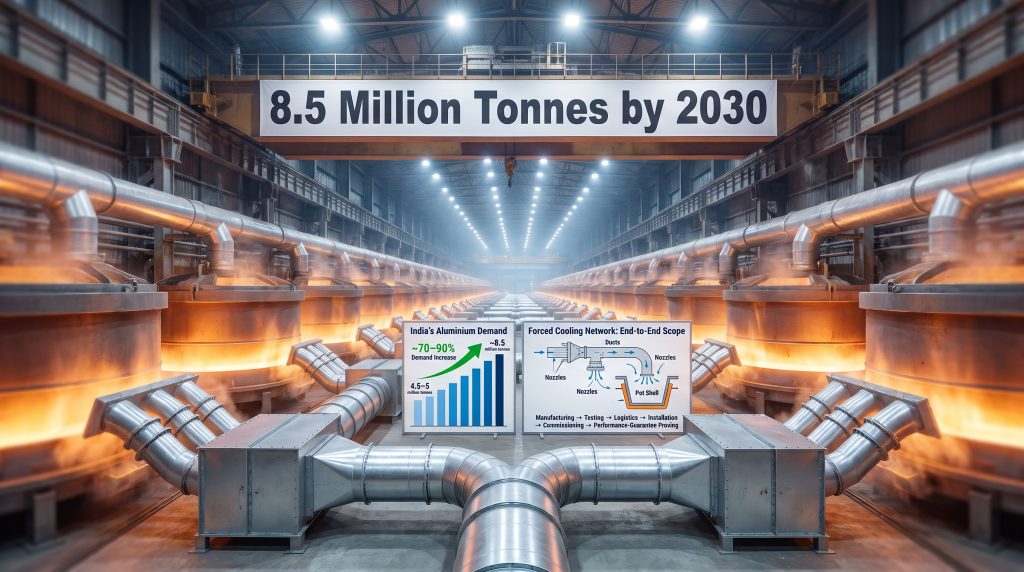
The term end-to-end is frequently used in industrial contracting but carries specific technical and commercial implications that distinguish it from simpler equipment supply arrangements. In the context of the Ducon cooling system contract at an Indian aluminium smelter, the scope encompasses every phase of the system lifecycle:
- Manufacturing and factory acceptance testing of FCN components to specified engineering standards
- Protective packaging and logistics management from the point of manufacture to the smelter site
- Mechanical installation within the live potline environment, which requires managing work around operating electrolytic cells
- System commissioning, including airflow calibration, nozzle alignment, and thermal distribution validation across the potline
- Performance-guarantee proving, where the contractor must demonstrate that the installed system achieves agreed operational benchmarks before the contract is considered fulfilled
- Provision of specialist technical personnel throughout execution to manage installation integrity and commissioning accuracy
Operational Insight: Performance-guarantee provisions are the most consequential element of this contract structure. They require Ducon to demonstrate measurable outcomes, potentially including maximum pot shell temperature thresholds or airflow uniformity specifications, before receiving final acceptance. This aligns contractor incentives directly with smelter operational outcomes and distinguishes end-to-end contracts from transactional equipment supply in both complexity and commercial risk.
Why India's Aluminium Sector Is Driving Potline Infrastructure Investment Now
The Structural Demand Gap Underpinning Capital Expenditure
India's aluminium market is defined by a persistent and widening gap between domestic production capacity and consumption growth. National aluminium demand is projected to reach approximately 8.5 million tonnes by 2030, roughly double current consumption levels, driven by expansion across construction, automotive lightweighting, electrical infrastructure, and packaging sectors. The emergence of electric vehicle manufacturing as a demand driver adds further structural momentum, given aluminium's role in battery housings, structural components, and thermal management systems within EV platforms.
| Metric | Current Estimate | 2030 Projection |
|---|---|---|
| India Aluminium Demand | ~4.5 to 5 million tonnes per year | ~8.5 million tonnes per year |
| Implied Growth Requirement | Baseline | ~70 to 90 percent increase |
| Primary Demand Growth Sectors | Construction, Automotive, Packaging | Above plus EVs, Grid Infrastructure |
Despite significant domestic smelting capacity, India has historically been a net importer of aluminium in certain product categories, reflecting the mismatch between production expansion rates and consumption growth. This structural gap incentivises smelter operators to maximise output from existing facilities through operational optimisation, including potline amperage increases that directly elevate the need for robust thermal management infrastructure. In addition, commodity price pressures on aluminium producers globally are reinforcing the need to extract maximum efficiency from existing assets rather than committing to new greenfield capacity.
Odisha's Role as India's Aluminium Industrial Centre
Odisha has emerged as the geographic focal point of Indian primary aluminium production. The state's combination of accessible bauxite reserves, established smelter infrastructure, rail and port connectivity, and existing industrial workforce creates conditions that have concentrated large-scale smelting capacity within its boundaries. Ducon's management has described Odisha as representing the centre of gravity for India's aluminium industrial activity, a characterisation that reflects the state's structural importance rather than any formal policy designation.
For engineering and systems contractors, this geographic concentration has a practical implication: a significant share of potline infrastructure procurement activity is being generated within a relatively contained industrial corridor. Contractors who establish a presence within this supply chain through demonstrated performance at major facilities gain a compounding advantage in subsequent procurement rounds. Furthermore, top aluminium producers operating in this region are accelerating capital expenditure timelines to meet projected demand.
The Operational Economics of Potline Cooling Investment
The financial logic driving smelter operators to invest in FCN system upgrades is more nuanced than it might initially appear. The direct costs of poor thermal management extend well beyond the visible expense of pot relining. They include reduced current efficiency, which increases energy consumption per tonne of aluminium produced; elevated bath chemistry variability, which affects metal purity and process consistency; and increased frequency of cell shutdowns for maintenance, each of which temporarily removes productive capacity from the potline.
When the full cost of thermal management failure is aggregated across a potline of 300 or more cells, the return on investment for a well-engineered FCN system upgrade becomes compelling even before considering the production gains from safe amperage optimisation.
Decoding the Contract: What Remains Known and Unknown
What the Disclosed Scope Reveals
The publicly available information about the Ducon cooling system contract at the Indian aluminium smelter confirms several strategically significant facts. First, the contract covers the complete FCN system lifecycle, indicating that Ducon is functioning as a primary contractor with full accountability rather than a component supplier or subcontractor. Second, the installation is at one of India's largest single aluminium smelter facilities, suggesting a potline scale that demands a correspondingly sophisticated and high-capacity FCN system.
Third, the inclusion of performance-guarantee proving as a contractual obligation indicates that the smelter operator has structured the procurement to ensure measurable operational outcomes, not merely equipment delivery.
Material Information That Has Not Been Disclosed
Equally important for any informed assessment is what the announcement does not reveal:
- The identity of the smelter operator and the precise plant location remain undisclosed
- The financial value of the contract has not been published, preventing direct revenue impact assessment
- No project completion timeline has been specified, making revenue-recognition timing uncertain for investors
- No quantified performance benchmarks, such as target pot shell temperature ranges or production efficiency improvements, have been stated
These gaps are not unusual in industrial contracting announcements where commercial sensitivity applies, but they do limit the conclusions that can be drawn about near-term financial impact.
The Dual-Sector Opportunity: Aluminium and Thermal Power
FCN Systems Within a Broader Industrial Engineering Capability
The engineering competencies required to design, manufacture, and commission a forced cooling network for an aluminium smelter potline overlap meaningfully with the technical capabilities needed in thermal power infrastructure. Ducting systems, forced-air management, industrial installation in high-temperature environments, and performance validation in operational facilities are skills that transfer across both sectors.
India thermal power capacity additions, estimated at approximately 33,000 MW of coal-fired generating capacity in the coming years, represent a separate but related infrastructure pipeline. New thermal generating units require fly-ash handling systems, environmental control equipment, and industrial air management infrastructure. For a contractor positioned across both the aluminium and power sectors, this creates a demand profile that is less dependent on the cyclicality of any single industry.
Investor Perspective: It is important to note that the 33,000 MW thermal power capacity figure represents a broader market opportunity rather than secured revenue for any specific contractor. The translation of this potential pipeline into actual contract awards depends on capital expenditure timing, procurement processes, and competitive outcomes that cannot be assumed in advance.
The Strategic Logic of Sector Diversification
The operational overlap between aluminium smelter cooling systems and thermal power infrastructure creates a natural hedge within an industrial contractor's business development strategy. When aluminium sector capital expenditure contracts, power sector procurement may expand, and vice versa. Maintaining demonstrated capability across both sectors reduces revenue concentration risk while leveraging a shared technical skill base. Consequently, metals decarbonisation trends are also shaping how contractors position their engineering offerings, as smelter operators increasingly face pressure to demonstrate environmental performance alongside production efficiency.
The next major ASX story will hit our subscribers first
What This Contract Signals for India's Industrial Engineering Landscape
The Shift Toward Full-Lifecycle Industrial Contracting
A broader trend is visible across India's aluminium sector procurement: major smelter operators are progressively moving away from fragmented equipment purchasing toward integrated, full-scope service contracts. The drivers of this shift are operational rather than simply financial. Single-contractor accountability across design, supply, installation, and performance validation eliminates the coordination risk that arises when multiple vendors share responsibility for a critical system's performance.
For engineering contractors, full-lifecycle contracts represent higher complexity and greater financial exposure through performance-guarantee provisions, but they also offer deeper client relationships, higher contract values per engagement, and the reference project credentials that are essential for winning subsequent procurement rounds in a sector where demonstrated experience matters enormously.
The Compounding Value of Reference Projects in Specialised Infrastructure
In industrial smelter contracting, a single successfully delivered project at a major facility carries disproportionate commercial weight. Smelter operators considering FCN system procurement prioritise contractors with verified experience in the specific operating environment of an aluminium potline. The high-temperature conditions, live potline proximity constraints, and electrolytic process continuity requirements during installation create a technically demanding environment where untested contractors represent genuine operational risk.
A contractor that completes a full-scope FCN installation with demonstrated performance-guarantee achievement at one of India's largest smelters effectively holds a credential that is difficult for competitors to replicate without comparable project history.
Frequently Asked Questions: FCN Systems and Potline Cooling Contracts
What is a Forced Cooling Network system in an aluminium smelter?
A Forced Cooling Network system is an engineered thermal management infrastructure that uses mechanically driven airflow, delivered through a network of ducts and directional nozzles, to remove excess heat from the exterior shell of electrolytic reduction cells in an aluminium smelter's potline. Its primary functions are controlling sidewall temperatures, preserving the protective frozen ledge inside each cell, and maintaining process stability as operating currents increase over time.
Why do aluminium smelters require dedicated potline cooling systems?
The Hall-Héroult electrolysis process generates substantial and continuous heat. Without active thermal management, pot shell temperatures rise to levels that compromise the frozen ledge, a solidified bath material layer that protects the carbon pot lining from molten aluminium penetration. Cooling failures accelerate pot lining degradation, increase maintenance costs, and reduce potline efficiency across hundreds of cells simultaneously.
What does an end-to-end FCN contract typically include?
A full-scope FCN contract generally encompasses component manufacturing and factory acceptance testing; protective packaging and logistics to site; mechanical installation within the potline environment; system commissioning including airflow calibration and thermal distribution validation; performance-guarantee proving against agreed operational benchmarks; and provision of specialist technical personnel throughout all execution phases.
How does potline cooling relate to aluminium production output?
Effective thermal management enables smelter operators to safely sustain or incrementally increase operating amperages, a practice known as amperage creep, which directly increases metal production rates per cell without requiring new pot construction. FCN systems are therefore an enabling technology for production optimisation at existing smelter facilities.
What is India's projected aluminium demand by 2030?
India's aluminium demand is projected to reach approximately 8.5 million tonnes by 2030, driven by growth across construction, automotive, packaging, and power infrastructure sectors, with electric vehicle manufacturing adding further structural demand as that industry scales domestically.
Key Takeaways
- FCN systems are critical enabling infrastructure for aluminium smelters operating at high amperages, directly supporting potline stability, pot lining longevity, and production efficiency through precise forced-air thermal control
- End-to-end industrial contracts covering the full lifecycle from manufacturing through performance-guarantee proving represent a materially more complex and strategically significant engagement than equipment-only supply arrangements
- India's aluminium demand is projected to reach approximately 8.5 million tonnes by 2030, creating sustained capital expenditure pressure on domestic smelter operators to expand and optimise production infrastructure
- Odisha has emerged as the focal point of Indian aluminium industrial activity, concentrating procurement opportunities for specialised smelter infrastructure contractors within a defined industrial corridor
- The convergence of aluminium sector expansion and thermal power capacity growth, estimated at approximately 33,000 MW of new coal-fired capacity, creates a dual-sector infrastructure opportunity for industrial systems providers with relevant engineering capabilities across both domains
- The absence of disclosed contract financials, project timelines, and operator identity limits the ability to quantify near-term commercial impact from this specific award, and investors should weigh the strategic significance of the contract's scope against the financial opacity of the announcement
This article contains forward-looking projections and market estimates drawn from publicly available industry sources. These figures represent analytical forecasts and should not be relied upon as guarantees of future outcomes. Readers conducting investment decisions should consult primary financial disclosures and seek independent professional advice.
Want to Capitalise on the Next Major Mineral Discovery Before the Broader Market?
Discovery Alert's proprietary Discovery IQ model delivers real-time alerts on significant ASX mineral discoveries — instantly transforming complex mineral data into actionable investment insights for both short-term traders and long-term investors. Explore historic examples of exceptional discovery returns and begin your 14-day free trial today to position yourself ahead of the market.