August 20, 2026
The Decarbonisation Gamble That Could Reshape Australia's Manganese Future
The global steel and battery industries are undergoing a once-in-a-generation transition. Pressure to eliminate carbon from industrial metal processing is no longer a distant policy aspiration — it is a commercial imperative reshaping capital allocation, supply chain architecture, and acquisition strategy across the resources sector. Against this backdrop, the Natrium Redox Liberty Bell Bay smelter story has positioned a decommissioned Tasmanian facility as an unlikely focal point for one of the most technically ambitious green metals proposals Australia has seen in years.
This is not simply a tale of industrial decline and potential revival. It is a case study in how novel decarbonisation technology intersects with liquidation law, critical minerals demand policy, and the economics of stranded industrial infrastructure — and what happens when all of those forces collide simultaneously.
When big ASX news breaks, our subscribers know first
Understanding What Makes the Bell Bay Site So Difficult to Replace
Sixty-six years of continuous manganese alloy production leaves behind more than rust and slag. The Liberty Bell Bay facility in Tasmania's northern Bell Bay industrial precinct represents an irreplaceable concentration of sunk capital: submerged arc furnaces, dedicated grid connections, port infrastructure capable of handling bulk ore shipments, and industrial zoning that would take years and considerable political will to replicate anywhere else in Australia.
Manganese is not a discretionary input in steelmaking. Every tonne of steel produced requires manganese as an alloying agent to improve tensile strength, hardness, and resistance to abrasion. Without domestic processing capacity, Australian steelmakers face structural import dependence — a vulnerability that becomes acutely visible whenever global supply chains experience disruption.
The smelter's collapse was not driven by commodity market failure. Manganese demand has remained robust, underpinned by both traditional steel applications and rapidly growing battery sector requirements. What failed was the corporate governance framework surrounding the asset — specifically, the financial architecture of GFG Alliance, the conglomerate controlled by Sanjeev Gupta that acquired the facility in 2020.
The Collapse Timeline: From Administration to Liquidation
| Milestone | Date | Key Development |
|---|---|---|
| Placed into administration | March 2026 | Financial distress under GFG Alliance ownership |
| Preferred buyer selected | Mid-2026 | White Oak-led consortium chosen |
| Sale collapses, site closes | July 2026 | Approximately 200 workers made redundant |
| Creditors vote to wind up | Early August 2026 | EY Parthenon appointed as liquidators |
| Liquidation formally begins | August 2026 | Creditor recovery process activated |
This timeline matters because it creates a compressing decision window. The longer Bell Bay sits idle, the more the underlying asset value erodes — particularly with respect to the submerged arc furnaces, whose restart viability degrades in a non-linear fashion with every week of cold shutdown.
The Sodium-Reduction Process: A Technical Deep Dive
To appreciate what Natrium Redox Technologies is actually proposing, it helps to understand why conventional manganese smelting is so carbon-intensive in the first place.
In a standard submerged arc furnace operation, metallurgical coke serves as the chemical reducing agent. It binds with the oxygen molecules in manganese ore at extreme temperatures, stripping them away and releasing the bound metal — but in doing so, generates significant volumes of carbon dioxide as a byproduct. This is not an inefficiency that can be engineered away within the conventional process; it is chemically inherent to coke-based reduction.
Natrium Redox Technologies, headquartered in the United Kingdom, has spent approximately six to seven years developing an alternative pathway. The company's sodium-reduction process substitutes sodium metal for metallurgical coke as the reducing agent. Sodium performs the same oxygen-stripping chemistry, but without generating CO₂ as a combustion product. Furthermore, the critical minerals processing implications of this approach are considerable for Australia's domestic supply chain ambitions.
"The output of this process is not standard ferromanganese alloy — it is ultra-high-purity manganese powder. That distinction is commercially significant. Battery-grade manganese commands substantially higher per-tonne pricing than the commodity-grade alloy produced by conventional smelting, reflecting its utility as a cathode input for next-generation lithium-manganese chemistries."
Why Purity Grade Changes the Entire Commercial Equation
The manganese product hierarchy matters enormously when evaluating the economics of any Bell Bay revival:
- Standard ferromanganese alloy: Commodity-grade, sold into steelmaking markets at relatively modest per-tonne margins
- High-purity manganese sulfate: Intermediate-grade, used in some battery applications but requiring further processing
- Ultra-high-purity manganese powder: Battery-grade, directly applicable as a cathode precursor for lithium-manganese-oxide (LMO) and lithium-manganese-iron-phosphate (LMFP) battery chemistries, commanding premium pricing
LMFP battery chemistry is gaining meaningful traction among major electric vehicle manufacturers for reasons that are both technical and economic. It offers improved thermal stability relative to nickel-heavy cathode chemistries, lower raw material cost exposure, and a more geographically diversified supply chain. Consequently, these characteristics make it attractive for manufacturers seeking to reduce dependence on Chinese processing dominance in the battery raw materials market.
Australia currently holds significant manganese ore reserves but lacks the domestic high-purity processing capacity to convert that geological advantage into battery supply chain positioning. Bell Bay, under the Natrium Redox proposal, would change that calculus.
Two Strategic Pathways, One Compressing Window
Natrium Redox has articulated two distinct operational scenarios for the Bell Bay site, each with different capital requirements, employment profiles, and risk characteristics.
Scenario A: Hybrid Furnace Restart With New Processing Unit
The more ambitious of the two proposals involves restarting Bell Bay's existing submerged arc furnaces while simultaneously commissioning a sodium-reduction processing unit on-site. The dual-stream operation would generate both conventional manganese alloy output and the new ultra-high-purity powder product.
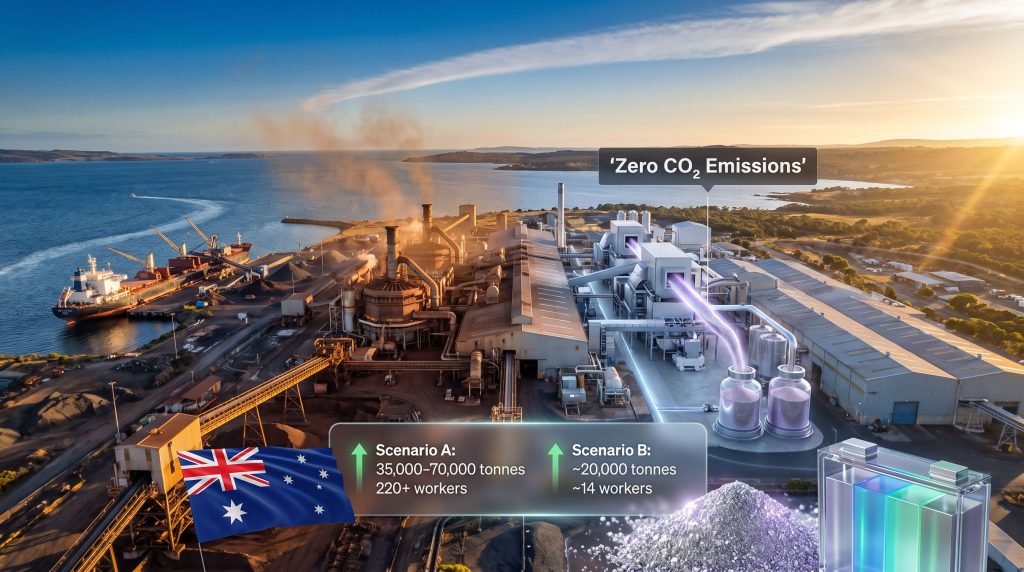
Projected annual throughput under this scenario sits between 35,000 and 70,000 tonnes — representing a 20 to 40 percent uplift over the site's previous production capacity. Employment potential at full operation exceeds 220 workers, comparable to the workforce that existed before the closure.
The critical constraint is time. Submerged arc furnaces are complex thermal systems that deteriorate during cold shutdown. Refractory lining degradation, electrode system complications, and mechanical seizing of ancillary equipment all accelerate during extended idle periods. Beyond a certain threshold, what was a dormant asset becomes stranded infrastructure — and the capital cost of recommissioning escalates to the point where it may no longer be economically justifiable.
According to Natrium Redox executive chairman Dr Bill Higgs, that threshold is approaching. The longer those furnaces remain inactive, the greater the technical complexity and financial burden of restart — and there is a point, not far off by his assessment, at which they effectively become abandoned assets regardless of any acquirer's intentions.
Scenario B: Waste Remediation and Metal Recovery
The second proposal is structurally more conservative and technically lower-risk. Rather than restarting furnaces, Natrium Redox would deploy its sodium-reduction technology to process the accumulated smelting waste stockpiles already present at the site.
Conventional smelting is, by its nature, an imprecise extraction process. Meaningful quantities of metallic manganese carry over into the slag and fine ore residues generated during processing — material that was previously uneconomic to recover using conventional methods. Natrium Redox's technology, operating at lower temperatures and using a chemical rather than thermal reduction pathway, can extract this carryover metal from waste streams that conventional processes would write off entirely.
Projected throughput under Scenario B is approximately 20,000 tonnes per year, with an initial workforce of around 14 workers. The employment footprint is modest compared to Scenario A, but the strategic value is twofold: it generates revenue from a previously unproductive waste stream while progressively eliminating the site's environmental liability rather than simply deferring it.
Side-by-Side Scenario Comparison
| Dimension | Scenario A: Hybrid Restart | Scenario B: Waste Remediation |
|---|---|---|
| Annual throughput | 35,000–70,000 tonnes | ~20,000 tonnes |
| Jobs created | 220+ (at full scale) | ~14 (initial) |
| Capital intensity | High | Moderate |
| Time sensitivity | Critical | Lower urgency |
| Environmental liability | Partially addressed | Progressively eliminated |
| Revenue profile | Dual-stream | Single-stream |
| Technology risk | Higher (scale-up required) | Lower (contained processing) |
The Environmental Liability Dimension: A Hidden A$200 Million Problem
Any analysis of Bell Bay's future that ignores the site's environmental remediation liability is incomplete. Decades of smelting operations have produced substantial waste stockpiles carrying an estimated clean-up cost of approximately A$200 million — a figure that becomes a taxpayer obligation if the site is disclaimed or if incoming operators successfully negotiate waivers.
Both White Oak and Natrium Redox have indicated they would seek environmental liability waivers as a condition of acquisition. The critical distinction between the two proposals lies in what happens to that liability over time.
Under a conventional acquisition with a waiver, the A$200 million remediation burden is effectively transferred from the corporate balance sheet to Tasmanian taxpayers — with no mechanism for progressive reduction. Under the Natrium Redox waste remediation scenario, the company argues that active processing of the waste stockpile writes down the liability over time, progressively returning sections of the site to usable condition rather than simply preserving the problem for a future generation to resolve.
It is also worth noting an unusual characteristic of this industrial asset that has received limited public attention: the Bell Bay smelter reportedly operated for decades without standalone insurance coverage. For an industrial facility of this scale and environmental complexity, that is a structurally unusual liability exposure that compounds the difficulty of the current situation.
Who Controls the Outcome — And What Are Their Incentives?
The liquidation framework creates a fundamental tension that is easy to underappreciate. EY Parthenon, as appointed liquidators, carries a legal fiduciary obligation to maximise returns to secured and unsecured creditors. That mandate does not include optimising for industrial employment outcomes, regional economic continuity, or national supply chain security — regardless of how significant those considerations may be from a public policy perspective.
Tasmanian Industry Minister Felix Ellis has formally requested that EY conduct a thorough market testing process before any site disposition is finalised. Separately, Minister Ellis and the federal treasurer jointly wrote to ASIC requesting an investigation into GFG Alliance's conduct and potential asset recovery actions.
The Tasmanian Government occupies a structurally unusual position in this process. It is simultaneously a secured creditor with direct financial exposure to the liquidation outcome and the regulatory authority with jurisdiction over the environmental approvals and energy arrangements that any incoming operator will require. That dual role gives it leverage that goes beyond simply submitting a creditor claim.
"The structural tension here is analytically important: a pure creditor-maximising outcome may not align with the outcome that best serves Tasmania's industrial employment base or Australia's critical minerals supply chain ambitions. These are legitimately competing objectives, and the liquidation process is not designed to resolve that tension."
The Competing Interests at the Negotiating Table
- EY Parthenon: Fiduciary duty to creditors; controls site access and sale process
- White Oak: US private equity firm; secured creditor with reported renewed acquisition interest; seeking environmental liability waiver as a precondition
- Natrium Redox Technologies: Proposing dual-scenario acquisition requiring partial co-investment; engaged with state and federal governments since March 2026; has registered a local office in Launceston
- Tasmanian Government: Dual role as secured creditor and regulatory authority
- Federal Government: Policy alignment interest through Critical Minerals Strategy and Future Made in Australia framework; discussions with potential buyers confirmed as commercial-in-confidence
The next major ASX story will hit our subscribers first
The Financial Architecture of the Natrium Redox Proposal
Natrium Redox has indicated that approximately A$30 million is required to reach operational readiness at Bell Bay. The proposed funding structure involves A$15 million from combined state and federal government sources, with Natrium Redox contributing the remaining A$15 million through a combination of private equity, debt financing, and potentially UK government grant streams.
Funding Scenario Risk Matrix
| Risk Factor | White Oak Scenario | Natrium Redox Scenario |
|---|---|---|
| Environmental liability | Waived (taxpayer absorbs ~A$200M) | Progressively remediated on-site |
| Technology risk | Low (conventional operations) | Moderate (unproven at commercial scale) |
| Employment outcome | Uncertain | 14 initial, scaling to 220+ |
| Strategic value to Australia | Limited | High (critical minerals, decarbonisation) |
| Government co-investment required | Potentially lower | A$15M requested |
| Power deal access | Required | Required |
Both potential acquirers have flagged the need for access to the power arrangement previously negotiated between Hydro Tasmania and Liberty Bell Bay. Access to renewable hydroelectric power is not incidental to either proposal — it is foundational to the operational economics and, in Natrium Redox's case, to the green credentials of the entire venture.
Technology Readiness: An Honest Assessment
One of the most important things to acknowledge about the Natrium Redox Liberty Bell Bay smelter proposal is also one of the most frequently underemphasised: the sodium-reduction technology has not yet been demonstrated at full commercial scale. Bell Bay would represent its first commercial proving ground.
That is a material technology risk, and it should be evaluated honestly rather than glossed over. However, context matters. Greenfield pilot plant construction for novel metallurgical processes typically costs multiples of what repurposing an existing industrial facility requires. Bell Bay provides:
- Established high-voltage grid connection capable of supporting industrial-scale electrical loads
- Existing ore handling, crushing, and storage infrastructure
- Deep-water port access for both raw material import and product export logistics
- Industrial zoning that would require years to replicate on a greenfield site
- A pre-existing waste stockpile that serves as a ready feedstock for Scenario B operations
Ray Mostogl, chief executive of the Tasmanian Minerals, Manufacturing and Energy Council, observed that testing novel metallurgical technology within an existing industrial facility offers meaningful cost advantages over purpose-built pilot facilities. In addition, he noted that Natrium Redox's approach to decarbonisation in mining could represent a significant advancement for the Bell Bay precinct as a whole.
The waste remediation scenario is particularly notable from a technology commercialisation perspective. It provides a lower-risk, revenue-generating entry point that allows the sodium-reduction process to be validated at meaningful scale before committing the larger capital required for full furnace restart. This sequenced approach reduces the binary all-or-nothing character of the technology risk.
What Happens If No Viable Buyer Proceeds
The consequences of site abandonment extend well beyond the immediate creditor recovery shortfall. Consider the cumulative impact across three dimensions:
1. National industrial capacity: Australia permanently loses its only manganese alloy processing facility, deepening import dependency at precisely the moment when domestic downstream processing is a stated national priority.
2. Environmental cost transfer: The estimated A$200 million remediation liability migrates from the corporate sector to Tasmanian taxpayers, with no offsetting economic activity and no progressive remediation pathway.
3. Regional economic disruption: The Bell Bay industrial precinct loses a major anchor tenant. The flow-on effects for northern Tasmanian employment, infrastructure utilisation, and the precinct's attractiveness to future industrial investment are difficult to quantify but potentially significant.
It is also worth noting that the Tasmanian Government purchased a A$14.5 million ore shipment for the site that has not been used — a sunk cost that further illustrates the depth of public financial exposure already accumulated through this episode. Broader mining sustainability transformation objectives at a national level only heighten the stakes of allowing such a strategically significant facility to fall into permanent disuse.
Three Possible Outcomes and Their Strategic Implications
Outcome 1 — Natrium Redox acquires the site: Green processing technology deployed at commercial scale for the first time; progressive environmental remediation; alignment with federal critical minerals policy objectives; employment pathway from 14 initial workers toward 220-plus at full operation; Australia retains and potentially upgrades its domestic manganese processing capacity.
Outcome 2 — An alternative buyer acquires the site with conventional operations: Near-term creditor recovery potentially maximised; conventional manganese alloy production may resume; decarbonisation opportunity foregone; environmental liability likely transferred to government through waiver arrangements.
Outcome 3 — No viable buyer emerges: Site disclaimed or demolished; A$200 million remediation obligation falls to Tasmanian taxpayers; permanent decommissioning of Australia's only manganese alloy processing facility; deepened structural import dependence for a critical steel input. The broader implications for the battery raw materials market would also be significant, given Australia's potential role as a supplier of battery-grade manganese to global electric vehicle manufacturers.
The Natrium Redox Liberty Bell Bay smelter proposal ultimately represents a choice between competing visions of what Australian industrial policy should prioritise — creditor recovery in the near term, or strategic positioning for a decarbonised economy over the longer horizon. That is a decision that extends well beyond the liquidation process itself, and the window to make it is narrowing.
This article is informational in nature and does not constitute financial or investment advice. Forward-looking assessments regarding technology viability, employment projections, and acquisition outcomes involve inherent uncertainty. Readers should conduct independent research and seek professional advice before making any investment or commercial decisions related to the matters discussed.
Want to Stay Ahead of the Next Major ASX Mineral Discovery?
As Australia navigates the critical minerals transition — from manganese processing to battery supply chain positioning — Discovery Alert's proprietary Discovery IQ model delivers real-time alerts the moment significant ASX mineral discoveries are announced, turning complex data across 30-plus commodities into clear, actionable insights for investors at every level. Explore historic discoveries and their market returns, then begin your 14-day free trial to ensure you're positioned ahead of the market.