
August 20, 2026
The Invisible Foundation: Why AI Data Governance in Mining Determines Digital Transformation Outcomes
Every major technology transition in industrial history has followed the same pattern: the tools that capture public attention are rarely the ones that determine success. The steam engine required standardised rail gauges. The internet required communication protocols. AI data governance in mining requires something equally unglamorous but equally essential: trustworthy, well-governed data infrastructure.
Before any mining organisation can meaningfully benefit from predictive analytics, process automation, or real-time operational intelligence, it must answer a foundational question that most digital transformation roadmaps quietly sidestep. Can the organisation genuinely trust the information that will feed its algorithms? That single question separates mining companies that extract durable value from AI from those that invest heavily in sophisticated tools only to surface deeper problems in their data foundations.
When big ASX news breaks, our subscribers know first
How Fragmented Data Architecture Undermines AI Performance in Mining Operations
Mining is among the most data-intensive industrial activities on the planet. Every drill hole, geological sample, material movement, reagent dosage, equipment cycle, and environmental measurement generates information that shapes consequential decisions. What has changed dramatically in recent years is not simply the volume of data being produced, but the speed at which it accumulates and the rising expectation that it can be converted into faster, more precise operational choices.
The challenge is not a shortage of data. It is the structural fragmentation that has accumulated across decades of siloed system deployment.
The Multi-System Reality Across the Mining Value Chain
Mining operations generate data across a deeply interconnected but historically compartmentalised value chain. Each operational domain carries its own governance vulnerabilities:
| Operational Domain | Data Types Generated | Common Governance Gap |
|---|---|---|
| Geology & Exploration | Drill hole logs, assay results, block models | Inconsistent naming conventions, version conflicts |
| Mine Planning | Schedules, pit designs, reserve estimates | Disconnected from operational execution data |
| Processing & Metallurgy | Recovery rates, reagent consumption, throughput | Non-standardised units and timestamps |
| Maintenance | Equipment health, failure logs, work orders | Siloed in OEM-specific platforms |
| Environmental & ESG | Water usage, emissions, rehabilitation data | Fragmented across regulatory reporting tools |
| Safety | Incident reports, near-miss logs, inspection records | Manual entry, limited integration with AI systems |
Key Insight: Organisations that accumulate large volumes of operational data without a unified governance architecture often discover that AI models surface contradictions rather than clarity. This phenomenon, sometimes described as a data paradox in enterprise analytics literature, means that more data can actually produce less reliable decision-making when governance structures are absent.
The practical consequence is an organisation that may possess enormous quantities of operational records while still being unable to construct an integrated, coherent picture of its own performance. In Latin American mining specifically, this dynamic is particularly pronounced given the mixture of legacy system environments, multi-generational equipment fleets, and varying levels of digital investment across operating sites.
Why More Data Does Not Automatically Mean Better AI Outcomes
A persistent misconception in mining boardrooms is that AI capability scales proportionally with data volume. The reality is more nuanced and, for unprepared organisations, significantly more costly. Furthermore, the hidden cost of dirty data is an increasingly recognised challenge across the sector:
- AI models trained on inconsistent or unvalidated inputs amplify existing data errors rather than correct them, producing outputs that carry misplaced confidence
- Conflicting versions of the same operational record, such as ore tonnage figures captured differently across planning, dispatch, and financial systems, create irreconcilable model inputs that no algorithm can independently resolve
- Without data lineage documentation, tracing why an AI model produced a specific output becomes practically impossible, a critical failure point for regulatory audits and operational incident investigations
- The absence of standardised data definitions across geological, operational, and financial systems creates a compounding reliability problem as AI deployment scales across more functions
- Unit-of-measure conflicts between subsystems, for example, tonnes versus short tons, or grams per tonne versus parts per million, introduce systematic error that propagates invisibly through analytical pipelines
The upstream consequence of these failures is that technology investments deliver returns well below expectations, and organisations attribute the shortfall to the AI tools themselves rather than to the data infrastructure on which they depend.
What Is AI Data Governance in Mining? A Practical Definition
AI data governance in mining refers to the structured set of policies, controls, accountability mechanisms, and technical standards that ensure data feeding AI systems is accurate, traceable, secure, compliant, and operationally fit for consequential decisions. Those decisions include ones affecting worker safety, environmental performance, reserve reporting, and ESG disclosure obligations, where errors are often irreversible or carry material financial and legal consequences.
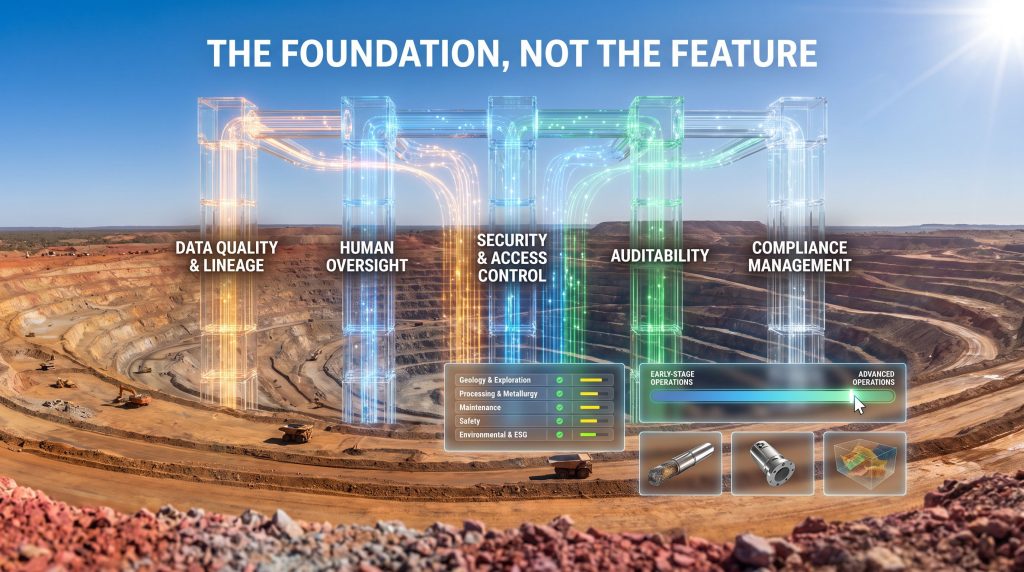
A mature AI data governance programme in mining is organised across five capability pillars:
- Data Quality and Lineage Management – Ensuring clean, standardised inputs with traceable origins from source systems through to AI outputs, with documented transformation steps at each stage
- Human Oversight and Control Protocols – Documented supervision, validation, and override mechanisms for AI decisions affecting high-consequence operational outcomes, including safety-critical processes
- Security and Role-Based Access Control – Protecting commercially sensitive geological, production, and equipment data from unauthorised access, vendor misuse, or cross-border data exposure
- Auditability and Explainability Standards – Maintaining decision logs, training data records, and model documentation sufficient for regulatory review and internal incident investigation
- Retention, Sovereignty, and Compliance Management – Governing data lifecycle, cross-border data flows, and jurisdictional privacy obligations across multi-country operating portfolios
How ISO/IEC 42001 Applies to Mining AI Governance
Framework Spotlight: ISO/IEC 42001, the international management system standard for artificial intelligence, is gaining traction in mining industry governance discussions. Its coverage of risk management, third-party oversight, human control requirements, and structured improvement cycles makes it a compatible foundation for building site-level AI governance programmes that can withstand external audit scrutiny.
The standard does not prescribe specific technical configurations. Instead, it establishes the organisational disciplines, accountability structures, and documentation requirements that responsible AI deployment demands. For mining companies operating across multiple jurisdictions with varying regulatory environments, this provides a useful common framework rather than a patchwork of site-specific policies. Advances in AI in mineral exploration are further accelerating the need for such standardised approaches.
What Are the Biggest Data Quality Risks in Mining AI Deployments?
Five Critical Data Integrity Failures That Compromise AI Reliability
Understanding where data quality breaks down before it reaches an AI model is essential for designing effective preventive controls:
- Timestamp misalignment across sensor systems, laboratory results, and planning tools creates temporal inconsistencies that distort predictive model outputs, particularly in real-time operational monitoring applications
- Unit-of-measure conflicts between geological and processing datasets introduce systematic measurement error that compounds through model training cycles without triggering obvious alert conditions
- Incomplete exception handling where data gaps caused by sensor downtime or manual entry failures are passed to models without flagging, causing models to treat absence of data as a meaningful signal
- Duplicate records arising from parallel data entry across legacy enterprise resource planning systems and operational technology platforms, inflating certain records and distorting statistical baselines
- Retroactive data modification without version control, which compromises the integrity of historical training datasets and can silently invalidate the assumptions underlying deployed models
The Validation Architecture Required Before Data Reaches AI Models
A practical pre-model validation layer should incorporate the following controls:
- Automated range checks against established operational thresholds calibrated to each data type and site-specific operating conditions
- Cross-system reconciliation rules that flag discrepancies between source systems before aggregation into analytical environments
- Null value and outlier protocols with defined escalation paths directing anomalous records to human review rather than silent imputation
- Data catalog registration requiring every dataset used in AI training or inference to be catalogued with ownership attribution, refresh frequency, known quality limitations, and a quality score or confidence rating
How Should Mining Companies Structure Their AI Data Governance Programme?
The sequencing of governance investment matters as much as its content. Organisations that attempt to impose governance structures after AI deployment are managing a substantially harder problem than those that establish the foundations beforehand. Consequently, data-driven mining operations increasingly depend on getting this sequencing right from the outset.
A Phased Implementation Roadmap for Operational Readiness
Phase 1 – Diagnostic and Baseline Assessment
- Audit existing data sources across geology, operations, maintenance, safety, and environmental domains to establish a current-state inventory
- Map data flows between operational technology, site information technology, and corporate information technology layers to identify integration gaps
- Identify format inconsistencies, ownership ambiguities, and undocumented transformation steps currently applied to data before it enters analytical systems
Phase 2 – Standards and Policy Development
- Establish enterprise-wide data definitions covering standardised units, naming conventions, timestamp formats, and quality acceptance thresholds
- Define data ownership roles and accountability structures for each operational domain, including escalation paths for quality failures
- Develop a formal data governance policy aligned with applicable regulatory requirements and ISO/IEC 42001 structural principles
Phase 3 – Technical Integration and Catalog Build
- Deploy a data catalog covering geological, production, maintenance, safety, and environmental data sources with metadata sufficient to assess AI readiness
- Implement API-based or middleware integration between previously siloed systems to reduce manual data transfer and transcription error
- Establish validation pipelines with exception-handling workflows that intercept quality failures before data enters AI training or inference environments
Phase 4 – Model Governance and Change Control
- Implement model approval processes covering initial deployment, retraining cycles, and documented rollback procedures for underperforming models
- Maintain risk registers and audit logs for all AI-related operational decisions above defined materiality thresholds
- Define incident response procedures for AI-generated outputs that trigger safety, environmental, or financial risk conditions
Phase 5 – Vendor Due Diligence and Third-Party Controls
- Establish contractual requirements for data ownership, transparency, and explicit restrictions on third-party AI providers using operational mining data outside the client's defined environment
- Conduct periodic audits of third-party AI tool providers against the organisation's governance standards, not merely against vendor-provided compliance certifications
Digital Maturity Gaps in Latin American Mining: Why Governance Urgency Varies by Operation
Latin American mining remains one of the region's most significant economic sectors while simultaneously facing escalating demands around productivity, sustainability performance, and resource efficiency. The digital transformation conversation in this context is complicated by a wide disparity in baseline capabilities across operations.
Mapping the Digital Maturity Spectrum Across Mining Contexts
| Maturity Dimension | Early-Stage Operations | Advanced Operations |
|---|---|---|
| System Integration | Multiple disconnected legacy platforms | Unified data layer with API connectivity |
| Data Standardisation | Ad hoc naming and unit conventions | Enterprise-wide data dictionary enforced |
| Governance Policy | Informal or absent | Documented, audited, and role-assigned |
| AI Readiness | Pre-deployment; foundational work required | Active deployment with model oversight |
| Human-AI Collaboration | Limited digital literacy | Structured human-in-the-loop workflows |
A critical insight for Latin American operations specifically is that digital maturity gaps do not simply reflect underinvestment. In many cases they reflect the operational reality of multi-generational asset bases where brownfield sites carry technology stacks assembled incrementally over decades, each layer added to solve an immediate problem rather than as part of a coherent architecture strategy.
Strategic Consideration: For operations at earlier maturity stages, investing in data infrastructure consolidation before AI deployment is likely to generate substantially greater long-term returns than accelerating technology adoption onto fragile data foundations. The smarter competitive move is frequently to build the conditions for reliable AI rather than to race toward deployment.
This perspective challenges the dominant narrative in technology marketing, which tends to present AI adoption as an urgent competitive necessity regardless of infrastructure readiness. For operations where the data foundation is not yet stable, the urgency should be directed toward governance investment first. In addition, tools such as 3D geological modelling are only as reliable as the underlying data governance frameworks that support them.
The next major ASX story will hit our subscribers first
The Human Capital Dimension: Why AI Governance Requires Organisational Change, Not Just Technology
Integrating Operational Knowledge Into AI-Driven Decision Environments
One of the most consistently underappreciated dimensions of AI data governance in mining is the irreplaceable role of domain expertise. Geologists, process engineers, metallurgists, maintenance specialists, and experienced operators carry accumulated knowledge that no training dataset can fully replicate. Governance frameworks that treat human expertise as a secondary consideration tend to produce AI systems that are technically sophisticated but operationally fragile.
Effective governance must account for several human capital dimensions:
- Human-in-the-loop requirements that are explicitly defined for AI decisions affecting safety-critical or high-consequence operational outcomes, with clear authority for human override
- Knowledge transfer mechanisms that capture tacit operational expertise and incorporate it into model training, validation, and ongoing calibration processes rather than treating it as inaccessible institutional memory
- Cross-disciplinary integration requiring geological, operational, metallurgical, and environmental teams to share data standards and collectively review AI outputs, preventing siloed interpretation of shared data
- Workforce capability development through training programmes that build genuine AI literacy among operational staff, enabling critical evaluation of model recommendations rather than passive acceptance
The trajectory of mining's digital transformation will not be determined by which organisation deploys the most advanced AI first. It will be determined by which organisations can connect algorithmic capability with deep operational expertise in a way that generates reliable, auditable, and genuinely useful decisions.
Governance Principle: AI systems deployed in mining environments should be designed to amplify specialist expertise rather than bypass it. The governance framework must define with precision where human judgement is mandatory, where AI recommendations are advisory, and where automated action is operationally permissible.
What Security and Access Controls Are Required for Mining AI Systems?
Protecting Commercially Sensitive and Safety-Critical Data
Mining data represents substantial commercial value. Geological models, reserve estimates, production performance records, and equipment configurations are all competitively sensitive assets. Embedding security controls at the data layer rather than only at the application layer is a fundamental governance requirement. The GMG framework for AI in mining offers valuable guidance on structuring these controls appropriately:
- Role-based access control with least-privilege principles applied to all AI training datasets and inference environments, preventing broad access to sensitive operational records
- Vendor data use restrictions through contractual prohibitions on third-party AI providers using operational mining data for model training outside the client's defined and controlled environment
- Data residency and sovereignty controls that are particularly relevant for cross-border operations where data must simultaneously satisfy multiple jurisdictional frameworks and privacy regimes
- Audit logging of all data access events, model queries, and output records sufficient to support incident investigation and regulatory review processes
- Encryption standards for data in transit and at rest across operational technology to information technology data pipelines, with key management policies aligned to jurisdictional requirements
How Does AI Governance Connect to ESG and Regulatory Compliance in Mining?
The Emerging Compliance Dimension of Mining Data Accountability
As ESG reporting obligations tighten across major mining jurisdictions, the quality and traceability of underlying data used to generate environmental and social performance metrics is attracting increasing scrutiny from regulators, investors, and downstream buyers. AI governance and ESG compliance are not parallel workstreams; they share the same data infrastructure foundations. Furthermore, effective mining risk management increasingly depends on the integrity of these shared foundations.
The compliance intersection spans several critical areas:
- Environmental data integrity requires that AI models used to forecast water consumption, tailings stability risk, or emissions profiles be trained on auditable, traceable environmental datasets with documented chain of custody
- Incident investigation readiness is becoming an expectation from safety regulators who increasingly require operators to explain the basis for AI-assisted decisions that preceded operational incidents
- Supply chain due diligence pressures from downstream buyers and institutional investors are beginning to extend to requirements for evidence that operational data used in AI-driven ESG reporting meets defined quality and governance standards
- Cross-border data compliance demands that operations spanning multiple jurisdictions navigate varying data privacy, retention, and sovereignty requirements within a single coherent governance framework rather than through fragmented site-level policies
Frequently Asked Questions: AI Data Governance in Mining
What is the difference between data governance and data management in mining AI?
Data governance defines the policies, accountability structures, and standards that determine how data should be handled, who is responsible for its quality, and what standards it must meet. Data management refers to the technical execution of those policies through the systems, processes, and tools used to implement governance requirements in practice. Governance without management is aspirational; management without governance is undirected.
Why does data quality matter more in mining AI than in other industries?
Mining decisions informed by AI outputs carry significant safety, financial, and environmental consequences that are frequently difficult or impossible to reverse. Errors in ore grade estimation can affect reserve declarations, capital allocation, and regulatory reporting. Equipment maintenance decisions based on corrupted sensor data can contribute to catastrophic failure events. The stakes associated with data quality failures in mining AI are categorically higher than in most commercial AI applications.
How long should mining companies retain AI training data and model logs?
Retention periods should be defined by the governance policy and calibrated to the longest applicable regulatory obligation in each jurisdiction. For safety-related AI applications, retention aligned with incident investigation statutes represents a minimum baseline, with some jurisdictions requiring records to be maintained for periods exceeding ten years depending on the nature of the decision and its potential consequences.
What is a data catalog and why is it foundational for mining AI?
A data catalog is a structured registry of all data assets used in AI systems, documenting their source, owner, refresh frequency, format, and quality rating. In mining, a catalog covering geological, production, maintenance, safety, and environmental datasets provides the visibility required to assess AI readiness honestly and maintain ongoing governance accountability as models are retrained and updated.
Can smaller mining operations implement AI governance without large IT teams?
Governance frameworks can be scaled to match operational complexity and resource constraints. Smaller operations can establish meaningful governance through a simplified data dictionary, basic validation rules, and clearly defined ownership roles, building the governance culture and accountability structures before committing to advanced technical tooling. The governance discipline matters more than the sophistication of the technology used to enforce it.
Key Takeaways: Building the Conditions for Trustworthy AI in Mining
The following points summarise the structural arguments for prioritising AI data governance as a strategic investment rather than a compliance overhead. AI-powered mining efficiency is ultimately only achievable when these foundational conditions are firmly in place:
- AI performance in mining is structurally dependent on data quality, integration, and governance disciplines, not on algorithm sophistication alone
- Fragmented systems across geological, operational, metallurgical, and environmental domains create compounding reliability risks when AI is introduced without prior governance investment
- A practical governance framework addresses five pillars: data quality and lineage, human oversight, security and access control, auditability and explainability, and compliance management
- Digital maturity varies significantly across mining operations, and governance investment should be calibrated to the operation's current data infrastructure state before AI deployment begins
- Human expertise is a critical governance input that must be embedded in AI validation, oversight, and exception-handling processes rather than displaced by algorithmic capability
- ISO/IEC 42001 provides a compatible management-system foundation for formalising AI governance in mining contexts and withstanding external audit scrutiny
- ESG reporting integrity and regulatory compliance depend increasingly on the same data governance foundations that enable reliable AI, making governance investment doubly justified from a risk management perspective
- The organisations that will lead mining's AI transformation are not necessarily those that adopt new tools first, but those that build the data reliability, system connectivity, and human-AI collaboration structures that allow those tools to function as intended
This article contains forward-looking perspectives on technology adoption and governance frameworks. Readers should conduct independent analysis before making technology investment or operational strategy decisions. Industry conditions, regulatory requirements, and technology capabilities vary significantly across jurisdictions and operational contexts.
Want to Know Which ASX Mining Discoveries Are Worth Acting On?
Discovery Alert's proprietary Discovery IQ model scans ASX announcements in real time, instantly converting complex mineral data across more than 30 commodities into clear, actionable insights — giving investors a genuine edge the moment significant discoveries are announced. Explore the historic returns major mineral discoveries have delivered or head to the Discovery Alert home page to begin your 14-day free trial and position yourself ahead of the broader market.