August 21, 2026
The Engineering Logic Behind Modern Underground Fleet Strategy
Underground mining contractors face a structural tension that rarely surfaces in public commentary: the gap between project pipeline visibility and equipment lead times. In an industry where a single delayed delivery can cascade into missed development metres, production shortfalls, and contract penalties, the decision to commit capital to large equipment orders is never purely transactional. It reflects a contractor's read on where the market is heading over the next two to three years, not just the next quarter.
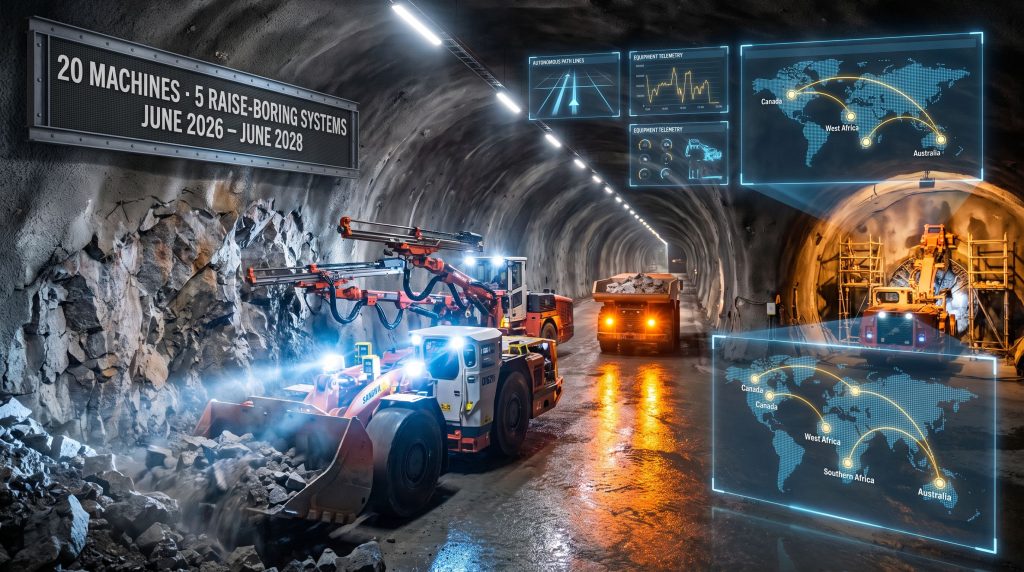
This strategic calculus is precisely what makes Byrnecut expands underground fleet with Sandvik worth examining in depth. The procurement, booked in June 2026 and extending through a two-year delivery window to June 2028, encompasses 20 underground machines and five raise-boring systems configured across development drilling, automated loading, haulage, and shaft boring functions. Reading the composition of this order reveals as much about underground mining's technological direction as it does about any single contractor's growth ambitions.
When big ASX news breaks, our subscribers know first
Breaking Down the Procurement: What Was Ordered and What It Signals
The fleet configuration is not a generic bulk purchase. Each equipment category serves a distinct operational function, and the weighting of units across those categories reflects deliberate choices about where Byrnecut anticipates the heaviest workload over the delivery period.
| Equipment Category | Model | Quantity | Primary Function |
|---|---|---|---|
| Development Drills | DD422i | 4 | Tunnel development and face drilling |
| Underground Loaders | Toro LH621i (AutoMine) | 4 | Automated ore loading |
| Underground Trucks | Toro TH663i | 4 | Underground haulage |
| Longhole Drills | DL432i | 2 | Production drilling |
| Longhole Drills | DL422i | 1 | Production drilling |
| Raise-Boring Machines | Rhino 100 (Mobile) | 4 | Raise and shaft boring |
| Raise-Boring Modules | Rhino Uphole Module | 1 | Uphole boring applications |
Several observations emerge from this breakdown. First, the balance between development drilling equipment and production drilling equipment suggests Byrnecut is positioning for significant mine development activity, not just steady-state production support. Four DD422i development drills against three longhole units points to an expectation of new tunnel development work across multiple sites.
Second, the presence of four AutoMine-equipped Toro LH621i loaders is a meaningful commitment to autonomous underground loading. These are not experimental units being trialled at a single site. Deploying four across a global operation signals institutional confidence in the technology's reliability and productivity returns. Furthermore, this reflects a broader shift in automation in mining that is reshaping how contractors approach large-scale fleet procurement.
Third, the five raise-boring systems constitute a substantial allocation of capital to a single development technique. This warrants closer examination.
Why Raise-Boring Technology Is Reshaping Underground Mine Development
Raise boring is a mechanised method of creating vertical or inclined excavations in underground mines, most commonly used for ventilation shafts, ore passes, and access raises. The process involves drilling a pilot hole from one level to another, then reaming the hole back upward to full diameter using a rotating cutter head. Unlike conventional drill-and-blast raise development, raise boring eliminates the need for workers to be present in an unsupported excavation during the boring process.
The Sandvik Rhino 100 is a mobile raise-boring machine, which means it can be transported and repositioned between sites without the infrastructure commitments of fixed shaft-boring rigs. This mobility factor is particularly relevant for contractors serving multiple projects simultaneously across different geographies. Underground drilling solutions of this nature are increasingly central to how modern contractors manage risk and development scheduling.
Raise boring's safety advantages over conventional methods are well-documented in underground mining literature. The elimination of personnel from the active boring zone reduces exposure to ground fall risk, one of the leading causes of fatalities in underground development work.
The additional Rhino Uphole Module in Byrnecut's order extends the system's versatility to uphole applications, where the boring direction is inverted. This expands the range of excavation scenarios the fleet can address without additional capital commitment.
The inclusion of five raise-boring systems in a single procurement event is notable. It suggests either that Byrnecut has secured contracts requiring intensive shaft and raise development across multiple sites, or that the company is building capacity in anticipation of winning such work. Either interpretation points to strong forward confidence in the underground contracting pipeline.
AutoMine and the Autonomous Underground Loader: How the Technology Functions
The Toro LH621i is a 63-tonne capacity underground loader equipped with Sandvik's AutoMine system, which enables autonomous tramming and loading cycles in underground environments. Understanding how this technology functions requires appreciating the specific challenges of underground navigation: confined spaces, irregular geometry, dynamic ground conditions, and the absence of GPS signals.
AutoMine addresses these constraints through a combination of:
- Laser scanning and environmental mapping to create a real-time model of the underground environment
- Inertial navigation systems that maintain positional awareness independent of satellite signals
- Collision detection and avoidance using proximity sensors calibrated for the tunnel dimensions
- Remote monitoring and intervention capability allowing operators above ground to oversee multiple machines simultaneously
- Traffic management integration to coordinate movement between autonomous and manually operated vehicles in shared underground zones
The productivity case for autonomous loaders in underground mining is grounded in operational continuity. A manually operated loader requires shift changes, meal breaks, and operator fatigue management. An AutoMine-equipped loader can maintain tramming cycles through shift transitions, theoretically improving utilisation rates during what would otherwise be idle periods. Industry participants have cited productivity improvements from autonomous loading systems in the range of 10 to 20 percent compared to equivalent manual operations, though outcomes vary significantly by site configuration.
Byrnecut's familiarity with this technology predates this order. The company deployed AutoMine-capable battery-electric loaders at OZ Minerals' Prominent Hill and Carrapateena underground copper-gold operations in South Australia, establishing operational protocols and maintenance workflows before committing to the current larger-scale integration. This prior experience matters when scaling autonomous systems across multiple continents, as the institutional knowledge around ground-truthing system limitations, training personnel, and managing edge cases in variable ground conditions is not trivial to develop from scratch.
Four Continents, One Fleet Standard: The Byrnecut Global Deployment Model
The new equipment will be distributed across Byrnecut's four primary operational regions:
- Australia — The company's domestic base and largest operational footprint, encompassing hard rock underground contracts across Western Australia, South Australia, and Queensland
- Canada — Cold-climate operations where equipment reliability in freeze-thaw conditions demands robust thermal management and lubricant specifications
- West Africa — A growing focus area for gold and base metals contracting, where tropical humidity and remote logistics chains create distinct maintenance challenges
- Southern Africa — Established deep-level mining corridors, particularly in Zimbabwe and Zambia, where Byrnecut has operated for over two decades
Deploying identical or near-identical equipment models across these four regions is a deliberate standardisation strategy with tangible financial benefits. When a DD422i development drill at a Canadian operation requires a specific hydraulic component, that part is interchangeable with the same drill operating in West Africa. Technician training programs developed for one region transfer directly to others. Warranty claims and OEM service agreements apply uniformly across the global fleet.
For a contractor managing equipment across four continents, the hidden cost of fleet heterogeneity can rival the apparent savings from competitive tendering. Parts inventory duplication, non-transferable technician skills, and fragmented OEM relationships represent a category of operational cost that rarely appears in procurement analyses but accumulates significantly at scale.
This logic also explains why long-term OEM relationships like the one Byrnecut has built with Sandvik carry strategic value beyond unit pricing. When a major equipment failure occurs at a remote West African site, the depth of the OEM relationship often determines how quickly a replacement component or technical specialist arrives. That response capability cannot be negotiated into a one-off purchase contract.
The Evolving Byrnecut–Sandvik Relationship: From Supplier to Strategic Partner
The June 2026 procurement represents the most visible milestone in a commercial relationship that has developed over multiple years. A meaningful turning point came in 2024 when the two companies directed joint focus toward diesel-electric underground loaders and trucks designed to deliver improvements across fuel efficiency, underground heat generation, and overall machine productivity. According to Mining Technology, the scale of this order underscores how deeply embedded the Sandvik relationship has become within Byrnecut's operational strategy.
Diesel-electric drivetrains function differently from conventional hydrostatic systems. Rather than using hydraulic fluid to transmit engine power to the wheels, diesel-electric machines use the diesel engine to drive a generator, which in turn powers electric motors at each wheel or drive axle. This arrangement offers several advantages in underground environments:
| Technology Type | Key Benefit | Operational Consideration |
|---|---|---|
| Diesel-Electric | Lower heat output, reduced fuel burn | Higher upfront capital cost vs conventional diesel |
| Battery-Electric | Zero underground emissions, quieter operation | Charging infrastructure and range limitations |
| AutoMine Autonomous | Continuous operation through shift changes | Integration complexity in variable ground conditions |
| Conventional Diesel | Lowest capital cost, established service networks | High ventilation demand, heat loading in deep mines |
The ventilation dimension is particularly significant for deep underground operations. Diesel engines generate substantial heat and exhaust emissions that must be diluted and removed by the mine's ventilation system. Ventilation infrastructure is one of the largest capital and operating cost line items in deep underground mine development. Equipment that reduces heat output and emissions directly reduces ventilation demand, which can translate into reduced fan capacity requirements, lower energy consumption, and in some cases, the ability to defer or scale back ventilation shaft development.
The Northern Star Resources (ASX: NST) procurement of Sandvik Toro TH663i trucks and Toro LH621i and LH517i loaders for its Western Australian underground operations, announced in December 2025, demonstrates that Byrnecut is operating within a broader market trend rather than pursuing an isolated strategy. Multiple major underground mining operators and contractors are converging on similar equipment configurations from the same OEM, which carries implications for Sandvik's production scheduling and delivery lead times across the industry.
The next major ASX story will hit our subscribers first
What Large Fleet Orders Tell Us About Underground Mining's Structural Trajectory
Contractor capital expenditure at this scale functions as a leading indicator of sector confidence. Byrnecut would not commit to a 20-machine order with a two-year delivery schedule without a credible view of the project pipeline that justifies the investment. The staging of deliveries from June 2026 through June 2028 implies that specific contract commitments or advanced-stage contract negotiations underpin the procurement timeline.
Five structural trends are reinforced by this fleet investment, each reflecting a broader pattern of mining industry innovation that is redefining how underground contractors compete:
- Automation adoption is accelerating at the contractor level — When mining service companies, rather than owner-operators, begin standardising on autonomous equipment, the technology has crossed a maturity threshold that signals broader industry adoption
- Raise boring is displacing conventional methods for routine shaft development — Five systems in a single order from one contractor reflects a preference for mechanised development that reduces personnel risk and improves schedule predictability
- Multi-year delivery windows are normalising — A two-year delivery schedule indicates that both the buyer and seller accept long forward planning cycles as standard commercial practice
- OEM ecosystem consolidation is a strategic priority — Single-supplier fleet strategies reduce complexity at the cost of procurement leverage, a trade-off increasingly favoured by global contractors
- Fleet standardisation across geographies is becoming a competitive differentiator — Contractors capable of rotating equipment, sharing parts, and redeploying trained personnel across multiple continents can respond to project opportunities more rapidly than those operating heterogeneous fleets
Consequently, data-driven mining operations are becoming inseparable from decisions about fleet composition, with real-time machine data now influencing procurement strategy as much as traditional productivity benchmarks. In addition, mining efficiency technologies are increasingly embedded in the equipment itself, blurring the line between hardware investment and digital capability. As reported by Mining Monthly, this convergence of fleet standardisation and digital integration is becoming a defining feature of how leading underground contractors structure their capital programmes.
Frequently Asked Questions: Byrnecut and Sandvik Underground Fleet Expansion
What Equipment Did Byrnecut Order From Sandvik?
Byrnecut ordered 20 underground machines comprising four DD422i development drills, four Toro LH621i autonomous loaders, four Toro TH663i trucks, and three longhole drills (two DL432i and one DL422i), along with five raise-boring systems including four mobile Rhino 100 machines and one Rhino Uphole Module.
When Were the Orders Placed and When Will Deliveries Be Completed?
The procurement was booked in June 2026, with deliveries scheduled to continue through June 2028, representing a two-year staged delivery programme aligned to project mobilisation requirements.
What Is AutoMine and How Does It Work on the Toro LH621i?
AutoMine is Sandvik's autonomous navigation and control system for underground loaders. On the Toro LH621i, it enables driverless tramming cycles using laser-based environmental mapping, inertial navigation, and proximity sensing, allowing the loader to operate continuously through shift changes under remote operator supervision.
What Is a Rhino 100 Raise-Boring Machine?
The Rhino 100 is a mobile raise-boring machine that creates vertical or inclined excavations in underground mines for ventilation shafts, ore passes, and access raises. Its mobility allows it to be repositioned between project sites, making it suited to contracting operations across multiple locations.
Which Countries Will the New Fleet Operate In?
The equipment will be deployed across Byrnecut's operations in Australia, Canada, West Africa, and Southern Africa.
Has Byrnecut Used Sandvik Equipment Before This Order?
Yes. Byrnecut has previously deployed AutoMine-capable battery-electric loaders at the Prominent Hill and Carrapateena underground operations in South Australia, and the two companies have maintained a commercial relationship extending back several years, with a joint development focus established in 2024.
Why Does Diesel-Electric Technology Matter in Underground Mining?
Diesel-electric drivetrains generate lower heat output and improved fuel efficiency compared to conventional hydraulic systems. In deep underground environments where ventilation is a major cost driver, reduced heat generation from mobile equipment can directly lower ventilation energy consumption and infrastructure requirements.
Disclaimer: This article contains forward-looking assessments of equipment deployment timelines, technology performance, and market trends. These assessments are based on publicly available information and industry analysis and should not be construed as financial advice. Actual outcomes may differ materially from those described. Readers should conduct independent research before making any investment or commercial decisions.
Want to Know Which ASX Mining Companies Are Driving the Next Wave of Underground Discovery?
The structural shifts reshaping underground fleet strategy — from autonomous loaders to raise-boring adoption — signal growing contractor confidence in the pipeline of new mineral projects. Discovery Alert's proprietary Discovery IQ model scans ASX announcements in real time, translating complex exploration data into actionable insights the moment a significant discovery is made. Start your 14-day free trial at Discovery Alert and explore historic discovery returns to see what positioning early in a major find can mean for investors.