
August 23, 2026
The Arithmetic of Decline: Why the UK Can No Longer Produce Its Way Out of a Gas Crisis
Every major energy transition contains a moment where the gap between political ambition and physical reality becomes impossible to ignore. For the United Kingdom, that moment has arrived in the form of a stark arithmetic problem: North Sea gas output is contracting at roughly 11% per year, domestic reserves are ageing faster than new developments can replace them, and the country now faces the prospect of spending billions of pounds importing the very fuel it once exported in abundance. The UK LNG import plans and North Sea production decline now under active government consideration represent not a policy invention but a structural response that has been building for more than two decades.
Understanding why this matters requires looking beyond the headlines and into the underlying geology, fiscal architecture, and geopolitical risk that together define Britain's energy position heading into the late 2020s. Furthermore, these energy export challenges are increasingly shaping how policymakers approach long-term supply security.
When big ASX news breaks, our subscribers know first
From Energy Exporter to Import-Dependent Nation: The Long Arc of North Sea Decline
The North Sea was once one of the most productive hydrocarbon basins in the world. At its late-1990s peak, combined oil and gas output from the basin reached approximately 4 million barrels of oil equivalent per day (boepd), turning the United Kingdom into a net energy exporter and a significant force in European supply markets.
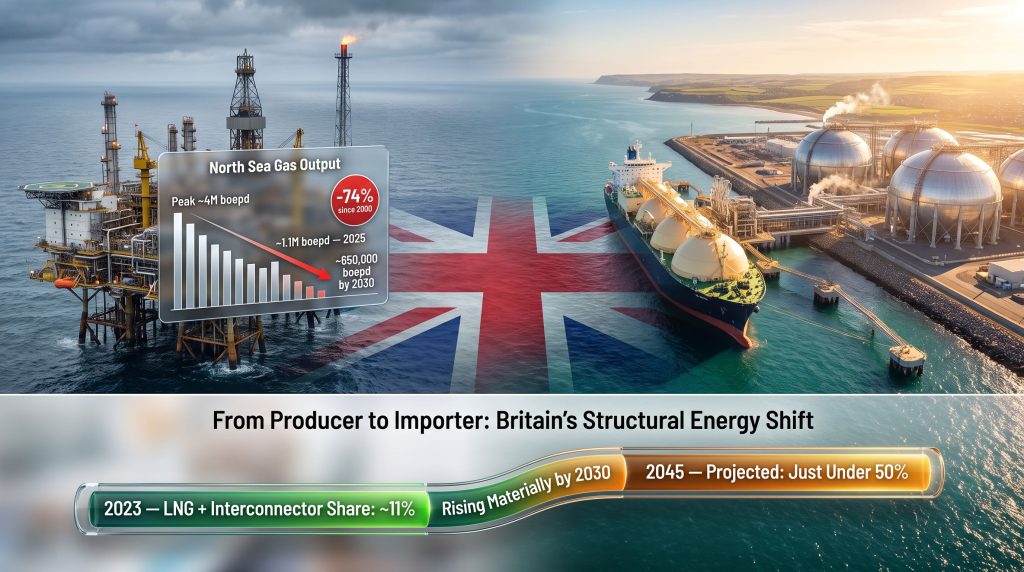
That era is now firmly in the past. Current combined output sits at roughly 1.1 million boepd, representing a fall of approximately 72% from peak production. More telling than the aggregate decline is the trajectory of individual streams:
| Metric | Peak (Late 1990s) | 2025 Level | Projected 2030 |
|---|---|---|---|
| Total North Sea Output | ~4 million boepd | ~1.1 million boepd | ~650,000 boepd |
| Gas Output Change (2000–2025) | Baseline | -74% | Continued decline |
| Oil Output Change (2000–2025) | Baseline | -75% | Continued decline |
| Combined Production Fall (1999–2023) | Baseline | -72% | NSTA projects ~7% annual oil / ~11% annual gas decline |
North Sea gas production has fallen by approximately 74% since 2000, while oil output has contracted by a comparable 75% over the same period. According to projections from the North Sea Transition Authority (NSTA), gas production is expected to continue shrinking at roughly 11% per year, a rate that places current output at its lowest level in more than fifty years, comparable to volumes last seen in the early years of North Sea development during the 1970s.
What a Mature Basin Actually Means
The term "mature basin" carries specific technical meaning in upstream oil and gas. It describes a producing region where the largest, most accessible, and highest-quality reservoirs have already been exploited, leaving smaller accumulations, thinner pay zones, and more geologically complex targets requiring higher capital intensity to develop.
In the North Sea's case, maturity translates into several compounding challenges:
- Remaining field sizes are substantially smaller than legacy producers like Forties, Brent, or Piper
- Reservoir pressures in many existing fields have depleted, requiring more intensive artificial lift and water injection programmes
- Well productivity rates are lower on average, reducing the economic returns per drilling dollar compared to frontier basins
- Decommissioning obligations are accelerating, consuming capital that might otherwise fund new development
The basin is not exhausted, but the economics of extraction have shifted in ways that make reversing the decline trajectory extremely difficult without a substantial change in either fiscal incentives or technology economics. Indeed, common myths about North Sea oil and gas often obscure just how structurally constrained the basin has become.
Mapping UK LNG Import Infrastructure: What Already Exists
Before evaluating whether additional capacity is needed, it is worth understanding what the United Kingdom already operates. The country currently has three operational LNG import terminals:
- South Hook LNG Terminal (Milford Haven, Wales) – one of Europe's largest LNG import facilities, capable of handling very large carriers
- Dragon LNG Terminal (Milford Haven, Wales) – a second terminal at the same strategic port location
- Isle of Grain LNG Terminal (Kent, England) – serving southern England and the broader grid interconnection network
These facilities provide meaningful regasification capacity, but utilisation rates fluctuate significantly depending on global LNG pricing, North Sea output levels, and the seasonal demand profile of the UK market. When spot LNG prices are high relative to pipeline alternatives, terminal throughput typically falls, exposing the structural tension between import economics and supply security objectives. Monitoring natural gas price trends helps clarify when these tensions are most acute.
Floating storage and regasification units (FSRUs) add a layer of flexibility to this picture, allowing temporary import capacity to be deployed without the capital commitment of permanent onshore infrastructure. Crown LNG's proposed Grangemouth terminal in Scotland represents one of the most discussed additions to the import infrastructure landscape, with the project targeting a potential commissioning window in early 2027, subject to regulatory approvals and a final investment decision.
Project Snapshot: Grangemouth LNG Terminal
- Developer: Crown LNG
- Location: Grangemouth, Scotland
- Target FID: Subject to regulatory approval
- Potential Commissioning: Early 2027 (if approved)
- Strategic Role: Adds northern UK supply flexibility as North Sea output contracts
The Import Dependency Trajectory: Modelling the 2045 Scenario
In 2023, LNG and interconnector imports accounted for approximately 11% of total UK gas demand. That figure is projected to rise materially through the 2030s before reaching close to 50% of total gas consumption by 2045, according to government supply-demand modelling. This trajectory deserves careful interpretation.
| Year | LNG + Interconnector Share of Total Gas Demand |
|---|---|
| 2023 | ~11% |
| 2030 (estimated) | Rising materially |
| 2045 (projected) | Just under 50% |
The key distinction analysts draw is between cyclical import dependency and structural import dependency. A cyclical dependency arises from temporary supply disruptions or price-driven switching; it resolves when underlying conditions normalise. A structural dependency, by contrast, is embedded in the physical production base and cannot be reversed without either discovering and developing new reserves at scale, or materially reducing demand through electrification and efficiency improvements.
Given that North Sea gas output is projected to contract at approximately 11% annually, the approaching import dependency is firmly structural in character. Understanding the broader LNG supply outlook is consequently essential for grasping what these projections mean in practice.
The arithmetic here is not ambiguous. At an 11% annual decline rate, North Sea gas production approximately halves every six to seven years. No realistic combination of incremental field development can offset that rate of loss without a fundamental change in the basin's fiscal and regulatory environment.
The Fiscal Architecture Problem: How the Energy Profits Levy Shapes Investment Decisions
One of the most consequential and least widely understood factors driving North Sea investment decisions is the fiscal environment created by the Energy Profits Levy (EPL). Under the current regime, oil and gas producers operating on the UK Continental Shelf face a headline tax rate of 78%, combining the existing ring-fence corporation tax, supplementary charge, and the EPL surcharge introduced following the 2022 energy price shock.
The consequences of this tax structure are not uniform across operators. For large, high-margin producing fields, an elevated headline rate reduces returns but does not necessarily destroy project economics. For marginal fields, defined as those with thinner reserves, higher development costs, or shorter production horizons, a 78% headline rate can push net present value into negative territory, triggering capital reallocation decisions.
| Tax Environment | Marginal Field Viability | Likely Operator Response |
|---|---|---|
| Pre-EPL baseline rate | Higher viability for marginal fields | Continued development investment |
| 78% EPL headline rate | Significantly reduced for thin-margin assets | Capital redeployment to other basins |
| EPL removal (proposed) | Improved economics for stranded assets | Potential revival of deferred projects |
Industry groups including the Aberdeen & Grampian Chamber of Commerce (AGCC) have called explicitly for the EPL to be removed, arguing that the levy is accelerating exactly the production decline that now appears to be driving government interest in expanded LNG import infrastructure. The implicit logic of the AGCC's position is that the government is solving a problem it has partially created.
For context, the Norwegian tax regime offers investment allowances that effectively reduce the state's take on qualifying capex, maintaining operator incentives to develop marginal assets. The Netherlands has pursued a different trajectory, having substantially wound down Groningen field output following induced seismicity concerns, but its broader continental shelf tax framework has remained more predictable than the UK's repeated EPL adjustments.
Jackdaw, Rosebank, and the Undeveloped Field Equation
Two undeveloped North Sea fields have become focal points in the debate over domestic supply versus LNG imports: Jackdaw and Rosebank. Both have faced significant regulatory and legal delays, and both are regularly cited in industry arguments about foregone domestic production.
The AGCC's position is that Jackdaw and Rosebank, developed together, could contribute roughly 10% of the UK's future gas supply requirements. While this figure should be understood as an estimate subject to development assumptions, production profiles, and reservoir performance, it illustrates the scale of what delayed approvals represent in terms of domestic supply foregone.
A useful scenario framework helps clarify the stakes:
- If both fields are approved and developed on accelerated timelines, their combined output could offset a meaningful portion of projected import growth through the early 2030s, compressing but not eliminating the structural need for additional LNG terminal capacity
- If development continues to be delayed, the supply gap widens more quickly, accelerating the timeline on which additional LNG infrastructure becomes operationally necessary
- If fields are ultimately rejected, the government's own supply security modelling becomes increasingly reliant on import infrastructure to fill the gap
The ongoing debate around the North West Shelf extension in Australia provides a useful international parallel, illustrating how other mature basins are wrestling with similar decisions about extending the productive life of ageing infrastructure.
The next major ASX story will hit our subscribers first
The Emissions Paradox: Is Restricting Domestic Gas Production Environmentally Counterproductive?
One of the more technically nuanced dimensions of the UK LNG import plans and North Sea production decline debate involves lifecycle emissions accounting. The conventional argument for restricting North Sea development is that reducing domestic fossil fuel output supports decarbonisation objectives. Critics of this argument point to a fundamental measurement problem.
Imported LNG carries a significantly higher lifecycle emissions intensity than domestically produced gas, for three compounding reasons:
- Liquefaction is an energy-intensive process, typically consuming 8 to 12% of the gas being processed to power the compression and cooling systems
- Maritime transport in LNG carriers adds fuel combustion emissions across voyages that can range from a few days to several weeks depending on origin
- Regasification at the receiving terminal requires additional energy input to convert cryogenic liquid back to gaseous form
When these factors are combined on a well-to-burner-tip emissions basis, imported LNG can carry a carbon footprint 20 to 40% higher than gas produced and consumed domestically, depending on origin country, transport distance, and facility efficiency. The AGCC has made precisely this point, arguing that blocking domestic North Sea production while importing higher-emissions LNG does not reduce total carbon output and may actually increase it.
The regulatory gap in UK carbon accounting is relevant here. Imported emissions are largely excluded from the UK's territorial greenhouse gas inventory, meaning that substituting domestic gas production with imported LNG can create an appearance of emissions reduction that does not reflect the global atmospheric impact of consumption.
However, green transition pressures continue to complicate this calculus, as policymakers must balance near-term supply security against longer-term climate commitments. Questions about whether expanding North Sea gas production could cut energy bills add another layer of complexity to an already difficult policy environment.
Energy Security Risk Under a High-Import Scenario
A near-50% import dependency by 2045 introduces risk dimensions that go beyond emissions accounting. The United Kingdom's experience during the 2021 to 2022 global energy price shock demonstrated how exposed gas-dependent economies are to international LNG market volatility, particularly when multiple large buyers compete simultaneously for spot cargoes.
Key risk categories in a high-import scenario include:
- Supply concentration risk: The geographic origins of UK LNG imports matter significantly. Over-reliance on a small number of supplier countries increases vulnerability to geopolitical disruption, export restrictions, or contract renegotiation
- Price exposure: LNG is priced on global markets where demand spikes in Asia or supply disruptions in the United States or Qatar can rapidly translate into higher UK household and industrial energy costs
- Infrastructure resilience: Terminal redundancy, storage capacity, and seasonal peak management all become more critical as the share of imported gas in the supply mix rises
- Asset lock-in: Building substantial new LNG import infrastructure implies a multi-decade commitment to gas use that may create tension with legislated net zero timelines
LNG Infrastructure and Net Zero: The Asset Lock-In Problem
Long-duration gas infrastructure, including LNG terminals, typically operates over a 30 to 40-year economic life. Approving major new import capacity today means committing to infrastructure that will still be economically active well past the UK's 2050 net zero target date. This creates a genuine policy tension.
One potential resolution lies in the dual-use potential of gas infrastructure:
- Hydrogen and ammonia can theoretically be imported through modified versions of existing LNG terminal equipment
- Carbon capture and storage (CCS) integration with gas-fired power generation could extend the climate compatibility of gas infrastructure
- Hydrogen blending in the existing gas grid is already being piloted, potentially reducing the emissions intensity of gas-derived energy
However, these pathways involve significant additional investment and technical modification. They should be treated as potential options rather than guaranteed transition routes.
The Internal Contradiction at the Heart of UK Gas Policy
The most striking aspect of the current situation is the policy configuration the UK government appears to have arrived at simultaneously:
- Acknowledging that gas will remain part of the energy mix for decades
- Restricting new North Sea exploration licensing
- Maintaining a headline tax rate of 78% under the EPL that constrains marginal field development
- Considering multi-billion-pound public expenditure on LNG import infrastructure
Industry groups argue this combination is internally contradictory. If the government accepts that gas demand will persist, the question is not whether that gas will be sourced but from where. Restricting the lower-emissions, domestically employed, fiscally contributing domestic option in favour of the higher-emissions, foreign-sourced import option appears difficult to justify on either environmental or economic security grounds.
A credible long-term gas strategy would likely require action across several levers at once: selectively reforming the EPL to preserve marginal field economics, approving developments with clear domestic supply benefits, diversifying LNG import origins to reduce concentration risk, and accelerating demand-side reduction through electrification to compress the window of peak import dependency. No single lever, applied in isolation, solves the arithmetic problem that UK LNG import plans and North Sea production decline has created.
Frequently Asked Questions: UK LNG Imports and North Sea Decline
Why is the UK considering expanding LNG import capacity?
North Sea gas production has declined approximately 74% since 2000 and is contracting at roughly 11% per year. As domestic supply falls, the gap between production and consumption must be filled by imports, prompting government consideration of additional LNG terminal infrastructure.
How much has North Sea gas production declined in recent decades?
Gas output from the North Sea has fallen approximately 74% since 2000, with combined oil and gas production down roughly 72% from its late-1990s peak of around 4 million boepd.
What LNG import terminals does the UK currently operate?
The UK operates three LNG import terminals: South Hook and Dragon LNG at Milford Haven in Wales, and the Isle of Grain terminal in Kent. Floating regasification units and proposed new facilities such as Crown LNG's Grangemouth terminal add potential additional capacity.
What is the Energy Profits Levy and how does it affect North Sea investment?
The EPL is a surcharge applied to North Sea oil and gas profits that, combined with existing taxes, produces a headline rate of 78%. This rate significantly reduces the economic viability of marginal field development and has contributed to capital being redirected away from the UK Continental Shelf.
Could developing fields like Jackdaw and Rosebank reduce the need for LNG imports?
The AGCC estimates that Jackdaw and Rosebank together could contribute approximately 10% of future UK gas supply requirements. Their development would reduce but not eliminate the structural need for increased LNG imports given the scale of overall basin decline.
What are the emissions differences between domestic North Sea gas and imported LNG?
Imported LNG carries additional emissions from liquefaction, maritime transport, and regasification. On a well-to-burner-tip basis, these processes can add 20 to 40% to the carbon footprint of the gas compared to domestically produced and consumed North Sea output.
How dependent will the UK be on imported gas by 2045?
Government projections suggest LNG and interconnector imports could account for just under 50% of total UK gas demand by 2045, compared to approximately 11% in 2023.
This article contains forward-looking projections based on publicly available government modelling and industry estimates. Production trajectories, import dependency ratios, and field development timelines are subject to change based on regulatory decisions, commodity prices, and technological developments. Nothing in this article constitutes investment or financial advice.
Want to Know Which ASX Companies Are Positioned to Benefit From the Global LNG Supply Shift?
As the UK's structural import dependency accelerates and global demand for LNG continues to reshape energy markets, Discovery Alert's proprietary Discovery IQ model delivers real-time alerts on significant ASX mineral and energy discoveries — ensuring subscribers can identify actionable opportunities the moment they emerge. Explore historic discoveries and their returns on Discovery Alert's dedicated discoveries page, and begin your 14-day free trial today to position yourself ahead of the market.