August 24, 2026
The Geological Lottery That Built a Nation's Export Economy
Long before a single tonne of iron ore was loaded onto a vessel at Dampier, the Pilbara region of Western Australia was quietly holding one of the most consequential geological secrets on Earth. Formed over billions of years within the ancient Pilbara Craton, banded iron formations accumulated during a period when the planet's chemistry was fundamentally different, creating ore bodies of exceptional grade and near-surface accessibility. This was not just fortunate geology. It was the physical foundation upon which an entire export economy would eventually be constructed.
Understanding Rio Tinto's 60 years of iron ore operations in Western Australia requires stepping back from the corporate milestone and examining the structural forces that made such a system possible in the first place: the right geology, at the right historical moment, aligned with a regional power in desperate need of exactly what the Pilbara held.
When big ASX news breaks, our subscribers know first
August 1966: A Shipment That Permanently Altered Australia's Trade Architecture
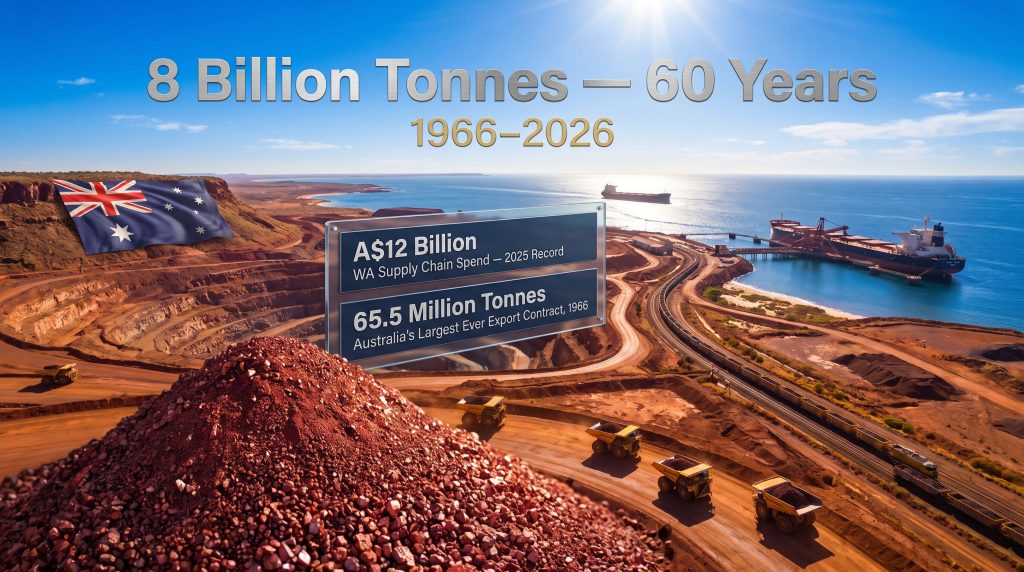
On 22 August 1966, the vessel Houn Maru departed Dampier carrying the first commercial iron ore cargo from the Pilbara, bound for Japanese steel mills. That departure was not simply a logistics event. It was the physical expression of what was, at the time, the largest export agreement ever signed in Australian history: a commitment to supply 65.5 million tonnes of iron ore over 15 years to Japan's rapidly expanding steel sector.
The context matters enormously. Post-war Japanese industrialisation was generating extraordinary demand for high-quality steel inputs, and domestic sources were wholly inadequate to satisfy it. Australia's north-west coast offered something that few other regions could match simultaneously: ore bodies of sufficient grade, geographic proximity to Asian markets, and the political stability to underpin long-term contractual commitments.
Why the Japan Agreement Was More Than a Commercial Contract
The 1966 supply deal is often described in purely commercial terms, but its structural significance was far deeper. Without a guaranteed long-term offtake arrangement, the capital investment required to build mines, townships, rail networks, and port facilities across hundreds of kilometres of arid, remote terrain could not have been economically justified. The Japanese steel mills, in effect, underwrote the infrastructure development of the Pilbara.
This model, securing anchor customers before committing to transformative capital expenditure, remains one of the foundational principles of large-scale resource project development today. The Pilbara example is among the most cited historical precedents for why demand-side certainty is as important as supply-side quality in resource project economics.
From One Mine to a Multi-Region Industrial System
The Tom Price mine, which began operations in 1966, served as the original anchor point for what would grow into one of the most productive iron ore systems on the planet. The scale of transformation across six decades is difficult to fully appreciate without direct comparison.
| Metric | Figure |
|---|---|
| Years of continuous WA operations | 60 years (1966 to 2026) |
| Total iron ore shipped from Pilbara | More than 8 billion tonnes |
| Original supply agreement volume | 65.5 million tonnes |
| Original contract duration | 15 years |
| WA local supply chain spend (2025) | A$12 billion (record) |
| Community investment over 5 years | Approximately A$500 million |
| Residential towns connected to operations | 6 Pilbara towns + 5 regional communities |
Rio Tinto's operational footprint now encompasses six residential towns across the Pilbara, with workforce reach extending into five additional regional communities through fly-in fly-out arrangements. Perth has evolved from a distant administrative centre into the global headquarters for Rio Tinto's iron ore division and the location of its remote operations centre, managing assets located more than 1,500 kilometres away.
What 8 Billion Tonnes Actually Represents
The cumulative export figure of more than 8 billion tonnes is one of those statistics that resists easy comprehension. Distributed across six decades, it equates to an average of roughly 133 million tonnes per year, though actual annual volumes have grown dramatically in more recent periods as infrastructure capacity, autonomous technology, and market demand expanded together.
The downstream application of that ore touches virtually every category of physical infrastructure in the modern world:
- Residential and commercial buildings across Asian, European, and Pacific markets
- Rail networks, bridges, and port infrastructure
- Wind turbine towers and energy transmission systems
- High-rise construction in the world's fastest-growing cities
Iron ore from the Pilbara is embedded in the material fabric of the 21st century's built environment in ways that rarely receive acknowledgment.
The Geological Advantage That Competitors Cannot Easily Replicate
Not all iron ore is equal, and this is a point that carries increasing weight as the global steel industry undergoes structural change. The Pilbara Craton hosts some of the world's highest-grade, most geologically accessible iron ore deposits, a product of ancient geological processes that concentrated iron minerals into extraordinarily pure formations. Furthermore, Australia's iron ore advantages in this context extend well beyond simple geology.
In practical mining terms, this translates into several structural advantages:
- Lower strip ratios, meaning less waste rock must be moved per tonne of ore recovered
- Higher Fe content in run-of-mine ore, reducing processing requirements before shipment
- Near-surface mineralisation across many deposits, enabling efficient open-cut extraction
- Large, continuous ore bodies that support high-volume production systems
These characteristics collectively produce a cost structure that is difficult for higher-cost, lower-grade producers in other regions to compete against at equivalent volumes. The Pilbara's geological inheritance is not merely an operational advantage; it is a structural competitive moat that has persisted across six decades and shows no indication of diminishing.
Industry Insight: Pilbara hematite ore typically grades between 57% and 62% iron content in run-of-mine form, with some premium products reaching above 62% Fe. This compares favourably to many global alternatives and has historically attracted price premiums in Asian spot markets. As green steelmaking specifications evolve, the grade and impurity profile of iron ore feedstocks is becoming increasingly important to pricing dynamics.
Infrastructure as Competitive Moat: Building a Region from Scratch
One aspect of the Pilbara story that receives insufficient attention is the sheer ambiguity of what existed before 1966. There were no towns, no sealed roads, no ports capable of handling bulk carriers, and no rail network connecting the inland ore bodies to the coast. Everything had to be built simultaneously, under extreme heat, across terrain that challenged every aspect of construction logistics.
The early photographic record of this period, documented by the late Western Australian photographer Richard Woldendorp, captures the extraordinary pace and scale of that construction effort. His archive, which documents the emergence of Mount Tom Price and the broader early Pilbara development, has been gifted to the State Library of Western Australia as part of the 60th anniversary commemorations, preserving a visual record of one of Australia's most ambitious regional development projects.
The infrastructure built during that founding period created durable competitive advantages that persist today. Pilbara rail networks, port facilities at Dampier, and the town infrastructure supporting residential workforces represent decades of accumulated capital investment that any new entrant attempting to replicate would face at prohibitive cost.
Record Economic Contribution and the Doubling of Local Supply Chains
Rio Tinto's contribution to the Western Australian economy has grown substantially alongside its production capacity. In 2025, the company's spending with Western Australian businesses reached a record A$12 billion, with local supply chain expenditure having doubled over the preceding four years. This trajectory reflects both the scale of ongoing operations and capital expenditure programs, as well as a deliberate strategic orientation toward in-state procurement.
The significance of this trend extends beyond the headline figure. Doubling local supply chain spend over four years implies a fundamental shift in sourcing strategy, one that embeds regional businesses and service providers more deeply into the operational fabric of Pilbara mining. For Western Australian manufacturers, logistics providers, engineering firms, and professional services businesses, this represents a structural demand signal rather than a cyclical one.
Separately, approximately A$500 million was directed toward community investment across Western Australia over the five years preceding the 60th anniversary, spanning education, health, cultural preservation programmes, and regional economic development initiatives.
The next major ASX story will hit our subscribers first
Traditional Owner Partnerships: The Relationship That Underpins Longevity
The relationship between large-scale Pilbara mining and Traditional Owner communities has evolved substantially across six decades, and that evolution is inseparable from the operational history of Rio Tinto's WA iron ore business. Early agreements reflected the limited legal frameworks of the 1960s. Contemporary partnership structures are fundamentally different, incorporating cultural heritage protections, employment pathways, business development opportunities, and revenue-sharing arrangements.
Rio Tinto Iron Ore chief executive Matthew Holcz has publicly acknowledged that the company's six-decade growth could not have been achieved in isolation, emphasising that the business was built collectively through partnerships spanning Traditional Owners, employees, communities, governments, joint venture partners, customers, and suppliers. This framing reflects a genuine operational reality: in remote regions with significant Traditional Owner populations, social licence and operational continuity are structurally inseparable.
Why Social Licence Is Operational Risk: The consequences of social licence failures in Australian mining have been well documented following high-profile incidents in the early 2020s involving cultural heritage site management. For long-duration operations like Pilbara iron ore, where mine lives extend across generations, the investment required to maintain genuine community relationships must be understood as a core operational cost, not a discretionary expense.
Autonomous Technology and the Remote Operations Revolution
Among the less visible but strategically significant developments in Rio Tinto's Pilbara operations is the degree to which autonomous technology has restructured how large-scale iron ore mining actually functions. The Perth remote operations centre, managing assets located across a region roughly the size of Western Europe's smaller nations, represents a fundamental reimagining of the relationship between workforce location and productive output.
Key autonomous systems now embedded across Pilbara operations include:
- Driverless haul trucks operating across multiple mine sites
- Autonomous drilling systems reducing manual intervention requirements
- Remote train management systems controlling hundreds of kilometres of private rail network
- Real-time ore quality monitoring and blending systems
The productivity and safety implications of these technologies are substantial. Removing personnel from the immediate operating environment of heavy machinery in remote, high-temperature conditions simultaneously reduces injury risk and allows operating hours to be extended beyond what rostered human crews could sustain. Consequently, the Pilbara has become one of the global benchmarks for autonomous mining deployment at scale.
Iron Ore Quality and the Green Steel Transition: A Forward-Looking Dynamic
One of the most consequential and underappreciated dynamics shaping the long-term future of Pilbara iron ore is the shift in feedstock specifications driven by emerging green steelmaking technologies. Traditional blast furnace steelmaking is relatively tolerant of impurities and a wider range of iron grades. However, green hydrogen-based direct reduced iron processes are considerably less forgiving, and hydrogen iron ore reduction technology is advancing rapidly in this space.
DRI technology requires ore with higher iron content and lower levels of contaminants such as alumina, silica, and phosphorus. This specification shift has material implications for how different iron ore products will be valued relative to each other in future markets:
- High-grade, low-impurity ores are likely to attract increasing price premiums as DRI capacity expands
- Mid-grade and lump products may face greater price differentiation depending on their suitability for DRI processing
- Beneficiation technology will become increasingly important for producers seeking to upgrade ore quality to meet evolving specifications
In addition, green iron production initiatives are increasingly shaping investment decisions across the sector. Rio Tinto's continued investment in next-generation Pilbara assets, including the Rhodes Ridge joint venture and the recently commissioned Gudai-Darri mine, positions the company to navigate this transition. Rhodes Ridge in particular is understood to contain significant resources with characteristics relevant to premium product development, though the full development timeline and product specifications for that project remain subject to ongoing planning processes.
Disclaimer: Forward-looking statements regarding iron ore pricing, green steel transition timelines, and product specification premiums involve inherent uncertainty. Market outcomes will depend on factors including the pace of decarbonisation policy implementation, technological development in steelmaking, and broader macroeconomic conditions. This analysis should not be construed as financial advice.
Six Decades in Numbers: A Structured Summary
Key Operational and Economic Statistics at a Glance
| Category | Detail |
|---|---|
| First commercial shipment | 22 August 1966, aboard the Houn Maru |
| Initial destination | Japanese steel mills |
| Founding mine | Tom Price, Pilbara |
| Cumulative exports | More than 8 billion tonnes |
| 2025 WA business spend | Record A$12 billion |
| Local spend growth | Doubled over 4 years |
| Community investment (5 years) | Approximately A$500 million |
| Workforce communities | 6 residential Pilbara towns, 5 regional FIFO communities |
| Global HQ location | Perth, Western Australia |
| Key growth assets | Gudai-Darri, Rhodes Ridge joint venture |
What the Next Chapter Looks Like
The 60th anniversary of Rio Tinto's 60 years of iron ore operations in Western Australia arrives at a genuine inflection point for the global iron ore industry. China iron ore demand, which has driven volume growth for decades, faces uncertainty as Chinese steel production approaches structural maturity. Furthermore, evolving conditions across China steel and iron ore markets are reshaping long-term supply expectations across the region. At the same time, new demand vectors are emerging from green steel investment in Europe, South Korea, Japan, and increasingly India.
The Pilbara's response to this environment will be shaped by three converging forces: the continued deployment of autonomous and digital technologies to maintain cost competitiveness, the development of next-generation ore bodies capable of supplying premium products suited to evolving steelmaking specifications, and the deepening of Traditional Owner and community partnerships that underpin the social licence for sustained operations. For a deeper understanding of how bulk commodity trade flows are evolving globally, industry data increasingly points to grade quality as a decisive differentiator.
Rio Tinto's 60 years of iron ore operations in Western Australia represent more than a corporate production record. They represent the construction, across six decades, of one of the most complex and consequential industrial systems in the Southern Hemisphere, built on a geological foundation of rare quality, secured by a demand agreement that rewrote Australia's export history, and sustained by relationships that extend far beyond the boundaries of any individual mine site.
Want to Identify the Next Major ASX Mineral Discovery Before the Market Does?
Discovery Alert's proprietary Discovery IQ model delivers real-time alerts on significant ASX mineral discoveries, instantly converting complex geological data into actionable investment insights for both short-term traders and long-term investors — explore historic discoveries and their extraordinary returns, then begin your 14-day free trial at Discovery Alert to position yourself ahead of the market.